Rotator Cuff Recovery: Weeks to Full Strength and Cost in China
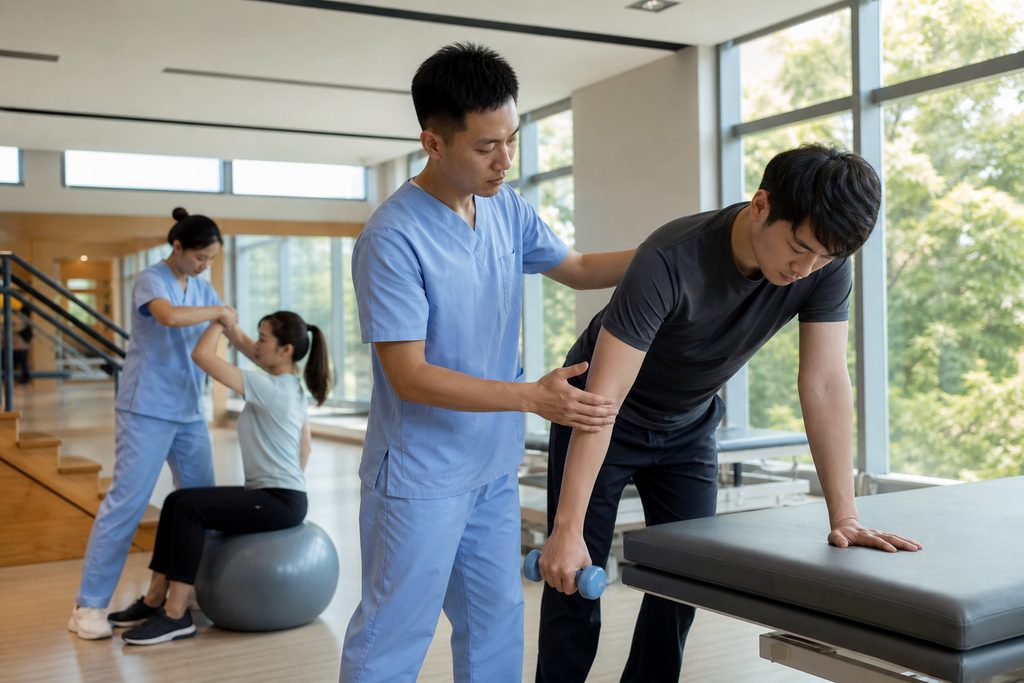
You’ve probably heard that traveling abroad for surgery means gambling on quality. The data on rotator cuff repair in China tells a different story. Top orthopedic departments in Beijing and Shanghai perform thousands of shoulder reconstructions annually, often using the same arthroscopic techniques and implant systems found in leading US and European centers. The difference shows up in the invoice, not the operating room. Understanding the real timeline from suture to full strength matters more than the price tag alone.
Rotator Cuff Recovery: The Short Answer
Most patients regain full strength between 6 and 12 months after rotator cuff repair. That is the honest range. You will be out of the sling at 6 weeks, driving around 8 weeks, and back to light overhead activity at 4 to 6 months. Full strength for heavy lifting or competitive sport takes closer to a year.
But tear size changes everything. A small partial tear repaired arthroscopically heals faster than a massive full-thickness tear requiring open surgery. Your age, tissue quality, smoking status, and commitment to physical therapy shift the curve by months in either direction.
Who This Is Right For — and Who It Isn’t
Rotator cuff repair suits a specific profile. The surgery works best when the tear is recent, the muscle has not atrophied, and the patient can commit to a structured rehabilitation program.
Typically good candidates include:
- Active adults under 65 with a full-thickness tear confirmed on MRI
- Patients who failed 3 to 6 months of conservative treatment — physical therapy, corticosteroid injections, activity modification
- Those with acute traumatic tears from a fall or dislocation, especially if weakness is immediate
- People willing to travel for high-volume surgical expertise at a lower rotator cuff surgery cost China offers compared to Western hospitals
This surgery is not for everyone. You should think twice if:
- You have a small partial-thickness tear without significant weakness — physical therapy alone resolves many of these
- You smoke and cannot stop for at least 6 weeks before and after surgery. Nicotine starves the healing tendon of blood flow and doubles failure rates
- You have advanced fatty infiltration of the rotator cuff muscles on MRI. Once the muscle is replaced by fat, even a perfect repair will not restore strength
- You cannot commit to 6 to 12 months of supervised rehabilitation. The surgery fails without the rehab
The Options, Compared
Patients weighing rotator cuff surgery abroad packages typically compare three paths: surgery at home in the US or UK, surgery in a private international hospital in China, or surgery in a top-tier Chinese public hospital through its international VIP department. Each path has different cost structures, wait times, and service models.
| Factor | US Private Hospital | China Private International (e.g., United Family, Jiahui) | China Public Top-Tier VIP Department |
|---|---|---|---|
| Total surgical cost | $25,000 – $45,000 | $12,000 – $20,000 | $8,000 – $15,000 |
| Wait time for surgery | 2 – 8 weeks | 1 – 3 weeks | 1 – 4 weeks via international channel |
| Surgeon background | Board-certified, variable volume | Western-trained or bilingual, moderate volume | High-volume specialists at Fudan-ranked orthopedics departments |
| Language support | Native English | English-speaking staff standard | English coordination via international department |
| Insurance | Direct billing common | Direct billing at most JCI-accredited facilities | Prepayment required; insurance reimbursement afterward |
| Follow-up after return home | Local surgeon | Telemedicine follow-up plus local PT | Telemedicine follow-up plus local PT |
Which column fits you depends on your priorities. If direct insurance billing and a fully Western-style experience matter most, a private international hospital in Shanghai or Beijing makes sense. If you want the highest surgical volume at the lowest rotator cuff surgery cost China can offer, a public top-tier hospital’s VIP department delivers that. Many international patients choose the public VIP route because it pairs senior surgeons with English coordination at roughly half the cost of a private international facility.
Week-by-Week: What Recovery Actually Feels Like
Recovery timelines are not linear. You will feel better, then plateau, then feel better again. Knowing the markers helps you avoid panic when progress stalls.
Weeks 0–2: Protection phase. You wake up in a sling with an abduction pillow. The arm stays immobilized. Pain is managed with a nerve block that wears off after 24 to 36 hours, followed by oral medication. Sleep is difficult. You need help dressing and bathing. Passive range-of-motion exercises begin — the therapist moves your arm, you do nothing.
Weeks 3–6: Passive to active-assisted. The sling stays on in public, comes off for hygiene and exercises. You progress from passive to active-assisted movement — you initiate the motion, the other arm or a pulley helps complete it. No lifting anything heavier than a coffee cup. Driving is still off the table if the right shoulder was repaired.
Weeks 6–12: Sling off, active motion begins. This is the most dangerous phase. The repair is strong enough to move but not strong enough to load. You start active range-of-motion exercises without assistance. Strengthening begins with isometrics — pushing against a wall without moving the joint. Driving resumes around week 8 for most patients. Many people feel good enough to use the arm normally. Do not. The tendon is still healing.
Months 3–6: Progressive strengthening. Resistance bands and light dumbbells enter the program. Overhead reaching becomes easier. You can return to desk work and light daily activities. Swimming, golf, and tennis remain off-limits. This is when patients who skipped rehab start reporting stiffness or re-tears.
Months 6–12: Return to full strength. The final phase focuses on sport-specific and work-specific training. Full strength for heavy lifting, throwing, or overhead labor typically returns between 9 and 12 months. Some patients never regain 100% strength after massive tears — realistic expectations matter.
How Long to Recover from Rotator Cuff Repair: What Changes the Timeline
Several factors compress or stretch this schedule. Tear size is the biggest variable. A small tear under 1 cm repaired arthroscopically may allow return to light overhead activity by 4 months. A massive tear over 5 cm involving two or more tendons often requires 12 to 18 months for maximal recovery, and some strength deficit may be permanent.
Age matters too. Patients under 50 heal faster and regain more strength than patients over 65, assuming equal tear size. Tissue quality on MRI predicts outcomes better than chronological age. A 60-year-old with healthy tendon tissue may outperform a 45-year-old with degenerative fraying.
Smoking is the single most controllable risk factor. Studies show smokers have significantly higher re-tear rates and slower healing. Quitting 6 weeks before surgery and staying off cigarettes for 6 months afterward is one of the highest-yield decisions you can make.
Rehabilitation adherence is non-negotiable. The surgery creates the environment for healing. Physical therapy does the actual work. Patients who attend 90% or more of their scheduled sessions consistently outperform those who skip.
Rotator Cuff Surgery Cost China: What You Actually Pay
The headline number for rotator cuff surgery cost China depends on hospital tier and tear complexity. At a top-tier public hospital’s international VIP department in Beijing or Shanghai, a standard arthroscopic rotator cuff repair runs between $8,000 and $15,000. That typically includes the surgeon’s fee, operating room, anesthesia, implant anchors, hospital stay of 2 to 3 nights, and basic postoperative imaging.
At a private international hospital like United Family or Jiahui, the same procedure costs $12,000 to $20,000. The premium buys English-speaking staff throughout, direct insurance billing, Western-style rooms, and a more familiar administrative experience.
The same surgery in the United States runs $25,000 to $45,000 before insurance. Even with good insurance, out-of-pocket maximums often reach $8,000 to $10,000. For uninsured or underinsured patients, the math favors travel.
What is not included in the Chinese price: your flights, accommodation for 10 to 14 days minimum, visa fees, and postoperative physical therapy back home. Budget an additional $3,000 to $6,000 for travel and lodging. Physical therapy in your home country costs $100 to $250 per session, and you will need 30 to 60 sessions over the first year.
Some patients ask about rotator cuff surgery abroad packages that bundle surgery, hotel, airport transfers, and interpreter services. These packages exist and typically add $2,000 to $5,000 on top of the surgical fee. They simplify logistics but rarely reduce total cost. The value is convenience, not savings.
Is Rotator Cuff Surgery Safe in China?
Safety depends on where you go, not the country. China’s top-tier orthopedic departments operate at international standards. Fudan University’s hospital rankings identify the top orthopedics programs across the country. Departments at hospitals like Peking Union Medical College Hospital, Zhongshan Hospital, and Ruijin Hospital perform arthroscopic shoulder surgery at volumes that rival or exceed most Western centers.
Infection rates at top Chinese hospitals are comparable to international benchmarks, typically under 1% for arthroscopic procedures. The surgeons are fellowship-trained, many with overseas experience in the US, Europe, or Japan. The implants — suture anchors, fixation devices — are the same brands used globally: Arthrex, DePuy Mitek, Smith & Nephew.
The risk is not the surgery itself. The risk is navigating a system you do not understand. Public hospitals in China see thousands of outpatients daily. Registration, payment, imaging, and pharmacy are separate queues. Without Chinese language ability, the process overwhelms. That is where a bilingual medical companion earns its fee — handling registration, translating during consultations, and ensuring you understand every step.
Private international hospitals remove most of this friction. English is standard. The trade-off is higher cost and sometimes lower surgical volume. The best shoulder surgeon Shanghai offers may practice at a public hospital with a VIP international department — giving you both expertise and coordination.
Practical Considerations: Records, Visa, and Follow-Up
Before you book rotator cuff surgery Beijing or Shanghai, prepare your documentation. Chinese surgeons expect to see your MRI images, not just the report. Bring the actual DICOM files on a CD or USB drive. Written reports without images are often insufficient for surgical planning.
Visa requirements are straightforward but specific. Foreign patients traveling to China for medical treatment use the S2 visa, annotated for medical purposes. Accompanying family members also apply for S2 visas. The hospital provides an invitation letter and treatment confirmation to support the application. Processing takes 1 to 4 weeks depending on your home country’s Chinese embassy or consulate. Do not book flights until the visa is approved.
Payment is typically required upfront at public hospitals. International credit cards are accepted at VIP departments and private international hospitals, but confirm before arrival. Wire transfer is common for larger deposits. Insurance reimbursement depends on your policy — most Chinese public hospitals do not bill international insurers directly. You pay, then claim.
Follow-up after returning home is essential. The Chinese surgeon will schedule a video consultation at 2 weeks, 6 weeks, and 3 months. You will need a local physical therapist who understands rotator cuff protocols. Bring the Chinese rehabilitation protocol home with you — it is usually provided in English at international departments.
Frequently Asked Questions
Desk work: 2 to 4 weeks, depending on which arm was repaired and your pain tolerance. Light manual work: 3 to 4 months. Heavy manual labor or overhead work: 6 to 12 months. Most patients underestimate how long the arm needs protection.
For small and medium tears in patients under 60, most regain 90 to 100% of pre-injury strength. For massive tears or patients over 65 with significant muscle atrophy, 70 to 85% strength is a realistic outcome. The goal of surgery is pain relief and functional improvement, not necessarily a return to competitive athletics.
Re-tear rates range from 5% for small tears to 40% for massive tears in older patients. If a re-tear occurs, revision surgery is more complex and less predictable. This is why the rehabilitation protocol matters so much. Rushing the process causes most failures. If you re-tear after surgery in China, you can pursue revision surgery locally or return to the same Chinese surgeon — many offer video consultations for this exact scenario.
No reputable Chinese hospital will schedule surgery without first reviewing your imaging and conducting a consultation. The standard path is a written second opinion first — you send your MRI and records, the orthopedic team reviews them and provides a surgical recommendation. If surgery is indicated, a video consultation follows. Only then is a surgical date scheduled. This protects both you and the surgeon.
For uninsured or high-deductible patients, usually yes. A $12,000 surgery in China plus $5,000 in travel costs totals $17,000. The same surgery in the US at $35,000 leaves an $18,000 gap. For patients with excellent insurance, the savings are smaller or nonexistent. Run the numbers on your specific policy before deciding.
Your Next Step
Rotator cuff recovery follows a predictable arc — 6 weeks in a sling, 3 to 6 months of progressive strengthening, and up to a year for full strength. The surgery itself is well-established, and China’s top orthopedic departments perform it at high volume with outcomes comparable to Western centers. The real decision is whether the cost savings justify the logistical complexity.
We are China Medical Services, a coordination team that connects international patients with top-ranked Chinese hospitals. We are not a hospital, and we do not provide medical advice or diagnoses. If you want to understand your options — including hospital recommendations, surgeon matching, and cost estimates — request a free consultation with our team. We will walk you through the process without pressure.
Recovery takes a year. Choosing the right surgeon takes a week. Start with information, not commitment.
For more medical information and treatment options in China, visit chinamedservices.com (China Medical Services).
