Brain Tumor Surgery in China: Real Wait Times and Costs for International Patients
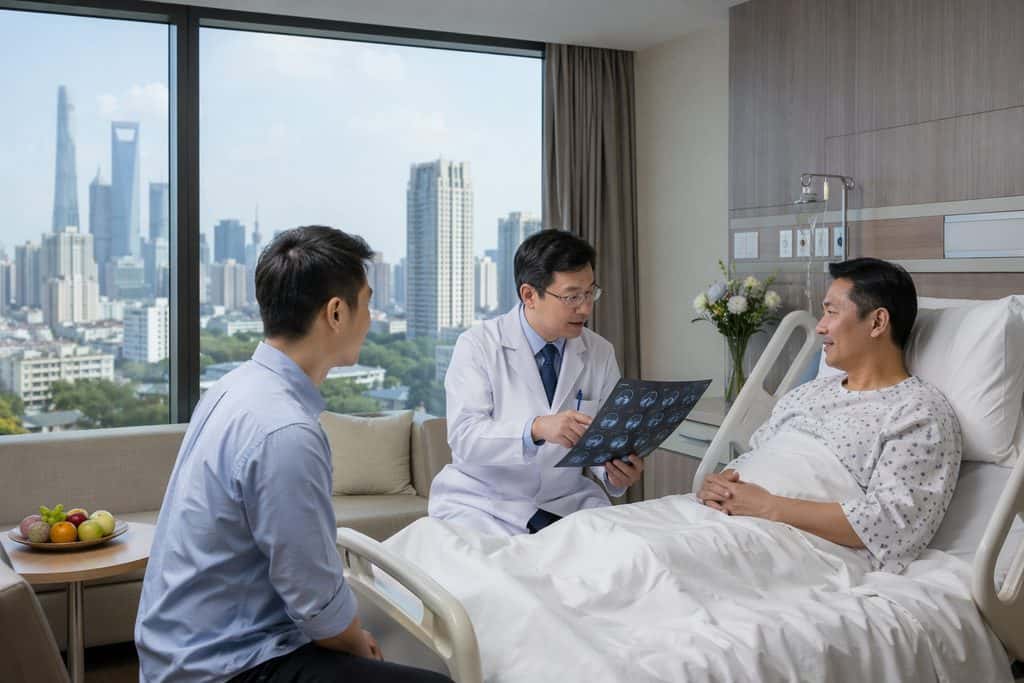
Brain Tumor Surgery in China: The Short Answer
You’ve probably heard that getting surgery in China means either endless waiting or cutting corners on quality. The reality splits down the middle. For international patients who use hospital international departments or VIP channels, the wait for brain tumor surgery in China typically runs 1 to 3 weeks from arrival to operating room. That timeline assumes your imaging and pathology reports are complete and the neurosurgery team accepts your case after a formal review.
Public hospital walk-in queues tell a different story. A Chinese citizen without connections might wait months for a top neurosurgeon through the standard outpatient route. Foreigners cannot use that route anyway — overseas patients cannot pre-book standard public outpatient slots. So the relevant question is not “how long is the wait in China generally” but “how long is the wait for the channel you can actually access.” That channel is the international department, and its wait times are short by Western standards. But the cost, the documentation burden, and the clinical screening are real. Let’s look at what actually determines your timeline.
Who This Is Right For — and Who It Isn’t
Brain tumor surgery abroad is a serious decision. The patients who benefit most from coming to China fit a fairly specific profile.
Typically good candidates:
- Patients with a confirmed diagnosis on MRI or CT who have already seen a neurosurgeon at home and received a surgical recommendation
- Patients facing wait times of 6 weeks or longer in their home country, or whose insurance does not cover the procedure locally
- Patients with meningiomas, pituitary adenomas, acoustic neuromas, or accessible gliomas where the surgical approach is well-established
- Patients who are stable enough to fly — no acute intracranial pressure crisis, no uncontrolled seizures, no rapid neurological decline
- Patients with family support or the budget for a bilingual medical companion, since navigating a Chinese hospital alone is genuinely difficult
Who should not pursue this:
- Patients with highly infiltrative brainstem gliomas or tumors requiring experimental protocols better handled at a dedicated research center
- Patients who are medically unstable — active herniation risk, severe edema requiring emergency decompression, or deteriorating consciousness
- Patients whose tumor requires intraoperative MRI-guided resection or awake craniotomy with language mapping in their native language, unless the hospital confirms English-capable neuropsychology support
- Patients expecting a Western hotel-style hospital experience. Chinese public hospitals — even top-tier ones — are efficient but not luxurious. Private international hospitals are more comfortable but have thinner neurosurgery depth.
Being honest about who should stay home is what makes the rest of this guide useful. If you’re in the first list, read on.
The Options, Compared
You have three realistic paths for brain tumor surgery in China. They differ in cost, speed, and comfort. Here they are side by side.
| Option | Typical Wait After Arrival | Brain Tumor Surgery Cost (USD) | Language Support | Best For |
|---|---|---|---|---|
| Top public hospital, international department | 1–2 weeks | $18,000–$35,000 | English-speaking coordinator, partial | Complex cases, best surgical volume |
| Top public hospital, VIP/special-need channel | 3–7 days | $25,000–$45,000 | Dedicated coordinator, often bilingual | Urgent but stable cases |
| Private international hospital (e.g., United Family, Jiahui) | 1–2 weeks | $40,000–$70,000 | Full English clinical staff | Comfort, insurance direct billing |
| US academic medical center (comparison) | 2–8 weeks | $80,000–$180,000 | Native English | Highest complexity, experimental protocols |
The right column depends on your tumor. A straightforward convexity meningioma can be handled superbly at a top Chinese public hospital for under $30,000. A complex skull-base tumor with cranial nerve involvement might justify the extra cost of a private international hospital — or staying home. The public hospital international departments at China’s top-ranked hospitals are where you get the best combination of surgical volume and price. The trade-off is administrative friction, which is exactly what a coordination service exists to absorb.
Why the Wait Is Short: Volume, Not Shortcuts
Here’s what most international patients don’t understand about Chinese neurosurgery. The wait is short not because Chinese hospitals are empty, but because they are enormous. A major neurosurgery department in Shanghai or Beijing performs 2,000 to 4,000 brain tumor operations per year. A large US academic center might do 800 to 1,200. That volume means operating rooms run six days a week, surgical teams are in constant rotation, and a stable patient with a complete workup can be scheduled quickly once the department chair approves the case.
But volume does not mean you skip the queue. It means the queue moves faster. You still need a formal case review. The hospital’s neurosurgery team will examine your MRI, pathology report if you have one, and neurological exam results before accepting you. That review typically takes 3 to 5 business days. After acceptance, scheduling depends on OR availability and the specific surgeon’s calendar. A senior specialist might have a 2-week backlog. A well-qualified attending on the same team might be available in days.
So the honest answer to “how long is the wait for brain tumor removal in China” is: the clinical review takes about a week, and the surgical slot takes another few days to two weeks. Total realistic timeline from first contact to surgery: 2 to 4 weeks, including your visa and travel. If you already have a Chinese visa and complete records, it can be faster.
Brain Tumor Surgery Cost China: What the Numbers Actually Include
The headline figure for brain tumor surgery cost China is typically $18,000 to $35,000 at a top public hospital’s international department. That covers the operation itself, anesthesia, standard ICU stay, routine pathology, and a typical 7 to 14 day hospital admission. It does not include your flights, visa, accommodation for family, or a bilingual companion if you hire one.
What drives the variance:
- Tumor location and complexity. A convexity meningioma is on the low end. A skull-base tumor requiring neuro-navigation, cranial nerve monitoring, and a 10-hour operation is on the high end.
- Surgeon seniority. A department chair or nationally known specialist commands a higher coordination fee and sometimes a higher surgical fee through the VIP channel.
- Length of ICU stay. Uncomplicated cases spend 1 to 2 nights in ICU. Complications or elderly patients extend that, at $800 to $1,500 per day.
- Hospital tier. The best neurosurgery hospital Shanghai has to offer — such as Huashan Hospital’s neurosurgery department — sits at the top of the price range because demand is highest.
Compare that to the US, where the same procedure runs $80,000 to $180,000 before insurance negotiations. Even with flights, a companion, and a month of recovery accommodation, most patients spend 60% to 80% less in China. The savings are real. But they come with administrative complexity that you either handle yourself or pay someone to manage.
Practical Considerations: Records, Visa, and the First 72 Hours
Before you book anything, get your records in order. Chinese neurosurgery departments will not accept a case without imaging. You need a recent MRI (within 3 months), ideally with contrast, in DICOM format on a CD or cloud link. You also need a written summary from your current neurologist or neurosurgeon, including the suspected diagnosis, any biopsy results, and a list of current medications. If you have a pathology report from a prior biopsy, include it — it can shorten the review process significantly.
Visa is the next hurdle. Foreigners coming to China for medical treatment apply for an S2 visa, which covers short-term private affairs including medical visits. Your accompanying family members also apply for S2. The hospital’s international department will issue an invitation letter and treatment confirmation, which you submit with your visa application. Processing takes 1 to 3 weeks depending on your home country’s Chinese embassy. Do not book flights until the visa is approved. And do not let anyone tell you to apply for an M visa — that’s for commercial trade, not medical care.
Payment works differently than you might expect. Public hospitals require a deposit upfront — typically 50% to 100% of the estimated surgical cost — before admission. International departments accept wire transfers and major credit cards. Private international hospitals like those listed on our private hospital guide often bill insurance directly, which matters if your policy covers treatment abroad. Most public hospital international departments provide itemized receipts for insurance reimbursement after the fact.
Language is the quiet challenge. Even in an international department, the neurosurgeon may speak limited English. The ward nurses may speak none. You will need someone to translate during pre-op consultations, consent signing, and daily rounds. Some hospitals provide basic interpretation. Many do not. This is not a reason to avoid China — it’s a reason to plan for it.
Follow-up after you return home is your responsibility. The Chinese hospital will give you a discharge summary in English if you request it, plus a copy of the surgical record and pathology report. Your home neurosurgeon uses these to manage ongoing care, radiation, or chemotherapy. Schedule that handoff before you leave China. A video consultation with your Chinese surgical team 2 to 4 weeks post-op is standard and costs $100 to $300.
Frequently Asked Questions
For stable patients with complete records, yes. The typical timeline is 1 to 2 weeks from hospital acceptance to surgery through an international department. The limiting factors are the case review (3 to 5 business days) and surgeon availability, not a long waiting list. Urgent cases can sometimes be scheduled within days through a VIP channel, but that costs more and still requires clinical approval.
Huashan Hospital, affiliated with Fudan University, is the most recognized name in Chinese neurosurgery. Its neurosurgery department handles enormous volumes of brain tumor cases and is ranked among China’s top departments for neurosurgery. For international patients, the hospital’s international medical center provides English coordination. Other strong options include Ruijin Hospital in Shanghai and Tiantan Hospital in Beijing. The right choice depends on your specific tumor type and the surgeon’s subspecialty.
Top Chinese neurosurgery departments have complication rates comparable to good Western centers for standard tumor resections. But complications do happen, and you should know the reality: if a serious complication occurs, you will be treated in the same hospital, not transferred overseas. ICU care in top Chinese hospitals is modern and capable. The bigger practical issue is communication — your family needs a translator during any crisis. Also confirm before surgery whether your insurance covers complications and extended ICU stays, because those costs add up quickly.
You cannot book directly from overseas as an individual patient. The process requires a case review by the hospital first. A coordination service can submit your records, arrange the review, and handle scheduling through the hospital’s international department. This is not a “skip the line” arrangement — it’s the standard channel for foreign patients, which operates separately from the public outpatient queue. If a service promises a specific surgeon on a specific date before reviewing your records, walk away. Legitimate coordination starts with a clinical review, not a booking confirmation.
Prices are similar, typically within 10% to 15% between the two cities. Beijing’s Tiantan Hospital and Shanghai’s Huashan Hospital both sit at the top of the market. Beijing has more top-ranked neurosurgery departments overall, but Shanghai is often easier for first-time international patients because of its larger English-speaking expat infrastructure. Choose based on the specific surgeon and department, not the city’s average price.
Your Next Step
The wait for brain tumor surgery in China is genuinely short — 1 to 3 weeks for international patients with complete records — and the cost is a fraction of Western prices. But the process is not something you want to navigate alone. Our team at China Medical Services helps international patients submit records for case review, coordinate with hospital international departments, and arrange bilingual support on the ground. We are not a hospital and we do not provide medical advice or diagnoses. What we do is handle the logistics so the neurosurgeons can focus on your brain.
If you have a confirmed diagnosis and want to know whether a Chinese neurosurgery department would accept your case, start with a written second opinion or video consultation. The fee is credited in full toward on-the-ground coordination if you proceed within 90 days. Send us your records and let’s find out what’s possible.
For more medical information and treatment options in China, visit chinamedservices.com (China Medical Services).
