Gene Therapy in China: CRISPR Clinical Trials for Inherited Blood Disorders
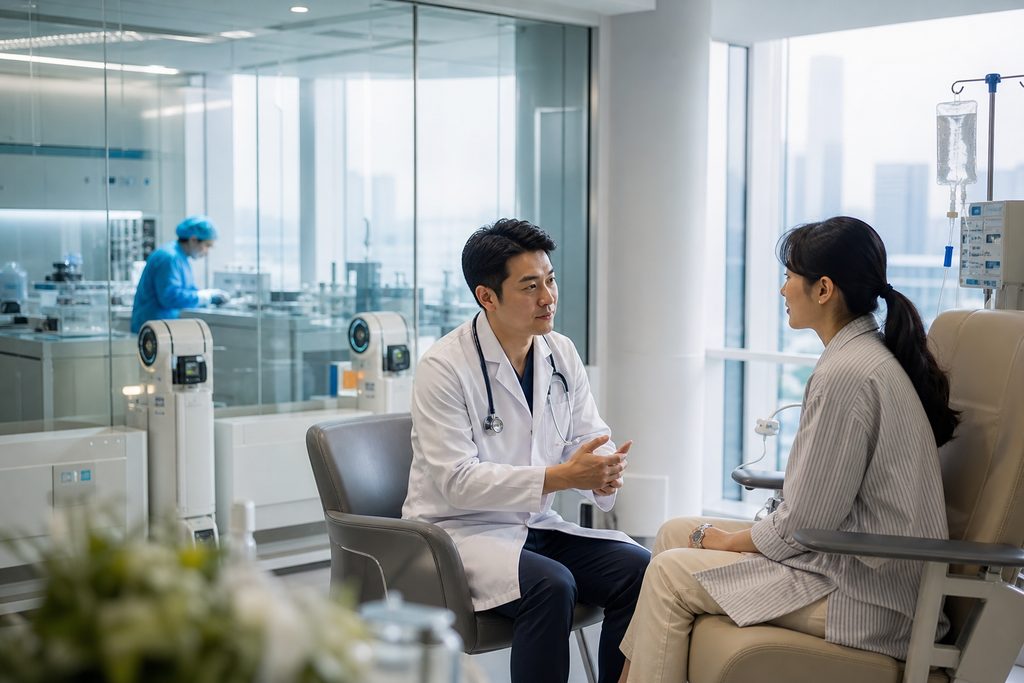
What if the one-time treatment that could free you or your child from a lifetime of blood transfusions was not a distant dream, but a flight away? For families navigating the relentless cycle of inherited blood disorders like beta-thalassemia and sickle cell disease, the question is no longer “if” a genetic cure exists. It is “where can I access it safely, and what will it cost?” The answer, increasingly, points to China. Our team has spent years mapping the landscape where groundbreaking CRISPR trials are enrolling patients and where the gene therapy cost China blood disorders patients face can be a fraction of what is quoted in the West.
Key Takeaways
- China has emerged as a global leader in CRISPR-based gene therapy, with over 40 registered clinical trials targeting beta-thalassemia and sickle cell disease as of early 2025.
- The structural cost of gene therapy in China can range from $150,000 to $280,000, a stark contrast to the $2.2 million to $3.1 million price tags seen in the US and Europe for comparable ex-vivo treatments.
- Navigating trial eligibility and hospital selection is the hardest part. Language barriers, visa logistics, and a fragmented hospital registration system make independent application extremely difficult for international patients.
- You are not buying a “cure” off a shelf. You are entering a complex medical journey that requires coordination with China’s top-tier hematology centers and a clear understanding that not every patient qualifies for a trial.
The Problem: A Lifetime of Management Instead of a Cure
Living with a severe inherited blood disorder is a marathon of medical management. Beta-thalassemia major patients require blood transfusions every two to four weeks, coupled with daily chelation therapy to remove the life-threatening iron overload that builds up in the heart and liver. Sickle cell disease brings unpredictable vaso-occlusive crises—episodes of excruciating pain that damage organs over time. The financial drain is staggering. In the United States, the lifetime medical cost for a sickle cell patient averages approximately $1.7 million. For transfusion-dependent thalassemia, the annual cost of chelation alone can exceed $40,000.
These numbers only measure the financial weight. They don’t capture the missed school days, the careers put on hold, or the constant fear of the next crisis. A bone marrow transplant offers a potential cure, but finding a fully matched donor is a lottery many patients lose. This is the gap that gene therapy fills. It uses the patient’s own cells. No donor search. No risk of graft-versus-host disease. But for years, the only approved gene therapies carried price tags north of $2 million, putting them out of reach for virtually everyone without top-tier insurance or a massive clinical grant. That reality is shifting. The scientific epicenter is moving, and with it, the economics of access.
Who We Are
We are China Medical Services, and we are not a hospital. We do not administer gene therapy, nor do we make clinical eligibility decisions. We are a medical concierge team built specifically for international patients who need to access China’s top 5% of hospitals—institutions ranked among the 35,000+ hospitals nationwide by the Fudan University ranking system and JCI accreditation bodies. Think of us as your logistical architects. We handle the visa guidance for your S2 medical visa, secure appointments through official hospital international departments, and provide bilingual medical companions so you are never lost in translation during a critical consultation. We bridge the gap between a complex healthcare system and your need for clarity.
Why China Delivers Results in CRISPR Gene Editing for Blood Disorders
The global gene therapy race is not being run solely in Boston or London. A significant portion of the clinical momentum has shifted to Shanghai, Guangzhou, and Shenzhen. The reason is a combination of regulatory agility, massive patient cohorts that allow for rapid trial enrollment, and a healthcare system that can deliver complex cellular manufacturing at scale. When patients ask us “is CRISPR safe for sickle cell disease clinical trial,” the answer lies in the data emerging from these centers.
Clinical Volume and Trial Density
China’s clinical trial registry shows a density of CRISPR-focused studies that is hard to match. Researchers here are not just replicating Western protocols; they are refining them. A notable example is the use of CRISPR-Cas9 to target the BCL11A enhancer region, a genetic switch that silences fetal hemoglobin. By disrupting this switch, the body can produce high levels of fetal hemoglobin, functionally curing both beta-thalassemia and sickle cell disease. Early data published in The New England Journal of Medicine from a collaborative trial involving Chinese centers showed that patients with transfusion-dependent beta-thalassemia became transfusion-independent for over 18 months after a single infusion of edited cells. This is not a maintenance drug. It is a one-time intervention.
What does this mean for you? It means the physicians at hospitals like the Nanfang Hospital in Guangzhou or the Ruijin Hospital in Shanghai have direct, hands-on experience managing the complex conditioning regimens and post-infusion recovery that these trials demand. A doctor who has guided 50 patients through the process sees complications earlier and acts faster than one who has managed five.
The Structural Cost Advantage
Let’s address the obvious question directly: how much is gene editing treatment in China? The numbers are not uniform, but the structure is consistently lower. In the US, the list price for Casgevy (exagamglogene autotemcel) is $2.2 million. Lyfgenia (lovotibeglogene autotemcel) is $3.1 million. These prices reflect not just the drug but a system of high-cost drug development, insurance negotiations, and hospital markups.
In China, the gene therapy cost China blood disorders patients encounter is built on different economics. The cost of Good Manufacturing Practice (GMP) vector production is lower. Hospitalization costs for the necessary myeloablative conditioning are a fraction of Western costs. While no commercial gene therapy for these conditions has a final approved price in China yet, the clinical trial landscape and early access programs point to total treatment costs ranging from $150,000 to $280,000. This includes cell collection, genetic editing, quality control, conditioning chemotherapy, and post-infusion monitoring. It is still a significant sum. But it is an order of magnitude different from the Western commercial price.
What You Need to Know Before Going Alone
The science is real. The cost advantage is measurable. But the path from your home country to a hospital bed in China is paved with genuine obstacles. We see international patients hit these walls constantly. Here is what you will face if you attempt to apply for gene therapy trial China inherited blood disease enrollment on your own.
- Visa Requirements: Medical treatment in China requires an S2 visa. This is a specific short-term private visit visa annotated for medical purposes. It is not a tourist visa. It is not an M business visa. Applying requires an official invitation letter or medical appointment confirmation from a Chinese hospital. Hospitals rarely issue these letters to patients who simply email them. You need a confirmed appointment first—a classic bureaucratic loop.
- Hospital Registration Systems: China’s top public hospitals, like Peking Union Medical College Hospital or West China Hospital, handle over 10,000 outpatient visits per day. Their online registration portals are in Mandarin. Appointments for star hematologists vanish in seconds. Walking in without a pre-arranged appointment means you will not be seen. The idea that you can fly to China and “figure it out” is a recipe for a wasted trip.
- Medical Record Translation: Trial eligibility hinges on precise medical history: transfusion records, ferritin levels, organ function tests, and genetic mutation reports. A minor translation error in your medical abstract can lead to a swift rejection. Chinese hematologists need these documents in a format and language they can trust immediately. A generic translation service will not understand the clinical nuance required.
How We Help You Navigate This
These barriers are not there to keep you out. They exist because China’s hospital system is optimized for its domestic population. It wasn’t built with international patient intake in mind. That is precisely the gap we fill. Our process turns a chaotic, uncertain journey into a structured medical pathway.
We start with your medical records. Our team works with you to collect every relevant document, translate it clinically, and present it to the hematology departments at hospitals known for leading CRISPR clinical trials China 2025 and beyond. We don’t blast your records to every hospital in our network. We target the centers with active trial arms that match your specific mutation and clinical status. For thalassemia, that often means the extensive programs in Guangzhou, where the disease prevalence has driven decades of clinical expertise. For sickle cell, we look at centers with specific experience managing vaso-occlusive complications during the engraftment phase.
Once a hospital confirms they will evaluate your case, we secure the appointment through the official international department channel. This is not a backdoor. It is the legitimate VIP pathway that ensures you see a senior specialist, with a bilingual medical companion at your side. Your companion handles registration, payment, queue management, and real-time translation of complex medical terminology. While you focus on the consultation, we handle the logistics. After the visit, if a trial or treatment plan is agreed upon, we coordinate the admission schedule and provide clear guidance on the S2 visa documentation you need to submit to your local Chinese embassy.
We also connect you with the practical resources you need for an extended stay. Our network spans Guangzhou, Shanghai, and Beijing—the three cities where most advanced gene therapy trials are concentrated. Finding long-term accommodation near a hospital for the 2-3 month treatment and monitoring period is something we can guide you through.
Frequently Asked Questions
Safety data from major trials is encouraging but not absolute. The primary risk is not the CRISPR editing itself but the busulfan-based conditioning chemotherapy required to make space in the bone marrow. This causes temporary infertility and carries a low risk of secondary blood cancers. The editing process has shown a very low rate of off-target mutations in published studies, but long-term monitoring is a mandatory part of every trial protocol.
For international patients paying out-of-pocket, the total cost for a full ex-vivo gene therapy protocol—including cell collection, editing, hospitalization for conditioning, and three months of post-treatment monitoring—typically falls between $150,000 and $280,000. This is an estimate. It does not include travel, accommodation, or our coordination service. It is significantly less than the $2 million-plus US price tags because the cost structure for hospital stays and vector manufacturing is fundamentally different in China.
Southern Medical University’s Nanfang Hospital in Guangzhou has one of the world’s largest clinical cohorts for thalassemia gene therapy. Shanghai’s Ruijin Hospital, affiliated with Shanghai Jiao Tong University, is another powerhouse, particularly for translational CRISPR research. These institutions are ranked among China’s top 10 for hematology in the Fudan University specialty reputation rankings. You can explore more top-ranked hematology centers on our specialty departments page.
Yes. Several investigator-initiated trials and hospital-based studies accept international patients, provided you meet the strict inclusion criteria. These criteria usually require a confirmed diagnosis of transfusion-dependent beta-thalassemia or severe sickle cell disease, adequate organ function, and no recent history of certain viral infections. The application process requires a detailed medical abstract in Chinese, submitted through the hospital’s international department—a step we handle as part of our coordination service.
In clinical trials, “failure” is usually defined as a return to transfusion dependence or a lack of engraftment. This is rare in recent CRISPR trials targeting BCL11A, where success rates have been high, but it is a possibility. If it occurs, patients return to standard supportive care (transfusions and chelation). The myeloablative conditioning is a one-time event; you cannot repeat it immediately. A thorough discussion with the treating physician about realistic expectations is the most important part of the pre-treatment consultation.
Your Next Step
The science of gene editing has moved from theoretical to therapeutic. For inherited blood disorders, the question is no longer “can we fix this?” but “how do we access the fix?” China’s clinical trial ecosystem offers a route that is scientifically robust and structurally more affordable than what is available in the West. The complexity of the journey is real, but it is navigable with the right local expertise.
If you are ready to understand whether you or your child meets the clinical criteria for these trials, we are here to map out the path. Our team can review your case and identify the right center among China’s 340+ top-ranked hospitals. When you are ready to explore the possibility, contact our team for a free initial consultation. We will help you understand the landscape, the costs, and the concrete next steps—without any pressure, just the facts you need to make an informed decision.
For more medical information and treatment options in China, visit chinamedservices.com (China Medical Services).
