30 Days Before Flying to China for Surgery: The Complete Pre-Travel Checklist
30 Days Before Flying to China for Surgery: The Short Answer
A solid pre surgery checklist China starts with three non-negotiable items at the 30-day mark: your passport must have 6+ months of validity, your medical records need to be translated and sent for a formal second opinion, and you need to apply for your S2 visa. Miss any of these and your timeline collapses. The rest — flights, accommodation, payment logistics — can flex. Those three cannot.
That’s the direct answer. But 30 days is tighter than most people realize. If you’re asking yourself “can I fly to China for surgery next month,” the answer is yes — if the hospital has already accepted your case. Without a confirmed treatment plan and a visa appointment, you’re gambling. This checklist assumes you’ve had at least one remote consultation and a specialist has agreed to take your case. If you haven’t gotten that far yet, start there first.
Who This Is Right For — and Who It Isn’t
Traveling internationally for surgery makes sense for a specific kind of patient. It’s not for everyone. Being honest about who should stay home is how we keep people safe.
Typically a good candidate:
- You have a confirmed diagnosis and your overseas doctor has recommended a specific procedure
- Your condition is stable enough for long-haul air travel (your doctor must clear this)
- You’ve already completed a remote video consultation with a Chinese specialist
- You have a written treatment plan and cost estimate from the hospital
- You’re prepared for a minimum 2-4 week stay post-surgery before flying home
- You have a companion traveling with you — recovering alone in a foreign country is brutal
Should reconsider or delay:
- Your condition is unstable, deteriorating, or causing severe pain that makes 12+ hours of flying dangerous
- You haven’t had a confirmed diagnosis — do not travel hoping to “figure it out when you arrive”
- You’re on blood thinners that cannot be safely paused before surgery (timing matters enormously)
- You have no companion and your procedure requires 24+ hours of hospitalization with limited mobility afterward
- You’re hoping to save money by skipping the remote consultation and just showing up — Chinese public hospitals do not work that way
If you’re in the second group, that’s not a dead end. It means you need more groundwork before booking a flight. A remote second opinion can clarify whether traveling is even the right move. That step alone has saved patients from flying across the world for a procedure they didn’t actually need.
What to Do 30 Days Before Surgery Abroad: Week-by-Week Breakdown
Thirty days disappears fast. Here’s how to structure it so nothing critical slips through the cracks. This is the backbone of any pre surgery checklist China — adapted for the reality of navigating a healthcare system in a country where you probably don’t speak the language.
Days 30-21: Documentation and Visa Sprint
This window is all about paperwork. Your passport needs a minimum six months of validity beyond your planned return date. Check it now. If it’s expiring sooner, you need an emergency renewal — and that alone can eat two weeks in some countries.
Your medical records are the next priority. Hospitals in China will want: your full diagnosis report, imaging studies (CT, MRI, X-ray — the original DICOM files, not just the written reports), blood work from the last 90 days, pathology reports if relevant, and a summary letter from your referring physician. Everything needs English-to-Chinese translation. Machine translation is not good enough for medical terms. A mistranslated lab value can delay or derail your entire trip.
The S2 visa application goes in during this window too. This is the short-stay visa category used for private affairs including medical treatment. You’ll need an invitation letter from the Chinese hospital — request this as soon as your case is accepted, because visa processing times vary wildly by country. Some consulates turn it around in 4 business days. Others take 3 weeks. Your companion applies for their own S2 visa with the same invitation letter. Do not book non-refundable flights until the visa is in your hands.
Days 20-14: Medical Clearance and Logistics Lock-In
Your primary care doctor or referring specialist needs to clear you for long-haul air travel and surgery. This is not a formality. Get it in writing. Airlines may ask for a fitness-to-fly certificate, especially if you’re traveling with medical equipment or visibly unwell.
This is also when you confirm the exact surgical date with the hospital. Chinese public hospitals typically cannot lock in a surgery slot until you’ve had an in-person consultation — that’s the standard rule. But international departments and VIP channels can often pre-schedule based on your remote evaluation. If you’re working through a coordinator, they should be able to give you a firm date by this point. If you’re arranging everything independently, expect to arrive, consult, and then wait a few days for the surgery to be scheduled.
Book your flights and accommodation. Choose a hotel or serviced apartment within 15 minutes of the hospital — you do not want to be navigating Shanghai or Beijing traffic with post-surgical pain. Confirm that your accommodation has an elevator, a walk-in shower, and a bed that’s easy to get in and out of. These details matter enormously when you can’t bend or lift.
Days 14-7: Payment, Insurance, and Pre-Op Preparation
Chinese hospitals, including top-tier public institutions, operate on a prepayment model. You deposit funds upfront, treatment is drawn against that deposit, and any remainder is refunded at discharge. The hospital will tell you the estimated deposit amount — for major surgery at a top-ranked public hospital’s international wing, this typically ranges from $15,000 to $40,000 USD depending on the procedure. Private international hospitals may quote higher deposits but offer direct insurance billing.
Speak with your insurance provider now. Most international policies require pre-authorization for overseas surgery. Even if the Chinese hospital is significantly cheaper than the equivalent procedure at home, your insurer may only reimburse a portion — or may require you to pay upfront and submit claims afterward. Get the reimbursement terms in writing. Do not assume anything.
Your surgical team will give you specific pre-op instructions around this time. Common requirements include: stopping certain medications (aspirin, ibuprofen, some supplements), fasting protocols, and pre-admission lab work. If you’re asked to repeat blood tests in China before surgery, that’s normal — many hospitals require labs drawn within 7 days of the procedure, regardless of what your home country results show.
Days 7-1: Final Coordination and Packing
Reconfirm everything. Surgery date, hospital admission time, interpreter availability, airport pickup, hotel check-in. One phone call or email to each point of contact. Things shift. Better to catch a scheduling conflict now than in the hospital lobby.
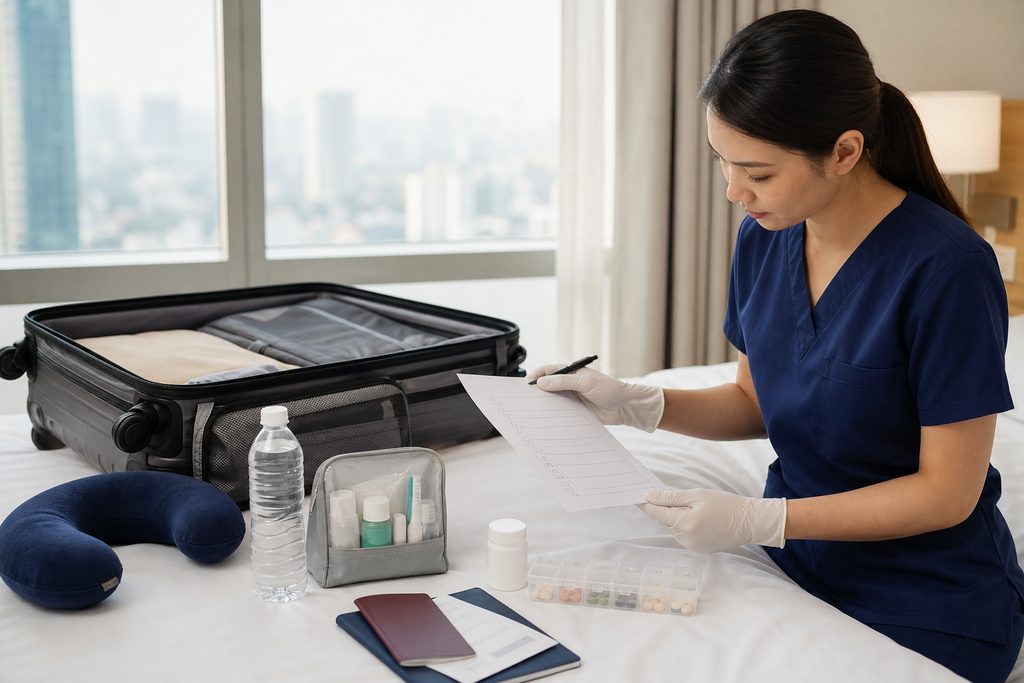
Pack strategically. Beyond the obvious — comfortable clothes, slip-on shoes, toiletries — bring: all original medical documents (not just digital copies), your passport and visa, a printed copy of your hospital invitation letter, a list of medications with generic names (brand names differ between countries), a phone with a VPN installed and tested (essential for accessing Google, WhatsApp, and many Western apps in China), and a power adapter for Chinese outlets. Leave jewelry and valuables at home. You’re not going on vacation.
Arrange your post-discharge support. Who is picking you up from the hospital? Who is handling pharmacy runs? Who is communicating with nurses if you’re too groggy to speak? If your companion doesn’t speak Mandarin, line up a bilingual medical escort for the critical first 48 hours post-discharge. This is not the moment to rely on translation apps.
The Options, Compared: Independent vs. Coordinated Medical Travel
There’s more than one way to prepare for surgery in Shanghai or any other Chinese city. The path you choose shapes your timeline, stress level, and what happens when things go sideways. Here’s how the two main approaches stack up.
| Factor | Independent Travel | Coordination Service |
|---|---|---|
| Hospital selection | You research and contact hospitals directly; may struggle with language barriers in public hospital administrative offices | Matched to a hospital based on your diagnosis, budget, and preferences; access to department-level scheduling |
| Medical translation | You arrange and pay for certified translation; errors are your responsibility | Included in case preparation; handled by translators familiar with medical terminology |
| Visa support | You request the invitation letter from the hospital yourself; follow-up is on you | Invitation letter coordinated with the hospital; visa process guidance provided |
| Pre-surgery scheduling | Typically requires in-person consultation first; surgery date set after you arrive | Remote evaluation often enables pre-scheduled surgery dates through international/VIP channels |
| On-ground support | You navigate registration, payment, and communication alone or with a companion | Bilingual medical companion handles hospital navigation, translation, and logistics |
| Cost (service fees only) | $0 in coordination fees, but translation, transport, and time costs add up | Varies by service level; written second opinions from $300, full coordination packages from $5,000 |
| Best for | Mandarin-speaking patients or those with family in China; people with flexible timelines | First-time visitors to China; patients who want a locked-in surgery date before flying; anyone who doesn’t speak Mandarin |
The independent route works. Plenty of patients do it. But it demands language skills, patience with bureaucracy, and a willingness to arrive without a guaranteed surgery date. The coordinated route costs more upfront but removes the variables that most often derail a trip — miscommunication, scheduling chaos, and the sheer exhaustion of navigating a massive Chinese hospital while jetlagged and anxious.
What Medical Tourism Packages China All Inclusive Actually Cover
The phrase “medical tourism packages China all inclusive” gets searched a lot. It’s worth clarifying what that typically means — and what it almost never includes.
A genuine all-inclusive package from a reputable coordinator usually bundles: hospital matching and case review, remote specialist consultation, medical records translation, visa invitation letter coordination, airport pickup and drop-off, accommodation booking assistance, a bilingual medical companion for hospital visits, and post-operative follow-up coordination. Some packages include the companion for the full hospital stay. Others cover only key appointments.
What these packages do not include: the actual hospital charges (surgery, anesthesia, implants, medication, room and board — these are paid directly to the hospital), international airfare, and any treatment not pre-authorized in the original plan. If complications arise and you need additional procedures, those costs fall outside the package. Read the fine print on that point specifically.
Price-wise, coordination packages range widely. A basic package covering remote consultation, translation, and hospital appointment scheduling might start around $1,500. A comprehensive VIP package with dedicated companion service, premium accommodation arrangement, and end-to-end logistics can run $5,000 to $8,000. That’s the coordination fee only — the hospital bill is separate. But many services credit the coordination fee toward on-the-ground support if you proceed with treatment within 90 days of your initial consultation. That structure rewards commitment without penalizing patients who are still exploring options.
What It Costs: Surgery, Travel, and the Hidden Expenses
The cost of surgery in China with travel breaks into three buckets. Understanding each one prevents the kind of financial surprises that ruin a medical trip.
The procedure itself. This is where the savings are real. A cardiac bypass at a top-ranked Chinese public hospital runs $12,000 to $20,000 USD — compared to $120,000+ in the United States. A hip replacement: $8,000 to $15,000 in China versus $40,000+ in the US. Orthopedic surgeries, oncology procedures, and neurosurgery show similar differentials. Private international hospitals in Shanghai and Beijing charge more — typically 1.5 to 2 times the public hospital rate — but still substantially less than Western private hospitals.
Travel and accommodation. Round-trip international flights: $800 to $2,500 depending on origin and class. Accommodation for a 3-4 week stay: $1,500 to $4,000 for a decent serviced apartment near a major hospital. Daily expenses (food, local transport, incidentals): $30 to $80 per day. A companion’s costs roughly double the accommodation and daily expense line items.
The hidden costs. Medical records translation: $200 to $600 if done independently. Visa fees: $100 to $200 per person. Post-discharge medications: variable, but budget $200 to $1,000 depending on the procedure. Follow-up imaging or lab work before you’re cleared to fly home: $300 to $1,000. And the biggest hidden cost — complications that extend your stay. If you need an extra two weeks in China because your wound isn’t healing on schedule, that’s more accommodation, more living expenses, and possibly more hospital charges. Build a 20% buffer into your budget for overruns.
Practical Considerations: Language, Follow-Up, and Going Home
The surgery itself is only half the equation. What happens after you leave the operating room determines whether the whole trip was worth it.
Language in the hospital. Top-tier Chinese hospitals with international departments have English-speaking staff — but that typically means the doctors speak English. Nurses, administrative staff, pharmacy workers, and the people at the registration desk often do not. A bilingual companion bridges that gap. Without one, you’ll rely on translation apps for everyday interactions like ordering meals, understanding medication instructions, and asking for pain relief. Apps work. They’re also slow, imprecise, and exhausting when you’re in pain and running on no sleep.
Post-operative follow-up. Your Chinese surgeon will want to see you before you fly home — typically 7 to 14 days after discharge, depending on the procedure. They’ll check wound healing, review lab work, and clear you for air travel. Get that clearance in writing. Your airline may ask for it. Once you’re home, you’ll need a local doctor to take over follow-up care. Arrange this before you leave for China. Your Chinese surgical team should provide a detailed discharge summary and post-operative care instructions in English — request this explicitly if it’s not offered.
Flying after surgery. The general rule: no long-haul flights for at least 7-10 days after major surgery, and sometimes longer. Orthopedic procedures with metal implants may require 2-4 weeks before flying due to swelling and clotting risk. Abdominal surgery carries a higher risk of deep vein thrombosis on long flights — compression stockings and mobility during the flight are non-negotiable. Your surgeon sets the timeline. Do not book your return flight before they confirm the date.
Frequently Asked Questions
It depends entirely on two things: whether a Chinese hospital has already accepted your case, and whether your local Chinese consulate can process your S2 visa in under four weeks. If you’ve completed a remote consultation and have a treatment plan in hand, 30 days is tight but workable. If you haven’t even contacted a hospital yet, you need more time. The remote evaluation, records translation, and visa invitation letter alone can consume three weeks before you even apply for the visa. Rushing this process leads to mistakes — and mistakes in medical travel are expensive and dangerous.
What if something goes wrong during surgery and I need extended care?
This is the question every medical traveler should ask and many don’t. Chinese hospitals are equipped to handle complications — the top-ranked ones manage complex cases daily that smaller Western hospitals would transfer out. But extended care means extended costs. Your initial hospital deposit may be exhausted. Your accommodation booking may expire.
For more medical information and treatment options in China, visit chinamedservices.com (China Medical Services).
