Hip Replacement China vs New Zealand: Skip the 12-Month Queue
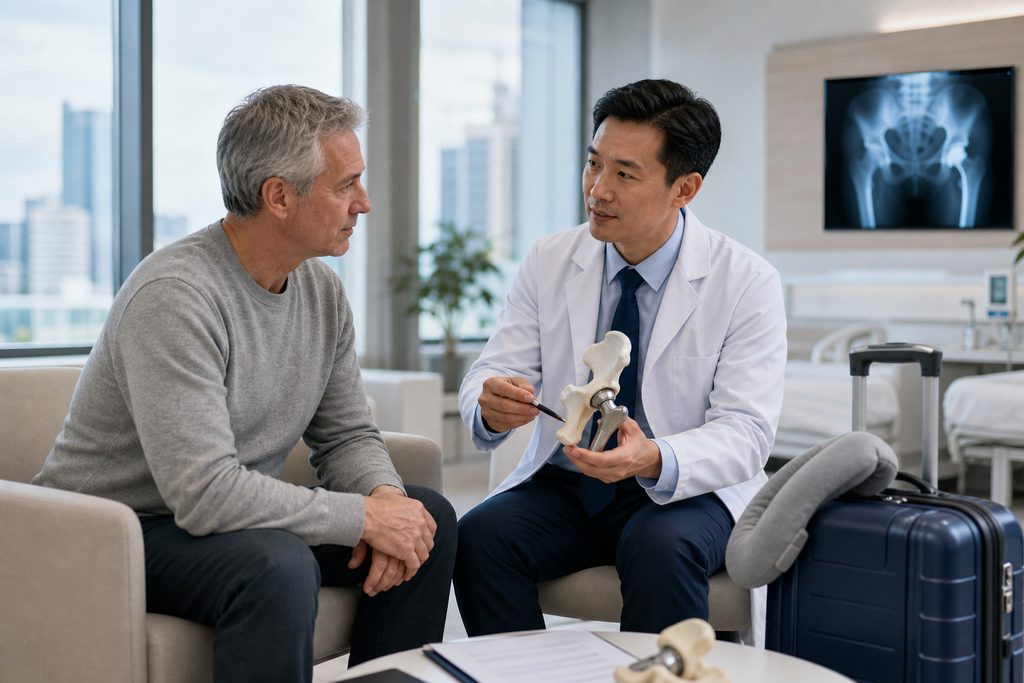
What if the pain in your hip has stopped being a “maybe someday” problem and is now dictating every choice you make—from walking the dog to simply sleeping through the night—yet your specialist tells you the public wait is still another year? You’re not imagining the frustration. For many New Zealanders, that timeline is the cold, hard reality. Data from the New Zealand Ministry of Health shows that in recent reporting periods, patients needing elective orthopedic surgery frequently waited beyond the target four-month threshold, with some languishing on lists for over 365 days. That’s a year of life on hold. The question we hear most often is blunt: is there a viable way to get high-quality surgery without that wait? The answer is yes, and it involves looking north to a system built on immense clinical volume and rapid access. This article breaks down the hip replacement cost China vs New Zealand, the logistics, and the hospital quality that makes it a serious option.
Key Takeaways
- Public system wait times in New Zealand frequently extend past 12 months, while coordination with a top Chinese orthopedic hospital can reduce the pre-surgery timeline to weeks.
- The out-of-pocket hip replacement cost China vs New Zealand private route is often 60-70% lower, with total packages starting from a fraction of the price at private facilities in Auckland or Christchurch.
- Language and administrative complexity are the biggest barriers—not clinical quality. Top Chinese hospitals perform thousands of these procedures annually, but navigating them without bilingual support is extremely difficult.
- This is not a package holiday. You need a clear plan for medical records, visa documentation, and post-operative follow-up once you return home.
The Problem: When the Public Queue Decides Your Life
Waiting for a hip replacement isn’t passive discomfort. It’s progressive. A joint that aches today can seize up tomorrow. New Zealand’s public health system, while excellent in an emergency, uses a scoring system to prioritize elective surgeries. If your pain isn’t deemed severe enough—or if the system is simply overloaded—you wait. The official target is treatment within four months of being assessed as ready for surgery. The reality on the ground tells a different story. A 2023 report from the Auditor-General highlighted that thousands of patients were waiting longer than intended, with orthopedic services consistently under strain.
The private alternative inside New Zealand removes the queue. It also introduces a bill that can stop you in your tracks. A total hip replacement performed privately in New Zealand can range from NZD $35,000 to $45,000 or more, depending on the implant and the surgeon. For patients without comprehensive health insurance, that’s a mortgage-level expense. This is the trap. You either wait in pain for the public system, or you face a financial shock in the private one. That binary choice—wait too long or pay too much—is what pushes so many Kiwis to search for a third option abroad.
Why China’s Orthopedic System Delivers a Different Answer
The phrase “medical tourism” often conjures images of small boutique hospitals catering to foreigners. That’s not the reality here. We’re talking about massive, government-affiliated teaching hospitals that serve as regional trauma centers. They are not set up for tourism. They are set up for volume, speed, and clinical repetition. A surgeon at a top-tier Chinese orthopedics department may perform more hip replacements in a month than a typical New Zealand surgeon does in a year. That volume isn’t just a number—it’s a predictor of reduced complication rates.
This system isn’t right for everyone. But for a patient who needs a straightforward total hip arthroplasty and is medically fit to travel, the structural advantages are clear. You’re stepping into a pathway where the bottleneck isn’t the operating theater schedule. It’s how fast you can get your records organized.
Clinical Volume Drives Better Outcomes
The link between surgical volume and patient outcomes is well-documented in orthopedic literature. A landmark study in The Journal of Bone and Joint Surgery found that hospitals performing over 200 total hip replacements annually had significantly lower rates of dislocation and revision surgery compared to low-volume centers. In China’s top-ranked orthopedics departments, the annual caseload often exceeds 1,000 primary hip replacements. Surgeons here see a spectrum of anatomy and pathology that keeps their skills sharp. This matters when you’re on the table. It means the team has likely handled a femur just like yours—dozens of times this month alone.
Technology Adoption Without Bureaucratic Lag
Hospitals in our network, many listed on our top-ranked hospitals page, routinely use computer-navigated and robotic-assisted surgery platforms for joint replacement. The Mako system and CORI surgical robot are active in major centers like Beijing and Shanghai. This isn’t futuristic gadgetry. It’s about precision: robotic assistance helps the surgeon position the implant within a tighter angular range, which studies suggest can reduce the risk of post-operative leg-length discrepancy and early wear. In a system driven by volume, efficiency technology gets adopted fast because it standardizes excellent results across a large surgical team.
Cost Structure: Where the Savings Actually Come From
The hip replacement cost China vs New Zealand gap isn’t about cutting corners on the implant. It’s structural. Chinese hospitals have lower pharmaceutical costs, a different labor market for nursing and support staff, and a high-throughput model that spreads fixed costs over thousands of cases. You’re not paying for a private suite with harbor views. You’re paying for the surgery, the prosthesis, and the medical team’s time. The result is a total hip replacement package that, through the international patient pathway, typically falls between USD $12,000 and $18,000. Compare that to the NZD equivalent of roughly NZD $20,000 to $30,000—still substantially less than the private rate in New Zealand, but more importantly, available without the year-long wait.
Hip Replacement Cost China vs New Zealand: A Direct Comparison
Numbers cut through the noise. The table below lays out the typical financial picture for a patient paying out-of-pocket for a primary total hip replacement. These are not quotes. They are ranges based on the most recent available data from public health reports and hospital international department fee schedules. Your specific cost will vary based on implant choice, length of stay, and any additional medical needs.
| Cost Factor | New Zealand (Public) | New Zealand (Private) | China (Top Public Hospital, International Pathway) |
|---|---|---|---|
| Surgery & Hospital Stay | Free (but waitlisted) | NZD $28,000 – $38,000 | USD $10,000 – $15,000 |
| Implant (Prosthesis) | Included (standard) | Included (standard) | Included (international brand) |
| Surgeon & Anesthetist Fees | Included | NZD $5,000 – $8,000 | Included in package |
| Pre-op & Post-op Rehab | Included | NZD $2,000 – $4,000 | USD $2,000 – $3,000 |
| Travel & Accommodation (2-3 weeks) | N/A | N/A | USD $3,000 – $5,000 |
| Total Estimated Out-of-Pocket | $0 (wait 12+ months) | ~NZD $35,000 – $50,000 | ~USD $15,000 – $23,000 |
The China option isn’t free. But for a patient who doesn’t have NZD $40,000 sitting in the bank and can’t endure another year of bone-on-bone pain, it’s a door that opens. The math shifts further when you factor in the cost of lost mobility—time off work, cancelled holidays, the slow erosion of mental health that comes with chronic pain. Those costs don’t appear on a hospital invoice, but patients feel them every day.
How to Skip the Hip Surgery Waiting List in New Zealand—Logistically
So how does a patient actually move from a waiting list in Wellington to a surgical ward in Shanghai? The process is surprisingly linear. It doesn’t require magic. It requires paperwork, patience, and a partner on the ground who speaks the language. The first step is always a remote evaluation. You send your existing X-rays, MRI reports, and a brief medical history. A specialist at a top Chinese orthopedics department reviews them. This written second opinion serves two purposes: it confirms you’re a suitable candidate for the surgery, and it gives the Chinese surgical team the data they need to plan your case before you even board the plane.
Once the surgical indication is confirmed, the timeline accelerates. While a New Zealand public patient might wait months between the specialist assessment and the surgery date, the international pathway in China often moves from confirmed treatment plan to surgery date in two to four weeks. This is the answer to the question can I get hip surgery in China without long wait. The wait isn’t for the surgeon’s availability. It’s for your own travel arrangements and visa processing. The hospital is ready when you are.
Choosing a Hospital: What “Best Orthopedic Hospitals China for Foreigners” Really Means
The phrase best orthopedic hospitals China for foreigners gets searched a lot. It’s the right question with a nuanced answer. The best hospital for a local Chinese patient isn’t always the best for an English-speaking Kiwi. You need a center that combines top-tier surgical volume with an established international patient department. That’s the difference between a smooth experience and a logistical nightmare.
Beijing’s Jishuitan Hospital is widely regarded as China’s premier orthopedic center, handling a staggering volume of joint replacements annually. Peking University Third Hospital is another heavyweight, particularly strong in sports medicine and joint reconstruction. In Shanghai, Shanghai Sixth People’s Hospital is a global leader in limb reconstruction and microsurgery, and its joint replacement department sees a steady stream of complex cases. These hospitals are ranked among the top in Fudan University’s prestigious specialty reputation rankings. You can explore the full list on our orthopedics department page.
But ranking alone isn’t enough. A foreign patient needs a hospital with an international ward where nurses and coordinators speak English, where the billing is transparent, and where the discharge summary will be written in a format your GP back in New Zealand can actually read. This is where hospital selection becomes a matchmaking exercise. The right hospital for you depends on your specific anatomy, your implant preference, and your comfort level with the city. We’ve seen patients choose a slightly lower-ranked hospital because its international department had a stronger track record of clear communication—and that trade-off often leads to a better overall outcome.
Practical Considerations: From Visa to Follow-Up
The surgery itself is only half the equation. The logistics of getting there, paying, and recovering safely are where many patients get stuck. Let’s walk through the concrete details.
Visa documentation. For medical treatment in China, the appropriate visa category is the S2 short-stay visa, annotated for private affairs including medical treatment. You’ll need an invitation letter from the hospital, proof of your medical condition, and a treatment plan. Your accompanying family member applies under the same S2 category. Processing times at the Chinese Visa Application Service Centre in Auckland or Wellington vary, but you should budget at least two weeks. Never book a flight before the visa is in your passport. The hospital’s international department will provide the stamped invitation letter you need—this is a standard document for them, not a special favor.
Payment and currency. Chinese hospitals operate on a pre-payment model. You deposit an estimated amount before admission, and the final bill is settled on discharge. International departments accept wire transfers and major credit cards. UnionPay is the dominant domestic network, but Visa and Mastercard are functional at international patient centers. Be aware of your card’s daily spending limit—a single transaction of USD $15,000 can trigger a fraud block if you haven’t pre-notified your bank. Also, New Zealand dollars will need to be converted. The hospital bills in Chinese Yuan (RMB), so factor in exchange rate fluctuations. A 5% swing can mean a difference of over NZD $1,000.
Medical records. Bring everything. Original imaging on CD, printed radiology reports, your GP’s referral letter, a list of current medications, and any records of prior surgeries. The more data the Chinese team has, the fewer surprises on surgery day. Have a summary translated into Chinese if possible—your coordination service should handle this, but it’s worth confirming.
Follow-up back home. This is the piece patients often forget. Your Chinese surgeon will provide a detailed discharge summary and a rehabilitation protocol. You need a New Zealand-based physiotherapist and your GP lined up before you travel. Book those initial post-return appointments in advance. The Chinese hospital’s international department can often arrange a follow-up video consultation at the 6-week and 12-week marks to review your progress. But the hands-on wound checks and early physio must happen locally. Plan for this. A hip replacement done perfectly in Shanghai can still go sideways if the rehab in Hamilton is neglected.
Frequently Asked Questions
Yes. Top Chinese hospitals use the same internationally certified prostheses you’d receive in a New Zealand private hospital—brands like Zimmer Biomet, DePuy Synthes, and Stryker. These are not local knock-offs. The implant itself is an imported medical device, identical to what’s used in Auckland or Christchurch. The surgeon’s skill in placing it is what varies, which is why hospital selection based on surgical volume matters so much.
This is the hardest question, and it deserves an honest answer. Your Chinese surgeon’s responsibility legally ends when you leave the hospital. If a post-operative infection or implant failure occurs back in New Zealand, you will be treated within the New Zealand health system. This is why thorough pre-operative clearance and a meticulous discharge summary are non-negotiable. The New Zealand orthopedic team taking over your care needs to know exactly what implant was used, what surgical approach was taken, and what the intraoperative findings were. We ensure that documentation is comprehensive and in English. In our experience, New Zealand surgeons are professionally willing to manage follow-up care for patients who had surgery abroad, provided they have the full clinical picture.
Plan for a total stay of roughly two to three weeks. You’ll arrive a few days before surgery for final pre-operative tests and a face-to-face consultation with your surgeon. The hospital stay after a primary hip replacement is typically 3 to 5 days. You’ll then spend another week to ten days locally, attending outpatient physiotherapy and a wound check before you’re cleared to fly. Long-haul flying immediately after joint replacement increases the risk of deep vein thrombosis, so your surgeon will want to see you mobile, with swelling controlled, before signing off on the flight home.
It would be, if you walked into a standard public hospital ward alone. You shouldn’t do that. The international patient pathway is different. It places you in a dedicated ward or VIP section with English-speaking nursing staff and coordinators. Your surgical consent forms, discharge instructions, and medication labels will be in English. That said, the moment you step outside the hospital into the street, you’re in a Chinese-speaking world. This is why having a bilingual medical companion for the non-clinical parts of the journey—pharmacy runs, hotel check-ins, navigating the city—is not a luxury. It’s a practical necessity that reduces stress and prevents dangerous misunderstandings.
Your Next Step
The decision to have major surgery abroad is never purely financial. It’s about reclaiming time. Every month spent on a waiting list is a month of cartilage grinding, muscle atrophy, and life shrinking to the radius of a walking frame. The hip replacement cost China vs New Zealand comparison shows a path that is both clinically robust and financially accessible—if you have the right support to navigate it. At China Medical Services, we don’t perform surgery. We are not a hospital and we do not provide medical advice. What we do is connect patients like you with the right department, in the right hospital, and ensure you have the bilingual coordination needed to move through the process safely. If you’re ready to explore whether this path fits your specific case, we invite you to reach out for a free initial consultation. We’ll help you understand your options, with
For more medical information and treatment options in China, visit chinamedservices.com (China Medical Services).
