Heart Bypass China Saudi: CABG at Fuwai with Arabic Support
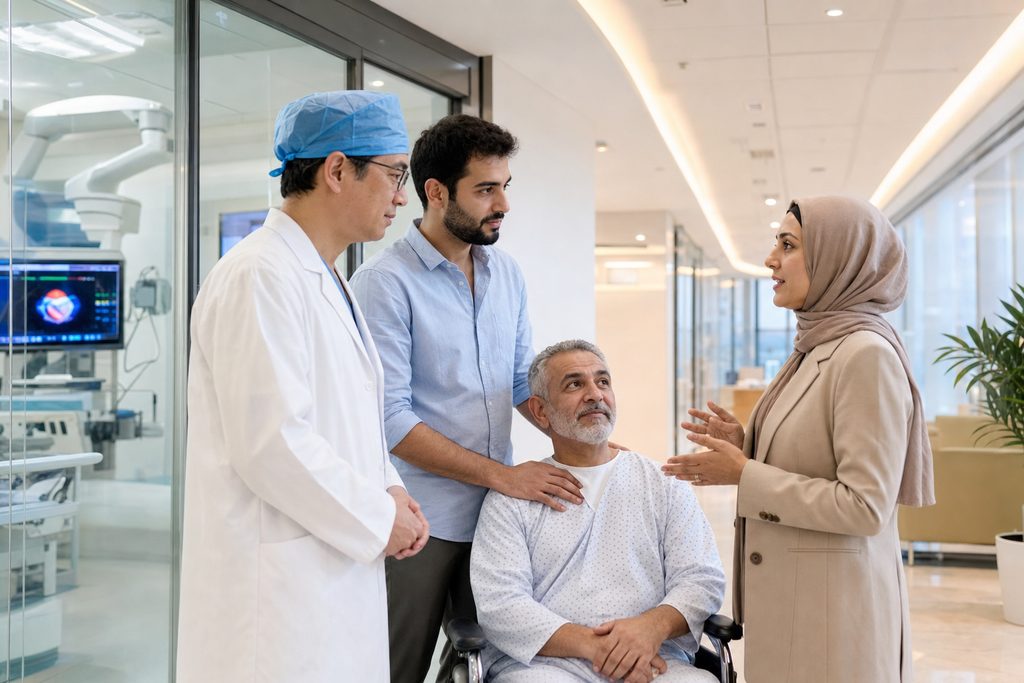
A single hospital in Beijing performs over 14,000 cardiac surgeries each year. That is more than many entire countries complete in the same period. For a patient in Riyadh or Jeddah who has just been told they need a coronary artery bypass graft, that number changes the conversation. It shifts the question from “can I get this done” to “where will the team have seen my exact situation a thousand times before.” We help patients from Saudi Arabia and across the Gulf region navigate that question every month, and the path is more straightforward than most people assume.
How This Actually Works, Step by Step
The process begins with paperwork, not a plane ticket. You send us your existing cardiac workup: the coronary angiography report, echocardiogram, stress test results, and any recent blood work. Our team translates these documents into clinical Chinese and submits them to the international patient office at Fuwai Hospital. A cardiac surgeon reviews your file. That review typically takes three to five business days.
What comes back is a written assessment. The surgeon confirms whether CABG is indicated, flags any anatomical complexities they see in your angiogram, and proposes a preliminary surgical plan. They also state whether they will accept your case. This is not a binding commitment to a specific surgery date. It is a clinical green light. You now know a top-tier surgical team has reviewed your vessels and said yes.
With that acceptance letter, you apply for your visa. Saudi passport holders apply for an S2 visa, which covers private medical treatment. The hospital’s invitation letter, your passport, a completed application form, and proof of accommodation are the core documents. Processing at the Chinese embassy in Riyadh or the consulate in Jeddah usually takes four to seven working days. We guide you through the exact document checklist, because a missing stamp can set you back two weeks.
Once the visa is issued, we lock in your arrival date and coordinate with the hospital’s international ward. You fly to Beijing. Our bilingual coordinator meets you at the airport. The next morning, you complete pre-operative tests at Fuwai: repeat labs, a chest X-ray, possibly a fresh echocardiogram. The surgeon conducts an in-person consultation. Surgery is typically scheduled within two to five days after that final assessment.
Heart Bypass Surgery Cost China vs Saudi Arabia: The Real Numbers
Let’s address the question that brought most readers here. The heart bypass surgery cost China vs Saudi Arabia comparison is not a simple line item. It depends on graft count, valve involvement, and whether you go through the public ward, the VIP wing, or the international department. But we can give you ranges that reflect what our patients have actually paid.
At Fuwai Hospital’s standard public ward, a straightforward three-vessel CABG runs between $12,000 and $18,000 USD. The international department, which provides English-speaking nursing staff, private rooms, and streamlined admission, ranges from $20,000 to $30,000 USD. These figures cover the surgery itself, anesthesia, the operating theater, standard ICU stay, and ward recovery.
Compare that with private hospitals in Saudi Arabia, where CABG typically ranges from $35,000 to $55,000 USD. Government hospitals in the Kingdom may offer lower rates for citizens, but wait times can stretch past three months. In the United States, the same procedure averages $120,000. The savings are real. A Saudi patient choosing Fuwai’s international department can expect to pay roughly half of what a private Jeddah hospital would charge, and a fraction of the U.S. price. That is before travel costs. Even with round-trip business class flights and a month of accommodation in Beijing, the total package often lands well below the Saudi private-sector quote.
| Procedure | Fuwai (Public) | Fuwai (International) | Saudi Private | USA Avg. |
|---|---|---|---|---|
| CABG (3-vessel) | $12,000–18,000 | $20,000–30,000 | $35,000–55,000 | $120,000+ |
| CABG + Valve | $22,000–28,000 | $32,000–42,000 | $55,000–75,000 | $180,000+ |
| Off-Pump CABG | $14,000–20,000 | $22,000–32,000 | $40,000–60,000 | $130,000+ |
All figures vary by case complexity. A patient with diabetes, renal impairment, or a low ejection fraction will need longer ICU time. That shifts the final bill. But the baseline differential holds across nearly every scenario.
Can I Get Heart Bypass in China with Arabic Translator?
Yes. And this is where we earn our keep.
Fuwai Hospital’s international department has English-speaking staff. Some nurses and coordinators speak basic Arabic phrases, but you should not rely on that for surgical consent discussions. The can I get heart bypass in China with Arabic translator question has a practical answer: our organization provides dedicated Arabic-English-Chinese medical interpreters who stay with you from admission through discharge.
This is not a phone app. This is a trained bilingual medical companion who sits beside you during the surgeon’s pre-op briefing, translates every word of the consent form, explains what the anesthesiologist is asking, and is present when you wake up in the ICU. Family members who travel with you can focus on being family. The interpreter handles the clinical communication.
We have coordinated care for dozens of Saudi and Gulf patients. The cultural nuances matter. Dietary requirements during recovery. Prayer space logistics. Gender preferences for nursing staff where possible. These are not afterthoughts in our process. They are part of the pre-arrival checklist we run with the hospital’s international office.
A Realistic Timeline
People underestimate the waiting steps. Here is what a typical Saudi patient’s calendar actually looks like, from the day they decide to explore the option.
| Stage | What Happens | Duration |
|---|---|---|
| Week 1 | You send us your cardiac file. We translate and submit to Fuwai. | 2–3 days for translation |
| Week 2 | Fuwai surgeon reviews. Acceptance letter issued (or further tests requested). | 3–5 business days |
| Week 3 | Visa application submitted to Chinese embassy. Documents: passport, invitation letter, photo, form, accommodation proof. | 4–7 working days |
| Week 4 | Flights booked. Accommodation confirmed near hospital. Pre-arrival instructions sent. | 1 week coordination |
| Week 5, Day 1 | Arrive Beijing. Airport pickup. Rest. | 1 day |
| Week 5, Day 2–3 | Pre-operative workup at Fuwai. Surgeon consultation. Consent signing. | 1–2 days |
| Week 5, Day 4–6 | Surgery. Typically 4–6 hours in the OR. 1–2 nights in ICU. | Surgery + ICU |
| Week 6 | Ward recovery. Mobilization. Drain removal. Discharge planning. | 5–7 days |
| Week 7–8 | Hotel recovery near hospital. Follow-up visit. Sutures out. Fitness-to-fly letter. | 1–2 weeks |
| Week 8–9 | Return to Saudi Arabia. Handover to your local cardiologist. | Ongoing |
Total time in Beijing: roughly three to four weeks from landing to flying home. Some patients with straightforward recoveries leave sooner. Anyone with a complicated post-op course stays longer. We never quote a minimum. We quote the realistic range and build flexibility into accommodations.
What Can Go Wrong — and What Happens Then
Honesty here matters more than reassurance.
The first failure mode is an incomplete workup. If your coronary angiogram is more than six months old or the images are low-resolution, the Fuwai surgeon will request a repeat study. That means you arrive, get a new angiogram, and only then receive a final surgical plan. It adds three to five days and about $800 to $1,200 in additional testing costs. Send the best-quality images you have, in DICOM format if possible.
The second is clinical unsuitability discovered on arrival. A patient’s condition can change between the file review and the pre-op exam. New arrhythmias, worsening renal function, an undetected infection. If the anesthesiologist or surgeon deems the risk unacceptable on the day, surgery is postponed or cancelled. The hospital refunds the surgery deposit. Our coordination fee covers rebooking and rescheduling. You are not stranded.
The third is post-operative complications. Bleeding, sternal wound infection, atrial fibrillation, pleural effusion. Fuwai’s complication rates are published and low — their in-hospital mortality for isolated CABG sits around 0.6%, compared to a global benchmark of 1–2% — but zero risk does not exist in cardiac surgery. If a complication occurs, you are already inside one of the world’s highest-volume cardiac centers. They manage these events daily. The extended stay will increase your hospital bill. Travel insurance that covers medical complications abroad is not optional. We strongly recommend it.
The fourth is language friction in an emergency. Even with an interpreter, a 3 a.m. ICU event moves fast. Our team provides 24-hour phone support for urgent interpretation needs. But the first few minutes of any emergency will happen in Mandarin between the bedside nurses and the on-call resident. This is the reality of receiving care in a foreign country. Most Saudi patients find the tradeoff acceptable given the surgical volume and cost. You should know the tradeoff exists.
How Safe is Cardiac Surgery at Fuwai Hospital Beijing?
The how safe is cardiac surgery at Fuwai Hospital Beijing question deserves a data answer, not a reassurance.
Fuwai Hospital is the world’s highest-volume cardiac surgery center. They perform over 14,000 cardiac operations annually. More than 4,000 of those are isolated CABG procedures. Volume correlates with outcomes in cardiac surgery. Study after study has shown that surgeons and centers performing more than 200 CABGs per year have significantly lower mortality rates than low-volume operators. Fuwai’s surgeons exceed that threshold many times over.
The hospital’s reported in-hospital mortality for isolated first-time CABG is approximately 0.6%. For reference, the Society of Thoracic Surgeons database in the United States reports an average CABG mortality of around 1.8%. The European average runs similar. Fuwai’s number is not a marketing claim. It is published in peer-reviewed journals and reflects a combination of surgical skill, standardized protocols, and the sheer repetition that comes with high caseloads.
Off-pump CABG is routine there. Many surgeons at Fuwai perform over 90% of their bypasses on a beating heart, avoiding the cardiopulmonary bypass machine. This technique reduces stroke risk and speeds recovery for appropriately selected patients. Not every patient is a candidate. But the option is on the table in a way it often is not at lower-volume centers.
Infection control is rigorous. The cardiac ICU is a dedicated unit. Antibiotic stewardship protocols are enforced. Deep sternal wound infection rates are under 1%. These are the numbers that matter when you are deciding whether to board a plane for heart surgery.
Best Heart Bypass Surgeon China for Saudi Patients: How to Evaluate
The phrase best heart bypass surgeon China for Saudi patients implies a single name. That is not how top-tier Chinese cardiac surgery works. Fuwai has over 20 attending cardiac surgeons. Many are internationally trained. Several have fellowships in the U.S., Germany, or Japan. They operate in teams.
What you should look for is not one surgeon’s reputation but the team’s annual CABG volume, their off-pump rate, and their complication data. The surgeon who actually performs your operation will be the attending assigned to your case based on the schedule and your clinical complexity. This is standard at any high-volume academic center worldwide. The Mayo Clinic does not let you pick your surgeon from a catalog either.
Our role is to ensure your case is reviewed by a senior attending whose sub-specialty matches your needs. A patient with diffuse coronary disease and a low ejection fraction may benefit from a surgeon who specializes in high-risk CABG with concomitant procedures. A younger patient with isolated LAD and circumflex disease may be perfectly served by a surgeon who does high-volume off-pump cases. We communicate these preferences when we submit your file.
Saudi patients sometimes ask about the book CABG surgery China medical tourism package approach. We do not offer packages in the all-inclusive resort sense. Surgery is not a vacation product. What we do offer is a coordinated care pathway: pre-arrival clinical review, visa support, airport transfer, hospital admission, Arabic interpretation throughout, accommodation near the hospital, and post-discharge follow-up before you fly home. You can think of it as a managed medical journey. The components are modular. You pay the hospital directly for the surgery. You pay us for the coordination, interpretation, and logistics. This separation matters. It keeps incentives clean.
Practical Considerations: Records, Visa, Payment, Follow-Up
Medical records. You need a coronary angiogram in DICOM format on a CD or USB drive, not just printed still images. The interventional cardiologist at Fuwai will review the raw data. You also need a recent echocardiogram report, ECG, blood work including renal function and HbA1c, and a detailed referral letter from your Saudi cardiologist summarizing your history and current medications. All documents must be translated into Chinese or English. We handle the Chinese translation.
Visa. The S2 visa is the correct category for short-term private medical treatment. It is typically issued for 30 to 90 days. If your recovery requires a longer stay, an extension can be applied for in Beijing. We provide the documentation package and guide you through the application. Do not enter China on a tourist L visa and then seek surgery. That creates administrative problems at the hospital.
Payment. Fuwai Hospital requires a deposit before surgery. The amount depends on your estimated procedure cost. International patients typically pay via wire transfer or credit card. Saudi bank transfers to China can take two to three business days. Plan for that lag. The hospital provides itemized receipts for insurance reimbursement. Most Saudi patients pay out of pocket and claim reimbursement from their insurer afterward. Check with your insurance provider before travel. Some Saudi insurers have direct arrangements with Fuwai. Most do not.
Language. We have covered this, but it bears repeating. The can I get heart bypass in China with Arabic translator question is a yes, but the interpreter works through our team, not the hospital directly. Budget for this service. It is not a luxury. It is a safety measure.
Follow-up at home. You will leave Beijing with a discharge summary in English and Chinese, a medication list, and a recommended follow-up schedule. Your Saudi cardiologist should receive these before you arrive home. We facilitate that handover. The first follow-up with your local doctor should happen within one week of your return. Sternal precautions continue for six to eight weeks. Cardiac rehabilitation can be done in Saudi Arabia. Fuwai’s team does not manage your long-term care. They hand you back to your home physician with a clear plan.
Frequently Asked Questions
The Fuwai Hospital CABG price for international patients ranges from $20,000 to $30,000 USD through the international department for a standard three-vessel bypass. This includes surgery, anesthesia, ICU, and ward stay. Complex cases with valve repair or extended ICU time run higher. The hospital provides a detailed estimate after reviewing your file. You pay the hospital directly.
Yes. The international department has private rooms where one family member can stay overnight. Hotels near the hospital in Beijing’s Xicheng district range from budget to five-star. We help families book accommodations within a 10-minute walk. Your accompanying relative applies for an S2 visa under the same application as yours.
Your discharge packet includes a direct phone number for Fuwai’s international office. They can consult with your Saudi physician if questions arise. But ongoing emergency care happens at your local hospital. We recommend establishing a relationship with a cardiac surgeon in Saudi Arabia before you travel, so you have a named contact for any post-operative concerns.
Yes. Fuwai performs a high volume of off-pump bypass procedures. Whether you are a candidate depends on your coronary anatomy and the surgeon’s assessment. The technique is discussed during the pre-operative consultation. There is no additional charge for off-pump versus on-pump CABG.
Send us your cardiac file. We handle the rest in sequence: translation, submission, surgeon review, acceptance, visa guidance, scheduling, and on-ground support. There is no commitment required to get the initial clinical review. You receive the surgeon’s assessment and then decide.
Your Next Step
The decision to travel abroad for heart surgery is not small. But the information you need to make it is accessible. Fuwai Hospital’s CABG program is one of the most experienced on the planet. The cost differential relative to private Saudi hospitals is substantial. The logistics, while real, are manageable with a team that has walked this path before.
Our organization, China Medical Services, exists to bridge the gap between patients in the Gulf and the clinical resources in Beijing. We do not perform surgery. We do not make medical decisions. We handle the coordination, the translation, the interpretation, and the thousand small practicalities that turn a daunting idea into a concrete plan. If you are weighing the heart bypass surgery cost China vs Saudi Arabia and want to know whether Fuwai is a viable option for your specific case, send us your file. We will get you an honest clinical answer, and we will be beside you every step if you decide to go.
For more medical information and treatment options in China, visit chinamedservices.com (China Medical Services).
