Pediatric Neuro China Arab: Brain Surgery with Family Housing
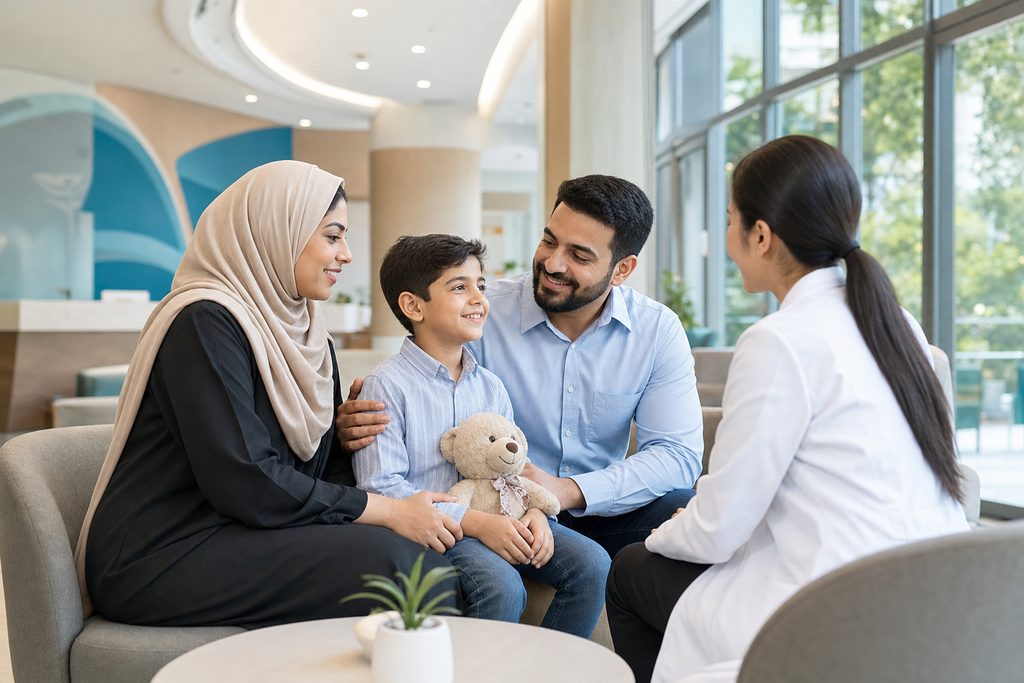
You have probably heard that traveling abroad for a child’s brain surgery means choosing between quality care and being together as a family. The assumption is you must sacrifice one. The reality is different. Shanghai now handles complex pediatric neurosurgery volumes that rival any Western center, and the ecosystem around its hospitals has adapted to accommodate entire families for weeks or months. The core question for Arab families is not whether the capability exists. It is how to match the clinical need with a living situation that keeps a family stable while a child undergoes treatment.
Pediatric Neurosurgery in China: The Short Answer
The pediatric neurosurgery China cost for a complex brain tumor resection typically ranges from $25,000 to $45,000. That figure usually includes the surgery itself, anesthesia, operating room fees, a standard ICU stay, and ward recovery. It does not include pre-surgical embolization if needed, proton therapy if recommended, or extended rehabilitation. When you compare that to the $100,000 to $250,000 common in the United States for equivalent procedures, the arithmetic is straightforward. But the real decision for an Arab family hinges on a different question: can we stay together, cook our own food, and maintain some normalcy while our child is treated? The answer in Shanghai is yes, and the infrastructure for that is more developed than most families expect.
Who This Is Right For — and Who It Isn’t
This path is not for everyone. Being honest about who should not get on a plane is what prevents disasters.
Families who typically benefit from this approach:
- A child with a diagnosed brain tumor, arachnoid cyst, hydrocephalus, Chiari malformation, or drug-resistant epilepsy requiring surgical intervention.
- Families who have a confirmed diagnosis and imaging (MRI, CT, EEG) already completed in their home country or who are willing to obtain a written second opinion remotely before traveling.
- Parents who need adjacent family housing with kitchen facilities — not a hotel room — because they plan to stay for 4 to 8 weeks.
- Families who are paying out-of-pocket or using international insurance that reimburses after treatment, and who value a lower total cost even after travel expenses.
Who should not pursue this:
- A child who is medically unstable for long-haul flight. Any neurosurgeon will require current imaging and a stability assessment before clearing travel.
- Families who need an immediate, emergency craniotomy within 48 hours. International coordination takes time. If the local team says surgery cannot wait, it cannot wait.
- Parents who expect a guaranteed private chef, a luxury recovery suite, and zero logistical friction. Shanghai offers excellent medical care and decent family housing. It is not a resort.
- Cases where the child’s primary treating team back home refuses to share records or collaborate with an overseas second opinion. Without records, no reputable Chinese neurosurgery department will accept the case.
The Options, Compared
When an Arab family researches how much does brain surgery for child cost in China versus staying in the region or going West, the numbers look like this:
| Factor | Shanghai (Public Top-Tier) | Private International (Shanghai) | United States | Germany |
|---|---|---|---|---|
| Surgery cost (tumor resection) | $25,000 – $45,000 | $60,000 – $90,000 | $100,000 – $250,000 | $55,000 – $95,000 |
| Family housing (monthly) | $1,500 – $3,000 (serviced apartment) | $3,500 – $6,000 | $4,000 – $8,000 | $3,000 – $5,500 |
| Bilingual coordination | Via medical service team | Included | Hospital interpreters | Hospital interpreters |
| Wait time (non-emergency) | 2 – 4 weeks | 1 – 2 weeks | 4 – 8 weeks | 3 – 6 weeks |
| Halal food access | Nearby restaurants and self-catering; some hospitals offer halal menu on request | Often available | Variable by city | Variable by city |
The public top-tier route in Shanghai wins on pure cost. The private international route wins on speed and built-in language support but costs more. For a family that can plan 4 to 6 weeks ahead and wants to keep the total financial burden manageable, the public hospital path with external family housing and bilingual support is the slot that makes the most sense. The money saved on the procedure often covers the flights, the apartment, and the coordination service, with room left over.
What “Family Housing” Actually Means in Shanghai for Arab Families
The phrase medical tourism package child neurosurgery China family accommodation gets searched because families want a single, packaged answer. The truth is more modular. No hospital in China sells a “surgery plus apartment plus halal meal plan” bundle the way a travel agency sells a vacation package. What exists instead is a network of serviced apartments within a 15-minute walk or short taxi ride of the major pediatric neurosurgery centers.
These apartments are not hospital-owned. They are independently operated buildings that cater to international patients and their families. A typical two-bedroom serviced apartment near the Shanghai medical district rents for $1,800 to $2,800 per month. It includes a kitchen with a cooktop, a refrigerator, and basic cookware. That kitchen is the difference-maker for an Arab family. You can prepare your own meals. You control the ingredients. You keep your family’s eating rhythm intact while your child recovers.
Some buildings also have a washing machine, weekly housekeeping, and a front desk that can help with grocery delivery. The hospital itself provides the medical care. The apartment provides the living infrastructure. A medical coordination team bridges the two — handling registration, appointment sequencing, and translation so you are not stranded between a discharge summary and a pharmacy counter.
Is Pediatric Neurosurgery Safe in China?
The question is pediatric neurosurgery safe in China sits behind every search. The data answers it better than any reassurance can. The neurosurgery department at Huashan Hospital, affiliated with Fudan University in Shanghai, performs over 17,000 neurosurgical procedures annually. Its pediatric neurosurgery subgroup handles complex tumor resections, epilepsy surgery, and endoscopic skull base procedures at volumes that create deep subspecialty experience. The Children’s Hospital of Fudan University runs a dedicated pediatric neurosurgery unit that manages congenital malformations, hydrocephalus, and brain tumors in children from across Asia and the Middle East.
Safety in pediatric neurosurgery correlates directly with case volume. A surgical team that does 200 pediatric brain tumor resections a year has refinements in technique, anesthesia protocols, and post-operative ICU management that a team doing 20 a year cannot match. Chinese centers that feature on the Fudan University Hospital Ranking for neurosurgery fall into the high-volume category. They use intraoperative MRI, neuronavigation, and neurophysiological monitoring — the same technology stack you would find in Munich or Boston.
The risk profile of the surgery itself does not change because the operating room is in Shanghai. A craniotomy for a posterior fossa tumor carries the same core risks of bleeding, infection, and neurological deficit regardless of geography. What changes is the team’s familiarity with that exact tumor in that exact location in a child of that exact age. High-volume centers see the rare presentations often enough that they are not rare to them.
What It Costs, Start to Finish
The pediatric neurosurgery China cost is the headline number, but families need the full picture. Here is a realistic breakdown for a 6-week stay — 1 week of pre-operative evaluation, the surgery and ICU stay, 3 weeks of ward recovery, and 1 week of outpatient follow-up before flying home:
- Surgery and hospitalization (public top-tier hospital, international department): $28,000 – $42,000. This covers the craniotomy, anesthesia, intraoperative monitoring, ICU days, ward bed, nursing care, and standard medications during admission. The range depends on tumor complexity, length of ICU stay, and whether additional procedures like an EVD placement are needed.
- Pre-operative diagnostics if not done at home: $1,500 – $3,000. Includes high-resolution MRI with contrast, MR spectroscopy if indicated, and full pre-surgical lab workup.
- Serviced apartment (6 weeks): $2,700 – $4,500 total. A two-bedroom unit with kitchen near the hospital.
- Flights (2 adults, economy, round-trip from Gulf region): $2,000 – $3,500 total.
- Bilingual medical coordination (full stay): $3,000 – $5,000. This covers hospital registration, appointment scheduling, in-person translation during consultations and on surgery day, and discharge coordination.
- Food, transport, incidentals (6 weeks): $1,500 – $2,500.
Total realistic range: $38,700 – $60,500.
That is the number to plan for. It is not the surgery alone. It is the whole stay. Compared to a US total that easily crosses $150,000 before family living costs, the financial logic holds. What is not included: post-operative proton beam therapy if the tumor pathology requires it (add $15,000 – $30,000), extended inpatient rehabilitation (add $800 – $1,500 per day), or any complication that extends the ICU stay beyond the standard window.
Practical Considerations: Records, Visa, and Post-Operative Follow-Up
The logistics are not trivial, but they are predictable. Arab families who book pediatric brain surgery China with family housing successfully tend to do three things right.
Medical records must travel before the child does. The neurosurgery department will require a recent contrasted MRI (ideally within 4 weeks of the planned surgery date), a full medical history summary, and any prior surgical or pathology reports. These need to be in English or translated into Chinese. A bilingual coordination team handles the translation, but the family must provide the original files. Without complete imaging in DICOM format, no surgeon will give a surgical opinion. This step alone can take 1 to 2 weeks.
Visa category matters. For medical treatment in China, the applicable short-stay visa is the S2 visa, endorsed for private affairs including medical treatment. The accompanying parent or family member applies under the same S2 category. The hospital provides an invitation letter and a treatment confirmation document that supports the visa application. Processing time varies by consulate, but 2 to 4 weeks is a safe planning window. No one can guarantee visa approval, but a complete application with the hospital’s documentation has a strong track record.
Payment is upfront. Chinese public hospitals, including their international departments, require a deposit before admission. The deposit is typically quoted as an estimate of the total hospitalization cost. Any unused portion is refunded at discharge. International insurance that works on a reimbursement model is acceptable — the family pays the hospital, the hospital issues a detailed invoice and medical report, and the family submits the claim to their insurer. Direct billing is available at some private international hospitals in Shanghai but is not standard at public hospital international departments.
Follow-up after returning home is non-negotiable. The Chinese neurosurgery team will provide a detailed discharge summary, post-operative imaging, and a recommended follow-up schedule. The child’s local neurosurgeon or neurologist must take over long-term surveillance. The Shanghai team can offer a remote video consultation at the 3-month or 6-month mark to review interval imaging, but the hands-on neurological exams must happen locally. Families that skip this step risk missing a slow-growing recurrence or a shunt malfunction.
Frequently Asked Questions
Yes. The area around the major Shanghai medical centers has a concentration of serviced apartments that specifically cater to international patients and their families. These are not hospital dormitories. They are private rental units with full kitchens, private bathrooms, and weekly cleaning. Booking is typically done through a medical coordination service that maintains relationships with the building management, not through a global booking platform. Expect to pay $1,800 to $2,800 per month for a two-bedroom unit within a 15-minute walk or short taxi ride. Halal food is available at nearby restaurants, and grocery delivery apps make self-catering straightforward.
This is the hardest question, and it deserves a straight answer. No pediatric neurosurgery team in the world has a zero percent complication rate. The Chinese team managing your child will have managed complications before — that is the value of a high-volume center. The international department of a top-tier Shanghai hospital has pathways for extended ICU stays, revision surgery, and post-operative rehabilitation. What it will not do is shield you from the financial reality of a longer stay. If the ICU stay doubles, the hospital bill increases accordingly. Families should have a financial buffer of at least 30% above the estimated total, or ensure their insurance covers extended hospitalization. The medical coordination team can help negotiate the logistics of a longer stay, but the clinical outcome is between the family and the surgical team.
Request a written second opinion first. This costs $300 to $500 and involves sending the child’s complete records to the neurosurgery department for review. The response comes back as a written analysis with a proposed surgical approach, a risk assessment, and the surgeon’s relevant case volume for that specific procedure. You can also request a video consultation for $500 to $800, where you speak directly with the neurosurgeon, ask about their experience with your child’s exact condition, and gauge the communication dynamic. If the answers are vague or the surgeon cannot cite specific case numbers for the procedure your child needs, that is information. You can walk away at this stage with no further commitment. Any video consultation fee is credited in full toward the on-the-ground coordination service if you proceed within 90 days.
Shanghai’s top-tier hospitals that regularly treat international patients are familiar with requests from Arab families. Private rooms can be arranged in the international department, which provides space for a parent to stay overnight and for family prayer. Halal food is not standard on the hospital menu, but many international departments can arrange halal meals with advance notice. The more reliable solution is the serviced apartment kitchen: the parent not staying overnight at the hospital prepares meals and brings them in. The hospital will not object to outside food as long as it meets any post-operative dietary restrictions set by the medical team. Modesty concerns during nursing care and physical exams can be discussed with the coordination team before admission so protocols are in place.
Your Next Step
The decision to bring a child to Shanghai for brain surgery is not a single leap. It is a sequence of smaller, verifiable steps. The first is a written second opinion. You send the records. You get a surgical assessment back. You decide if the expertise matches the need. Our team at China Medical Services handles the logistics between you and the hospital — records translation, surgeon matching, visa documentation, apartment booking, and bilingual accompaniment throughout the stay. We are not a hospital. We do not diagnose or treat. We connect your family with the right department and make sure language and bureaucracy never stand between your child and the care they need. When you are ready to explore whether this path fits your case, request a free consultation. No pressure. Just the facts you need to make a clear-eyed decision.
For more medical information and treatment options in China, visit chinamedservices.com (China Medical Services).
