Bathroom and Shower After Surgery: Navigating a Chinese Hospital Ward
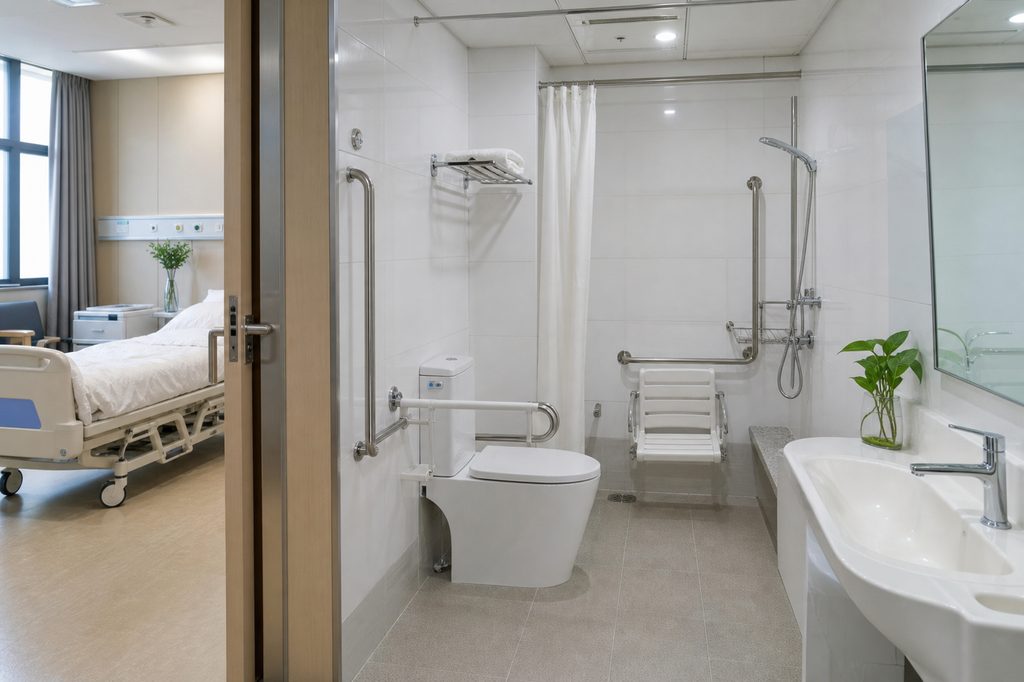
You have probably seen the glossy brochures. Sleek private suites with marble bathrooms that look more like a five-star hotel than a medical facility. The reality of post-surgical bathroom facilities in a standard Chinese public hospital ward is often quite different. And that gap between expectation and reality can be genuinely jarring if you are unprepared.
Our team has walked hundreds of international patients through these hallways. We have seen the relief on someone’s face when they understand exactly what to expect. We have also seen the stress when they do not. This guide is about closing that gap. It is a practical look at what bathroom and shower access actually looks like after surgery in a Chinese hospital — from the basic shared facilities to the VIP suites that rival any Western private room.
Key Takeaways
- Standard multi-bed wards in Chinese public hospitals typically have shared, squat-toilet bathrooms down the hall — not the private en-suites many Western patients expect.
- VIP and international ward rooms offer private Western toilets and showers, with costs ranging from approximately $150 to $500 per night, a fraction of comparable US private room rates.
- Early showering is often restricted by surgical protocol, not facility limitations; your surgeon, not the room type, dictates when you can get wet.
- You can secure a private room with a bathroom before you travel, but it requires coordination through a hospital’s international department — walk-in requests on arrival rarely succeed.
The Problem: Expecting a Private Bathroom and Getting a Squat Toilet
A patient from London once told us the hardest part of his knee replacement in Shanghai was not the pain. It was the bathroom. He had watched videos of the hospital’s international wing and assumed that was the standard. When he was admitted to a standard three-bed room for his first night, the shared facility down the corridor — a ceramic squat toilet with no seat and a handheld shower head over a simple floor drain — left him feeling vulnerable and frustrated. He is not alone. Many international patients underestimate how much ward type determines bathroom access in China’s public hospitals.
China’s top-tier public hospitals are enormous, high-volume institutions. A single facility might handle 10,000 outpatient visits a day. The infrastructure reflects that reality. Standard inpatient wards are designed for efficiency and capacity, not privacy. A typical general ward room contains three to six beds. The bathroom is communal, located at the end of the hall. It is clean and functional, but it is shared. For a Western patient recovering from major abdominal surgery or a hip replacement, navigating a squat toilet and a wet-room-style shower without a seat or grab bars can feel unsafe. Understanding this before you arrive is the difference between a manageable recovery and a deeply stressful one.
What Are Hospital Bathrooms Like in China? A Ward-by-Ward Breakdown
The single most important factor determining your bathroom experience is the ward class you are admitted to. Chinese public hospitals typically offer three or four tiers of inpatient accommodation. The bathroom facilities scale dramatically between them. Here is what you can actually expect.
The Standard Multi-Bed Ward
This is where the vast majority of local patients recover. Rooms hold three to six patients. The bathroom is a shared facility, usually one per hallway serving multiple rooms. The toilet is almost always a squat-style pan set into the floor. For a post-surgical patient with limited mobility, using a squat toilet is physically demanding and can be risky without assistance. The shower area, if separate from the toilet, is typically a wet room with a handheld shower head and a floor drain. Hot water is generally available but may be on a fixed schedule — often mornings and evenings. Privacy curtains are rare. You shower in an open space. This is a functional system that serves millions of patients. But if you are recovering from a C-section or spinal surgery, it presents real challenges.
The Semi-Private Room
Some hospitals offer two-bed rooms as a middle tier. These sometimes have a small en-suite bathroom shared between the two patients. The toilet may still be a squat style, though Western-style seated toilets are becoming more common in newer hospital wings. The shower is still basic — expect a handheld head over a floor drain, not a glass enclosure. Water pressure can be inconsistent. The key advantage is proximity; the bathroom is inside your room, not down a public corridor. This makes a significant difference at 3 a.m. when you need to go. Semi-private rooms are not available in every department, and they fill quickly. You cannot count on getting one without advance coordination.
The VIP and International Ward: Private Room with Bathroom for Medical Tourism in China
This is the tier that aligns with what most Western patients consider normal. A private room with bathroom for medical tourism in China is not a luxury — it is the standard of care that international patients should target. These rooms are single-occupancy. The en-suite bathroom features a Western-style seated toilet, a sink with a mirror, and a proper shower enclosure — often a glass cubicle with a mounted shower head. Grab bars are standard. Hot water is available 24 hours a day. Toiletries, towels, and sometimes a hairdryer are provided. The room itself typically includes a patient bed, a sofa that converts to a family member’s bed, a television, and a small refrigerator.
These wards are usually run by the hospital’s international medical center or VIP department. Nursing ratios are higher. English-speaking staff are more common. The environment is quieter and more controlled. For a patient who has just undergone a hip replacement and needs to navigate a bathroom safely, the difference between this and a standard ward is not about comfort — it is about clinical safety.
| Ward Type | Toilet Style | Shower | Privacy | Approx. Cost/Night |
|---|---|---|---|---|
| Standard Multi-Bed (3-6 beds) | Shared squat toilet, hallway | Shared wet room, fixed schedule | None | $30-60 |
| Semi-Private (2 beds) | Shared en-suite, squat or Western | Basic en-suite, handheld head | Shared with 1 person | $80-150 |
| VIP/International (1 bed) | Private en-suite, Western seated | Private glass enclosure, grab bars | Full | $150-500 |
Costs are approximate and vary by hospital and city. A VIP room in a top Beijing hospital will cost more than one in a provincial capital.
How to Shower After Surgery in a Chinese Hospital: The Real Constraints
Here is something that surprises many patients. The biggest barrier to showering after surgery is usually not the bathroom itself. It is the surgeon’s protocol. In Chinese hospitals, post-operative wound care tends to be conservative. Many surgeons will instruct you to keep the incision completely dry until the sutures or staples are removed — often 7 to 14 days after the operation. That means no showering at all, regardless of how nice your bathroom is.
Nurses will provide daily sponge baths. In a VIP ward, this is done with warm water, privacy screens, and a professional, dignified approach. In a standard ward, it is more utilitarian. You can also purchase waterproof adhesive dressings at most hospital pharmacies, but do not apply them without your surgeon’s explicit approval. The risk of infection is taken very seriously. If you are cleared to shower, the process in a VIP room is straightforward: sit on a built-in shower stool if needed, use the handheld head to avoid the incision site, and pat dry carefully. In a shared ward, showering while keeping a wound dry is far more complicated. You will likely need a family member or a hired companion to help you manage the logistics.
For patients who have undergone orthopedic surgery, the bathroom setup matters even more. A squat toilet is simply not an option after a hip or knee replacement. The deep flexion and weight-bearing required are contraindicated. This is why we strongly advise any patient undergoing joint replacement to secure a private room with a Western toilet and grab bars before traveling. It is not a preference. It is a post-operative requirement.
The Cost of a VIP Ward with Shower in a China Hospital
The cost of a VIP ward with shower in a China hospital is often the single most pleasant surprise for international patients. Even the highest-tier private rooms at China’s most elite hospitals are priced well below what you would pay for a standard private room in the United States or Europe.
At a top-tier public hospital in Beijing or Shanghai — say, Peking Union Medical College Hospital or Zhongshan Hospital — a VIP single room with a private en-suite bathroom, Western toilet, and shower enclosure typically ranges from $200 to $500 per night. In a strong provincial capital like Hangzhou or Nanjing, the same standard of room might cost $150 to $300. A semi-private room is $80 to $150. Compare this to a standard private room in a US hospital, which averages $1,500 to $2,500 per night, often with insurance negotiated rates still exceeding $800. The structural cost advantage of Chinese healthcare extends to the room itself.
There is a catch. These VIP rooms are limited in number. A large hospital might have only 20 to 40 such beds across all departments. They are in high demand from both international patients and affluent local patients. You cannot simply book one on the hospital’s website. Access is managed through the international department or VIP clinic. This is where advance coordination becomes essential. You need someone to confirm availability for your dates, reserve the room, and ensure it is ready when you are admitted. Showing up and hoping for an upgrade rarely works.
Post-Surgery Care Facilities in a China Hospital Ward: Beyond the Bathroom
The bathroom is the focal point of anxiety, but the broader post-surgery care facilities in a China hospital ward deserve attention too. In a standard ward, nursing care is task-focused and efficient. Nurses manage high patient loads. They will administer medications, check vital signs, and change dressings on schedule. They will not typically help you to the bathroom or assist with a shower. That responsibility falls to family members. In Chinese culture, it is expected that a family member — usually a spouse, child, or sibling — stays with the patient throughout the hospitalization to handle personal care, meal assistance, and bathroom trips. There is often a small cot or folding chair provided for this person.
For an international patient traveling without family, this creates an immediate gap. You will be alone in a system that assumes you have a companion. In a VIP ward, the nursing ratio is better, and staff are more accustomed to assisting international patients with personal care. But even there, the cultural expectation of family involvement lingers. This is why many international patients choose to hire a bilingual medical companion — not just for translation, but for the practical, hands-on assistance that the nursing staff may not provide. Someone to help you stand up, walk to the bathroom, and ensure you do not fall. That role is not a luxury. In a standard ward, it is a necessity.
Practical Considerations: Securing the Right Room Before You Travel
You cannot control your surgeon’s shower protocol. You can control which ward you recover in. The most effective way to ensure you have a private room with a bathroom after surgery in a Chinese hospital is to coordinate everything through the hospital’s international medical center before you leave home.
Start by sending your medical records — imaging, lab results, physician’s notes — for review. The international department will confirm whether your case is suitable for treatment at their facility and which department will handle it. At that stage, you can specify that you require a VIP single room with a private bathroom. The department can check availability and tentatively reserve the room for your anticipated admission date. This is not a hotel booking. It is a clinical coordination process. The room assignment is tied to your admission under a specific surgeon’s service. If the surgeon’s schedule shifts, your admission date may shift, and the room reservation shifts with it.
You will need an S2 visa for medical treatment. The hospital will issue an invitation letter confirming your admission. This letter is essential for the visa application. The process takes time — budget at least four to six weeks from initial contact to travel. Payment for the room is typically handled as a deposit upon admission. International departments accept credit cards and wire transfers. The room charge is separate from the surgical and medical fees. Ask for a detailed breakdown before you commit.
Frequently Asked Questions
You can ask, but the answer will almost certainly be no. The plumbing infrastructure is fixed. A squat toilet cannot be swapped out for a seated toilet on request. If you have a medical need for a seated toilet — for example, after hip surgery — this must be communicated during the admission planning process so you are placed in an appropriate room from the start. Once you are in a standard ward bed, moving to a VIP room depends on availability, which is often zero.
This is one of the most common concerns we hear. In a standard ward, the nursing staff will not provide bathroom assistance beyond the most basic level. You will need a companion. Some international patients hire a private caregiver through the hospital’s nursing department for an additional daily fee. Others arrange for a bilingual medical companion who can provide both translation and physical assistance. In a VIP ward, the nursing staff are more available to help, but do not assume round-the-clock one-on-one assistance. Confirm the level of support before you arrive.
The standard varies by hospital tier and ward class. In the VIP and international wards of top-ranked public hospitals — the kind our network focuses on — cleanliness is generally very good. These rooms are cleaned daily, often twice a day. Linens and towels are changed regularly. In a standard multi-bed ward at the same hospital, the shared bathroom is cleaned on a schedule but sees heavy use. It is functional, not pristine. The floor may be wet. Bring your own flip-flops or shower shoes regardless of ward class. It is a simple precaution that makes a real difference to your comfort.
Yes. The nightly room rate covers the private en-suite bathroom with shower and toilet. It does not cover medical consumables, nursing procedures, medications, or the surgery itself. Those are billed separately. The room rate is a facility fee. Expect it to appear as a distinct line item on your hospital bill.
Your Next Step
Recovery is hard enough without worrying about how you will manage a basic human need in an unfamiliar environment. The bathroom situation in a Chinese hospital is not something to discover on arrival. It is something to plan for. Our team helps international patients navigate these practical realities — from identifying hospitals with suitable VIP ward availability to coordinating room reservations before you travel. We are not a hospital and we do not provide medical advice. We are the bridge between your needs and the right facility. If you are considering surgery in China and want to understand your options for a private room with proper bathroom facilities, reach out for a free consultation. We will walk you through what is possible, what it costs, and how to make it happen. It is a conversation, not a commitment.
For more medical information and treatment options in China, visit chinamedservices.com (China Medical Services).
