Shoulder Surgery China vs Canada: Arthroscopy Without the Wait
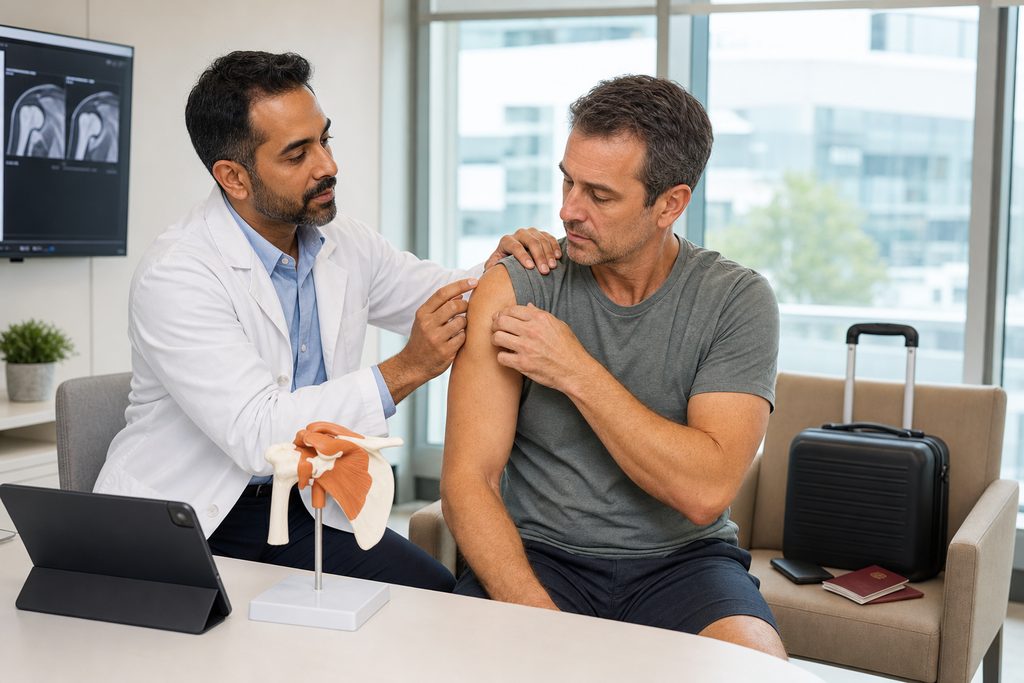
You have probably heard that leaving Canada for surgery means gambling on quality. The data tells a different story. Across China’s top-tier orthopedics departments, the rotator cuff repair volume in a single center often exceeds what an entire Canadian province performs in a year. That repetition breeds a specific, hard-to-replicate expertise. But the real reason our team fields calls from Vancouver and Toronto every week is simpler: a torn labrum hurts today, and waiting 18 months for a fix feels impossible.
This is not about cutting corners. It is about understanding a parallel system where capacity meets clinical excellence, and where the question shifts from “how long must I suffer” to “when can I fly.”
How This Actually Works, Step by Step
The process starts long before you board a plane. You send us your existing imaging — MRI reports, X-rays, ultrasound findings, and your surgeon’s clinical notes if you have them. We translate these documents into clinical Chinese and route them to the orthopedic department that best matches your specific condition.
Within five to seven business days, you receive a written second opinion. This document outlines whether the Chinese specialist agrees with your Canadian diagnosis, what surgical approach they recommend, and a preliminary treatment plan. The fee for this written analysis ranges from $300 to $500. No commitment beyond that.
If you decide to proceed, we coordinate a video consultation with the treating surgeon. You speak directly, through a medically qualified interpreter. You ask about anchor placement, about single-row versus double-row repair, about the rehab protocol. The surgeon reviews your images on screen. This call costs between $500 and $800 for a top-specialist consultation.
Only after that conversation, and only if you feel confident, do we move to scheduling. We coordinate your surgery date through the hospital’s international department, arrange your admission paperwork, and provide the documentation you need for your visa application.
Shoulder Arthroscopy Cost China vs Canada: A Direct Comparison
Let us look at the numbers that drive this decision. The shoulder arthroscopy cost China vs Canada comparison reveals a gap that surprises most patients, especially when factoring in the hidden cost of waiting.
| Cost Factor | Canada (Public System) | Canada (Private Clinic) | China (Top-Tier Public Hospital, International Wing) |
|---|---|---|---|
| Surgeon & Hospital Fee | $0 (covered by provincial plan) | $15,000 – $25,000 CAD | $6,000 – $10,000 USD |
| Anesthesia | Covered | Included | Included |
| Implant Hardware (anchors, sutures) | Covered | Included | Included |
| Physiotherapy (6-month protocol) | Covered, but limited sessions | $2,000 – $4,000 CAD | $1,500 – $3,000 USD (private, English-speaking) |
| International Patient Coordination | N/A | N/A | $800 – $1,200 USD (one-time) |
| Total Estimated Out-of-Pocket | $0 (but see wait times below) | $17,000 – $29,000 CAD | $8,300 – $14,200 USD |
The Canadian public system covers the surgery itself. That is true. But the cost of waiting — lost income, muscle atrophy, opioid dependence, a frozen shoulder that complicates the eventual repair — does not appear on any provincial health card statement. A patient who waits 12 months with a retracted supraspinatus tear may need a far more complex procedure than someone treated at month three.
In China’s international wings, the all-inclusive surgical package typically covers the operating theater, surgeon’s fee, anesthesia, implant hardware, and a private recovery room. Post-operative physiotherapy is billed separately and can be arranged with English-speaking therapists in Shanghai or Beijing.
How Long Is the Wait for Shoulder Surgery in Canada? The Real Numbers
The question “how long is the wait for shoulder surgery in Canada” does not have one answer. It has a range that varies cruelly by province and by triage category.
The Canadian Institute for Health Information tracks this closely. In 2023, the national benchmark for arthroscopic shoulder surgery — the target within which 90% of patients should receive care — was 182 days. Many provinces miss this target by a wide margin. In Nova Scotia, patients wait a median of 387 days for a shoulder arthroscopy. In British Columbia, the median hovers around 260 days. Ontario performs better, but even there, a patient classified as non-urgent can wait 10 to 14 months.
During that wait, the rotator cuff tear can retract. The muscle belly undergoes fatty infiltration. A repairable tear becomes a partial repair. A partial repair becomes a reverse total shoulder arthroplasty down the road. The orthopedic literature is blunt on this point: surgical outcomes for rotator cuff repair decline measurably after six months of delay, and significantly after one year.
China’s top orthopedic hospitals do not operate on a waitlist model for international patients. Once your video consultation is complete and both you and the surgeon agree on the plan, surgery can typically be scheduled within two to four weeks. That timeline accounts for hospital bed availability in the international ward, not for rationing.
A Realistic Timeline
Here is what the full journey looks like, from your first inquiry to your first post-op physio session at home. This is not an optimistic scenario. It is a median based on the cases we coordinate.
| Stage | What Happens | Typical Duration |
|---|---|---|
| Day 1–3 | You send MRI files, clinical history, and your questions. We translate and prepare the submission package. | 2–3 business days |
| Week 1–2 | Written second opinion from the matched orthopedic department. You review the findings. | 5–7 business days |
| Week 2–3 | Video consultation with the treating surgeon. Real-time discussion of approach, hardware, rehab, risks. | 30–60 minute call, scheduled within 5 days of request |
| Week 3–5 | Surgery date confirmed. Hospital admission paperwork issued. We provide the documentation package for your S2 visa application. | 1–2 weeks for hospital scheduling |
| Week 4–6 | Visa processing at your nearest Chinese embassy or consulate. S2 visa for short-term private affairs, including medical treatment. | 5–10 business days (varies by consulate) |
| Week 5–7 | Arrival in China. Pre-op bloodwork, ECG, and anesthesiology clearance. Surgery the following day or within 48 hours. | 2–3 days pre-op; 2–5 days inpatient recovery |
| Week 7–9 | Early post-op physiotherapy in China, if you choose to stay. Or clearance to fly home with a detailed rehab protocol. | 1–2 weeks optional stay |
| Month 2–6 | Rehabilitation at home, following the Chinese surgeon’s protocol. We can arrange video follow-ups as needed. | Ongoing |
The step people forget is document translation. Medical Chinese is a language unto itself. An MRI report translated by a generalist misses the nuance of “partial-thickness bursal-sided tear with 3mm retraction” versus “full-thickness tear with tendon delamination.” Our clinical translators are embedded in the workflow specifically to prevent that kind of error.
What Can Go Wrong — and What Happens Then
This is the section where we earn or lose your trust. Cross-border surgery carries risks that local care does not. We need to name them.
A tear looks different under the arthroscope than on MRI. This happens roughly 10 to 15 percent of the time. The surgeon may find a larger tear, a concurrent SLAP lesion, or early glenohumeral arthritis that the imaging did not capture. In a Chinese international wing, the surgeon has the authority to adjust the procedure intraoperatively — converting a planned single-row repair to a double-row, for example — without waking you for a new consent discussion. The preoperative consent form covers these contingencies. But it means the final bill may shift. You need to be prepared for that.
Post-operative infection is rare in shoulder arthroscopy, with rates around 0.1 to 0.5 percent in high-volume centers. The hospitals we work with track and publish their surgical site infection rates. Ask to see these numbers during your video consultation. A surgeon who cannot produce them is a surgeon you should not book.
Deep vein thrombosis from long-haul travel is a real concern. You will fly 10 to 14 hours, undergo surgery, and then be relatively immobile for days. The standard protocol in Chinese international wards includes perioperative low-molecular-weight heparin and compression stockings. But you must disclose any personal or family history of clotting disorders during your pre-op clearance.
What if you arrive and the surgeon falls ill? It happens. The hospital’s international department will assign a colleague of equivalent seniority within the same department. You will have the opportunity to speak with that surgeon before proceeding. If you are not comfortable, we reschedule — and our coordination fee covers that rebooking. You are not financially penalized for the hospital’s disruption.
Finding the Best Shoulder Surgeon China for International Patients
The phrase “best shoulder surgeon China for international patients” implies a single name. That is not how Chinese academic medicine works. The top orthopedic departments are teams — 15 to 20 attending surgeons, each performing 300 to 500 shoulder arthroscopies per year. The department chief may be the most published, but the surgeon who handles 400 rotator cuff repairs annually might be a younger attending with exceptional technical speed and a sub-3 percent re-tear rate.
So how do you evaluate who is right for your case?
Look at the department’s annual arthroscopy volume. A center performing fewer than 500 shoulder scopes per year is not a high-volume center by Chinese standards. The orthopedic department at Peking University Third Hospital, for instance, performs over 3,000 shoulder arthroscopies annually. Shanghai’s Sixth People’s Hospital is another shoulder powerhouse. These are the kinds of numbers that correlate with lower complication rates in the orthopedic literature.
Ask about the surgeon’s fellowship training. Many Chinese shoulder specialists have spent one to two years at U.S. or European centers — the Hospital for Special Surgery, the Steadman Clinic, the Shoulder Unit at the Cappagh National Orthopaedic Hospital in Dublin. They bring those techniques back and adapt them. If your surgeon trained under a name you recognize, that is a meaningful signal.
Confirm that the international ward has dedicated English-speaking nursing staff. The surgeon may speak functional English, but your 3 a.m. pain management request goes to the nurse on duty. The hospitals we work with, listed on our top-ranked hospitals page, staff their international wings with bilingual nurses as a baseline requirement.
And ask the question that makes every surgeon pause: “What is your personal re-operation rate for rotator cuff repair at two years?” A rate above 5 percent warrants a conversation. A surgeon who does not track this number is not running a data-driven practice.
Practical Considerations: Visa, Records, and Follow-Up Care
Your visa is not an afterthought. For medical treatment in China, you apply for an S2 visa — a short-term visa for private affairs, which explicitly covers medical visits. The Chinese embassy or consulate will require an invitation letter from the treating hospital, your passport with at least six months’ validity, a completed application form, and a passport photo. Processing typically takes five to ten business days. We provide the hospital invitation letter as part of our coordination package. Do not apply for an M visa. That is for commercial and trade activities and is not appropriate for medical travel.
Medical records must travel with you. Bring your original MRI on a CD or USB drive, not just the printed report. The surgeon will load your images into their planning software and take measurements that the radiologist’s report may not include. Bring a summary of any prior shoulder surgeries, including the operative report if you have it. And bring a list of every medication you take, with generic names, not brand names.
Payment in Chinese public hospitals is upfront. The international department will issue an estimated bill before admission, and you settle the balance upon discharge. Most international patients pay by credit card or wire transfer. The hospital provides a detailed invoice and a discharge summary in English, which you submit to your Canadian insurer for reimbursement. China’s international wings do not direct-bill Canadian provincial plans, but many Canadian patients successfully claim reimbursement for medically necessary procedures obtained abroad when the domestic wait time exceeds what is clinically reasonable. Check with your provincial plan before you commit.
Language is the friction point that surprises no one but frustrates everyone. The surgeon may speak English. The anesthesiologist may speak some. The physiotherapist almost certainly does not. Our bilingual medical companion service — from $200 per day — places a medically fluent interpreter at your side from admission to discharge. They handle the pharmacy run, the meal ordering, the post-op instruction translation, and the hundred small interactions that make a hospital stay feel manageable rather than alienating.
Follow-up at home is essential. You will leave China with a detailed, week-by-week rehabilitation protocol. Your Canadian physiotherapist can execute this protocol, but they may not be familiar with the specific surgical technique used. We can arrange a video handoff call between your Chinese surgeon and your local physio team. That call costs between $100 and $300 and is worth every dollar when it prevents a rehab protocol mismatch.
Frequently Asked Questions
Can I get shoulder surgery in China without a referral from my Canadian doctor?
Yes. The Chinese hospital system does not require a gatekeeper referral. You can self-refer directly to the international department. That said, having your Canadian GP or sports medicine physician on board is valuable. You will need someone at home to manage post-op pain, order follow-up imaging, and coordinate physiotherapy. We recommend informing your Canadian doctor of your plans, even if you do not need their formal referral.
Is medical tourism China shoulder surgery packages price all-inclusive, or are there hidden costs?
The surgical package from the hospital is typically comprehensive: operating room, surgeon, anesthesia, implants, and inpatient stay. What it does not include is your pre-op consultation fee, your post-discharge physiotherapy, your medication after discharge, or any extended stay if complications arise. Our coordination fee covers the logistics — hospital matching, translation, visa documentation, and on-ground support — but not the hospital bill itself. We provide a line-item estimate before you commit to anything. Read our service details on the China Medical Services homepage for a full breakdown.
What if I need a revision surgery later? Who is responsible?
No surgeon guarantees a permanent result. If you re-tear your rotator cuff six months after returning to Canada, your Chinese surgeon is not going to fly to Vancouver to fix it. You will need to re-enter the Canadian system or return to China at your own expense. This is the structural risk of cross-border surgery. Mitigate it by choosing a surgeon with published, audited re-tear rates under 5 percent and by following your rehab protocol with monastic discipline.
Is affordable shoulder arthroscopy abroad no wait time too good to be true?
It is not too good to be true. It is a function of volume economics and a different healthcare financing model. Chinese surgeons in high-volume centers perform more procedures, which drives down per-case cost while maintaining or improving outcomes. The international wing pricing — while higher than the domestic rate — is still a fraction of what a private Canadian clinic charges. The trade-off is that you travel, you pay upfront, and you manage your own follow-up. For many patients, that trade-off is worth it. For others, it is not. Only you can make that calculus.
Your Next Step
Shoulder pain that wakes you at night, that stops you from reaching into the back seat of the car, that makes you guard your arm when someone goes for a handshake — that is not a condition you manage indefinitely. It is a mechanical problem that needs a mechanical solution. The question is not whether you need surgery. The question is where and when you can get it done well.
Our team at China Medical Services does not perform surgery. We do not offer medical advice. What we do is remove the logistical obstacles between you and a high-volume, data-driven orthopedic team
For more medical information and treatment options in China, visit chinamedservices.com (China Medical Services).
