Language Barriers During Hospital Stay China: How to Cope Without Speaking Mandarin
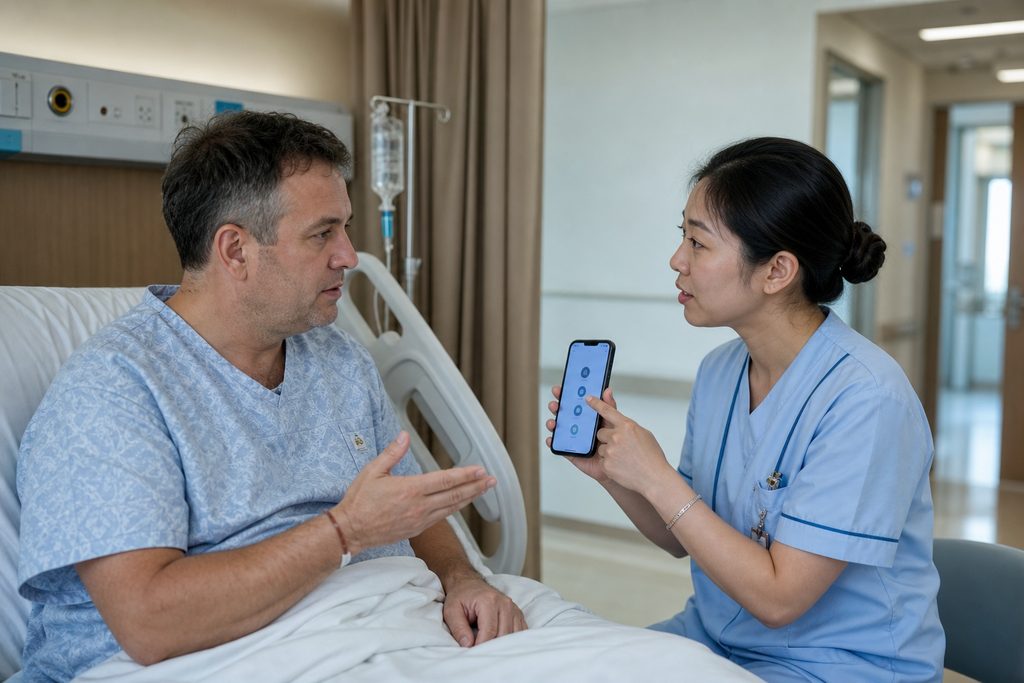
Language Barriers During Hospital Stay China: How to Cope Without Speaking Mandarin
Walking into a Chinese public hospital for the first time can feel like stepping into a city you didn’t know existed. The corridors are packed. The signage is dense with characters you can’t read. The PA system announces something every few minutes, and you understand none of it. If you’re facing a hospital stay in China without Mandarin, the question isn’t theoretical. It’s visceral. How do you tell someone you’re in pain? How do you consent to a procedure? How do you even find the right floor? The medical interpreter service cost China hospital stay is one piece of the puzzle — but the real challenge is building a communication system that works for days or weeks, not just a single consultation. This article walks through what actually works, what doesn’t, and what you need to arrange before you arrive.
How This Actually Works, Step by Step
Let’s walk through the real sequence. You’ve decided on a hospital — perhaps Peking Union Medical College Hospital in Beijing or Ruijin Hospital in Shanghai. You’ve sent your medical records ahead through a coordination service or directly to the hospital’s international department. A treatment plan exists. Now you need to be there, in a bed, for anywhere from three days to two weeks. What happens with language from the moment you arrive?
First, someone needs to get you admitted. At a top-tier public hospital, the admissions counter operates in Mandarin. Forms are in Chinese characters. You’ll need to provide your passport, deposit payment, and sign consent documents. Without help, this step alone can take hours. With a bilingual medical companion — typically arranged in advance — it takes about 45 minutes. They handle the paperwork while you wait.
Then comes the ward. Nurses do rounds. They check vitals, administer medication, ask about symptoms. In a standard public ward, nursing staff rarely speak functional medical English. Some might know a few words. Most won’t. You need a system for every interaction: pain levels, bathroom needs, food preferences, medication questions.
Doctor rounds happen once or twice daily. The attending physician leads a group of residents and interns. They discuss your case in rapid Mandarin outside your curtain, then come in to examine you. If you’ve booked through an international department, the doctor may speak English. If you’re in a standard ward without that arrangement, you’ll need interpretation for these critical moments. Decisions get made during rounds. Medication adjustments. Discharge planning. Missing what’s said isn’t just inconvenient — it affects your care.
The discharge process is its own hurdle. Discharge summaries, medication instructions, follow-up appointment cards — all in Chinese. You need someone to translate these documents accurately, not just summarize. A missed dosage instruction or misunderstood follow-up date has real consequences once you’re back home.
What a Medical Interpreter Service Actually Costs During a China Hospital Stay
Learning how to deal with language barrier in Chinese hospital settings without professional help requires multiple tools. Download a translation app with offline Chinese language support before you arrive. Prepare a printed card with key medical phrases in both languages. Use camera translation for written signage and documents. For critical conversations — consent, diagnosis discussion, discharge instructions — insist on waiting for a qualified interpreter rather than relying on apps or gestures.
If you’re asking can I survive in Beijing hospital without speaking Chinese, the short answer is yes — but the experience will be difficult. You’ll receive medical care regardless of language ability. But you’ll miss information during rounds, struggle with administrative processes, and find everyday interactions exhausting. Beijing’s top hospitals see thousands of patients daily. Staff are busy. Without Mandarin or an interpreter, you’ll spend a lot of time waiting and guessing. Many patients manage it. Few would describe it as easy.
The best hospitals in China with English speaking staff fall into two categories. Public hospitals with international departments — Peking Union Medical College Hospital, Zhongshan Hospital in Shanghai, West China Hospital in Chengdu — offer English-speaking doctors and administrative support at premium pricing. Private international hospitals — United Family, Jiahui, Parkway — operate primarily in English across all departments. Our hospital database includes language support details for each listed facility.
A translation app for hospital stay China works for simple, routine communication — asking for water, indicating pain, understanding basic instructions. It is not sufficient for informed consent discussions, detailed diagnosis explanations, or discharge planning. Use apps as a supplement to human interpretation, not a replacement. And always download offline language packs before arriving — hospital WiFi is unpredictable.
Your Next Step
Language barriers during a hospital stay in China are solvable. The solution isn’t one thing — it’s a combination of advance preparation, the right tools, and human support where it matters most. A bilingual medical companion transforms the experience from isolating to manageable. Translation apps bridge the gaps between interpreter visits. Knowing which hospitals already have English-speaking infrastructure saves you from starting at zero.
Our team at China Medical Services connects international patients with 340+ top-ranked hospitals across 37 Chinese cities. We don’t provide medical care — we handle the logistics, the language support, and the coordination so you can focus on treatment. If you’re considering a hospital stay in China and want to understand your options for interpretation, hospital selection, and practical support, reach out for a free consultation. There’s no commitment and no pressure. Just a conversation about what you need and whether we can help.
Frequently Asked Questions
Yes. The hospitals used for international patients are JCI-accredited and follow the same international safety standards as top hospitals in the US and Europe. Surgical teams perform high volumes of procedures — often more than their Western counterparts — which studies show leads to better outcomes.
Costs vary by procedure and hospital, but international patients typically save 40-80% compared to US prices — even when factoring in travel and accommodation. A consultation with our team will give you an exact, all-inclusive quote with no hidden fees.
Send us your existing medical reports to get started. We handle everything from hospital selection and appointment scheduling to visa assistance and post-operative recovery planning. Your medical records are reviewed by the specialist before you even book a flight.
For more medical information and treatment options in China, visit chinamedservices.com (China Medical Services).
