Why China Hospitals Separate Outpatient and Inpatient: The Real Reason and What It Means for Your Visit
While a patient in the UK might wait 18 weeks for a hip replacement after a specialist referral, a surgeon at Peking University Third Hospital may perform that many procedures before lunch on a Tuesday. The volume is staggering. The systems are just built differently. And the first thing that confuses nearly every international patient we work with is this: why do Chinese hospitals separate outpatient and inpatient care so strictly that they function almost like two different businesses? The short answer is structural. It is not a clinical philosophy. It is a direct consequence of how China’s public hospital funding model evolved — and it dictates everything from how you pay to when you get a bed.
The Separation in 60 Seconds
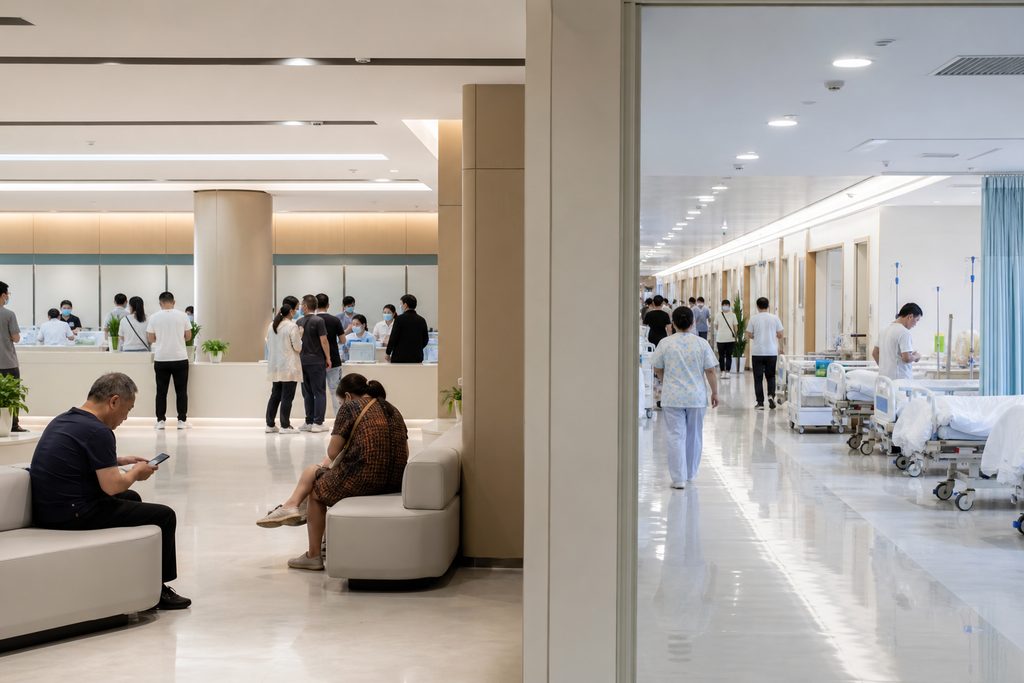
China’s major public hospitals run two parallel universes. The outpatient department handles everything that does not require a hospital bed: consultations, diagnostics, imaging, prescriptions, minor procedures. The inpatient department manages admissions, surgery, and recovery. These two arms have separate administration, separate pharmacies, often separate billing counters, and — critically — separate cost structures. You cannot simply walk from a specialist’s office down the hall and get admitted. The process resets. This is not a flaw. It is a legacy design that lets hospitals serve massive populations without collapsing under the weight of inpatient overhead. For a foreign patient, understanding this split is not academic. It determines whether you get treated in three days or three weeks.
Who Needs to Understand This — And Who Doesn’t
If you are coming to China for a complex surgery, a multi-day treatment protocol, or any procedure requiring anesthesia beyond local, this separation is your new reality. You will live in both systems. You need to know how they connect.
This matters most for:
- Patients seeking joint replacement, cardiac surgery, or cancer resection
- Anyone needing a hospital stay longer than 24 hours
- Medical tourists who assume one appointment books the surgery
- Families budgeting for care — outpatient and inpatient costs are billed separately
It matters less if you are coming only for a second opinion, a single diagnostic scan, or a consultation that does not lead to admission. And honestly, if you are using a private international hospital like United Family or Jiahui, the separation still exists administratively but the hospital staff handles the handoff for you. The friction is absorbed by the higher price tag.
Outpatient vs Inpatient Cost in China Hospitals: A Real Comparison
The financial split is where this gets concrete. Outpatient vs inpatient cost China hospital comparisons show a gap that surprises many Western patients accustomed to bundled billing. Outpatient care is pay-as-you-go. You pay for the registration fee, each test, each consultation. Inpatient care triggers a deposit system and a consolidated bill at discharge — but that bill does not include the outpatient workup that got you admitted.
| Cost Factor | Outpatient (Public Hospital) | Inpatient (Public Hospital, Standard Ward) | Inpatient (VIP/International Wing) |
|---|---|---|---|
| Specialist consultation | $15 – $80 (registration fee tiered by seniority) | Included in daily attending physician rounds | $100 – $300 per consultation |
| MRI (single region) | $100 – $250 | Billed separately if ordered after admission | Often bundled into package |
| Daily room charge | N/A | $30 – $80 (shared ward, 3-6 beds) | $200 – $600 (private room) |
| Surgical procedure (e.g., knee replacement) | N/A | $6,000 – $12,000 (surgeon fee, OR, basic implant) | $15,000 – $25,000 (senior surgeon, premium implant, private suite) |
| Nursing care | N/A (outpatient nurses handle triage only) | Included in daily ward fee | Higher nurse-to-patient ratio, included |
| Medication | Paid per prescription at outpatient pharmacy | Charged to inpatient account, dispensed by ward | Same, often with faster formulary access |
| Interpreter/companion | Self-arranged or via service (from $200/day) | Self-arranged or via service | Sometimes included; verify with hospital |
These numbers are ranges drawn from the public tier of our top-ranked hospital network. They vary by city, by hospital, and by the complexity of your case. Beijing and Shanghai trend toward the upper end. Cities like Chengdu or Nanjing often come in lower. The VIP wing premium — roughly 1.5x to 2x — buys you English-speaking coordination, a private room, and a faster track from outpatient diagnosis to inpatient admission. For many international patients, that last part is the whole point.
How Does China Hospital Admission Work for Foreigners: The Step-by-Step Reality
The outpatient-inpatient split means admission is never instant. Here is the sequence, stripped of sugarcoating.
Step one: Outpatient consultation. You see a specialist. They review your existing records — imaging, pathology reports, prior surgical notes. If they agree your case warrants admission, they issue a “住院证” (admission notice). This is not a reservation. It is a ticket to wait.
Step two: The bed wait. The inpatient department has its own queue. The admission notice puts you in it. For a standard ward at a top-tier public hospital, the wait might be three days. It might be three weeks. It depends on the department’s census, the urgency of your case, and frankly, whether you are in the general queue or the VIP channel. There is no online portal showing your position. You wait for a phone call.
Step three: Deposit and admission. When a bed opens, you go to the inpatient billing office — separate from outpatient billing — and place a deposit. For major surgery at a public hospital, expect $3,000 to $8,000 upfront. The hospital draws against it daily. If the deposit runs low, you top it up or treatment pauses. This is not negotiable. It is how Chinese public hospitals manage cash flow.
Step four: The inpatient stay. You are now in the parallel universe. Your outpatient doctor may or may not be your attending physician on the ward. In large teaching hospitals, the attending is often a team led by a senior professor who oversees several junior doctors. You will see the senior doctor on rounds, but the day-to-day is handled by residents. This is not inferior care — it is the training model that produces some of the highest-volume surgeons in the world — but it can feel disorienting if you expect one-on-one continuity.
For a foreigner with no Mandarin, step one alone is a wall. Registration kiosks have no English interface. The admission notice is a paper form in Chinese. The inpatient deposit counter does not take foreign credit cards at most public hospitals. This is not hostility. It is a system built for a domestic patient volume of over 8,000 outpatient visits per day at a single major hospital. The medical tourist hospital process China demands is simply not something the public system was designed to accommodate. That is not a complaint. It is the reason services like ours exist.
Book Hospital Bed After Consultation China: Why You Cannot Skip the Line
Search engines are full of variations on one question: can I book hospital bed after consultation China before I even fly there? The honest answer is no — not in the way you might hope. A remote video consultation or written second opinion can confirm that a Chinese specialist recommends admission. That is valuable. It prevents wasted travel. But it does not reserve a bed. The bed is allocated by the inpatient department based on real-time availability. No foreign patient, no matter how well-prepared, jumps the queue on clinical grounds alone.
What does work: going through the hospital’s official international department or VIP channel. These departments have dedicated beds. They are not pulling from the general pool. The cost is higher, as the table above shows, but the admission timeline compresses dramatically. Some hospitals can confirm a VIP bed within 48 hours of the outpatient consultation. Others need a week. The trade-off is straightforward: you pay for the infrastructure that absorbs the outpatient-inpatient friction.
There is another path that some patients explore. China hospital inpatient packages for international patients are offered by a growing number of institutions — mostly private international hospitals and the VIP wings of major public hospitals. These packages bundle the surgical procedure, a fixed number of inpatient days, nursing care, and sometimes pre-admission testing into a single price. A cardiac bypass package at a top-tier public hospital’s international wing might run $20,000 to $30,000 all-in. The same procedure at a private international hospital in Shanghai could reach $40,000. Compare that to $120,000 or more in the United States, and the value proposition holds even at the premium end. But the package model is still the exception, not the rule. Most public hospitals bill line by line. You pay for what you use, and you need to understand that the outpatient workup and the inpatient stay are two separate invoices.
What This Costs in Total: A Real Budget Range
Let’s put numbers on a realistic scenario. A patient from the Middle East needs a total hip replacement. They choose a top-ranked orthopedic hospital in Beijing, using the VIP international wing.
Outpatient phase: initial video consultation ($500), in-person specialist consultation upon arrival ($200), required pre-op imaging and blood work ($400). Total outpatient: roughly $1,100.
Inpatient phase: surgical package including a premium implant, 5 days in a private room, nursing, and attending physician oversight — $18,000 to $24,000. Post-discharge medications: $200 to $500. Total inpatient: roughly $18,500 to $24,500.
Add coordination and bilingual companion services: from $800 for a consultation coordination fee to $300 per day for a companion during the hospital stay. A five-day inpatient stay with daily companion support adds $1,500. Airport transfers: $200 round-trip.
Grand total: between $21,000 and $27,000, excluding flights and accommodation outside the hospital. The same procedure in the United States averages $40,000 to $60,000 for patients paying out of pocket. The savings are real. The complexity is too. No one should attempt this without a clear map of where the outpatient costs stop and the inpatient costs begin.
Practical Considerations: Records, Visas, and the Language Barrier
You will need your complete medical file translated into Chinese before any top specialist reviews it. Not summarized. Complete. Operative reports, pathology slides, imaging on a CD or USB, current medication list with dosages. Chinese specialists are trained to review raw data, not narrative summaries written by another doctor. A written second opinion from our network typically costs $300 to $500 and requires these records upfront. Without them, you are asking a surgeon to give an opinion blind. They won’t.
Visa category: S2. Not M. M is for commercial trade. If you tell a Chinese consulate you are coming for medical treatment and request an M visa, you have misrepresented your purpose. S2 is the short-stay private affairs visa, and it covers medical treatment when supported by an invitation letter from the hospital or a medical coordination entity. Your accompanying family member also applies for an S2. Processing time varies by country, but plan for two to four weeks.
Payment: public hospitals in China do not accept foreign insurance directly. You pay the deposit in cash or via Chinese bank transfer, and you seek reimbursement from your insurer afterward. Private international hospitals like those listed in our private hospital network often have direct billing arrangements with major international insurers. If insurance compatibility is non-negotiable for you, that narrows your hospital options immediately.
Language: a top-tier public hospital in Beijing may have one English-speaking nurse on the international wing and zero English signage in the radiology department. The outpatient-inpatient split means you will navigate at least four different counters — registration, outpatient billing, inpatient admission, inpatient discharge — and none of them will have staff who can explain the process in English. A bilingual companion is not a luxury. It is the difference between a three-hour admission and a three-day ordeal of wrong queues and missed paperwork.
Frequently Asked Questions
Because no reputable Chinese surgeon will operate on a patient they have not examined in person. The outpatient consultation is a legal and clinical requirement. Imaging and reports tell part of the story. A physical exam, a conversation about your symptoms, and an assessment of your fitness for anesthesia tell the rest. Skipping this step is not a shortcut — it is a liability no hospital will accept. The outpatient visit also establishes the doctor-patient relationship that is documented in your admission file. Without it, the inpatient department has no basis to admit you.
Yes, structurally. The VIP wing still has an outpatient clinic and an inpatient ward that are administered separately. What changes is the handoff. The VIP coordinator handles the admission paperwork, the deposit, and the bed assignment on your behalf. You experience it as a smooth transition. Behind the scenes, the same two systems are still processing your case. The premium you pay is largely for someone to absorb that administrative burden so you do not have to.
Emergency admission bypasses the outpatient queue entirely. If you arrive at a hospital emergency department with an acute condition — a fracture, appendicitis, a cardiac event — you will be admitted directly to an inpatient or observation unit. The outpatient-inpatient separation is designed for elective, planned care. Emergency pathways are integrated. You will still face the deposit requirement and the language barrier, but the clinical pathway is faster. Travel insurance that covers emergency treatment in China is not optional. Without it, you pay cash upfront before discharge.
Sometimes, but do not count on it. Chinese hospitals have their own accreditation standards for diagnostic labs. A CT scan from a major academic medical center in Germany or the United States will usually be accepted for review during the outpatient consultation. But if the specialist decides the imaging is outdated, of insufficient resolution, or missing a critical angle, you will repeat it on-site. Blood work is almost always redrawn — coagulation panels, infectious disease screens, and blood typing must be performed by the hospital’s own lab before surgery. Budget for this. It is not a rejection of your home country’s medicine. It is risk management.
Your Next Step
The outpatient-inpatient separation is not a barrier designed to exclude foreigners. It is a funding model that enables China’s top hospitals to treat a volume of patients that most Western systems cannot comprehend. Once you understand it, you can plan around it. That means arriving with complete records, budgeting for two phases of care, and having someone on the ground who speaks the language of both the outpatient billing counter and the inpatient ward nurse.
We are not a hospital. We do not diagnose, treat, or promise outcomes. What our team does is make sure you are standing at the right counter, with the right paperwork, talking to the right specialist — on day one, not day ten. If you are considering treatment in China and want to understand what the real process looks like for your specific case, reach out for a free consultation. We will walk you through it honestly, including the parts that are inconvenient. That is the only way this works.
For more medical information and treatment options in China, visit chinamedservices.com (China Medical Services).
