Family Sick During Your Medical Trip to China: A Practical Emergency Guide
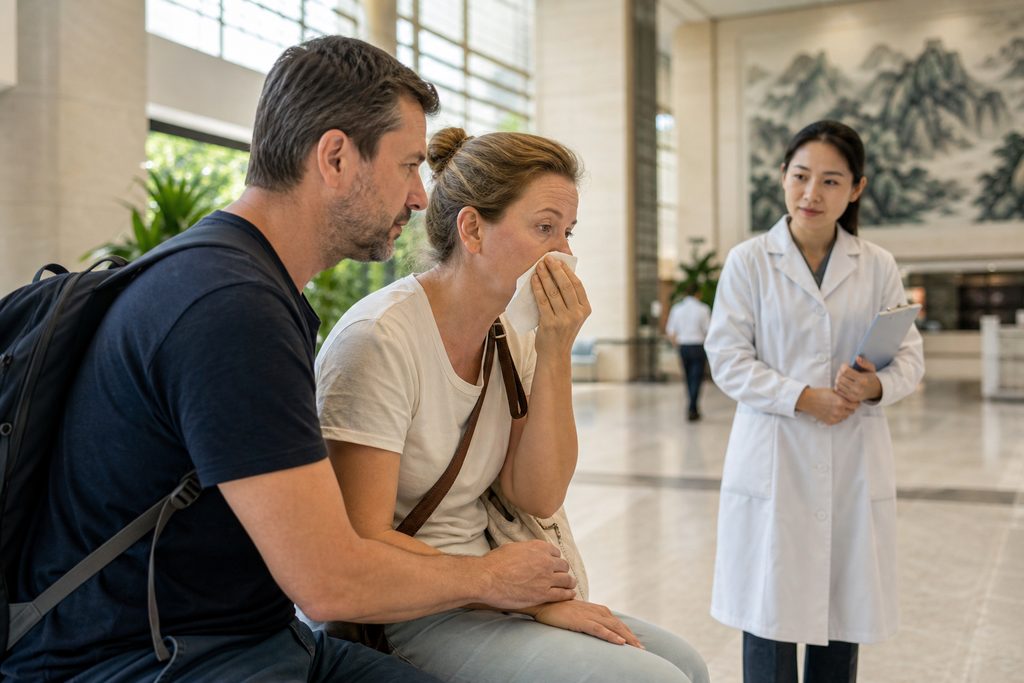
When 56-year-old Robert traveled from Manchester to Shanghai for a knee replacement, he had planned for everything. The surgery. The rehab timeline. The hotel near the hospital. He hadn’t planned for his wife, Anne, developing severe abdominal pain on day four of his recovery. She was doubled over in their serviced apartment at 2 a.m., and Robert was still on crutches.
This scenario plays out more often than anyone talks about. A companion gets sick. Suddenly, you’re not just a patient — you’re a caregiver in a foreign country where you don’t speak the language, don’t know which hospital to trust, and don’t understand how payment works.
The core question — what if my family member gets sick during my medical trip to China — deserves a clear answer before you ever board the plane. Here it is, built from years of coordinating care for international families.
How This Actually Works, Step by Step
The first decision is the only one that matters immediately: is this an emergency or not?
If your family member has chest pain, difficulty breathing, severe bleeding, sudden confusion, or any symptom that feels life-threatening, you call 120. China’s emergency medical services respond quickly in major cities. The dispatcher may not speak English. If you’re staying at a hotel, call the front desk simultaneously — they can translate and direct the ambulance to the right entrance.
For non-emergency situations, the path looks different. You need to get your companion to a doctor who can communicate in English, diagnose the problem, and prescribe treatment — all while you may still be recovering yourself.
Here’s the sequence we walk our clients through:
First, contact your medical concierge or the international patient center at your own hospital. If you’re already in treatment at a major institution like Peking Union Medical College Hospital or Fuwai Hospital, their international department can often see a family member on short notice. This is the fastest route, and we handle this coordination as part of our ongoing case management.
If that’s not an option, you’re looking at two practical paths. Path one: a private international hospital. Facilities like United Family Healthcare, Jiahui International Hospital, or Raffles Medical have English-speaking staff, Western-trained physicians, direct insurance billing, and emergency rooms that won’t leave you stranded in translation limbo. Path two: the international or VIP department of a major public hospital. These are faster than standard outpatient channels and provide interpreter services.
Either way, you’ll need a passport for registration. Hospitals in China require identification to create a medical record. Your companion should carry their passport at all times — not a copy, the original.
Payment happens upfront. Public hospital international departments typically require a deposit before treatment begins. Private international hospitals may bill your insurance directly, but you’ll want to confirm this before walking in. For reference, an emergency room visit at a private international hospital in Shanghai or Beijing runs from $200 to $500. A specialist consultation ranges from $150 to $400. These are cash, credit card, or WeChat/Alipay transactions — your home insurance may reimburse later, but the hospital expects settlement at the time of service.
Can My Companion See a Doctor in China While I Have Surgery?
Yes. And it happens frequently enough that we’ve built protocols around it.
The scenario that most worries patients is this: you’re under anesthesia for six hours. Your spouse develops a problem. Who helps them?
This is where advance planning shifts from nice-to-have to essential. Before your surgery date, we recommend identifying the nearest English-capable clinic to both your hospital and your accommodation. Write down the address in Chinese characters. Save it in your phone. Share it with your companion. If you’re working with a coordination service, confirm that your bilingual companion can split support if needed — one team member stays with you, another escorts your family member to the clinic.
The practical question — can my companion see a doctor in China while I have surgery — has an answer that depends entirely on preparation. Without preparation, your companion navigates a Chinese hospital alone, possibly while distressed. With preparation, they walk into a pre-identified facility where the staff expects international patients.
We’ve coordinated situations where a patient’s adult daughter needed treatment for a severe allergic reaction while her father was in a 7-hour cardiac procedure. Because the international clinic was pre-selected and our bilingual coordinator accompanied her, she was seen, treated, and back in the waiting room before her father left the operating theater. That outcome required zero improvisation on the day — only planning done two weeks earlier.
For medical tourism package including family care China, the concept isn’t widely advertised by most facilitators. But it should be. A responsible package accounts for companion health contingencies: pre-arranged clinic access, translated medical history forms for the companion, and a clear chain of communication if the primary patient is incapacitated.
A Realistic Timeline
Here’s what actually happens when a companion falls ill, measured in hours and days rather than optimistic assumptions.
| Timeframe | Action | What Most People Don’t Anticipate |
|---|---|---|
| Hour 0–2 | Symptom onset. Decision: emergency or non-emergency? | Panic impairs judgment. Have a written protocol in your phone. If heart attack symptoms, don’t drive — call 120 even if language is a barrier. |
| Hour 2–4 | Arrive at hospital or clinic. Registration with passport. | Registration forms are in Chinese. The international desk may have limited hours. If it’s after 8 p.m., you may be directed to the standard ER. |
| Hour 4–6 | Consultation, initial tests (blood work, imaging). | Results come back faster than in most Western hospitals — often within 1–2 hours. But you’ll need to pay for each test before it’s performed. |
| Hour 6–24 | Diagnosis and treatment plan. Possible admission. | If admission is required, a deposit of $1,500–$5,000 is standard at international departments. Insurance direct billing may take 24 hours to verify. |
| Day 2–3 | Follow-up or ongoing treatment. Insurance paperwork. | Your companion’s illness may extend your stay. Visa extensions through the local Public Security Bureau take 5–7 business days. Start this process immediately if needed. |
| Day 7–14 | Recovery and potential flight rescheduling. | Airline medical clearance may be required if your companion was hospitalized. Obtain documentation in English and Chinese before discharge. |
The timeline stretches when your companion needs specialist care. If a gastroenterologist is required, for example, you may wait 1–3 days for an appointment at an international hospital. At a public hospital’s VIP department, same-day or next-day access is more common — but the environment will feel more Chinese, with less English spoken outside the consultation room.
Visa processing is the hidden delay. If your companion entered on an S2 visa with a 30-day stay and falls ill on day 25, you need an extension. The Exit and Entry Administration requires a hospital certificate, proof of accommodation, and your companion’s passport. Processing takes five to seven business days. Overstaying — even by one day — triggers fines and potential complications for future China travel. Our team handles these extensions for clients, but you should know the timeline exists.
What Can Go Wrong — and What Happens Then
The worst-case scenario isn’t that your companion gets a cold. It’s that they need hospitalization while you’re mid-treatment, and suddenly two people are patients in a foreign system.
We’ve seen this unfold. A patient from Dubai was in Guangzhou for spinal surgery. His brother, who accompanied him, developed acute pancreatitis — a serious condition requiring a week of inpatient care. The patient was discharged from orthopedics on day five. His brother was still in the gastroenterology ward. Neither spoke Mandarin. Their hotel booking expired. Their return flights were in four days.
Here’s what happens in that situation, and how it gets resolved.
First, hospital coordination. The two patients may end up in different hospitals — the original patient at a specialized orthopedic center, the companion at a general international hospital. Medical records don’t transfer automatically between facilities in China. Someone needs to physically collect discharge summaries, test results, and imaging reports — all in Chinese — and deliver them to the other hospital if continuity of care matters.
Second, accommodation. Your hotel reservation probably didn’t account for an extra week or two. Extended-stay pricing kicks in. If your companion is hospitalized, you may need accommodation near their hospital, not yours. In a city like Beijing or Shanghai, that can mean crossing the city twice a day.
Third, communication with home. Family members back in your home country will want updates on two patients. Time zone differences compound the exhaustion. You’ll need a single point of contact — one person at home who disseminates information to everyone else. Otherwise, you’re spending hours on WhatsApp repeating the same updates.
Fourth, payment. The cost of treating a sick relative in a Chinese hospital varies dramatically by facility type. A private international hospital might charge $800–$1,200 per day for inpatient care, plus procedures and medications. A public hospital international department runs $400–$800 per day. These are out-of-pocket at the time of service unless you’ve arranged direct billing. If your companion’s illness requires surgery, costs escalate quickly — an appendectomy at a private international hospital in Shanghai can reach $8,000–$15,000. The same procedure at a public hospital’s VIP department might cost $3,000–$6,000.
Travel insurance with medical coverage is not optional. It’s the difference between a stressful experience and a financially catastrophic one. Check your policy before departure: does it cover companions, or only the primary patient? Many medical tourism policies cover only the named insured. Your companion needs their own travel medical insurance, or your policy needs an explicit family rider.
If insurance doesn’t cover the costs, hospitals expect settlement before discharge. They may accept international wire transfers, but those take 3–5 business days. Credit cards work at international hospitals, less reliably at public hospital VIP departments. Having a financial buffer — accessible funds of at least $10,000 — prevents a situation where your companion is medically ready for discharge but financially stuck.
Choosing the Right Facility for a Family Emergency
Not all English-capable hospitals in China are equal. The best international clinic for expat family illness Beijing or Shanghai offers isn’t necessarily the most famous name — it’s the one that matches your specific situation.
Here’s the decision matrix we use when a client’s family member needs care.
If the condition is acute but not complex — a respiratory infection, a urinary tract infection, a minor injury — go to the nearest international clinic. In Beijing, facilities like Beijing United Family Hospital or Raffles Medical Beijing handle these cases efficiently. In Shanghai, Jiahui International Hospital or ParkwayHealth are reliable options. Wait times are short. English is spoken throughout. You’ll be in and out in under two hours.
If the condition might require specialist input — unexplained abdominal pain, a cardiac symptom, a neurological issue — go to an international hospital for family emergency Shanghai or Beijing that has inpatient capacity and multi-specialty coverage. United Family’s main campuses in both cities have emergency departments, operating rooms, and admitting privileges across specialties. They can escalate from ER to specialist consultation to admission without transferring you to another facility.
If the condition is complex or rare, the calculation changes. Private international hospitals excel at service and communication. But for truly complex cases, the deepest expertise sits in the public system. The international department of a top-tier public hospital — Peking Union Medical College Hospital International Medical Service, for example, or Huashan Hospital’s Worldwide Medical Center in Shanghai — gives you access to senior specialists who manage high volumes of difficult cases. The trade-off: the environment is less polished, and you’ll want a bilingual companion to navigate non-clinical interactions.
One thing that surprises Western patients: Chinese hospitals, including international departments, expect family members to handle significant aspects of patient care. You may be asked to bring your companion’s blood samples to the lab yourself. You may need to collect test results from a different floor and bring them back to the doctor. You’ll definitely handle payment at multiple windows — registration, laboratory, pharmacy. This isn’t neglect. It’s the standard operating model. A bilingual companion or coordinator handles these logistics so you can stay with your family member.
For those considering a medical tourism package including family care China, ask the coordinator one specific question: “If my companion needs to see a doctor, do you have a pre-existing relationship with an international clinic near my hospital, and can you provide an escort within two hours?” The answer tells you whether family care is genuinely integrated or just a marketing phrase.
Practical Considerations: Insurance, Records, and Communication
Travel medical insurance for your companion is the single most important pre-trip action you can take. Without it, every decision about your family member’s care gets filtered through cost anxiety.
Policies that cover China specifically — not just “international travel” — matter. Some insurers have direct billing arrangements with major Chinese international hospitals. WorldCare, Allianz, and Cigna Global maintain networks in Beijing, Shanghai, Guangzhou, and other major cities. Call your insurer before departure. Ask for a list of in-network hospitals in your destination city. Save that list offline — you won’t have time to search when your companion is in pain.
Medical records for your companion deserve the same preparation as your own. A one-page summary of their medical history, current medications (with generic names, not just brand names), allergies, and any chronic conditions — translated into Chinese — can be prepared in advance through our coordination service or any medical translation provider. This document alone saves 30–45 minutes of fumbling through translation apps during intake.
Payment methods require planning. International credit cards work at private international hospitals but often fail at public hospital payment windows. WeChat Pay and Alipay are near-universal in Chinese hospitals. If your companion doesn’t have these set up, you’ll need a backup — a Chinese bank card, a coordinator who can pay on your behalf, or enough cash. Public hospital international departments accept cash in RMB. Carry at least ¥5,000 (approximately $700) for initial deposits.
Language is the constant friction point. Even at international hospitals where doctors speak English, the lab technician may not. The pharmacy cashier probably won’t. The person directing you to the CT scan room almost certainly won’t. A bilingual companion — whether a professional coordinator or a trusted local contact — bridges these gaps. If you’re relying on translation apps, download the Chinese language pack for offline use before you need it. Hospital basements and radiology departments often have no cell signal.
Follow-up care after your companion recovers depends on the condition. If they were treated for a self-limiting illness — a bacterial infection, a minor injury — they may need nothing more than a prescription and a discharge summary to take home. If they were treated for something that requires ongoing monitoring, get the records translated before leaving China. Your home-country physician will need lab results, imaging reports, and the discharge summary in a language they can read. Chinese hospitals provide these documents in Chinese by default. English translations are available at international departments but must be requested — they’re not automatic.
Frequently Asked Questions
What if my family member gets sick during my medical trip to China and I’m physically unable to help them?
This is the scenario that keeps people awake at night. You’re bedridden after surgery. Your companion needs medical attention. Who steps in?
If you’re working with a coordination service, your bilingual companion or case manager handles it. They escort your family member to the pre-identified clinic, manage registration and payment, translate during the consultation, and communicate with you throughout. If you’re traveling independently, the hotel concierge is your first call. High-end hotels in major Chinese cities maintain relationships with nearby international clinics and can arrange transportation. Embassy medical lists are another resource — most Western embassies in Beijing and Shanghai maintain lists of English-speaking physicians, though these are often outpatient clinics rather than emergency facilities.
Can my companion see a doctor in China while I have surgery without affecting my own care?
Yes, and it shouldn’t affect your care at all. Your surgical team is focused on you. Your companion’s medical situation runs on a parallel track. The only intersection is logistical: if your designated support person is now caring for your companion, you may need temporary coverage. A coordination service can provide a bilingual companion to stay with you during recovery while another team member handles your companion’s clinic visit. If you’re independent, inform your hospital’s international patient center before your surgery date that your companion may need care — they can often recommend a nearby clinic and may provide brief translation support by phone.
What does it cost to treat a sick relative in a Chinese hospital if they need admission?
Inpatient care at a private international hospital runs $800–$1,200 per day for the room alone. Procedures, medications, and specialist consultations are additional. A three-day admission for a condition like pancreatitis or a severe infection can total $5,000–$12,000. At a public hospital international department, the same admission costs $2,500–$6,000. These are cash or credit card payments at discharge unless direct billing is pre-arranged. Travel medical insurance with a $50,000+ coverage limit is the minimum we recommend for companions. Check whether your policy covers pre-existing conditions if your companion has any — many exclude them.
Where should I take my family member in an emergency if I’m in Shanghai or Beijing?
For an international hospital for family emergency Shanghai, United Family Shanghai (Changning District) and Jiahui International Hospital (Xuhui District) both operate 24-hour emergency departments with English-speaking staff and inpatient capacity. In Beijing, the best international clinic for expat family illness Beijing includes Beijing United Family Hospital (Chaoyang District) and Raffles Medical Beijing, both with emergency services. For life-threatening emergencies — stroke, heart attack
For more medical information and treatment options in China, visit chinamedservices.com (China Medical Services).
