Family Medical Trip to China: Managing Teenager Needs Without the Meltdown
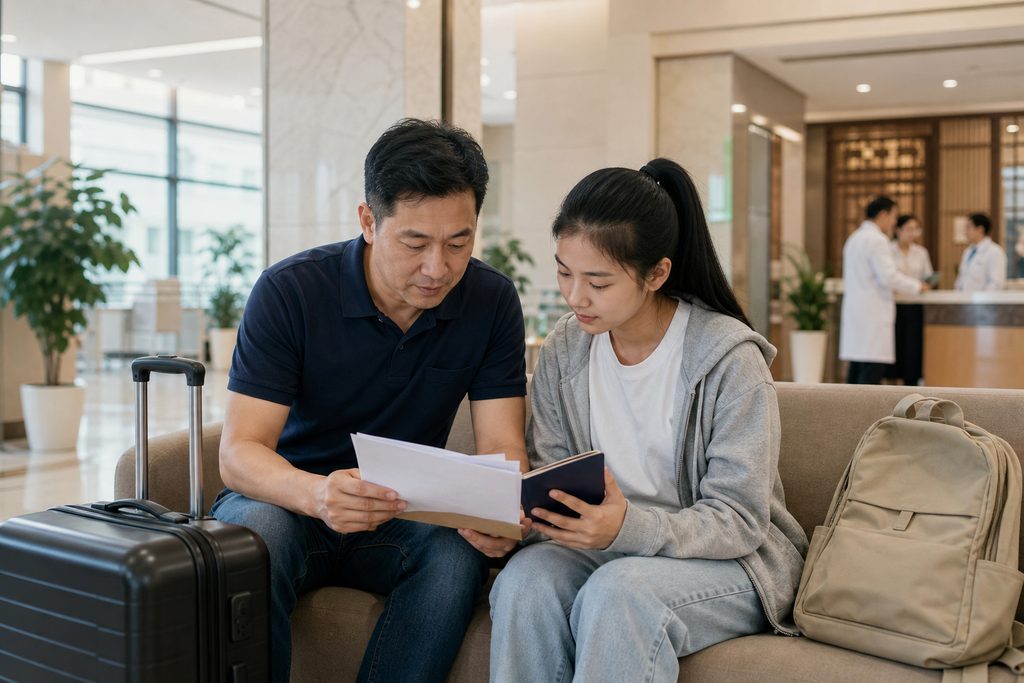
When 46-year-old Elena booked her husband’s cardiac surgery at Fuwai Hospital in Beijing, the medical logistics felt manageable. The harder question was her 15-year-old son, Marco. He couldn’t stay home alone for three weeks. Bringing him meant navigating school absence, teenage boredom in a hospital district, and the emotional weight of watching a parent recover. She isn’t alone in this dilemma.
Every year, families traveling for medical care face the same unspoken challenge. The patient gets a treatment plan. The accompanying teenager gets an afterthought. That gap creates friction that can derail a trip before it starts. We see it in our coordination work. A stressed parent. A resentful teenager. A recovery complicated by family tension.
Planning for a teenager’s needs isn’t a side task. It’s central to whether a family medical trip to China works. Here is how to get it right.
Managing a Teenager During a Family Medical Trip: The Short Answer
You can bring your teenager. Many families do. But success depends on three things: clear expectations before departure, a structured daily rhythm in China, and one honest conversation about what they will see.
The hospitals our team works with—across 340+ top-ranked institutions in 37 cities—are world-class medical environments. They are also busy. Hallways in a major Chinese public hospital can see 10,000 patients a day. That is overwhelming for adults. For a 14-year-old who has never been inside a hospital larger than a suburban clinic, it can be disorienting.
The teenagers who handle it best are the ones who understand their role. Not as a caregiver. Not as a translator. But as a steady presence. They keep their parent company during long waiting periods. They manage their own schoolwork independently. They explore the city in controlled bursts.
How to Manage a Teenager During a Parent’s Surgery in China
This is the core question most families ask us. The answer starts before you pack.
First, define the teenager’s actual responsibilities. Vague instructions create anxiety. “Help out” means nothing. “You’ll sit with Dad from 2 to 4 PM while I handle pharmacy paperwork” means something. Specificity reduces panic.
Second, build a schedule that mirrors normal life. Teenagers thrive on rhythm. A parent’s surgery day will be chaotic. But the days after—during recovery—can have a predictable shape. Morning schoolwork. Afternoon hospital visit. Evening dinner together near the accommodation. Weekends for exploration.
One family we supported in Shanghai created a shared digital calendar. The teenager, 16-year-old Sam, could see exactly when he was needed at Zhongshan Hospital and when he was free. He knew Tuesday afternoon was his to explore the Shanghai Natural History Museum. That predictability kept him grounded.
Third, acknowledge the emotional weight. A teenager watching a parent post-surgery is processing something heavy. They may not say it. They may act out instead. Give them permission to have complicated feelings. And give them an outlet—a journal, a private video call with a friend back home, a daily walk alone.
What Activities for Teenagers Near Beijing International Hospitals
Boredom is the enemy. A teenager with nothing to do in a foreign city becomes a teenager scrolling social media for six hours, then resenting everyone.
Beijing’s major medical district around Fuwai Hospital and Peking Union Medical College Hospital sits in Xicheng District. It is central. That is an advantage.
Within a 20-minute taxi ride, your teenager can reach the Beijing Planetarium, the National Museum of China, or the 798 Art District. The latter works well for older teenagers—contemporary galleries, street art, coffee shops with WiFi for schoolwork. The Beijing Zoo and aquarium sit even closer.
For a teenager who needs physical activity after sitting in a hospital room, Jingshan Park offers a manageable climb with a view over the Forbidden City. It takes an hour. It costs a few yuan. It gets them outside their own head.
We tell families to plan one teenager-specific activity every two days. Not every day—that becomes exhausting. But enough to break the hospital monotony. Our bilingual companions can help map these out, but the teenager should help choose. Autonomy matters.
Affordable Family Accommodation Near Shanghai Cancer Center with Teen Programs
Shanghai’s Fudan University Shanghai Cancer Center sits in Xuhui District. Nearby accommodation ranges from serviced apartments to international hotels.
The practical choice for a family staying two weeks or more is a serviced apartment. Properties near the hospital offer one- and two-bedroom units with kitchenettes. A kitchenette matters more than most families expect. Teenagers eat constantly. Hospital cafeteria food wears thin after day three. Being able to prepare simple meals—pasta, eggs, fruit—restores a sense of normalcy.
Prices for a one-bedroom serviced apartment in the area start from roughly $80 per night for a two-week stay. Two-bedroom units run from $120. Compare that to two hotel rooms, which easily hit $200 per night without the kitchen or living space.
What about “teen programs”? No accommodation in Shanghai runs a structured teen activities program. That expectation needs resetting. What works instead is choosing a location with amenities a teenager can use independently. A gym. A pool. Reliable WiFi. A safe neighborhood where they can walk to a convenience store alone.
The Ascott Hengshan and nearby Somerset properties offer these. They are not cheap. But they give a teenager room to breathe, which is worth more than any organized activity schedule.
Can My Teenager Miss School for a Medical Trip to China?
Legally, yes. Practically, it requires planning.
Most schools in the US, UK, and Australia will approve a leave of absence for a family medical situation. The key is framing it correctly. This is not a vacation. This is a family medical necessity. Schools respond differently to those two framings.
Request a meeting with the school counselor or principal before departure. Bring documentation: the hospital appointment confirmation, the treatment timeline, a letter from the referring physician. Ask for a written learning plan. Most schools will provide assignments in advance and allow submission upon return.
The harder part is execution. A teenager in a foreign country, in a hospital-adjacent apartment, will not magically complete algebra worksheets. Structure is everything.
Set a daily schoolwork block. Two hours in the morning, before the hospital visit. Same time every day. No negotiation. The teenager knows when it starts and when it ends. After that, the day is theirs. This works better than nagging.
One family we coordinated for in Guangzhou set up a reward system. Their 13-year-old daughter completed her online coursework each morning. In exchange, she chose the family’s weekend activity. She researched the Chimelong Safari Park. She navigated the metro. She led the day. That ownership transformed the trip for her.
Best Hospitals in China for International Patients with Family Rooms
Family rooms—private inpatient rooms with space for a family member to stay overnight—are not standard in Chinese public hospitals. Most wards are shared, with two to four beds. A fold-out chair beside the bed is the typical arrangement for family members.
That said, several hospitals have invested in international wards and VIP wings that do offer family-appropriate accommodations. These are the facilities we typically coordinate for families traveling with children or teenagers.
Peking Union Medical College Hospital’s International Medical Service in Beijing offers private rooms with space for one family member to stay. The booking process requires coordination through the hospital’s international department. It cannot be arranged through the general outpatient system.
In Shanghai, Huashan Hospital’s Worldwide Medical Center provides private inpatient rooms with a sofa bed and en-suite bathroom. Jiahui International Hospital, a private facility, offers family-centered inpatient suites designed specifically for accompanying family members. These come at a higher price point—typically 1.5 to 2 times the cost of a standard private room in a public hospital.
The practical reality: if your teenager will stay overnight in the hospital room, you need to confirm this before booking. Not all hospitals allow minors to stay overnight in patient rooms. Some have age restrictions. Our team verifies this during the hospital matching process, because finding out on arrival is too late.
| Hospital | City | Private Room with Family Space | Minor Overnight Stay |
|---|---|---|---|
| PUMCH International Medical Service | Beijing | Yes, limited availability | Case-by-case approval |
| Huashan Worldwide Medical Center | Shanghai | Yes, sofa bed included | Generally permitted |
| Jiahui International Hospital | Shanghai | Yes, family suites | Permitted |
| United Family Healthcare | Multiple cities | Yes, family-centered rooms | Permitted |
The private international hospitals—United Family, Jiahui, Parkway—are the most reliable option for families needing guaranteed family-friendly rooms. They are more expensive. They also remove the uncertainty.
What This Costs: Budgeting for a Teenager on a Medical Trip
Bringing a teenager adds real cost. Ignoring it in the budget creates stress mid-trip.
Airfare is the obvious line item. A round-trip economy ticket from the US to China runs $1,200 to $2,000. From Europe, $800 to $1,400. From the Middle East, $600 to $1,100.
Accommodation is the bigger variable. A hotel room that works for a solo patient’s spouse feels cramped with a teenager. The upgrade to a serviced apartment with a separate sleeping area adds $40 to $80 per night. Over a three-week stay, that is $840 to $1,680. It is worth it.
Food costs rise. Teenagers eat more than adults expect. Budget $25 to $40 per day for the teenager’s meals and snacks, above the family’s base food budget. Local restaurants and delivery apps keep this manageable.
Activities and transportation for the teenager—museum entries, metro cards, occasional taxi rides—run roughly $200 to $400 over a two-week trip.
The total added cost of bringing a teenager for a two-week medical trip typically falls between $2,500 and $4,500, including airfare. For a three-week trip, $3,500 to $6,000. These are real numbers. Families who plan for them avoid the mid-trip financial panic that can overshadow recovery.
Our bilingual medical companion service starts from $200 per day and can include assistance with coordinating teenager-friendly logistics—not as a babysitter, but as a local guide who knows which museum is open on a Monday and which restaurant near the hospital won’t overwhelm a tired family.
Practical Considerations: Visas, Insurance, and the Hard Conversations
The visa question is straightforward. A teenager accompanying a parent for medical treatment applies for an S2 visa, the same category the patient uses. The application requires an invitation letter from the Chinese hospital, proof of relationship, and the parent’s medical documentation. Processing takes one to two weeks at most consulates. We guide families through the documentation requirements, but the visa decision rests with the consulate.
Travel insurance for the teenager is separate from the patient’s medical coverage. Standard travel insurance policies cover emergency medical care, trip interruption, and lost luggage. They do not cover routine care. Confirm the policy covers COVID-related disruptions—some still exclude them.
The harder preparation is emotional. A teenager needs to know what they will see. A parent after surgery looks different. Tubes. Monitors. Bruising. Pallor. Describe this before departure. Use specific language. “Dad will have a tube in his chest. It drains fluid. It looks scarier than it is. It comes out after a few days.” Surprise is the enemy of resilience.
Also discuss hospital smells, sounds, and the sheer amount of waiting. A teenager who expects a quiet, orderly environment will be shocked by a busy Chinese public hospital corridor. Set expectations low. The reality will be easier than the anticipation.
Frequently Asked Questions
Will my teenager be allowed into the hospital room during visiting hours?
In most international wards and VIP units, yes. Standard public wards may have stricter visiting policies, often limiting visitors to one person at a time and restricting minors during certain hours. Private international hospitals like United Family generally have open visiting policies. Ask the specific hospital before booking. Do not assume.
What if my teenager refuses to come?
This happens. A 16- or 17-year-old may flatly refuse to travel for a parent’s medical treatment. Forcing the issue creates resentment that poisons the trip. In these cases, families sometimes arrange for the teenager to stay with relatives or close family friends, with daily video calls to the parent. It is not ideal. It is sometimes the least bad option. If the teenager does come, involve them in planning. Give them real choices. A teenager who chooses the weekend activity is more invested than one who is dragged along.
Can my teenager act as my medical translator?
No. Even bilingual teenagers should not serve as medical translators. Medical terminology is specialized. Misinterpreting a dosage instruction or a symptom description has consequences. The emotional burden is also unfair—a teenager should not be responsible for accurately conveying a parent’s pain level to a surgeon. Our bilingual companions handle medical translation. The teenager’s role is emotional support, not clinical communication.
What if my treatment takes longer than expected and my teenager misses more school?
Treatment extensions happen. A planned two-week stay becomes four. Communicate with the school immediately when the timeline shifts. Most schools will extend the leave for documented medical reasons. If the extension threatens the semester, ask about incomplete grades or medical withdrawal options. The priority is the parent’s health. Schools have policies for this. Use them.
Your Next Step
Bringing a teenager on a family medical trip to China is not a logistical afterthought. It is a central planning variable that shapes accommodation choices, hospital selection, daily schedules, and overall trip cost. The families who do it well treat the teenager as a stakeholder, not luggage.
Our team at China Medical Services coordinates the full picture—hospital matching across 340+ top-ranked institutions, bilingual companion support, accommodation guidance, and the practical details that turn a stressful medical trip into a manageable family experience. We are not a hospital. We do not provide medical advice or make diagnoses. We make the system navigable.
If you are planning a family medical trip and need to account for a teenager’s needs, start with a conversation. No commitment. Just clarity on what is possible.
For more medical information and treatment options in China, visit chinamedservices.com (China Medical Services).
