Bringing Your Scans to China: File Formats That Work
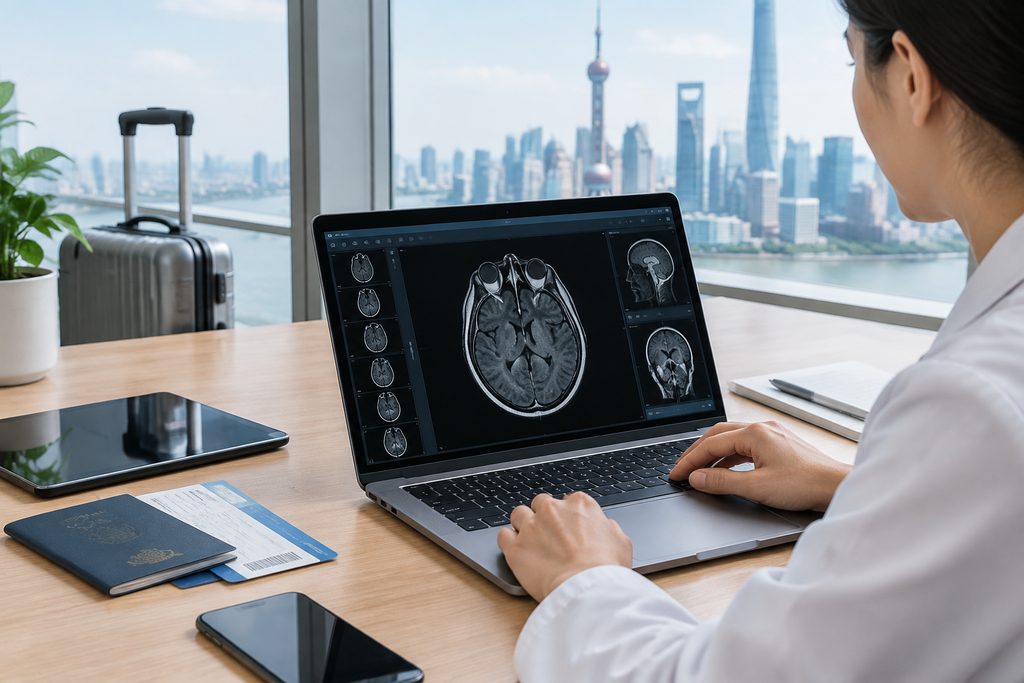
Bringing Your Scans to China: File Formats That Work
What if the single biggest obstacle between you and a Chinese specialist isn’t the language, the distance, or even the money — but a file that won’t open? It happens more than you’d think. The good news: the medical imaging file formats accepted by Chinese hospitals are the same global standards used in the US and Europe. DICOM is the universal language of scans. If your imaging came from a modern hospital, you almost certainly already have what you need.
The complication isn’t the format itself. It’s how the files are packaged, whether they include the full image series or just a few screenshots, and whether the receiving hospital’s international department can actually load them into its system. Get those three things right and your records travel smoothly. Get them wrong and you’ll be re-scanning in a Chinese hospital lobby, wondering why nobody warned you.
Medical Imaging File Formats Accepted by Chinese Hospitals: The Short Answer
Chinese hospitals accept DICOM (Digital Imaging and Communications in Medicine) as the primary standard for CT, MRI, PET-CT, ultrasound, and X-ray. That’s the same format your US or European hospital already uses. For documents — reports, pathology, discharge summaries — PDF is the near-universal choice. JPEG and PNG are acceptable for photographs and simple visuals but are not a substitute for diagnostic-quality scans.
So the short answer is: DICOM for images, PDF for reports. But here’s what actually trips people up. A radiologist in China can’t diagnose from a screenshot of your MRI. They need the full series — every slice, at full resolution, with the metadata intact. A single JPEG of one slice tells them almost nothing.
Who This Is Right For — and Who It Isn’t
Remote review of your existing scans makes sense for a lot of people. It’s not for everyone, though, and being honest about that saves time.
You’re likely a good fit if:
- You have a diagnosis or suspected condition and want a second read from a Chinese specialist before deciding on treatment.
- You’ve already had imaging done at home and want to know whether traveling to China is even worth it.
- You’re comparing surgical options and need a written opinion to weigh against what your local doctors told you.
- Your case is complex enough that a multidisciplinary review would help clarify next steps.
You should probably not pursue remote review if:
- You’re having an acute emergency. Go to the nearest emergency room. Remote review takes days, not hours.
- Your only imaging is old — say, more than 12 to 18 months — and your condition may have changed. You’d need fresh scans first.
- You’re looking for a guaranteed diagnosis or a promise of a specific outcome. No legitimate service can offer that from images alone.
- You haven’t had any imaging yet. There’s nothing to send.
The Options, Compared
How you get your scans to China matters as much as the format. Here are the realistic routes, with what each one actually costs you in time and reliability.
| Method | Format Delivered | Typical Time | Reliability | Best For |
|---|---|---|---|---|
| Physical CD/DVD from imaging center | DICOM on disc | Same day pickup | High — full series intact | Patients who can visit the imaging center in person |
| Hospital patient portal download | DICOM zip or PDF | Minutes to hours | Medium — portals vary widely | Patients whose hospital offers full DICOM export |
| Cloud link from imaging center | DICOM via secure link | Same day request | High if link doesn’t expire | Most international patients |
| Email attachments | Usually PDF or JPEG | Immediate | Low for scans — often compressed | Reports and documents only |
| Phone photos of screen | JPEG | Immediate | Very low — not diagnostic | Nothing clinical |
If you can get DICOM on a disc or through a secure cloud link, that’s your best path. Portals are hit-or-miss — some export full DICOM, others only give you a PDF summary. Email works fine for the written report but will mangle large image sets. And those phone photos? They’re fine for showing a friend, useless for a radiologist.
How to Send MRI Scans to a China Hospital Without Losing Quality
This is where most people stumble. The file format is correct, but the transfer method destroys the data. Here’s the practical sequence.
Start at the imaging center, not at your computer. Ask the front desk or radiology department for a copy of your study “in DICOM format, full series, on disc or via secure download link.” Say those words. If you just ask for “my scans,” you may get a PDF slideshow that looks impressive and contains almost nothing diagnostically useful.
A typical MRI study runs 200 to 800 images and can be 200 MB to over 1 GB. A CT can be similar or larger. That’s why email fails. A secure cloud link — WeTransfer, a hospital portal, or a file-sharing service — handles the size without compressing the images.
Bundle everything together:
- The DICOM image files (all series, not a selection)
- The written radiology report as a PDF
- Any prior imaging for comparison, if relevant
- Pathology or lab reports as PDFs, if you have them
One more thing worth knowing. Chinese hospital systems are not always plug-and-play with foreign discs. A disc that opens fine on your laptop may need conversion on the receiving end. That’s a technical hiccup, not a rejection — but it’s a reason to send files early rather than the week of your appointment.
What It Costs and How Long It Takes
Getting a remote review of your scans isn’t free, but it’s far cheaper than flying to China on a guess. A written second opinion from a top-tier hospital specialist typically runs from $300 to $500. A video consultation with a standard international department is $100 to $300, while a top-specialist video session runs $500 to $800. If your case warrants a multidisciplinary team review, expect $1,500 to $2,000.
Final pricing varies by hospital and case complexity, and it’s confirmed after your records are reviewed — not before.
Timing is more predictable. Once your files are received and verified, a written opinion usually comes back within several business days. Video consultations can often be scheduled within one to two weeks, depending on the specialist’s availability. The variable is you: how fast you can obtain the DICOM files from your imaging center. Some patients get them in an afternoon. Others spend a week chasing portals and phone numbers.
Here’s a detail that matters for planning. Any consultation fee is credited in full toward on-the-ground coordination if you decide to travel to China within 90 days. It’s a one-time credit applied to the coordination fee only — never to hospital treatment charges. So the review isn’t a sunk cost if you move forward.
Practical Considerations: Records, Language, and What Comes Next
Records first. Beyond the scans, gather your most recent specialist notes, medication list, and any biopsy or lab results. All of it as PDF. Chinese specialists reading a foreign case rely heavily on the written context — the images show what’s there, the reports explain what’s been done about it.
Language is handled at our end. Reports in English, German, Arabic, or Russian get translated into Chinese for the reviewing physician, and the response comes back in your language. You don’t need to translate anything yourself.
Visa logistics come later, and only if you decide to travel. For medical treatment in China, the applicable short-stay category is the S2 visa, with accompanying family members applying under the same category. Requirements shift, so always confirm current rules with the nearest Chinese embassy or consulate and rely on supporting documents from the treating hospital. We never guarantee approval — no one legitimately can.
Payment is worth flagging early. Public hospitals generally require prepayment, with insurance reimbursed afterward. Private international hospitals often bill insurers directly. If you’re weighing public versus private, our overview of private international hospitals with direct insurance billing explains the trade-offs.
And follow-up after you return home? That’s a real gap. Chinese hospitals can send you home with imaging and reports, but continuing care happens with your local physician. Ask for everything in writing before you leave.
Frequently Asked Questions
Yes. DICOM is an international standard, and Chinese hospitals use it exactly as US hospitals do. The occasional snag is a disc that needs conversion or a portal export that isn’t true DICOM. Sending files early gives time to sort that out.
They need DICOM for images and PDF for reports. Photos of a screen are not diagnostic and won’t support a real opinion. If photos are all you can get, be upfront about it, because the specialist’s assessment will be limited.
Use a secure cloud link or the hospital’s own portal rather than open email attachments. Reputable services handle records under confidentiality protocols. If a provider asks you to post scans in a public forum, walk away.
Bundle DICOM images and PDF reports, send them via secure link, and confirm receipt before assuming they arrived. A short cover note listing your diagnosis, key dates, and your main question helps the reviewing physician focus.
That’s a useful answer, not a failure. It means you’ve avoided an expensive trip for nothing. A written opinion that rules out travel is often worth more than one that encourages it.
Your Next Step
The takeaway is simple: DICOM for images, PDF for reports, secure transfer, and send early. Do that and your records will reach a Chinese specialist intact. We’re a medical concierge service, not a hospital — we don’t diagnose or treat anyone. What we do is translate your records, route them through official hospital international departments, and coordinate the review. If you’d like to know whether your scans are ready to send, start with a free consultation and we’ll tell you exactly what’s missing.
This article is for general information only and is not medical advice. Always consult a qualified physician about your individual situation.
For more medical information and treatment options in China, visit chinamedservices.com (China Medical Services).
