Order Food Delivery to Chinese Hospital Room as Foreigner: A Practical Survival Guide
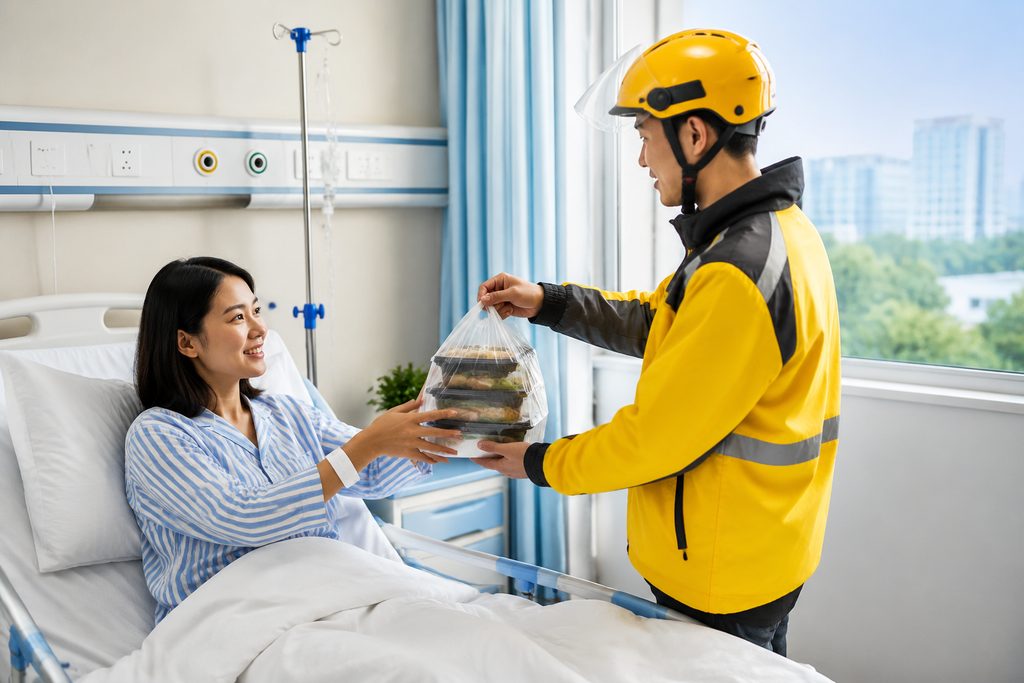
According to data from China’s National Health Commission, international patient visits have rebounded sharply, with major hospitals in Beijing and Shanghai reporting a 40% increase in foreign admissions during the first half of 2025 compared to the previous year. A common friction point emerges within the first 24 hours of admission. The hospital canteen schedule doesn’t match your appetite. The menu is entirely in Chinese characters. You’re recovering, hungry, and staring at your phone wondering if you can actually get a proper meal delivered to your bedside. The direct answer is yes.
You can order food delivery to a Chinese hospital room as a foreign patient. The major platforms—Meituan and Ele.me—deliver to hospital addresses without issue. But the gap between “possible” and “easy” is wider than most people expect. Address formatting, payment setup, delivery handoff logistics, and dietary restrictions all need attention before you place that first order.
The Short Answer: Yes, But Here’s What Nobody Tells You
Food delivery to hospital China foreign patient scenarios work. Riders from Meituan and Ele.me deliver to hospital gates, lobby drop-off points, and sometimes directly to ward floors. The catch? Hospital security protocols vary wildly. Some wards allow riders upstairs. Most don’t. You’ll need a plan for the last 100 meters of the journey.
Chinese hospitals are vertical cities. A single building might house 3,000 inpatients across 20 floors. Delivery riders navigate this on electric scooters, racing against platform-imposed time limits measured in minutes. They won’t wander hospital corridors looking for your room. You need to provide a precise meeting point that a non-English-speaking rider can find immediately.
Also worth knowing: hospital food delivery in China isn’t just about convenience. For many international patients, it’s about medical necessity. Bland congee three times a day doesn’t work when you’re recovering from surgery and need specific nutrition. The ability to order familiar food directly impacts recovery morale.
Who This Is Right For — and Who It Isn’t
Food delivery to your hospital room makes sense for most international patients. But some situations call for a different approach entirely.
Good candidates for ordering in:
- Patients on regular wards without dietary restrictions tied to treatment protocols
- Those staying at private international hospitals with English-speaking nursing staff who can assist with receiving deliveries
- Patients with a companion or family member who can meet the rider at the hospital entrance
- Short-stay patients who just need a few decent meals during a 3-5 day admission
Skip the delivery apps if:
- You’re on a strict pre-surgical or post-surgical diet prescribed by your attending physician—deviating from this is genuinely dangerous
- You have severe food allergies and cannot read Chinese ingredient labels or communicate restrictions to restaurants
- You’re in an ICU or high-dependency unit where outside food is prohibited by hospital policy
- You’re alone, bedridden, and have no one to physically retrieve the delivery from the lobby
The last point matters more than you’d think. A rider will not wait. If you can’t meet them within 60 seconds of arrival, the order gets marked as undeliverable.
The Options, Compared
Three paths exist for getting food into your hospital room. Each has trade-offs worth examining before you’re hungry and frustrated.
| Method | Cost per Meal | Language Barrier | Dietary Flexibility | Best For |
|---|---|---|---|---|
| Hospital canteen | $2–5 | High — menus are Chinese-only, staff rarely speak English | Low — standard Chinese hospital fare, limited customization | Budget-conscious patients with a bilingual companion |
| Meituan / Ele.me delivery | $5–20 | Medium — app interfaces have partial English, restaurant menus are mostly Chinese | High — thousands of restaurants, including western, halal, vegetarian options | Patients who want variety and have a companion or can meet the rider |
| Private international hospital kitchen | $15–40 | Low — English menus and English-speaking nutrition staff | Medium — western and Chinese options, but limited to hospital-approved menus | Patients at United Family, Jiahui, or similar facilities who prioritize ease |
Most international patients in public hospitals land on the middle option. The cost is reasonable, the variety is staggering by any global standard, and with the right setup it becomes routine within a day or two. The private hospital route is frictionless but ties you to specific institutions like those listed on our private international hospitals page.
Setting Up Meituan and Ele.me as a Foreigner: The Step-by-Step That Actually Works
This is the section that answers the question “can you order Meituan to Chinese hospital room” with specifics. Both Meituan and Ele.me accept foreign phone numbers and foreign credit cards now—a change that only rolled out fully in 2024. But the setup process still contains friction points that stop many first-time users.
Start with Meituan. Download it from your app store. The interface now includes an English toggle, though it’s imperfect—about 60% of the UI translates, mostly navigation elements. Restaurant names and dish descriptions remain in Chinese. Register with your foreign phone number. The verification SMS arrives reliably to most country codes. Then add a payment method. Visa and Mastercard work. American Express is spottier.
The critical step: your delivery address. Do not type your hospital’s name in English and hope for the best. Chinese delivery riders see addresses in Chinese characters. If you enter “Peking Union Medical College Hospital, Dongdan, Beijing,” the platform’s auto-translation will produce something unrecognizable to a local rider. Instead, ask a nurse or your bilingual medical companion to write the exact Chinese address. Copy it. Paste it into the address field. Add a note in Chinese specifying the meeting point: “东门门口” (east gate entrance) or “住院部一楼大厅” (inpatient building first floor lobby).
Ele.me works identically. It’s owned by Alibaba and integrates with Alipay, which now also supports foreign cards through its Tour Pass feature. Some foreigners find Ele.me slightly easier because Alipay’s English interface is more mature. But restaurant selection between the two platforms overlaps by roughly 80% in major cities.
One more thing about the best food delivery app for foreigners in hospital China: neither app is objectively “best.” Meituan has marginally more restaurant listings. Ele.me has marginally better English payment integration. Use both. Install both. When one restaurant is 45 minutes away on Meituan, the same kitchen might show 25 minutes on Ele.me due to different rider allocation algorithms.
Getting Western Food Delivered to Your Hospital in Shanghai
Shanghai presents a special case. The city has China’s highest concentration of western restaurants per square kilometer, and the delivery infrastructure is correspondingly mature. How to get western food delivered to hospital in Shanghai isn’t a difficult question—it’s a filtering question.
Open Meituan in Shanghai and search by cuisine type. The category icons are visual enough that you can navigate without reading Chinese. Look for the burger icon, the pizza slice, the salad bowl. Shanghai’s French Concession area alone has over 200 western restaurants on delivery platforms. Many are run by expat chefs who understand food safety standards that align with what you’d expect at home.
Specific hospitals matter. If you’re at Huashan Hospital, you’re surrounded by excellent delivery options in the Jing’an district. Zhongshan Hospital puts you near the former French Concession’s dense restaurant cluster. Ruijin Hospital sits in the Huangpu district with equally strong coverage. Hospitals in Pudong—like Shanghai East Hospital—have fewer nearby western options but still deliver reliably within 30-40 minutes.
For patients at Shanghai’s top hospitals, ordering western food is straightforward. Stick to restaurants with ratings above 4.5 stars on the platform. Look for photos in reviews that show the actual food, not studio shots. And order during off-peak hours if possible—11:30 AM to 12:30 PM is the lunch rush, and delivery times can double.
Ordering Halal Food to Your Beijing Hospital Room
Beijing has China’s second-largest Muslim population after Xinjiang, and the halal food delivery ecosystem reflects this. To order halal food hospital Beijing delivery successfully, you need to know what to look for in the app.
Search for “清真” (qīngzhēn)—this is the Chinese term for halal. Restaurants displaying this certification in their name or description are Muslim-owned or halal-certified. Beijing’s Niujie neighborhood is the historic Muslim quarter, and many restaurants from that area deliver citywide. Lanzhou lamian shops, which are ubiquitous across Beijing, are nearly always halal-operated. They deliver hand-pulled noodles, lamb dishes, and vegetable sides that travel well.
The larger challenge isn’t finding halal food—it’s verifying that a restaurant’s halal claim is legitimate. Meituan and Ele.me don’t independently verify halal certifications. Restaurants self-declare. For international patients from the Middle East or Southeast Asia where halal standards are government-regulated, this can feel uncertain. A practical approach: favor restaurants with “清真” in their registered business name rather than just in their description. These have passed at least basic municipal certification. And avoid any restaurant that lists both halal certification and pork dishes on the same menu—this happens more often than it should and indicates the certification is decorative rather than operational.
For patients at Beijing’s top-ranked hospitals, the Niujie area restaurants deliver reliably to most major medical centers within the city’s core districts. Factor in Beijing traffic, though. A restaurant 5 kilometers away might take 50 minutes during evening rush hour.
What It Costs
Food delivery in China is shockingly affordable compared to Western benchmarks. But hospital delivery adds small complications that affect the total.
A typical meal for one person runs $5–12 including delivery fees. That’s a full western-style dinner with a main, side, and drink. Chinese food is cheaper—$3–7 for a generous single portion. Delivery fees range from $0.50 to $2.50 depending on distance. Platform service fees add another $0.30–1.00. Tipping doesn’t exist in the Chinese delivery ecosystem, though some platforms now offer an optional tip function that few locals use.
What drives cost variance: restaurant category, distance from hospital, and time of day. Ordering sushi at 9 PM from a restaurant 8 kilometers away might push a meal to $20–25. Ordering dumplings at noon from a shop 1 kilometer away might cost $4.
For patients using a hospital food delivery service for international patients China—meaning a concierge or companion who handles ordering and retrieval—expect to pay the meal cost plus the companion’s hourly rate. Our bilingual medical companions can manage this as part of a broader support day, typically from $200 per day for full-day accompaniment. That covers far more than food, of course—it includes navigating the entire hospital visit. But if food delivery is your only need, a full companion day is overkill. The apps work independently once you’re set up.
Practical Considerations: What Can Go Wrong and How to Prevent It
Address formatting is the number one failure point. Riders navigate by GPS pin, not by building name. If your hospital’s delivery pin drops in the middle of a 15-building complex, the rider will call you. In Chinese. Rapidly. While their delivery timer counts down. The fix: set your delivery location to a specific gate or entrance, not the hospital’s generic address. Walk outside once before your first order and identify a landmark—a bank ATM, a convenience store, a specific statue—and add that to your delivery notes.
Payment failures happen. Foreign cards sometimes trigger fraud alerts from your home bank when used on Chinese platforms. Call your bank before your trip and notify them of expected China-based transactions. Keep a backup payment method. Alipay Tour Pass, which lets you load a virtual prepaid card with your foreign card, provides a reliable fallback when direct card payments decline.
Dietary miscommunication is real. A restaurant listing “vegetable pasta” might arrive with minced pork. This isn’t carelessness—it’s a different culinary framework where “vegetable” describes the main ingredient, not an exclusion of meat. If you have absolute dietary restrictions, use a translation app to write a clear note in Chinese. Something like “I am Muslim, no pork, no alcohol in cooking” (我是穆斯林,不要猪肉,烹饪不要用酒) or “strict vegetarian, no meat, no fish, no egg” (严格素食,没有肉,没有鱼,没有蛋). Pin this note to your account profile so it auto-attaches to every order.
Hospital ward policies vary. Some wards have no restrictions—food comes up to your room. Others prohibit outside food entirely, usually in oncology or transplant units where infection control is paramount. Ask the head nurse about the policy before ordering. If outside food is banned, the hospital canteen can usually prepare special meals on request through your attending physician’s dietary order.
Frequently Asked Questions
Almost never. Hospital security protocols in Chinese public hospitals restrict non-staff, non-patient access to inpatient wards. Riders deliver to the hospital lobby, main entrance, or a designated delivery pickup shelf. You or your companion must go down to collect the order. Some private international hospitals like United Family allow delivery to the nurse station, but this is the exception. Plan for lobby pickup unless you’ve confirmed otherwise with hospital staff.
The apps handle most communication. When a rider is approaching, you’ll see their real-time location on a map. If they call, you can use the in-app messaging function with built-in translation. Type in English, it translates to Chinese, the rider responds in Chinese, it translates back. It’s clunky but functional. For the actual handoff, the rider will typically call out the last four digits of your phone number to confirm identity. Know those digits. Hold up your phone showing the order screen. That’s usually sufficient.
China’s food delivery platforms have implemented tamper-evident packaging seals on most orders since 2021. Look for the sealed sticker across the bag opening. If it’s broken, the platform’s customer service will typically refund without argument. Restaurant hygiene standards vary enormously. Stick to restaurants with high ratings and many reviews—the crowd-sourced quality filter is genuinely effective. Avoid raw or undercooked dishes while hospitalized. Your immune system is already under stress, and a foodborne illness during recovery is a complication you don’t need.
No. Chinese food delivery operates on a hyperlocal model. Restaurants deliver within a radius of typically 3-8 kilometers. When you move from a hospital in Beijing to one in Shanghai, your available restaurants change completely. Even within the same city, moving from one district to another reshuffles your options. Each hospital admission means rebuilding your list of go-to restaurants.
Neither Meituan nor Ele.me offers fully English restaurant menus. Meituan’s app interface has partial English, but dish names and descriptions remain in Chinese. The workaround most international patients use: browse restaurants by photo, use the in-app image search or your phone’s camera translation (Google Lens works in China with a VPN), and build a shortlist of 5-6 reliable restaurants with dishes you recognize. After the first order from each, the app learns your preferences and surfaces similar options.
Your Next Step
Food delivery to your Chinese hospital room is entirely manageable once you clear the setup hurdles. Install both Meituan and Ele.me before you travel. Add your payment method while you still have stable home WiFi and can call your bank if needed. Screenshot or save the Chinese-language address of your hospital and a specific meeting point. If this all sounds like more friction than you want to handle while recovering, our team at China Medical Services can include meal coordination as part of a broader bilingual companion arrangement. We’re not a hospital—we don’t provide medical care or make diagnoses. We’re the logistical layer between you and China’s healthcare system, handling the practical details so you can focus on recovery.
For a conversation about your specific situation—which hospital you’ll be at, your dietary requirements, and how we can support your stay—visit our patient support page. No pressure. Just practical answers from a team that has helped international patients navigate Chinese hospitals across 37 cities and 340+ top-ranked institutions.
For more medical information and treatment options in China, visit chinamedservices.com (China Medical Services).
