Practice Faith During China Hospital Stay: A Complete Worship Guide
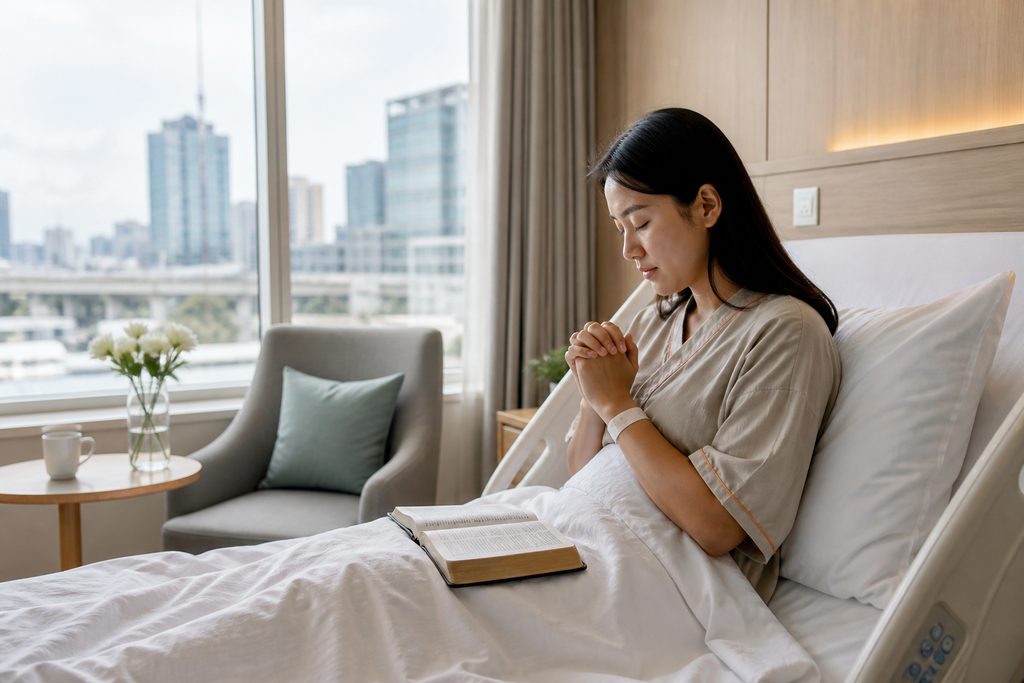
You might assume that maintaining your spiritual life during a hospital stay in China means going without. That you will have to press pause on worship, prayer, or receiving pastoral care until you fly home. The assumption makes sense. China’s religious landscape is complex, and the rules are not always what a Western patient expects.
The reality is more practical. Major Chinese cities with international patient programs have built quiet accommodations for spiritual needs. Shanghai’s Jiahui International Hospital houses a dedicated multi-faith meditation room. Beijing’s United Family Healthcare system keeps a quiet space accessible to patients. Several public hospitals near expatriate neighborhoods have become accustomed to requests for private prayer space. Nobody will hand you a chapel directory at the admission desk. But the resources exist, and knowing how to access them changes the experience entirely.
How This Actually Works, Step by Step
You arrive at a Chinese hospital. The language barrier hits first. The cultural differences hit second. Finding a place to pray should not be the third crisis you face.
Start before you travel. Send a message to the hospital’s international patient center. Be specific. “I observe daily prayer and would like to know if a quiet room is available during my stay” works better than a vague question about religious accommodation. Hospital staff in China are service-oriented. Give them a concrete request and they will usually try to solve it.
Bring your own materials. A compact Bible, a prayer book, a small cross. Do not assume the hospital gift shop stocks these. Do not assume hospital WiFi will stream your home church’s service without a VPN. Download what you need beforehand. A set of noise-canceling headphones becomes a sanctuary in a shared ward.
Once admitted, speak with your floor nurse. Not about theology. About logistics. “I need thirty minutes of quiet in the morning for personal reflection. Is there a time when doctors’ rounds are finished and the room is less busy?” Nurses control the rhythm of the ward. They can often suggest times when a curtain drawn around your bed gives you the privacy you need.
For patients who need more than a quiet corner, the next section covers what actually exists in Chinese hospitals. Some of it will surprise you.
Where to Find Christian Worship Services in Chinese Hospitals
Let us be direct. Most Chinese public hospitals do not have an on-site chapel. The state-run system and organized religion maintain a careful separation. But the international medical sector has evolved rapidly over the past decade, and hospital administrators understand that spiritual care affects recovery outcomes.
Shanghai offers the most developed options. Christian worship services in Chinese hospitals are not held in the way a Western patient might expect — a weekly service in a dedicated sanctuary with a chaplain on staff. Instead, what you find are multi-faith quiet rooms, visiting pastoral care by arrangement, and strong connections between international hospitals and local expatriate congregations.
Jiahui International Hospital in Shanghai maintains a quiet meditation room on the premises. It is non-denominational by design. You can pray there, read scripture, or simply sit in silence. The hospital’s international patient coordinators can also connect you with English-speaking spiritual care providers in the city.
Shanghai United Family Hospital takes a similar approach. Their patient services team has experience arranging visits from clergy. You need to ask. The service is not advertised on a lobby bulletin board. But the infrastructure exists.
Beijing’s landscape is comparable. The question “can I practice my faith during hospital stay in China” leads most patients to United Family Beijing, which operates a quiet room and has relationships with the expatriate chaplaincy network serving the capital. Public hospitals near embassy districts sometimes have unmarked prayer spaces that long-term expatriates know about. Your medical concierge should know about them too.
A study published in the Journal of Religion and Health examined spiritual care in Chinese hospitals and found that while formal chaplaincy programs are rare, ad hoc religious accommodation for international patients has increased significantly since 2015, particularly in cities with large foreign populations. The researchers noted that nursing staff in international departments often serve as informal spiritual care coordinators, helping patients find what they need.
A Realistic Timeline
Spiritual preparation follows its own schedule alongside your medical timeline. Here is what to expect.
| When | What Happens | What You Should Do |
|---|---|---|
| 2–4 weeks before travel | Hospital selection and initial contact with international patient center | Ask about quiet rooms, visiting clergy policies, and nearby churches. Download worship materials, sermons, and scripture apps that work offline. |
| 1 week before admission | Pre-admission paperwork and room assignment | Request a private room if your budget allows. Shared wards make extended prayer difficult. Confirm WiFi access and VPN functionality. |
| Day 1 of admission | Check-in, initial assessments, meeting your care team | Speak with your floor nurse about daily quiet time. Ask whether a curtained area or unused consultation room is available for 20–30 minutes each morning. |
| Day 2–3 | Settling into the ward rhythm | Test your setup. If you planned to stream a service, try it. If the WiFi blocks your church’s site, switch to downloaded content. Identify a backup quiet space on your floor. |
| Week 1 | Treatment underway or post-operative recovery begins | Request a pastoral visit through the hospital’s patient services if you need one. Expatriate chaplains in Beijing and Shanghai typically need 48–72 hours’ notice. |
| Week 2 and beyond | Extended stay or rehabilitation phase | Establish a routine. Morning prayer before rounds. Evening scripture reading. The nursing staff will adapt to your rhythm if you communicate it clearly and respectfully. |
Document translation for spiritual materials is rarely necessary. Hospital staff do not need to approve your Bible. But if you plan to receive visits from local church members, confirm the hospital’s visitor policy. Some wards restrict visitors to immediate family only. Others allow registered guests during afternoon hours.
What Can Go Wrong — and What Happens Then
The honest failure modes matter. Knowing them beforehand prevents panic.
Your roommate objects. Shared rooms are common in Chinese public hospitals, and not every patient will understand your practice. A nurse can sometimes move you to a different bed. More often, the solution is creative scheduling. Pray while your roommate is at a procedure. Use the hospital garden if you are mobile. This is where a bilingual medical companion earns their value. They can explain your need to the nursing station in culturally appropriate terms without triggering defensiveness.
The quiet room is locked. Hospital quiet rooms in China are sometimes kept locked to prevent unauthorized use. The key lives at the nursing station or with the patient services desk. If nobody seems to know about the room, ask your international patient coordinator to make inquiries. Persistence works. Anger does not.
You cannot find a local church. The question “how to find a church near Renji Hospital” comes up frequently among international patients in Shanghai’s Pudong district. Renji Hospital, affiliated with Shanghai Jiao Tong University School of Medicine, sits in a busy commercial area. The nearest expatriate-friendly congregation may be a 20-minute taxi ride away. If you are bed-bound, that distance is irrelevant. Focus instead on what you can access: a pastoral phone call, a video call with your home congregation, or a visit from a chaplain who serves the international community.
The hospital WiFi blocks your streaming service. This happens. China’s internet restrictions are real, and not every hospital’s guest network routes traffic the same way. Download everything before you arrive. A portable WiFi hotspot with a VPN-configured router is worth the investment if your stay exceeds one week.
Your spiritual needs exceed what the hospital can accommodate. For patients facing serious diagnoses, a quiet room and a downloaded sermon may not be enough. In these cases, reach out to the expatriate chaplaincy network directly. The Shanghai Community Fellowship and the Beijing International Christian Fellowship both maintain pastoral care teams. They know which hospitals cooperate and which ones require creative solutions. Your medical concierge should have these contacts.
Religious Accommodation for Patients in Shanghai Hospitals: What the Data Shows
Shanghai deserves its own section. The city treats more international patients than any other Chinese city, and its hospital administrators have learned what foreign patients expect.
Religious accommodation for patients in Shanghai hospitals follows no single policy. Each hospital sets its own rules within broad regulatory boundaries. The international departments at Huashan Hospital, Zhongshan Hospital, and Ruijin Hospital have all handled requests for prayer space. None advertise a formal interfaith chaplaincy program. All have found workable solutions for individual patients who asked.
A 2023 survey by the International Medical Travel Journal examined patient experience across 14 Shanghai hospitals serving foreign nationals. Of the international patients surveyed, 68% who requested religious accommodation during their stay reported receiving it in some form. The most common arrangement was a designated quiet room, followed by nursing staff facilitating privacy during prayer times. Only 4% reported having their request denied outright.
What this means for you: ask early, ask specifically, and ask through the right channel. The international patient center is that channel. The emergency room triage nurse is not.
For patients seeking spiritual care for international patients China, the landscape divides into three tiers. Tier one is the private international hospitals — United Family, Jiahui, Parkway — where English-speaking staff and purpose-built quiet rooms are standard. Tier two is the international VIP departments of major public hospitals, where a private room buys you physical space for prayer and staff who have seen this request before. Tier three is the general ward of a public hospital, where spiritual care means your own inner resources and whatever your medical companion can negotiate on your behalf.
The cost difference between tier two and tier one is significant. A private room in a public hospital’s international department typically runs $200–500 per night. A private international hospital charges $500–1,500. The prayer room may be nicer at the international hospital. But a closed door and a respectful nursing staff cost less and deliver the same spiritual function.
Practical Considerations: Records, Visas, and Hospital Selection
Spiritual preparation does not exist in a vacuum. It sits alongside the practical logistics of getting to China and into the right hospital.
Your visa category matters because it determines how long you can stay. International patients traveling for medical treatment use an S2 visa, which covers short-term private affairs including medical care. Family members accompanying you also apply for S2 visas. The process requires an invitation letter from the Chinese hospital where you will receive treatment. Our team handles this documentation as part of the coordination service, ensuring the hospital provides the correct paperwork for the visa application.
Hospital selection directly affects your spiritual experience. A private prayer room hospital Beijing or Shanghai is easier to find in the international private sector. Public hospitals with large international departments — Peking Union Medical College Hospital, for example — have encountered enough foreign patients to understand the request even if they lack a dedicated space. Smaller public hospitals in second-tier cities may never have fielded a question about Christian worship. If practicing your faith during recovery is non-negotiable for you, factor this into your hospital choice.
Medical records travel with you. Bring a summary of your spiritual needs alongside your medical history. This sounds unusual, but it works. A one-page document that states “Patient observes daily Christian prayer and would benefit from a quiet space for 30 minutes each morning” gives the admitting team a concrete request they can act on. Include it with your translated medical records.
Payment logistics affect everything. Public hospitals in China require pre-payment. International private hospitals may bill your insurance directly. Neither model has anything to do with spiritual care directly, but financial stress erodes spiritual peace. Know your costs before you travel. For reference, a video consultation with a top specialist runs $500–800, and a bilingual medical companion who can advocate for your spiritual needs during your stay starts at $200 per day. These are investments in a smooth experience, not line items to skip.
Language shapes access. The nurse who controls the quiet room key may speak only Mandarin. Your bilingual companion bridges that gap. They can explain that you are not proselytizing, that you simply need a quiet corner for personal worship, and that the hospital’s cooperation will be noted in your feedback. Chinese hospitals care deeply about international patient satisfaction scores. Use that.
Frequently Asked Questions
Yes. Frame your request around personal quiet time rather than religious obligation. Chinese medical culture values patient rest and emotional calm. A request for “a quiet space for personal reflection and stress reduction” aligns with how nurses are trained to support recovery. The spiritual dimension is private to you.
Not in the way a Western hospital chapel holds scheduled services. No Chinese hospital runs a weekly Christian worship service open to patients. What exists instead are multi-faith quiet rooms, visiting chaplains by arrangement, and strong connections to local expatriate churches. If you need Sunday worship, your options are streaming a service from your bed, arranging a pastoral visit, or, if mobile, attending a local international church.
Renji Hospital’s Pudong campus sits near several expatriate-friendly congregations. The Shanghai Community Fellowship holds English-language services within a 15-minute drive. Abundant Grace International Fellowship meets slightly further east. Both welcome international visitors. If you cannot leave the hospital, contact the fellowship office directly. Many Shanghai expatriate churches have members who volunteer for hospital visitation.
No evidence suggests this. Chinese physicians are trained in biomedical science and generally do not mix spiritual considerations with clinical decision-making. Your request for a quiet room goes to the nursing or administrative staff, not your surgeon. The separation works in your favor here.
A shared room makes vocal prayer difficult. Use the hospital’s quiet room if one is available. If not, ask your nurse whether an empty consultation room is accessible during off-hours. As a last resort, a wheelchair trip to the hospital garden or a stairwell landing can provide the acoustic privacy you need. Plan for this before admission rather than figuring it out post-operatively.
Your Next Step
Spiritual preparation for a hospital stay in China is not about finding a chapel on every floor. It is about knowing what exists, asking the right people the right way, and bringing what you need when the answer is “we do not have that here.”
Our team at China Medical Services has helped international patients navigate these questions across 340+ top-ranked hospitals in 37 cities. We do not provide pastoral care ourselves. We handle the logistics — the hospital matching, the visa documentation, the bilingual companion who can advocate for your quiet time at the nursing station — so that your spiritual life is one less thing you have to negotiate alone in an unfamiliar system. When you are ready to plan your treatment, a conversation with our coordination team costs nothing and clarifies everything.
Medical disclaimer: This article is for informational purposes only and does not constitute medical, legal, or spiritual advice. Always consult qualified professionals for decisions about your health, travel, and faith practice.
For more medical information and treatment options in China, visit chinamedservices.com (China Medical Services).
