Why Chinese Hospital ER Works Differently from Western ER: A Patient’s Guide
What Actually Happens When You Walk In
You are in a taxi, gripping your side. The driver understands “hospital” and accelerates. You arrive at a massive complex, not a neat standalone ER entrance. Where do you go? The first shock is the layout. Most Chinese public hospitals scatter emergency services across different buildings. Internal medicine emergencies in Building 1. Surgical trauma in Building 3. Pediatrics somewhere else entirely. There is rarely a single “Emergency Department” sign in English that solves everything.
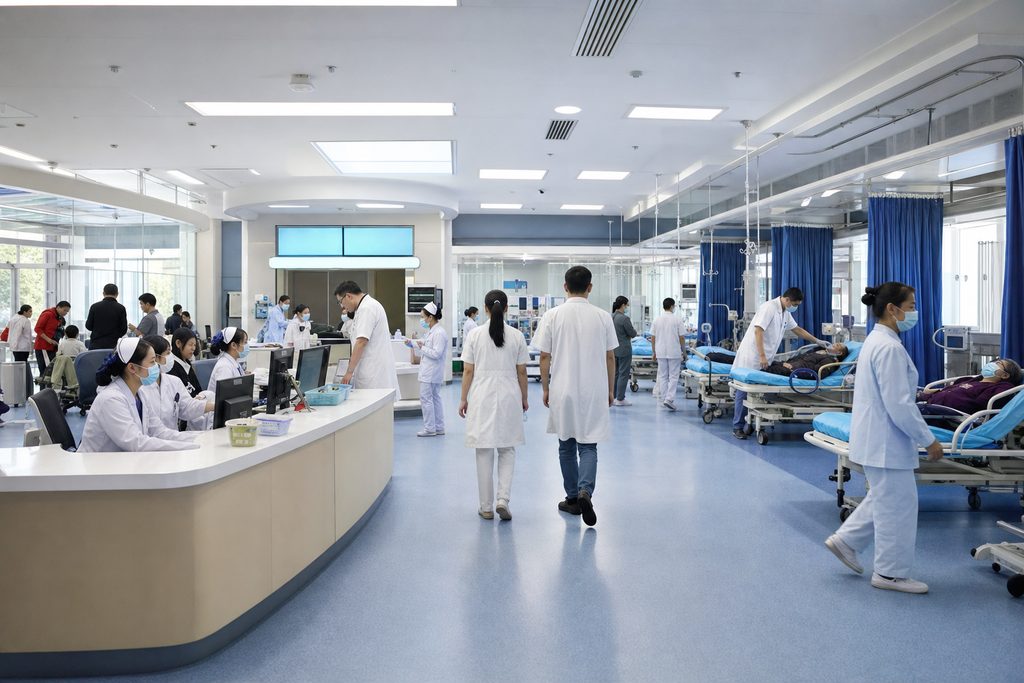
Walk into the main emergency hall. It looks like organized chaos. Hundreds of people. No quiet triage corner with a nurse asking calm questions. You need to register first. Always. Before any doctor sees you, you must have a hospital card and a registration ticket. This is non-negotiable. For foreigners, this step alone can take 30 minutes if you don’t have a Chinese ID or a local phone number.
Our team has guided patients through this exact moment. The process is logical once you know it, but brutal if you don’t. Here is the sequence:
- Step 1: Registration. Go to the emergency registration window. You will need your passport. They create a hospital file. You pay a registration fee upfront—usually ¥50 to ¥300 (roughly $7 to $40), depending on the hospital tier. This is not the treatment cost. It is just the ticket to be seen.
- Step 2: Triage. After registration, a nurse assesses you. Chinese hospitals use a 4-level triage system: Level 1 (immediate resuscitation), Level 2 (critical, within 10 minutes), Level 3 (urgent, within 30 minutes), Level 4 (non-urgent, can wait). This is similar to Western systems but executed with less verbal communication and more rapid physical assessment.
- Step 3: Consultation. You are directed to a specific room. The doctor sees you. They will likely order tests immediately—blood work, CT scans, ultrasounds. Chinese ER doctors rely heavily on rapid diagnostic imaging. It is fast and data-driven.
- Step 4: Pay, then test. Here is the critical difference. After the doctor orders a CT scan, you do not go straight to radiology. You go to the payment window first. You pay for the scan. Then you take the receipt to radiology. Every test, every medication, every supply is a separate payment loop. Pay. Get service. Repeat.
- Step 5: Results and disposition. Results come back fast—often within 30 to 60 minutes for blood work and CTs. The doctor reviews them and decides: admit you, treat and discharge, or refer you to a specialist outpatient clinic for follow-up.
This pay-as-you-go model shocks most Western patients. In a U.S. or European ER, you receive treatment and a bill arrives weeks later. In China, your treatment pauses if the deposit runs out. Hospitals require a prepaid balance on your hospital card. When it hits zero, the pharmacy will not dispense. Radiology will not scan. It feels transactional. It is. But it also keeps the system moving at remarkable speed for those who are prepared.
Why the Payment System Feels Backward—and Why It Isn’t
The emergency room cost China for foreigners question cannot be answered without understanding this deposit system. When you register, the hospital asks for an initial deposit. For a serious emergency, expect to put down ¥5,000 to ¥10,000 (about $700 to $1,400) upfront. This is not the final bill. It is a float. As tests and treatments consume the balance, you top it up. If you cannot pay, the hospital will stabilize you—Chinese law mandates emergency treatment for life-threatening conditions regardless of ability to pay. But once stabilized, further care requires payment.
This feels harsh. But consider the context. China’s public hospitals serve an enormous volume of patients. A top-tier hospital in Shanghai might see 1,000 emergency visits a day. The deposit system prevents the hospital from absorbing millions in unpaid bills. It also eliminates the massive billing bureaucracy that drives up costs in Western systems. You pay for exactly what you use, right when you use it. No surprise bills six months later. No insurance coding nightmares. Just a running tab you control.
For foreigners, this system creates a specific pain point: payment methods. Many hospital payment windows do not accept international credit cards. They want WeChat Pay, Alipay, UnionPay, or cash. Walking into a Chinese ER with only a Visa card is a recipe for frustration. We always advise patients to set up Alipay or WeChat Pay before traveling, or to carry a substantial cash reserve specifically for medical emergencies.
How Much Does an ER Visit Actually Cost?
Let’s talk real numbers. The international patient emergency care Shanghai price varies by hospital tier and severity, but ranges are well-documented. A moderate emergency—say, severe abdominal pain requiring a CT scan, blood work, and IV medication—typically runs between ¥2,000 and ¥5,000 ($280 to $700) at a top public hospital. A more complex case requiring specialist consultation, advanced imaging, and overnight observation might reach ¥8,000 to ¥15,000 ($1,100 to $2,100).
Compare this to a U.S. ER. A 2023 study by the Kaiser Family Foundation found the average emergency room visit cost in the United States was $2,700. A CT scan alone can bill at $3,000 to $6,000. In China, the same CT scan costs ¥300 to ¥800 ($40 to $110). The cost differential is not marginal. It is an order of magnitude.
But here is the nuance. Those low Chinese prices apply to the standard public hospital pathway—long waits, limited English, crowded conditions. If you choose an international private hospital like United Family or Jiahui, the emergency room cost China for foreigners shifts dramatically. An ER visit at a JCI-accredited international hospital in Shanghai or Beijing will cost ¥3,000 to ¥8,000 ($420 to $1,100) for a moderate case. Still cheaper than the U.S., but no longer dirt cheap. You are paying for English-speaking staff, direct insurance billing, and a Western-style care experience.
| Service | Chinese Public Hospital (Top Tier) | Chinese International Hospital | U.S. Average ER |
|---|---|---|---|
| ER Registration Fee | $7–$40 | $100–$250 | $150–$400 (facility fee) |
| CT Scan (Abdomen) | $40–$110 | $300–$600 | $3,000–$6,000 |
| Blood Work (Comprehensive) | $30–$80 | $150–$400 | $500–$1,500 |
| IV Medication & Observation (2 hrs) | $50–$150 | $200–$500 | $800–$2,000 |
| Total (Moderate Case) | $280–$700 | $800–$2,000 | $2,700–$5,000+ |
These are real, documented ranges based on patient receipts and hospital pricing data. They vary by city, hospital, and case complexity. But the pattern holds: Chinese public hospitals offer world-class diagnostics at a fraction of Western costs, while international hospitals bridge the service gap at a premium.
A Realistic Timeline: From Arrival to Discharge
People want to know about Beijing ER wait time vs Western hospital comparisons. The data surprises most foreigners. A 2022 study published in the International Journal of Emergency Medicine analyzed triage-to-doctor times across 12 countries. Chinese Level 3 (urgent) patients saw a doctor within a median of 22 minutes. U.S. emergency departments averaged 37 minutes for the same acuity level. The U.K. NHS target of 4 hours from arrival to discharge was met only 74% of the time in 2023. Chinese ERs routinely process patients from registration to disposition in under 2 hours.
Speed comes at a cost: the experience is assembly-line efficient, not comforting. Here is a realistic timeline for a foreigner presenting with acute abdominal pain at a top Beijing public hospital:
| Time Elapsed | What Happens | What You Need |
|---|---|---|
| 0:00 | Arrive at ER registration. Queue to create hospital file. | Passport. Cash or local payment method. |
| 0:15–0:30 | Registration complete. Triage nurse assesses you. | Basic Chinese phrases or translation app. Describe symptoms clearly. |
| 0:30–0:50 | Wait for doctor. Level 3 patients seen within 30 minutes typically. | Patience. The waiting area is crowded and loud. |
| 0:50–1:10 | Doctor consultation. Orders CT and blood work. | Ability to describe pain location, onset, and history. |
| 1:10–1:25 | Pay for tests at payment window. Walk receipt to radiology and lab. | Sufficient deposit balance on hospital card. |
| 1:25–2:00 | Blood drawn. CT scan completed. | Follow signs or ask for directions. Radiology may be in a different building. |
| 2:00–2:45 | Wait for results. Results available on self-service kiosks or via phone app. | Hospital app installed (if possible) or wait near doctor’s room. |
| 2:45–3:15 | Doctor reviews results. Diagnosis given. Prescription or admission arranged. | Decision: treat and discharge, or admit? |
| 3:15–3:45 | If discharge: pay final bill, collect medication from pharmacy, leave. | Final payment. Medication instructions may be in Chinese—ask for clarification. |
This assumes no complications. Add 60 to 90 minutes if you need a specialist consult. Add 2 to 4 hours if admission is required and a bed must be located. The system is fast, but it is not forgiving. A missing stamp, an underfunded deposit, or a language barrier can add hours.
What Can Go Wrong—and What Happens Then
Let’s be blunt. Things go wrong. The most common failure mode for foreigners is the payment bottleneck. You arrive, you register, you see a doctor, and then you cannot pay because your international card is declined. The hospital cannot proceed. You are stuck. The recourse is limited: find an ATM that accepts your card (not all do), contact a friend or colleague to transfer money via WeChat, or in the worst case, negotiate with the hospital’s international department—if one exists.
Another common failure: misdiagnosis due to communication breakdown. You say “chest pain.” The doctor hears “stomach pain” because the translator app garbled it. You get a gastroscopy instead of an ECG. This is not negligence. It is a systemic vulnerability when language is a barrier. The fix is to have a fluent Mandarin speaker with you, or to use a professional medical interpretation service. Google Translate is not sufficient for “crushing substernal chest pain radiating to the left arm.”
A third scenario: you are stabilized but need admission. The hospital has no beds. This happens. Top-tier hospitals in Beijing and Shanghai run at near-full capacity. The ER may hold you in an observation unit for 24 to 48 hours while a bed opens up. You are technically admitted but physically still in the ER. This is uncomfortable. It is also standard practice in many high-volume systems globally. The recourse is patience or transfer to a partner hospital with availability—something a bilingual coordinator can facilitate faster than you can alone.
And then there is the question that haunts every traveler: can foreigners go to ER in China without insurance? Yes. Absolutely. You will not be turned away. The hospital will treat you. But you will pay out of pocket, in full, before discharge. If you cannot pay, the hospital may hold your passport as collateral—this is technically illegal but happens in practice. The smarter path is to have travel insurance that covers medical evacuation and hospitalization in China, or to have a local contact who can guarantee payment. We have seen too many travelers assume their U.S. insurance will be accepted. It will not. China’s public hospitals do not do direct billing with foreign insurers. You pay, you claim later. International private hospitals are the exception—they often have direct billing arrangements with major global insurers. Check before you go.
How to Choose Between Public and International ERs
The medical tourism emergency room package China concept is emerging but still rare. Most medical travelers do not arrive expecting to use the ER. But emergencies happen. When they do, you face a split-second decision: public or private? The choice depends on three factors: severity, language, and money.
For true life-threatening emergencies—heart attack, stroke, major trauma—go to the nearest top-tier public hospital. Do not waste time traveling across the city to an international facility. Public hospitals like Peking Union Medical College Hospital or Zhongshan Hospital in Shanghai have world-class emergency capabilities. Their stroke thrombolysis times and STEMI door-to-balloon times match or beat Western benchmarks. A 2023 study in The Lancet Regional Health showed that major Chinese tertiary hospitals achieved a median door-to-balloon time of 67 minutes for acute myocardial infarction, well under the 90-minute international standard. They are fast and competent. But you will struggle with language. Accept that trade-off for time-critical conditions.
For moderate emergencies—severe pain, high fever, fractures, lacerations—the international hospital becomes more attractive. You trade some speed for comfort, communication, and insurance compatibility. The international patient emergency care Shanghai price at Jiahui or United Family will be higher, but you will understand your diagnosis, your discharge instructions will be in English, and your insurance may cover it directly. This reduces stress significantly.
What about the middle ground? Some public hospitals have international departments or VIP wings. These offer a hybrid: public hospital expertise with English-speaking staff and streamlined payment. The cost is roughly 1.5 to 2 times the standard public rate—still far below U.S. prices. Fuwai Hospital’s international department, for example, handles cardiac emergencies with the same team that performs 14,000+ cardiac surgeries annually, but with English-language coordination. This is often the optimal choice for foreigners who need top-tier care without the chaos of the standard ER.
Practical Considerations: Records, Visas, and Follow-Up
If you use a Chinese ER, get your records before you leave. This sounds obvious. It is not easy. Discharge summaries, lab results, and imaging reports are often in Chinese. You must specifically request copies—and sometimes pay a small fee for them. Ask for a printed discharge summary and a CD or USB with your imaging data. CT and MRI images on a CD are standard in China and can be read by any radiologist worldwide. Do not leave without them. If you need them translated, that is a separate service, but having the raw data is non-negotiable for continuity of care back home.
Visa considerations: if you are in China on an S2 visa for medical treatment and you experience an emergency that extends your stay, you can apply for a visa extension. The hospital can provide documentation confirming your treatment necessity. This is straightforward but requires a visit to the local Exit-Entry Administration bureau. Do not overstay your visa because of a medical emergency. The hospital can help with the paperwork, but the extension is your responsibility.
Insurance reimbursement: if you paid out of pocket at a public hospital, you will need to file a claim with your insurer. Request a detailed invoice (发票, fāpiào) and an itemized statement from the hospital’s billing office. These documents are essential for reimbursement. International hospitals will provide these automatically. Public hospitals may require you to ask specifically. Keep every receipt. Every single one. The payment window receipts, the pharmacy receipts, the registration ticket—all of it. Insurance companies love to deny claims for missing documentation.
Follow-up
Frequently Asked Questions
Yes. The hospitals used for international patients are JCI-accredited and follow the same international safety standards as top hospitals in the US and Europe. Surgical teams perform high volumes of procedures — often more than their Western counterparts — which studies show leads to better outcomes.
Costs vary by procedure and hospital, but international patients typically save 40-80% compared to US prices — even when factoring in travel and accommodation. A consultation with our team will give you an exact, all-inclusive quote with no hidden fees.
Send us your existing medical reports to get started. We handle everything from hospital selection and appointment scheduling to visa assistance and post-operative recovery planning. Your medical records are reviewed by the specialist before you even book a flight.
For more medical information and treatment options in China, visit chinamedservices.com (China Medical Services).
