Recovery Without Cabin Fever: How to Find Entertainment and Pass Time During a Long Medical Stay in China
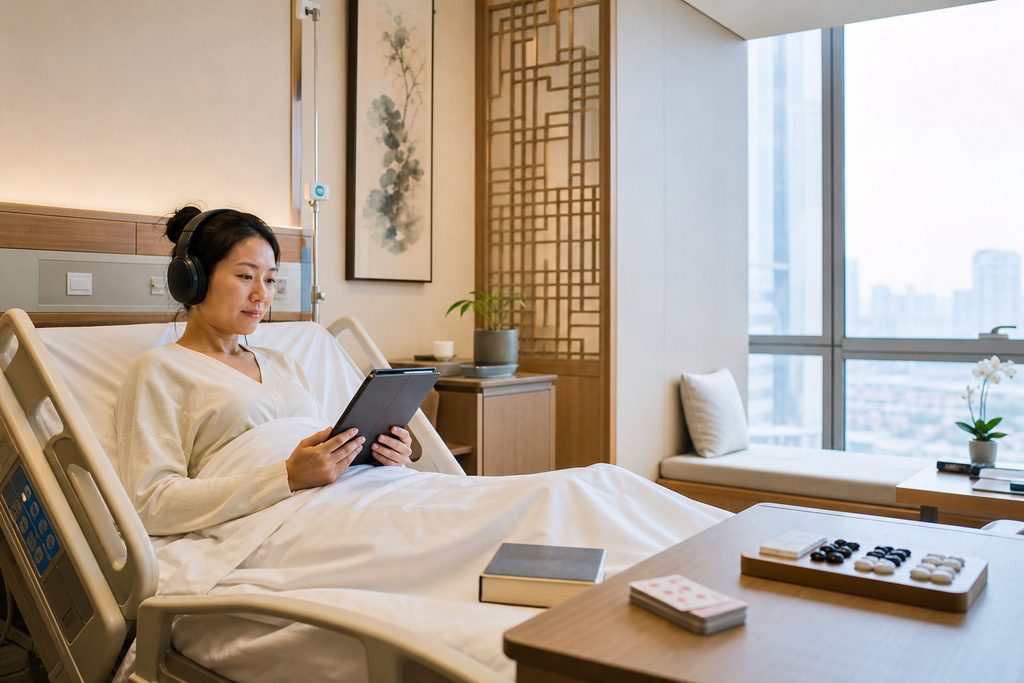
You have probably heard the horror stories. Long-haul flights, unfamiliar food, and then being trapped in a sterile room with nothing but daytime television you cannot understand. The fear of boredom during a long medical recovery in China can feel almost as heavy as the procedure itself. Our team has seen that worry in the eyes of dozens of international patients. The reality, however, lands somewhere quite different. A recovery period here, particularly in cities like Shanghai and Beijing, offers a strange and unexpected window into a culture that most tourists only glimpse from a tour bus. You just need to know how to unlock it.
Finding Things to Do During Medical Recovery in China: The Short Answer
You are not going to be climbing the Great Wall three days after a knee replacement. Let’s get that straight. But you can fill your days with remarkably rich, low-impact experiences. The most effective things to do during medical recovery in China fall into three buckets: digital immersion, gentle on-the-ground exploration, and hands-off cultural learning. You can master a language app, stroll barrier-free botanical gardens, or watch a tea master perform a ceremony from your wheelchair. The catch? Your physical limitations and your location inside China’s unique digital ecosystem will define everything. A patient recovering in a private suite at a JCI-accredited hospital in Shanghai has vastly different entertainment options than someone in a standard public ward. We will walk through both.
Who This Is Right For — and Who It Isn’t
This approach to recovery—treating it as a slow-travel cultural immersion rather than a medical sentence—works brilliantly for some. For others, it is a non-starter. Knowing which camp you fall into saves a lot of disappointment.
You are a good fit if:
- Your surgeon clears you for light, non-weight-bearing movement or wheelchair use within a few days.
- You are curious by nature. You get energy from new sights, sounds, and tastes, even in small doses.
- You are traveling with a companion who can push a wheelchair or help navigate.
- You accept that “entertainment” here might mean a tea tasting, not a rock concert.
- You are recovering in a major city like Shanghai, Beijing, or Guangzhou, where infrastructure is more forgiving.
This is probably not for you if:
- Your recovery requires strict bed rest with zero sitting tolerance for weeks.
- You are immunocompromised and cannot risk any public exposure (air quality, crowds).
- You expect a Western-style resort recovery with poolside bars. Medical recovery is not a vacation.
- You have zero patience for language barriers and digital workarounds. Frustration is the enemy of healing.
The Options, Compared: Entertainment Strategies by Recovery Phase
Not all recovery days are equal. Day 3 post-op is a different universe from Day 30. We break down what works when, based on feedback from our patients and their companions.
| Recovery Phase | Physical State | Best Entertainment Strategy | Key Tool/Place |
|---|---|---|---|
| Acute (Days 1-5) | Bed-bound, groggy, pain-managed | Passive digital immersion: Chinese cinema with English subs, audiobooks, language learning apps | VPN installed pre-arrival, noise-canceling headphones |
| Early Mobility (Days 6-14) | Sitting up, short wheelchair rides | Hotel/hospital garden walks, tea houses, short private car tours | Wheelchair-accessible van, bilingual companion |
| Late Recovery (Days 15-30+) | Walking with aids, increased stamina | Museum visits (weekdays only), cooking classes, TCM wellness experiences | Museum audio guide, pre-booked private class |
The acute phase surprises people. You are too tired to do much, but too awake to sleep all day. This is where your pre-trip preparation pays off. Download a VPN before you leave home. Load up a tablet with shows, but also download Pleco, the indispensable Chinese dictionary app. You can point your phone camera at a menu or a sign and watch it translate in real time. It feels like a superpower. For the early mobility phase, the game changes. A private car tour through the French Concession in Shanghai, never stepping out of the vehicle, can be a stunning way to pass an afternoon. You see the plane trees, the art deco mansions, the old men walking songbirds in bamboo cages. You absorb the city without exhausting your body.
Best Places to Visit While Recovering from Surgery Shanghai: A City Built for Gentle Exploration
Shanghai is, frankly, the easiest city in mainland China for a recovering international patient. The reason is simple: it is flat. The Bund has a wide, smooth promenade. The former French Concession has endless tree-lined streets with curb cuts. Many of our patients find that the best places to visit while recovering from surgery Shanghai are not the famous tourist traps, but the quiet, accessible pockets.
Yu Garden is a classic, but the crowds are a nightmare for someone unsteady on their feet. Skip it. Instead, go to Guilin Park on a weekday morning. It is small, exquisitely maintained, and full of locals practicing tai chi. You can sit on a bench and watch for an hour. It costs 2 RMB. The Shanghai Natural History Museum has ramps everywhere and a stunning collection that requires no Chinese to appreciate. The Propaganda Poster Art Centre, tucked in a basement, is a weird, wonderful, and entirely seated experience. You shuffle through decades of visual history in a single, climate-controlled room. For a longer outing, a slow cruise on the Huangpu River at dusk, when the Pudong skyline lights up, requires nothing but sitting. Book a private boat if you can afford it. The public ferries are functional but jostling.
How to Pass Time After Surgery in Beijing: History at a Slower Pace
Beijing presents a trickier challenge. The distances are vast, the traffic legendary. Figuring out how to pass time after surgery in Beijing means accepting that you will not see it all. You will see one thing, deeply, per day. The Temple of Heaven is better than the Forbidden City for a recovering patient. The Forbidden City involves miles of walking on uneven stone. The Temple of Heaven park, by contrast, is a living community space. Go early. Watch the retirees practice calligraphy on the pavement with giant water brushes. Listen to the amateur choirs. The energy is infectious, and there are benches everywhere.
The 798 Art District is another solid bet. It is a sprawling complex of former factory buildings turned galleries. You can rent a wheelchair at some entrances. The floors are mostly smooth concrete. You roll from one air-conditioned gallery to the next, stopping for a pour-over coffee at a hipster café that would not look out of place in Berlin. For something quieter, the Jingshan Park, directly north of the Forbidden City, has a gentle, paved path to a pagoda with the best aerial view of the ancient palace rooftops. It is a climb, but a short one, and the reward is a photograph that looks like a drone shot. A private car can drop you at the east gate, which has the most gradual incline.
Long Recovery Entertainment Options China: The Digital Toolkit
You cannot access Google, Facebook, Instagram, WhatsApp, or Netflix without a VPN. This is non-negotiable. Buy a reputable, paid VPN before you leave your home country. Install it on your phone and tablet. Test it. This single action unlocks the majority of your long recovery entertainment options China. With a VPN, you can stream your home country’s content, video call family without interruption, and maintain your digital life.
But the real entertainment gold is inside China’s own walled garden. Download WeChat. It is not just a messaging app. It is the operating system of daily life. You can use its “Mini Programs” to order food, play games, read articles, and even book doctor appointments. Douyin, the Chinese version of TikTok, is an endless scroll of bizarre, fascinating, and often subtitled content. You do not need to speak Chinese to watch a chef pull noodles with surgical precision or a farmer build a robotic horse. These platforms are designed to be addictive. For a recovering patient, that is a feature, not a bug.
What Can I Do During Extended Hospital Stay China? Making the Ward Work for You
A private room in an international hospital wing changes the calculus. You have space, privacy, and usually a decent WiFi connection. But even in a shared public ward, you have options. The single most common question we hear is, “What can I do during an extended hospital stay China?” The answer often involves bringing the culture to you.
We have arranged for tea masters to perform private ceremonies in hospital suites. A small table, a quiet gaiwan, the scent of oolong. It is meditative and takes an hour. Calligraphy teachers can bring ink, brushes, and paper. Learning to write a few characters is absorbing and requires minimal physical effort. Many hospitals with international departments have in-house TCM wings. A wheelchair ride downstairs for a gentle ear acupuncture session or a hand massage can break up the monotony of the day. Food is another frontier. If your diet allows, ask your bilingual companion to curate a tasting menu of the hospital’s congee variations. Century egg and lean pork congee is a savory, comforting classic. It sounds adventurous, but it is the chicken soup of China. Recovering is the perfect excuse to explore it.
Recovery Holiday Packages China Medical Tourism: Blending Rest with Experience
There is a growing trend of patients, particularly from Southeast Asia and the Middle East, seeking structured recovery holiday packages China medical tourism. These are not “packages” in the bus-tour sense. They are curated, slow-paced itineraries built around a medical procedure. A typical flow might look like this: procedure at a top-tier hospital, 5 days of in-hospital monitoring, transfer to a serviced apartment or hotel with nursing support, and then a series of gentle, private experiences spaced out over two weeks.
Think a private tai chi instructor coming to a nearby park three mornings a week. A Chinese cooking class where you sit at a table and direct the chef. A visit to a silk market where you design a qipao while seated. These packages work because they remove the mental load. You do not have to research wheelchair-accessible vans or negotiate with drivers. The logistics are handled. The cost varies wildly. A basic coordination service might start from $800 for the non-medical logistics. A full-service, high-end recovery experience with 24/7 bilingual support and a private nurse can run $5,000 to $8,000 for the coordination alone, excluding accommodation and treatment costs. It is not cheap. But for a patient who values peace of mind over price, it transforms a medical trip into something resembling a restorative retreat.
Practical Considerations: The Logistics Nobody Tells You About
The romance of recovery travel hits a hard wall if you ignore the basics. Here are the unglamorous facts.
Visa Reality: You are not coming on a tourist visa. Medical treatment requires an S2 visa, and your accompanying family member needs the same. The hospital will provide an invitation letter. Visa processing times vary, but factor in at least two weeks. Overstaying is not a minor offense. It means fines, detention, and a black mark that makes future travel difficult.
Payment and Insurance: Most public hospitals want payment upfront. They do not bill your US or European insurer. You pay, you get a receipt, you submit a claim at home. International private hospitals like United Family or Jiahui often have direct billing arrangements with major global insurers. Check this before you commit to a facility. The financial buffer for unexpected complications needs to be real. A $20,000 procedure estimate can become $30,000 if your recovery takes longer.
The Language Barrier: You cannot rely on Google Translate because Google is blocked. Baidu Translate works. Pleco works. Hand gestures work. But in a moment of pain or confusion, an app is a poor substitute for a human. A bilingual medical companion is not a luxury. It is the single most effective tool for reducing recovery stress. They can read the fine print on your discharge medication, argue with a taxi driver, and tell you that the strange sensation you are feeling is normal and the nurse just explained it five minutes ago in Mandarin.
Air Quality: Beijing has bad days. Shanghai has moderate days. If you have respiratory issues, this matters. Your surgical wound will not care about PM2.5, but your lungs will. Download an air quality app. On heavy pollution days, stay inside. Make that your cinema and tea ceremony day.
Frequently Asked Questions
Yes, with rules. Stick to hot, cooked foods. Congee, noodle soups, steamed buns. Avoid raw vegetables and tap water. The hospital’s international wing will have safe, if bland, options. If you venture out, let your companion guide you to clean, reputable restaurants. A bout of food poisoning during recovery is a serious setback, not a minor inconvenience.
Not necessarily. Bring a supply from home that covers your entire stay plus a two-week buffer. Some Western medications are unavailable or sold under different brand names. Have your doctor write a letter listing your medications, their generic names, and dosages. Keep it with your passport. A bilingual companion can help you find an equivalent at a hospital pharmacy if needed, but never assume availability.
You carry your hospital discharge summary and your companion’s phone number at all times. Your companion knows the nearest hospital with an emergency department. In a major city, an ambulance ride is fast and cheap by Western standards. Your companion’s primary job in that moment is communication, not medical care. They bridge the gap between you and the Chinese-speaking emergency staff.
This is the unspoken challenge. The first week is novel. The third week can be crushing. Schedule daily video calls with family at a set time. Join expat WeChat groups for your city; you can find them through a search on your companion’s phone. Just reading the English chatter can make you feel less isolated. Some patients find that the forced stillness, away from the demands of home, becomes an unexpected psychological reset. But do not underestimate the emotional weight. It is real, and it is normal.
Your Next Step
A long recovery in China is what you make of it. It can be a sterile, boring, frustrating stretch of days. Or it can be a strange, slow, deeply human chapter in your life. The difference lies entirely in preparation and local knowledge. Our team at China Medical Services does not provide medical care. We are not doctors, and we do not make diagnoses. What we do is handle the thousand small logistical knots that tie a recovering patient to their bed. From coordinating a bilingual companion for a tea house visit to arranging a private, wheelchair-accessible car for a museum day, we make sure your recovery is not defined by what you cannot do. If you are considering a procedure in China and the long recovery is the one thing holding you back, let’s talk. You can explore how we work at our patient coordination page. Recovery is a waiting game. It does not have to be a lonely one.
For more medical information and treatment options in China, visit chinamedservices.com (China Medical Services).
