Find English Hairdresser Barber Near Chinese Hospital: A Medical Tourist’s Practical Guide
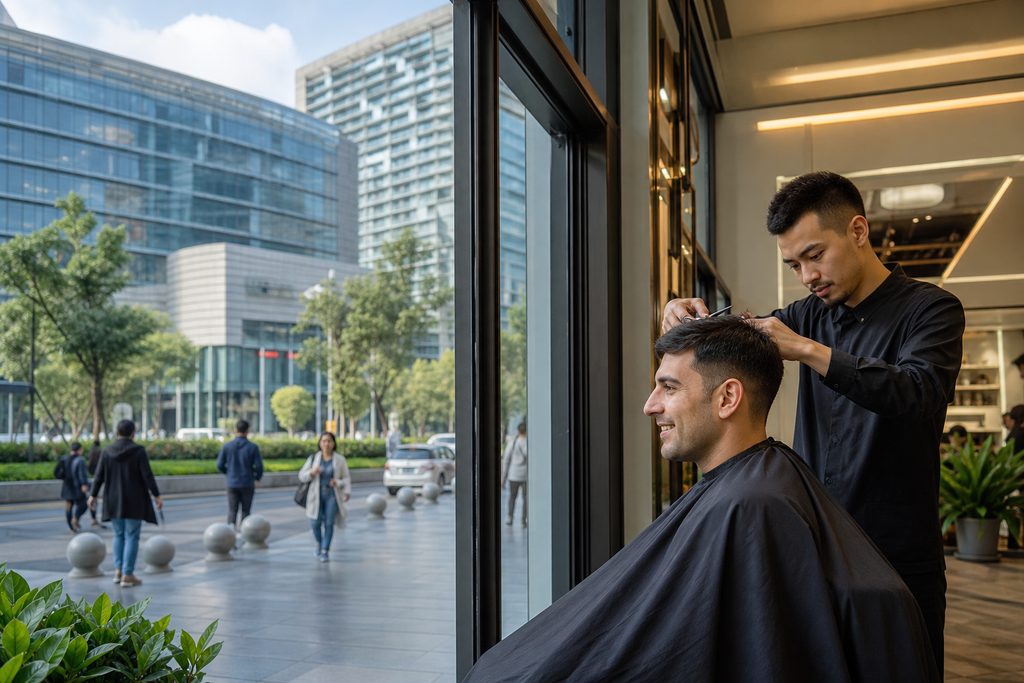
When 67-year-old Robert flew from Manchester to Shanghai for a knee replacement at Zhongshan Hospital, he had his surgery date, his visa, and a folder of translated medical records. What he hadn’t planned for? Three days before admission, sitting in his serviced apartment near Fenglin Road, realizing he looked like he’d been sleeping in an airport lounge for a week. He needed a haircut. Not a dramatic restyle. Just a barber who could understand “short back and sides, please” without a 15-minute game of charades.
Robert’s problem is more common than you’d think. Medical travel isn’t just about the procedure. It’s about the days before and after—the waiting, the recovery, the strange limbo in a foreign city where you need ordinary things done. Like finding an English speaking barber near Chinese hospital campuses.
This isn’t a guide to luxury salon experiences. It’s a practical breakdown of how to get a decent haircut when you’re in China for medical treatment, don’t speak Mandarin, and need someone who understands what you’re asking for.
How This Actually Works, Step by Step
The process is less about finding one magic barbershop and more about knowing where foreigner-friendly services cluster. Here’s the sequence that works.
First, identify your hospital’s neighborhood. Most top-tier Chinese hospitals sit in dense urban districts with mixed commercial and residential blocks. Fuwai Hospital in Beijing is in Xicheng District. Huashan Hospital in Shanghai is in Jing’an. These aren’t isolated medical campuses—they’re surrounded by shops, restaurants, and yes, hair salons. But not all of them can handle an English-speaking client.
The practical approach: search for international clinics or expat-oriented businesses within a 15-minute walk or a short DiDi ride from your hospital. Barbershops and hair salons that cater to foreigners tend to cluster near international schools, expat housing compounds, and—crucially—private international hospitals. A barber shops near international hospitals Beijing search will almost always surface options in Chaoyang District near Beijing United Family Hospital, not in the hutongs around the public hospital you’re actually visiting. That’s fine. The 20-minute DiDi ride is worth the language barrier you’ll avoid.
Once you’ve identified a candidate salon, book through their English-language WeChat account or via a call handled by your medical concierge team. Show up with a photo. Photos transcend language. A picture of the haircut you want eliminates 90% of the communication risk.
Why Hospital Location Determines Your Options
This is the part most guides skip. Your choice of hospital shapes everything about your daily life during treatment—including where you’ll get a haircut.
Shanghai’s top public hospitals cluster in Xujiahui (Zhongshan Hospital, Shanghai Sixth People’s Hospital) and the former French Concession (Ruijin Hospital, Huashan Hospital). These areas have decades of expat history. Walk 10 minutes from Huashan Hospital on Wulumuqi Road and you’ll pass three hair salons with English-speaking stylists. The concentration isn’t accidental. It’s the legacy of the French Concession’s international character, now reinforced by nearby corporate headquarters and international schools.
Beijing is different. The top public hospitals—Peking Union Medical College Hospital, Fuwai Hospital, Beijing Hospital—sit in Dongcheng and Xicheng districts, areas with far fewer expat-oriented businesses. The international hospital cluster in Chaoyang is a 30-minute drive east. If you’re staying near PUMCH for cardiac care, you’re not going to find an English-speaking barber on Dongdan North Street. You’ll need to plan a trip to Chaoyang or Sanlitun.
This geographic reality explains why how to find English hairdresser in Shanghai is a fundamentally different question from finding one in Beijing or Guangzhou. Shanghai’s medical and expat infrastructure overlap geographically. Beijing’s don’t. Guangzhou’s top hospitals cluster in Yuexiu District, but the expat-friendly salons are across the river in Tianhe. Chengdu’s Huaxi Hospital sits in Wuhou District, with international services scattered south toward the Hi-Tech Zone.
The takeaway: map your hospital first, then search for foreigner-friendly services in the nearest expat neighborhood, not the nearest commercial street.
A Realistic Timeline
Getting a haircut during a medical trip isn’t like booking one at home. You’re working around hospital schedules, recovery periods, and unfamiliar booking systems. Here’s what the timeline actually looks like.
| Stage | What Happens | Typical Duration |
|---|---|---|
| Pre-arrival research | Identify 2-3 candidate salons near your hospital or accommodation; check WeChat or English booking channels | 1-2 hours, 1-2 weeks before departure |
| Arrival and settling | Check into accommodation, complete hospital registration, initial consultations | Days 1-3 |
| Booking the appointment | Contact salon via WeChat, concierge, or walk-in; confirm English-speaking stylist availability | Same day to 48 hours ahead |
| The haircut itself | 30-60 minutes; bring a photo, confirm price before starting | Day 2-5 of your stay |
| Post-surgery timing | If you need a cut after surgery, wait until mobility is comfortable and wounds are protected from water and product | 5-10 days post-procedure minimum |
The critical window is the 48 hours before hospital admission. That’s when you’re settled but not yet under medical restrictions. Get the haircut then. After surgery, you may not feel like sitting in a salon chair for weeks.
What Can Go Wrong — and What Happens Then
The honest failure modes matter. Here are the ones we’ve seen.
The stylist you booked isn’t working that day. This happens. Chinese salons sometimes rotate stylists without updating English-language booking platforms. You show up, and the one person who speaks English is off. Your options: use a translation app with photos, reschedule, or ask your medical companion to interpret over the phone. None are ideal. All are workable.
The “English-speaking” claim is optimistic. A stylist who can say “hello,” “shampoo,” and “short” is not English-speaking in any functional sense. You’ll know within 30 seconds. If the communication gap is too wide, politely decline and leave. You’re not obligated to sit through a bad haircut. Have a backup salon identified before you go.
The price quoted isn’t the price you’re charged. This is rarer at expat-oriented salons but worth watching. Confirm the total price—including wash, cut, and any styling—before the scissors touch your head. A simple “How much total?” while pointing at your photo is enough.
You’re too tired, in too much pain, or too medicated to care about your hair. This is the most common “failure mode” and it’s not really a failure. Post-surgery fatigue is real. If you don’t have the energy for a salon visit, you don’t go. A hat works fine. Recovery comes first.
What Makes a Salon Actually Work for Medical Tourists
Not all English-speaking salons are equal when you’re in China for treatment. The criteria shift when you’re a patient, not a tourist or business traveler.
Proximity to your accommodation matters more than proximity to the hospital. You’ll spend more time at your apartment or hotel than at the hospital itself. A salon 10 minutes from where you’re sleeping is worth more than one 2 minutes from the outpatient department you’ll visit twice.
Booking flexibility is non-negotiable. Medical schedules change. Tests get rescheduled. You feel worse than expected and need to rest. The best salon for a medical tourist is one that doesn’t penalize last-minute changes. Expat-oriented salons in Shanghai’s Jing’an district and Beijing’s Chaoyang district tend to understand this. Neighborhood Chinese salons often don’t—they operate on tight appointment books and may charge for no-shows.
Hygiene standards are higher stakes for you than for the average customer. You may be immunocompromised or have healing incisions. Look for salons that visibly sanitize tools, use fresh towels, and maintain clean stations. International chain salons and those inside five-star hotels almost always meet this standard. A ¥30 street-side barbershop probably doesn’t.
Price transparency helps when you’re managing a medical budget. The best English hair salon for medical tourists China experience isn’t necessarily the most expensive. It’s the one where you know exactly what you’ll pay before you sit down. In Shanghai, expect ¥150-400 (roughly $20-55 USD) for a men’s cut at an expat-friendly salon. In Beijing, ¥120-350. Hotel salons run higher—¥300-800. These are modest sums compared to what you’re spending on treatment, but surprises add stress you don’t need.
Practical Considerations: Booking, Payment, and Getting There
Most expat-oriented hair salons in Chinese cities use WeChat for booking. If you don’t have WeChat set up, this is one of the first things to arrange before your trip. Your medical concierge can handle WeChat communication if you haven’t set up the app.
Payment is straightforward. Alipay and WeChat Pay dominate. International credit cards work at hotel salons and higher-end expat establishments but rarely at neighborhood shops. Carry some cash in RMB as backup. A men’s cut at a decent expat salon in Shanghai typically runs ¥150-300. Bring ¥500 to be safe.
Getting there: DiDi is the ride-hailing app you want. It has an English interface and works like Uber. Show the driver the salon’s address in Chinese characters—have it saved on your phone or printed. If you’re post-surgery and mobility is limited, ask your medical companion to accompany you. The ¥200/day bilingual companion fee covers exactly this kind of practical help.
Language backup plan: even at an English-speaking salon, have a photo of your desired haircut ready. Have the Chinese name of your accommodation saved so you can show the driver for the return trip. Small preparations prevent big frustrations.
Timing matters. Avoid Chinese holidays. During Spring Festival (late January/February) and National Day (first week of October), many salons close or operate with skeleton staff. Book around these dates if your treatment schedule allows.
Frequently Asked Questions
Can I book haircut near hospital Shanghai English without a Chinese phone number?
You can, but it’s harder. Most salons use WeChat for booking, and WeChat requires a phone number for registration—not necessarily Chinese, but you need one that receives SMS verification. If you haven’t set up WeChat before arriving, ask your hotel concierge or medical companion to book on your behalf. Walk-ins work at larger salons, but you risk a long wait or no English-speaking stylist availability.
Are there hair salon for foreigners near hospital in China that understand medical patient needs?
Not explicitly. Salons don’t market themselves as “medical tourist friendly.” But the ones near international hospitals and in expat neighborhoods have seen it all—clients recovering from surgery, clients with limited mobility, clients who need to avoid certain products. The best approach: when booking, briefly mention you’re in town for medical treatment and may need flexibility. The good salons will accommodate. The rigid ones will tell you upfront, and you’ll know to book elsewhere.
What if I need a haircut urgently right before surgery and nothing is available?
This is where hotel salons earn their premium. Five-star hotels in Shanghai, Beijing, and Guangzhou almost always have an in-house salon with at least basic English capability. They’re expensive—¥400-800 for a men’s cut—but they’ll fit you in same-day and the communication barrier is minimal. If you’re staying at a serviced apartment near the hospital rather than a hotel, the front desk can usually recommend a nearby salon that handles foreign guests.
Will an English speaking barber near Chinese hospital understand Western hair textures?
It depends on the salon and the stylist. Expat-oriented salons in Shanghai and Beijing routinely work with non-Asian hair types. Stylists at places like Bono Salon in Shanghai or Toni & Guy locations in major Chinese cities have training on diverse hair textures. But if you have very curly, coily, or Afro-textured hair, call ahead and specifically ask. Don’t assume. A 5-minute phone call or WeChat message saves you from a bad experience. Some salons have specific stylists who specialize in non-Asian hair—ask for them by name if recommended.
Is it safe to get a haircut after surgery in China?
Generally yes, with common-sense precautions. Wait until your surgeon clears you for normal activity. Keep surgical sites dry and protected from water, product, and clippings. Avoid positions that strain incisions—reclining at a shampoo bowl can pull on abdominal or chest wounds. If you’re on blood thinners, mention this; a small nick from scissors is usually trivial but worth the stylist knowing about. When in doubt, wait. A bad haircut grows back. A surgical complication doesn’t.
Your Next Step
A haircut is a small thing in the context of a major medical journey. But small things accumulate. When you feel like yourself—clean, groomed, put-together—you face treatment with more confidence. The practical work of finding an English-speaking barber near your Chinese hospital is exactly the kind of detail our team handles daily.
We’re not stylists. We’re not a booking platform for salons. What we do is connect international patients with China’s top-ranked hospitals and manage the logistics around treatment—from hospital matching and appointment coordination to bilingual companion services that include exactly this kind of practical, everyday support. If you’re planning treatment in Shanghai, Beijing, or any of the 37 cities we cover, we can help you focus on your health while we handle the rest.
A good haircut won’t fix what brought you to China. But it’s one less thing to worry about. And sometimes that’s enough.
For more medical information and treatment options in China, visit chinamedservices.com (China Medical Services).
