Lab Tests and Imaging in China Hospitals: The Complete Process Flow for Foreign Patients
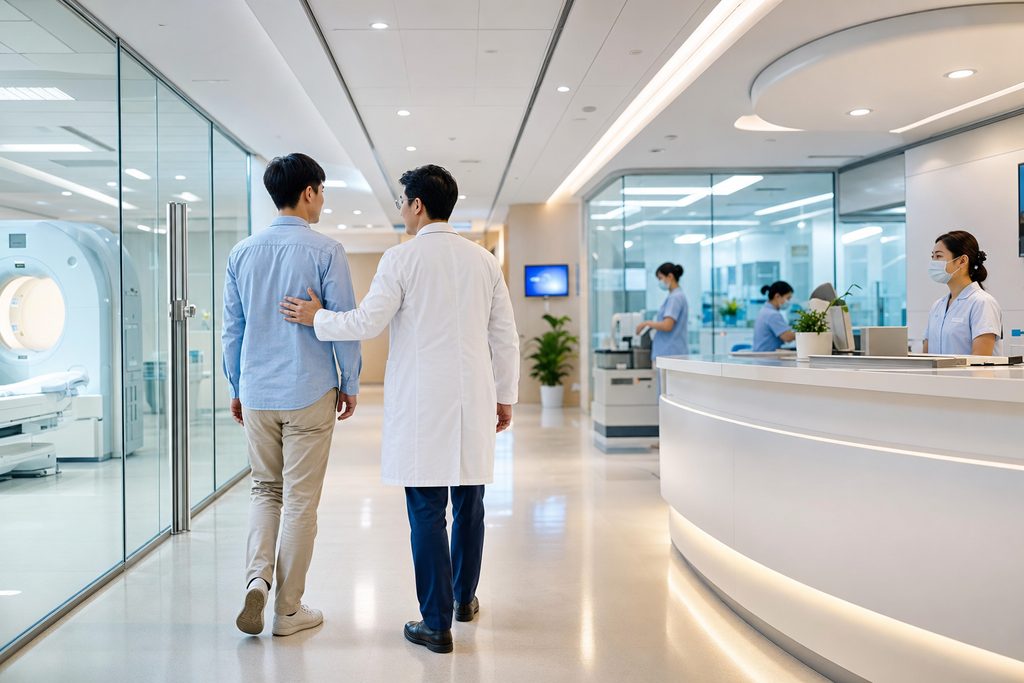
When 42-year-old Michael first heard the diagnosis, he had no idea where to start looking for treatment. His cardiologist back in Manchester recommended an MRI and a full cardiac enzyme panel. The wait time at his local NHS trust? Fourteen weeks. Frustrated, he started searching online. He typed in “lab test cost China hospital” and “MRI scan price Shanghai.” The numbers stunned him. But what really kept him up at night wasn’t the price. It was the process. How does a foreigner actually walk into a Chinese hospital, get blood drawn, and walk out with reliable results? He couldn’t find a clear answer.
So we wrote one.
Our team handles this exact puzzle every week. We connect patients with China’s 340+ top-ranked hospitals across 37 cities. We don’t practice medicine. We translate the system. Here is the unvarnished process flow for lab tests and imaging in Chinese hospitals—what actually happens from the moment you land to the moment you have your report in hand.
How This Actually Works, Step by Step
The process isn’t complicated once you see it laid out. But it is different from what most Western patients expect.
First, you need a doctor’s order. Chinese hospitals rarely let you walk in off the street and request a full body scan or a blood panel without a physician’s requisition. This is true for public hospitals and most private international ones. The doctor must assess you, determine which tests are clinically indicated, and issue the order through the hospital’s internal system.
That means step one is always a consultation. You either schedule a video consultation from abroad—our team arranges these with the relevant specialty department—or you show up in person at the international medical center of a hospital. The doctor evaluates your existing records. They decide what’s needed. Then the order gets generated.
Step two is payment. Chinese hospitals operate on a prepaid model. You load funds onto a hospital-issued card or pay the estimated charges upfront at the cashier. The lab test cost China hospital patients face varies dramatically. A standard CBC and metabolic panel at a public hospital’s international department might run from $40 to $120. The same panel at a private international hospital like United Family could be $200 to $350. An MRI scan price Shanghai patients typically encounter ranges from $500 to $900 at a top-tier public hospital, and $1,200 to $1,800 at a private facility. These are real ranges based on actual cases we coordinate. They shift with the hospital, the body part scanned, and whether contrast dye is used.
Step three is the actual draw or scan. For blood work, you go to the phlebotomy station. Most major hospitals in Beijing, Shanghai, and Guangzhou have designated international patient areas where the queues are shorter. A typical blood draw takes under ten minutes. For imaging—MRI, CT, ultrasound—you head to the radiology department. If you need a PET-CT, that usually requires a separate appointment and sometimes fasting.
Step four is the wait. Blood test results often come back same-day or within 24 hours. A standard X-ray report may be ready in two hours. An MRI with a full radiologist read typically takes 24 to 48 hours. A PET-CT might take three days. These are faster than most Western systems. The trade-off is that you need to be physically present or have someone collect the digital files for you.
Step five is the follow-up consultation. The same doctor who ordered the tests reviews the results with you. This is not optional. The hospital won’t just email you a PDF and call it done. You sit down, the doctor explains the findings, and they write the next steps—further imaging, a treatment plan, a referral, or a clean bill of health.
That’s the skeleton. Now let’s look at the parts that actually trip people up.
Can You Trust Lab Results from Chinese Hospitals?
This question comes up in nearly every initial consultation. The short answer: yes, when you choose the right facilities.
China’s top-tier hospitals—the ones in the Fudan ranking system, the ones we work with—operate clinical laboratories that participate in international external quality assessment programs. Many are CAP-accredited (College of American Pathologists) or ISO 15189 certified. Peking Union Medical College Hospital, Fuwai Hospital, West China Hospital, Ruijin Hospital—these are not small community clinics. They run hundreds of thousands of lab tests annually. Their equipment is the same Siemens, Roche, and Abbott analyzers you’d find in a major U.S. or European hospital.
Imaging tells a similar story. The MRI and CT scanners in China’s top 100 hospitals are overwhelmingly modern. Siemens Healthineers, GE Healthcare, Philips. 3T MRI machines are standard in large centers. The radiologists reading your scans are fully board-certified in China, and many have trained abroad.
Where things get uneven is at smaller, lower-tier hospitals. A county-level hospital in a third-tier city may have older equipment and less rigorous quality control. That’s why hospital selection matters enormously. Our top-ranked hospitals database filters for the institutions that meet international benchmarks. You don’t need to guess.
One practical point: always request your raw data. If you get an MRI, ask for the DICOM files on a CD or a USB drive. If you have blood work done, ask for the full report with reference ranges. This lets your home physician review everything independently. Chinese hospitals in the international tier are accustomed to this request and will comply without pushback.
A Realistic Timeline
People come to us with tight schedules. They want to know exactly how many days to block. Here is a realistic timeline based on cases we coordinate, assuming no complications and a patient who already has a confirmed diagnosis from abroad.
| Stage | What Happens | Typical Duration |
|---|---|---|
| Week 1–2 | Remote consultation scheduling, document translation, hospital selection | 5–10 business days |
| Day 1 (in-country) | In-person consultation with specialist, test orders issued, payment loaded | 2–4 hours |
| Day 1–2 | Blood draw and standard X-ray completed | 30–60 minutes for draw; 2 hours for X-ray report |
| Day 2–4 | MRI or CT scan appointment (non-emergency) | 1–3 days lead time for the slot; 1–2 hours for the scan itself |
| Day 3–5 | MRI/CT radiology report finalized | 24–48 hours after scan |
| Day 5–7 | Follow-up consultation, review of all results, treatment plan discussion | 1–2 hours |
| Day 7+ | If treatment or surgery is indicated, admission scheduling begins | Varies widely by hospital and procedure |
The part people forget is the document translation. If your previous medical records, imaging reports, and referral letters are not in Chinese, the reviewing physician may need them translated. Our team handles this. But it adds time. Plan for it.
Visa processing adds another layer. An S2 visa for medical treatment typically takes 4 to 10 business days depending on your local Chinese embassy or consulate. We provide the invitation letter and hospital documentation. We don’t control the consular timeline.
What Can Go Wrong—and What Happens Then
Let’s be direct. Things go sideways. Here are the failure modes we see most often, and the actual recourse.
The hospital rejects the test order. This happens when a doctor reviews your case and decides the requested imaging isn’t clinically justified. Maybe you want a full-body MRI as a screening tool. Many Chinese public hospital specialists will refuse. They’re trained in evidence-based medicine and won’t order scans without a clinical indication. The fix: switch to a private international hospital that offers executive health screening packages, or accept the doctor’s recommendation and proceed with what’s medically appropriate.
Results are delayed. Radiology departments in top hospitals are busy. A promised 48-hour turnaround can stretch to 72 if the department is overloaded. This isn’t negligence. It’s volume. Our bilingual medical companions track these deadlines and escalate when needed. Often, a polite in-person inquiry at the radiology desk resolves the delay within hours.
The report contains terminology that confuses your home doctor. Chinese radiology reports sometimes use descriptive language that differs from the standardized templates Western physicians expect. The image quality is fine. The interpretation is sound. But the phrasing can feel foreign. The fix: request a structured report addendum from the radiologist, or have the report reviewed by a bilingual specialist who can bridge the terminology gap. We do this as part of our case management service.
You can’t pay with your international credit card. Many Chinese hospital payment counters accept UnionPay but not Visa or Mastercard. Cash is always accepted. Wire transfers work for larger deposits. We warn patients about this in advance and help them set up payment methods before they arrive. It’s a small friction, but surprising if you’re not ready.
How to Book a Full Body Checkup Package in China
This is different from diagnostic testing. A full body checkup—what Chinese hospitals often call a “health checkup package” or “executive physical”—is a screening program. You don’t need a specific symptom or diagnosis. You walk in, spend a half-day going through stations, and walk out with a comprehensive report.
Many foreigners search for “book full body checkup China package” because they’ve heard about the speed and value. The packages are genuinely impressive. A mid-tier package at a public hospital international department might include chest X-ray, abdominal ultrasound, full blood chemistry, tumor markers, thyroid function, and an ECG. Cost: roughly $300 to $600. A premium package adding cardiac CT, full-body MRI, and advanced cancer screening can run $1,200 to $2,500.
These packages are bookable in advance. That’s the key difference from diagnostic testing. You don’t need a doctor’s order first. You contact the hospital’s health management center directly, select a package, and schedule a date. Our team handles this booking, confirms which specific tests are included, and ensures an English-speaking coordinator is present on the day.
A few cautions. The packages are standardized. You can’t easily swap out one test for another without paying an upcharge. The reports are typically available within 3 to 7 days. And the doctors reviewing your results will flag abnormalities and recommend follow-up—but they won’t treat you on the spot. If something concerning shows up, you’ll need a separate specialist consultation.
For patients who want a one-day snapshot of their health status, these packages are efficient and cost-effective. Just go in with clear expectations about what a screening can and cannot tell you.
Practical Considerations: Records, Payment, and Language
Bring everything. Every previous scan, every lab report, every discharge summary. Bring the DICOM files, not just the printed reports. Chinese specialists want to see the primary data, not someone else’s interpretation. If you had a cardiac MRI in London two years ago, bring the disc. The doctor here will load it and compare it side-by-side with the new scan.
Payment is straightforward but inflexible. Public hospitals require prepayment. You deposit a lump sum at the international medical center, they deduct as tests are performed, and any remainder is refunded at discharge. Private international hospitals may accept direct insurance billing. Check with your insurer before you travel. If you’re paying out of pocket, the lab test cost China hospital patients pay is almost always lower than the equivalent U.S. list price—often by a factor of five or more.
Language is the invisible wall. The phlebotomist drawing your blood probably doesn’t speak English. The radiology technician positioning you for an MRI probably doesn’t either. The international department receptionist does. Your consulting physician almost certainly does, at least at the top-ranked hospitals. But the in-between moments—finding the right floor, understanding the cashier’s instructions, knowing which queue to stand in—those are where a bilingual companion earns their value. Our medical companions cost from $200 per day and handle exactly these frictions.
Insurance reimbursement is your responsibility. Chinese hospitals will give you detailed invoices and medical reports. You submit those to your insurer back home. We advise getting pre-authorization from your insurance company before you travel. Some international plans have network restrictions or require second opinions. Know your policy.
Frequently Asked Questions
An MRI scan price Shanghai patients typically pay ranges from $500 to $900 at a top-tier public hospital’s international department, and $1,200 to $1,800 at a private international hospital. The exact cost depends on the body part scanned, whether contrast is used, and the specific hospital. These prices include the radiologist’s report.
You need a doctor’s order first. Schedule a consultation at a hospital’s international medical center, bring your medical records and a clear explanation of what you need tested, and the physician will issue the requisition. Then you pay at the cashier and proceed to the phlebotomy station. Results typically come back within 24 hours.
Yes, when you choose the right hospital. China’s top-ranked institutions use the same lab equipment as major Western hospitals and many hold CAP or ISO 15189 accreditation. Always request your raw data and reference ranges so your home physician can independently verify. Avoid small, unaccredited facilities.
Yes. Medical travelers use an S2 visa, which covers short-term private affairs including medical treatment. The application requires an invitation letter and supporting documents from the Chinese hospital. Processing typically takes 4 to 10 business days. We provide the documentation package as part of our coordination service.
This is rare but it happens. The fix is to request the raw data—DICOM files for imaging, full lab values with reference ranges—and have them reviewed by a bilingual specialist who can translate the report into the format your doctor expects. You can also request a written second opinion from the Chinese specialist addressing your home doctor’s specific concerns.
Your Next Step
The process flow for lab tests and imaging in China is manageable once you understand the sequence: consultation, order, payment, test, results, follow-up. The system moves faster than most Western alternatives. The quality at top-tier hospitals is genuine. But the friction points—language, payment, document translation, hospital selection—are real and can waste days of your time.
Our team exists to remove that friction. We help you choose the right hospital from our network of 340+ top-ranked institutions, schedule the consultations, translate your records, and put a bilingual companion by your side through every step. We don’t practice medicine. We don’t promise outcomes. We make the system navigable.
If you’re considering diagnostic testing in China, start with a conversation. Tell us what you need, and we’ll tell you honestly whether it makes sense. The first consultation is free. No pressure. Just clarity.
Get a free consultation about your diagnostic testing options in China.
For more medical information and treatment options in China, visit chinamedservices.com (China Medical Services).
