Service Animal China Surgery: Guide Dog Access Rules and Costs
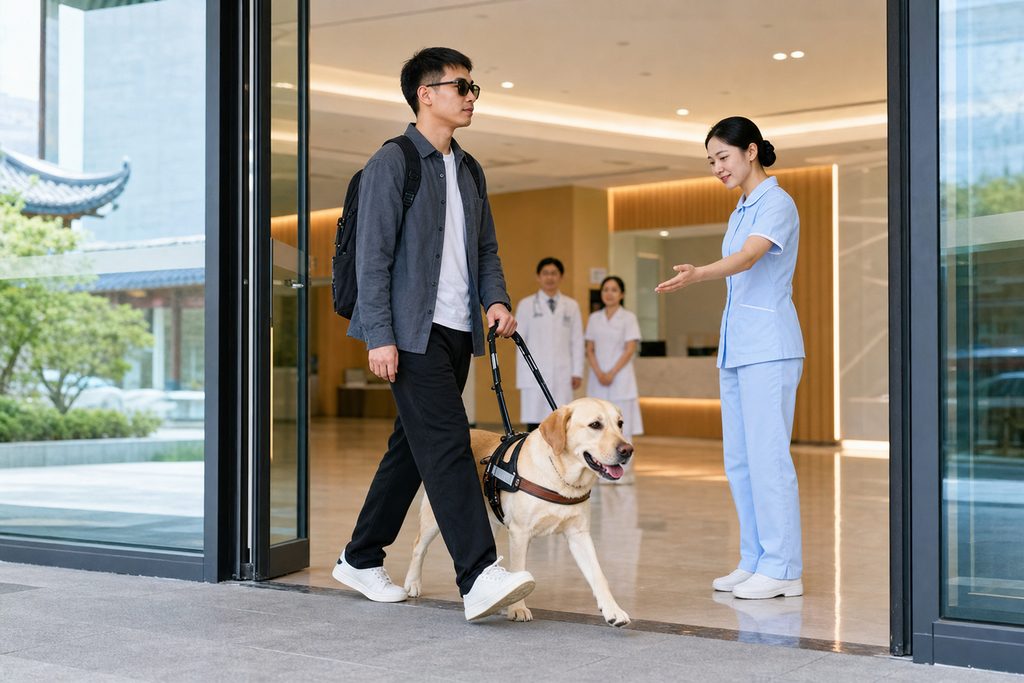
According to the China Disabled Persons’ Federation, the country has over 85 million people living with disabilities, yet the formalized guide dog infrastructure remains concentrated in major metropolitan hubs. If you are searching for “guide dog surgery cost China” while planning your own medical procedure, you are stepping into a logistical niche that few international patient coordinators discuss openly. The surgery itself is often the straightforward part. The intersection of animal quarantine laws, hospital infection-control policies, and the absence of a unified national service-animal standard creates a puzzle you need to solve before booking a flight.
We see this scenario unfold regularly. A patient needs a knee replacement or a cardiac ablation in Shanghai. They cannot leave their guide dog at home for six weeks. They call us after hitting a wall of vague embassy replies and hospital websites that never mention animals. Our team does not provide veterinary services, but we coordinate the human medical journey. That journey includes mapping out whether your dog can stay with you, where the gaps are, and what it costs to bridge them. Let’s walk through it without the sugarcoating.
How This Actually Works, Step by Step
The process splits into two parallel tracks: your medical clearance and your dog’s entry clearance. They do not move at the same speed. Start the dog’s paperwork first. Always.
You send us your diagnostic imaging, bloodwork, and a summary of what you need treated. We route it to the relevant specialty at a top-tier hospital—cardiac surgery at Fuwai Hospital, orthopedics at Peking University Third Hospital, or oncology at Fudan University Shanghai Cancer Center. Within 5 to 7 business days, you receive a written second opinion. It outlines whether the Chinese team agrees with the proposed surgical plan, what the protocol would be, and an estimated treatment cost. This step costs from $300 to $500 and is for reference only, not a prescription. If you proceed, we coordinate a video consultation with the surgeon. That runs $500 to $800 for a top specialist.
While the medical evaluation unfolds, you tackle the animal side. China requires guide dogs to enter through designated ports—Beijing, Shanghai, Guangzhou, and a few others. You need a valid rabies antibody titer test from an approved lab, a microchip meeting ISO 11784/11785 standards, and an international health certificate endorsed by your home country’s authority. Quarantine is not automatic. If your paperwork is perfect and you arrive at the right port, your dog may be released on-site after a physical exam. If anything is missing, expect a 30-day quarantine at a government facility. We have seen this happen. It is not reversible once you land.
We do not handle veterinary paperwork, but we connect you with specialized pet relocation agents in China who do. Their fees start around $1,500 for document review and customs brokerage. That is separate from your medical coordination costs. After the video consult, if you decide to come, we lock in the hospital admission date through the international VIP channel. You apply for your S2 visa with the hospital’s invitation letter. You book a service-animal-friendly serviced apartment near the hospital. You fly. You recover. You go home.
Can You Actually Bring Your Service Animal to a Chinese Hospital?
Here is the core friction. China does not have an equivalent to the Americans with Disabilities Act. There is no federal law that compels a private business or a public hospital to admit a service animal. The Shanghai Municipal Government issued guidelines in 2023 encouraging public venues to accommodate guide dogs, but the language is permissive, not mandatory. A hospital administrator can say no. And some do.
Infection control is the cited reason. An operating theater is a sterile field. An ICU is a high-risk zone. No hospital in the world allows a dog into an OR. The question is whether your dog can stay with you in a private inpatient room. The answer depends on the hospital. Public tertiary hospitals—the ones with the best surgical outcomes—are often the least flexible. Their wards are crowded. Private rooms are scarce. A guide dog lying beside your bed is an unfamiliar sight for nursing staff who have never encountered this request. The international VIP wings at hospitals like Peking Union Medical College Hospital or Huashan Hospital are more accustomed to unusual patient needs. They have dedicated nursing teams and private suites. They are also more expensive, typically 1.5 to 2 times the standard rate.
We always verify the hospital’s current policy in writing before you book. We have seen policies shift within the same calendar year. A hospital that said yes in January might say no in June after a change in nursing leadership. We do not promise what we cannot control. We tell you what the hospital’s international department confirms at the time of your case review. If the answer is no, we pivot. We find a nearby private serviced apartment that accepts guide dogs and arrange daily outpatient visits instead of a prolonged inpatient stay. That is the backup plan. It works, but it changes the recovery rhythm.
A Realistic Timeline
Patients underestimate the pre-departure runway. The medical evaluation is the fast part. The animal paperwork is the bottleneck. Here is what a realistic timeline looks like when everything goes right.
| Stage | What Happens | Duration |
|---|---|---|
| Week 1–2 | Submit medical records for written second opinion. Simultaneously, book your dog’s rabies titer test if not already done. | 5–10 business days for opinion; titer results take 3–4 weeks from the lab. |
| Week 3–4 | Video consultation with the Chinese specialist. Confirm surgical plan and provisional dates. | 1–2 weeks to schedule the call. |
| Week 5–8 | Receive titer results. Begin China import permit application through a pet agent. We request the hospital’s invitation letter for your S2 visa. | Permit processing: 2–3 weeks. Visa processing: 1–2 weeks after embassy appointment. |
| Week 9–10 | Finalize hospital admission date. Book flights and accommodation. Confirm airport pickup and hospital registration. | 1–2 weeks. |
| Week 11 | Arrive in China. Dog cleared by port quarantine. Pre-op testing at the hospital. | 2–3 days before surgery. |
| Week 12 | Surgery. Inpatient recovery begins. | Varies by procedure. |
This timeline assumes your dog already has a compliant microchip and a current rabies vaccination. If not, add another 4 to 6 weeks. The rabies titer test is the hard gate. You cannot rush a lab. You cannot skip it. Plan for 3 months minimum from the day you start to the day you land. Many patients need 4.
What Can Go Wrong — and What Happens Then
Let us be blunt about the failure modes. We have seen each of these happen.
The hospital revokes access at the last minute. A department head changes. A new infection-control audit triggers a policy rewrite. Your dog was approved, and now it is not. We activate the outpatient pivot. You stay in a verified pet-friendly apartment. A bilingual medical companion escorts you to daily wound checks, physiotherapy, and follow-up imaging. The dog stays in the apartment during those hours. The recovery is slower and less comfortable than having 24/7 nursing care, but the surgery still happens.
Your dog is flagged at port quarantine. The health certificate has a smudge. The microchip read fails. The titer result is from an unrecognized lab. The dog goes into a 30-day government quarantine kennel. You cannot visit. You cannot intervene. The only prevention is obsessive document review by a local agent before you fly. If it happens anyway, you proceed with your surgery alone and wait. It is brutal. It is legal. We have no leverage to override a customs officer’s decision.
You need a longer inpatient stay than planned. A complication extends your hospitalization from 3 days to 10. Your dog is in the apartment with a hired caregiver. You are in the hospital without your dog. The separation is emotionally harder than the physical recovery. We can arrange extended pet care and daily updates, but we cannot bend the hospital’s no-animal policy for the general ward. This is the reality to budget for emotionally and financially.
What the Guide Dog Surgery Cost in China Actually Covers
When people search for “guide dog surgery cost China,” they are often conflating two separate budgets: the human surgery and the animal logistics. You need to split them clearly. The human surgery cost in a top Chinese hospital is significantly lower than in the United States or Europe. A total knee replacement at a public tertiary hospital runs between $8,000 and $15,000. A cardiac bypass is $12,000 to $20,000. These are the prices for the international VIP channel, which includes an English-speaking coordinator and a private room. Standard public ward pricing is lower, but the private room is often the only option where a guide dog might be permitted, and even then, permission is not guaranteed.
The guide dog’s logistical cost is additive and non-negotiable. You are paying for a pet import agent ($1,500 to $2,500), a rabies titer test ($300 to $500), an international health certificate ($200 to $400), and a pet-friendly serviced apartment for the duration of your stay ($80 to $150 per night). If you need a dog sitter during your inpatient days, budget another $50 to $80 per day. For a 3-week trip, the dog’s total logistics can easily reach $4,000 to $6,000. That is before any emergency veterinary care. No insurance policy we know of covers these costs. They are out-of-pocket.
The medical tourism packages you might see advertised rarely include service animal accommodation. We have looked. The standard packages bundle airport transfer, hospital admission, and a hotel room. They do not factor in a guide dog. When you inquire about “medical tourism with guide dog China packages,” you are essentially asking for a custom arrangement. That is what we build case by case. The coordination fee for a fully customized journey, including hospital liaison for the dog policy, apartment sourcing, pet agent handover, and bilingual companion services, runs from $5,000 to $8,000. That fee covers the human coordination. It does not cover the hospital’s treatment charges or the pet agent’s fees. If you paid for a video consultation earlier, that amount credits in full toward this coordination fee within 90 days.
Practical Considerations: Records, Visas, and the Return Home
Your dog’s paperwork must be flawless. The People’s Republic of China requires a valid rabies antibody titer test from an OIE-approved laboratory, with a result of at least 0.5 IU/ml. The test must be done no sooner than 30 days after the most recent rabies vaccination and no later than 12 months before entry. The microchip must be implanted before the titer test. If the sequence is wrong—chip after the test, or test before the vaccine—the entire file is invalid. You start over.
Your visa is an S2, issued for short-term private affairs including medical treatment. The hospital’s invitation letter must state the purpose and duration of your stay. Your accompanying family member or caregiver applies for their own S2. The M visa is for commercial trade and has nothing to do with medical travel. We repeat this because we have seen embassies reject applications where the wrong category was selected. Do not guess.
Payment at Chinese public hospitals is prepaid. You deposit an estimated amount at admission. The hospital draws down from that deposit. International credit cards are accepted at the international VIP counters, but not always at the standard cashier windows. Private international hospitals like United Family or Jiahui accept direct insurance billing from major global insurers. The top public hospitals generally do not. You pay, then you claim reimbursement from your insurer. Request an itemized invoice in English before discharge. The billing office may take 24 hours to prepare it. Plan for that delay.
Your return home requires a plan for post-surgical follow-up. The Chinese surgeon will provide a discharge summary in English if you request it early. You need to identify a local physician who will accept the handoff before you leave. We coordinate the document translation and digital imaging transfer. Your guide dog needs an exit health certificate from a Chinese veterinary authority within 7 to 10 days of departure. Your pet agent handles this. Book the appointment when you book your surgery date. It is one more moving part.
Frequently Asked Questions
Yes, if your paperwork is perfect and you arrive through a designated port. Your dog needs a compliant microchip, a valid rabies titer test from an approved lab, a vaccination certificate, and an international health certificate endorsed by your home government. A local pet import agent is strongly recommended to pre-clear the documents. If any document fails inspection at the port, a 30-day quarantine is mandatory and cannot be appealed on the spot.
There is no national law guaranteeing access. Each hospital sets its own policy. International VIP wards at hospitals like Peking Union Medical College Hospital and Huashan Hospital are more likely to accommodate a guide dog in a private inpatient room, but permission must be confirmed in writing before admission. Public general wards almost never allow animals. If the hospital says no, the backup is a pet-friendly serviced apartment with daily outpatient visits.
No hospital specializes in serving patients with guide dogs. The practical filter is which hospitals have international VIP wings with private rooms and a nursing team willing to accommodate the request. In Beijing, Peking Union Medical College Hospital and China-Japan Friendship Hospital have international departments that have handled unusual patient needs. In Shanghai, Huashan Hospital and Ruijin Hospital’s international wings are options. We verify the current policy for each case. A hospital that was accommodating last year may not be this year.
You need three pieces in place before you fly: a confirmed hospital policy on where your dog can be during your inpatient stay, a pet-friendly apartment within walking distance of the hospital, and a local contact who can care for the dog during your surgery and immediate recovery hours. We coordinate the hospital confirmation and the apartment sourcing. We connect you with a vetted pet agent for the import paperwork and a local pet sitter for the care hours. The arrangement is custom-built. Off-the-shelf packages do not cover this.
The human surgery cost depends on the procedure. A joint replacement runs $8,000 to $15,000 in the international VIP channel. The guide dog’s separate logistics—import agent, titer test, health certificates, pet-friendly apartment, and sitter—typically total $4,000 to $6,000 for a 3-week stay. The coordination fee for building this custom journey is $5,000 to $8,000. These are additive budgets. Plan for $20,000 to $30,000 all-in for a major surgery with guide dog accompaniment, compared to $100,000 or more in the U.S. for the surgery alone.
Your Next Step
Traveling for surgery is a significant decision. Doing it without your guide dog is often not an option. The path exists, but it is narrow and requires precise footwork. We have walked it with patients before. Our team at China Medical Services does not perform surgeries and does not process veterinary paperwork. What we do is map the human medical journey—hospital selection, specialist consultation, visa guidance, and on-the-ground bilingual support—while coordinating with the pet agents and housing providers who handle the animal side. If you want to know whether your specific case can work, send us your medical records and your dog’s current vaccination and microchip details. We will tell you honestly what is possible, what it will cost, and how long it will take. The first conversation costs nothing. Start with a free consultation here.
For more medical information and treatment options in China, visit chinamedservices.com (China Medical Services).
