Penile Implant Surgery Cost China: Erectile Dysfunction Full Service Cost and Recovery Guide
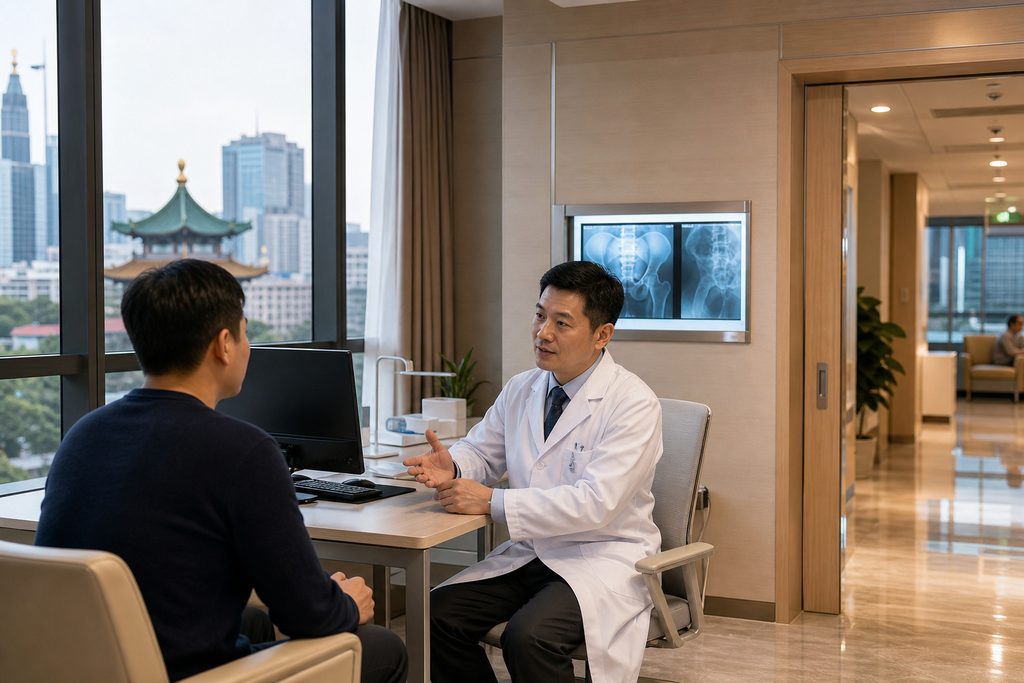
When 52-year-old David from Manchester first searched for “penile implant surgery cost China,” he had a spreadsheet open, a dozen browser tabs, and a deep frustration with the prices he was seeing at private clinics in London. He had lived with erectile dysfunction for four years. Pills worked for a while. Then they didn’t. The injections were a hassle. The vacuum device sat in a drawer. His urologist had mentioned a three-piece inflatable implant as the definitive solution — but the quote of £45,000 to £65,000 at a UK private hospital stopped him cold.
David’s story is not unusual. We hear versions of it every week. The math that brings patients to our desk is straightforward: a procedure that costs $50,000 to $70,000 in the United States, or €40,000 to €60,000 in Western Europe, can be performed at a top-tier Chinese hospital for a total of $12,000 to $28,000. That includes the device, the surgeon’s fee, the operating theater, the hospital stay, and the follow-up care before you fly home. The gap is not marginal. It is transformational.
But a Google search for a price tag only gets you halfway. The real question is what that number actually buys you, which hospital you should trust, how long you will be in the country, and what happens if something does not go according to plan. That is what this guide covers.
How This Actually Works, Step by Step
The process begins long before you board a plane. Most patients we work with have never traveled to China for medical care. The sequence is unfamiliar. Here is the path, laid out plainly.
First, you send your existing medical records. This means your urologist’s notes, your medication history, any Doppler ultrasound results if you have them, and a summary of what treatments you have tried and why they stopped working. We translate these documents into clinical Chinese — not machine translation, but a proper medical translation that preserves the nuance a surgeon needs.
A urology department at one of the hospitals in our network reviews the file. They are looking at whether you are a candidate for an implant, which type (two-piece or three-piece inflatable), and whether any complicating factors — diabetes, Peyronie’s disease, prior pelvic surgery — need to be accounted for in the surgical plan.
You receive a written opinion. This document outlines the recommended approach, the specific prosthesis model they would use, the anticipated hospital stay, and a treatment timeline. It also includes a detailed cost estimate. This is not a binding contract. It is a starting point for deciding whether to move forward.
If the plan makes sense, we coordinate a video consultation. You speak directly with the surgeon who would perform the procedure. You ask your questions. You get a feel for the communication dynamic. Many patients tell us this is the moment the decision crystallizes — when an abstract cost on a spreadsheet becomes a conversation with a real person who has done this surgery thousands of times.
After that, the logistics begin: visa documentation, scheduling a surgery date, booking accommodation for your recovery period, and arranging airport pickup.
What Penile Implant Surgery Actually Costs in China
The headline number that most patients want is the all-in surgical package price. At top-tier public hospitals in Beijing, Shanghai, and Guangzhou, the cost for a three-piece inflatable penile prosthesis — the gold standard device, such as the AMS 700 or Coloplast Titan — falls between $12,000 and $22,000. That covers the device itself, the surgeon’s fee, anesthesia, a 2- to 3-day inpatient stay, and basic post-operative medications.
At private international hospitals, where English-speaking staff are standard and the environment is closer to what a Western patient expects, the same procedure runs from $18,000 to $28,000. The premium buys you a more familiar bedside manner, direct insurance billing in some cases, and a smoother administrative experience. For many patients, that trade-off is worth it. For others, the cost savings of the public route — paired with a bilingual medical companion — hits the right balance.
These numbers are not guesses. They reflect the range we see across the 340+ top-ranked hospitals in our network. The exact figure depends on the prosthesis brand, the surgeon’s seniority, and whether you go through the standard inpatient pathway or the hospital’s international VIP department.
To put this in context, the same AMS 700 device implanted in the United States typically costs $50,000 to $70,000 as a cash-pay patient. In the United Kingdom, private rates run £45,000 to £65,000. In Australia, expect AUD $60,000 to $80,000. The Chinese price is not cheap because the care is inferior. It is cheaper because the structural cost of healthcare delivery — hospital overhead, surgeon compensation, device procurement — operates on a different economic baseline.
| Cost Component | China Public Hospital (USD) | China Private International (USD) | USA Cash-Pay (USD) |
|---|---|---|---|
| Three-piece prosthesis device | $6,000 – $10,000 | $8,000 – $12,000 | $15,000 – $25,000 |
| Surgeon & anesthesia fees | $3,000 – $5,000 | $5,000 – $7,000 | $15,000 – $20,000 |
| Hospital stay (2-3 days) | $1,500 – $3,000 | $2,500 – $4,500 | $10,000 – $15,000 |
| Post-op medications & supplies | $500 – $1,000 | $500 – $1,000 | $1,000 – $2,000 |
| Pre-op testing & consultation | $1,000 – $3,000 | $2,000 – $3,500 | $5,000 – $8,000 |
| Total Estimated Range | $12,000 – $22,000 | $18,000 – $28,000 | $50,000 – $70,000 |
A note on the device itself: the AMS 700 and Coloplast Titan are American-made prostheses. They are the same devices implanted in New York or London. Chinese hospitals import them through formal medical device distribution channels. There is no “local knock-off” version being substituted. When a surgeon quotes you for an AMS 700 at Peking Union Medical College Hospital or Ruijin Hospital in Shanghai, you are getting the genuine article.
For patients specifically researching how much is penile implant in Beijing, the range at top public hospitals like Peking Union Medical College Hospital or Peking University First Hospital falls between $13,000 and $20,000. Shanghai prices are comparable, with the best hospital for penile prosthesis Shanghai — typically Ruijin Hospital or Zhongshan Hospital — quoting $12,500 to $21,000 depending on the prosthesis model and the surgeon’s seniority.
A Realistic Timeline
This is not a one-week trip. Patients who underestimate the timeline create stress for themselves. Here is what the calendar actually looks like, from the moment you decide to explore the option.
| Phase | What Happens | Duration |
|---|---|---|
| Week 1–2 | Medical record collection, translation, and submission to the hospital for review. | 1–2 weeks |
| Week 3–4 | Hospital reviews your file and issues a written second opinion with a treatment plan and cost estimate. | 1–2 weeks |
| Week 4–5 | Video consultation with the surgeon. You discuss the plan, ask questions, and confirm you want to proceed. | 1 week to schedule |
| Week 5–8 | Visa processing. You apply for an S2 visa with the hospital’s invitation letter and supporting documents. Processing times vary by country. | 2–4 weeks |
| Week 8–9 | Travel to China. You arrive, complete pre-operative testing (blood work, ECG, possibly a repeat Doppler), and meet the surgeon in person. | 2–3 days before surgery |
| Surgery Day | The procedure itself takes 60–90 minutes. You stay in the hospital for 2–3 nights for pain management and initial recovery. | 1 day surgery + 2–3 days inpatient |
| Week 1 Post-Op | You rest at your hotel or serviced apartment. The surgical site is healing. You have a follow-up appointment to check the wound and review device cycling instructions. | Stay in the city |
| Week 2 Post-Op | Second follow-up. Sutures may be removed. The surgeon teaches you how to cycle the device (inflate and deflate) if swelling has subsided enough. | Stay in the city |
| Week 3–4 Post-Op | Final follow-up before departure. You receive a discharge summary, a recovery protocol in English, and contact information for post-operative questions. | Return home around Day 21–28 |
| Month 1–3 | You continue cycling the device daily at home to maintain pump function and allow the capsule to form properly around the reservoir and cylinders. | At home |
| Month 3+ | The device is fully healed into position. You can begin using it for intercourse. Most surgeons recommend waiting 4–6 weeks after surgery before attempting this. | Ongoing |
The total in-country stay is typically 21 to 28 days. Some patients push to leave at the two-week mark. We advise against it. That second follow-up appointment, where the surgeon checks the implant positioning and teaches you to cycle the device, is critical. Missing it means figuring out the pump mechanism on your own, which leads to unnecessary anxiety.
The hidden waiting periods are the ones that catch people: document translation takes real time if done properly. The hospital’s urology department may need a week to review your file because the surgeons are in the operating room, not at a desk. Visa processing at your local Chinese embassy is outside anyone’s control. Build buffers into your planning.
What Can Go Wrong — and What Happens Then
No honest discussion of surgery skips the failure modes. Penile implant surgery has a high satisfaction rate — studies consistently report over 90% of patients and partners are satisfied with the outcome — but it is still surgery on a delicate part of the body. Things can go sideways.
Infection is the complication that surgeons worry about most. The rate is low, roughly 1% to 3% in first-time implant surgeries at high-volume centers. But when an infection takes hold on a prosthetic device, the standard response is explantation: removing the entire implant, treating the infection with intravenous antibiotics, and waiting three to six months before attempting a re-implant. This is devastating for the patient. It is also rare. Chinese hospitals follow the same sterile protocol as any Western center: pre-operative antibiotics, a 10-minute surgical scrub, and strict no-touch technique when handling the device.
Mechanical failure is the other long-term concern. Modern three-piece implants are remarkably durable. Five-year mechanical survival rates exceed 95%. But pumps can fail, cylinders can leak, and tubing can disconnect. When this happens, a revision surgery is needed to replace the faulty component. At a Chinese hospital, a revision procedure typically costs $5,000 to $10,000 — significantly less than the primary surgery because the most expensive component, the cylinders and reservoir, may not need replacement.
Then there is the aesthetic outcome. Some patients are unhappy with the way the implant looks or feels. The glans (head of the penis) may not engorge the way it did naturally. The erection angle may be slightly different. The flaccid penis may look shorter than it did before surgery, though this is usually a temporary perception caused by the fact that the implant keeps the penis partially filled at all times. Over months, the tissues stretch and length returns. A surgeon who rushes the sizing decision in the operating room can leave you with a cylinder that is too short, leading to a floppy glans, or too long, causing discomfort. This is why surgeon experience matters enormously.
If a complication occurs while you are still in China, the hospital that performed the surgery manages it. This is built into the surgical package. You are not discharged and abandoned. If a problem emerges after you return home, you need a local urologist who is comfortable managing implant patients. Not every urologist is. Before you travel to China for surgery, identify a urologist in your home city who can handle follow-up care. Ask them directly: “If I have a penile implant placed overseas, will you see me for post-operative issues?” Some will say no. Find one who says yes.
The question of whether is penile implant surgery safe in China deserves a direct answer. The safety profile at top-tier Chinese hospitals is comparable to any Western center of excellence. The surgeons at the hospitals we work with have performed hundreds or thousands of these procedures. The operating theaters meet international standards. The devices are the same FDA-approved prostheses used globally. The variable that matters most is not the country. It is the specific hospital and the specific surgeon.
How to Choose the Right Hospital and Surgeon
A hospital’s general reputation tells you nothing about its penile implant program. A hospital can be ranked among China’s top 100 overall and still have a urology department that does only a handful of implants per year. You need to look at the specific department.
The metric that matters most is annual implant volume. A surgeon who does 50 or more penile implants per year operates differently from one who does 5. The high-volume surgeon has seen the anatomical variations, the scarred corpora from Peyronie’s disease, the challenging dilations. Their complication rate is lower. Their operative time is shorter. Their sizing judgment is better.
Ask the hospital directly: “How many three-piece inflatable penile implants did your department perform last year?” If they cannot give you a clear number, that is information in itself. If they can, and the number is substantial, ask the follow-up: “What is your infection rate for primary implants?” A high-volume center should be tracking this and should be comfortable sharing it.
The device choice also matters. The AMS 700 and Coloplast Titan are both excellent prostheses, but they have different characteristics. The AMS 700 has a softer, more natural feel when deflated. The Coloplast Titan provides greater rigidity when inflated. A surgeon who only offers one device may simply prefer it — or may not have access to the other. A surgeon who discusses both and explains why one suits your anatomy better is demonstrating the kind of nuanced judgment you want.
For patients looking at penile implant medical tourism China packages, be careful about what the word “package” includes. Some facilitators bundle the surgery, hotel, and airport transfers into a single price. Others include only the medical components and leave you to arrange accommodation yourself. Neither model is inherently better. The risk is in the package that obscures who the surgeon is. Any arrangement where you do not know the name of the person who will operate on you, and cannot verify their credentials independently, should be rejected immediately.
The hospitals we work with for this procedure include Peking Union Medical College Hospital in Beijing, Ruijin Hospital and Zhongshan Hospital in Shanghai, and West China Hospital in Chengdu. These are not the only options. They are the ones where we have seen consistently strong urology departments with dedicated andrology subspecialists who focus on prosthetic urology. You can explore more about these institutions on our top hospitals page or browse by city, such as Shanghai or Beijing.
Practical Considerations: Visas, Payments, and Follow-Up Care
The visa category for medical treatment in China is the S2 visa. This is a short-stay visa issued for private affairs, including medical treatment. Your spouse or partner traveling with you applies for the same S2 category. The hospital provides an invitation letter and treatment confirmation that you submit with your application. Processing times vary by country — plan for three to four weeks, and do not book non-refundable flights until the visa is in your passport.
Payment is almost always required upfront. Chinese public hospitals operate on a pre-payment model. You deposit funds at admission, and the hospital deducts costs as they accrue. Any balance is refunded at discharge. Private international hospitals may accept direct insurance billing, but this is not guaranteed. Check with your insurer before you travel. Most patients pay out of pocket
Frequently Asked Questions
Yes. The hospitals used for international patients are JCI-accredited and follow the same international safety standards as top hospitals in the US and Europe. Surgical teams perform high volumes of procedures — often more than their Western counterparts — which studies show leads to better outcomes.
Costs vary by procedure and hospital, but international patients typically save 40-80% compared to US prices — even when factoring in travel and accommodation. A consultation with our team will give you an exact, all-inclusive quote with no hidden fees.
Send us your existing medical reports to get started. We handle everything from hospital selection and appointment scheduling to visa assistance and post-operative recovery planning. Your medical records are reviewed by the specialist before you even book a flight.
For more medical information and treatment options in China, visit chinamedservices.com (China Medical Services).
