Total Shoulder Arthroplasty Cost China: Reverse & Anatomic Replacement With Care Companion
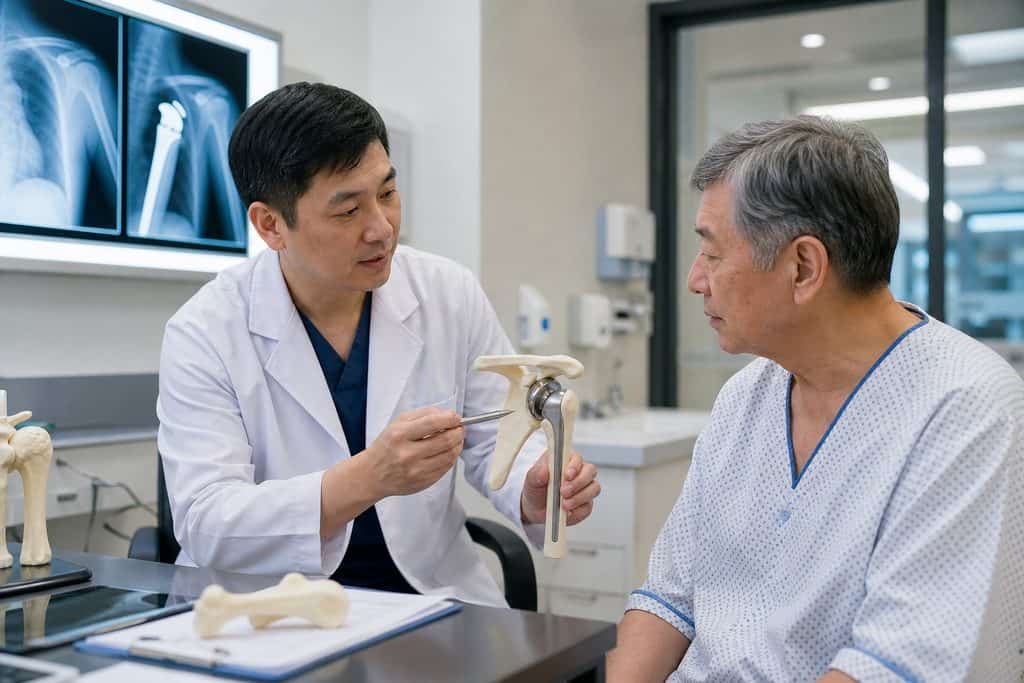
When 54-year-old Linda from Manchester finally got her MRI results, the orthopedic surgeon didn’t mince words. Her glenohumeral joint was bone-on-bone. The rotator cuff was a mess. She needed a total shoulder replacement, and the NHS waiting list stretched past 14 months. The private quote back home made her blink: £15,000 to £18,000. She started typing “total shoulder arthroplasty cost China” into Google at 2 a.m., not knowing if the numbers she’d find were real or too good to be true.
They’re real. But they come with complexity most price-comparison pages skip entirely. A reverse total shoulder arthroplasty at a top-tier Chinese orthopedic center typically lands between $12,000 and $18,000 USD. An anatomic total shoulder replacement runs lower, roughly $10,000 to $15,000. Those figures usually bundle the implant, surgeon fees, hospital stay, and basic rehabilitation during admission. What they don’t include is what Linda actually needed most: someone to translate the surgical consent form, argue with the billing department about the deposit slip, and sit in the recovery room explaining why the physiotherapist wants her to move her elbow before her shoulder.
That’s where the care companion becomes the real variable in the equation. Without one, the sticker price is a mirage. With one, the math starts making sense.
How This Actually Works, Step by Step
The sequence isn’t complicated. But every step has friction points that Google searches don’t warn you about.
You start by sending your existing imaging and reports. Not summaries. The actual DICOM files from your MRI or CT, plus the radiologist’s full report, plus any surgeon’s notes from back home. Our team translates these into clinical Chinese. Not Google Translate. A medical translator who knows the difference between “glenoid retroversion” and a mistranslated phrase that makes the Chinese surgeon squint at the screen.
The orthopedic department reviews everything. This takes 3 to 5 business days at most major hospitals. They come back with a written assessment: whether you’re a surgical candidate, which procedure fits your anatomy, and a preliminary treatment plan. At this stage, you haven’t paid a hospital deposit. You’ve paid for the coordination and the second opinion. That ranges from $300 to $500 for a written review from a top-tier specialist.
If the plan looks right, we schedule a video consultation. The surgeon sees your face, asks about your pain patterns, watches you demonstrate your limited range of motion through a screen. You ask the questions that keep you awake: “Will I regain external rotation?” “How long until I can drive?” “What implant brand do you use, and why?” The consultation costs $500 to $800 with a senior specialist. That fee gets credited toward the coordination service if you proceed to surgery within 90 days.
Only then do you book travel. S2 visa processing takes 7 to 14 business days at most Chinese embassies. Flights get booked. The hospital admission date gets locked. And the care companion is assigned to your case before you ever board the plane.
Reverse vs. Anatomic: The Surgical Decision That Drives the Price
Not all total shoulder arthroplasties cost the same. The implant choice isn’t a preference. It’s dictated by your rotator cuff.
Anatomic total shoulder arthroplasty replaces the humeral head and glenoid with components that mimic your original anatomy. It works beautifully when the rotator cuff tendons are intact. The deltoid lifts the arm. The cuff stabilizes the ball in the socket. Recovery follows a predictable arc. This procedure costs less because the implant is less complex and the surgical technique is more straightforward.
Reverse total shoulder arthroplasty flips the biomechanics. The ball goes on the glenoid side. The socket goes on the humeral side. This shifts the center of rotation medially and inferiorly, recruiting the deltoid to do the work the rotator cuff can no longer manage. It’s the right call for cuff tear arthropathy, failed prior replacements, and complex fractures in older patients. It also costs more. The implant itself is pricier. The surgery takes longer. The rehabilitation pathway is different.
Surgeons in China’s top orthopedic centers perform both procedures at volumes that would surprise most Western patients. A single high-volume shoulder surgeon at a major Shanghai or Beijing hospital may complete 200 to 300 arthroplasties annually. That repetition matters. Studies consistently link surgeon volume to lower complication rates and shorter operative times in shoulder arthroplasty.
The question isn’t which procedure is better. It’s which one matches your specific cuff integrity, glenoid bone stock, and functional demands. The second-opinion process answers that before you ever commit to travel.
What Does Total Shoulder Arthroplasty Cost in China, Actually?
Let’s put numbers on the table. These are all-inclusive estimates for international patients going through hospital international departments or VIP channels. Standard public-ward pricing exists but isn’t accessible without fluent Chinese and local residency.
| Procedure | China (International Dept.) | United States (Cash Pay) | United Kingdom (Private) | Australia (Private) |
|---|---|---|---|---|
| Anatomic TSA | $10,000 – $15,000 | $40,000 – $60,000 | £14,000 – £18,000 | AUD $25,000 – $35,000 |
| Reverse TSA | $12,000 – $18,000 | $50,000 – $75,000 | £16,000 – £22,000 | AUD $30,000 – $42,000 |
| Implant Brand (commonly used) | Zimmer, DePuy Synthes, Stryker | Same brands | Same brands | Same brands |
| Hospital Stay | 5–7 days typical | 1–3 days (outpatient trend) | 2–4 days | 3–5 days |
A few things jump out. The implants are the same multinational brands used in Cleveland or London. The hospital stay is longer in China, and that’s intentional. Chinese orthopedic wards don’t rush discharge. Patients stay until drains are out, pain is controlled on oral medication, and a physiotherapist has taught the first phase of home exercises. For international patients traveling thousands of miles, that longer inpatient window is protective. Problems caught before discharge are problems you don’t handle alone in a hotel room.
The reverse shoulder replacement price Shanghai tends to cluster at the higher end of the China range. Shanghai’s top orthopedic hospitals command premium pricing. Beijing follows closely. Hospitals in Guangzhou, Chengdu, or Hangzhou often land 10% to 15% lower for the same procedure with the same implant. The trade-off is surgeon selection and international-department infrastructure. Shanghai and Beijing have the deepest English-speaking support teams.
A Realistic Timeline
This isn’t a two-week trip. Plan for a month in-country at minimum, and longer if you’re doing both the surgery and the early rehabilitation phase before flying home.
| Phase | Duration | What Actually Happens |
|---|---|---|
| Remote evaluation | 2–3 weeks | Document translation, specialist review, written second opinion, video consultation. Back-and-forth questions are normal here. |
| Visa processing | 7–14 business days | S2 visa application with hospital invitation letter. Embassy processing times vary by country. Factor in passport mailing time. |
| Travel and pre-op | 3–5 days before surgery | Arrival, hospital registration, pre-operative labs, ECG, chest X-ray, anesthesia consult. The care companion handles registration queues. |
| Surgery and inpatient stay | 5–7 days | Surgery day, drain removal, initial physiotherapy, pain management transition to oral meds. |
| Early recovery in China | 2–3 weeks post-discharge | Outpatient physiotherapy, suture removal, first post-op X-ray. Many patients stay in a serviced apartment near the hospital. |
| Return home | Week 4–6 post-op | Cleared for flight. Carry a letter from the surgeon for airport security explaining the implant. Continue physiotherapy at home. |
| Full recovery | 3–6 months (anatomic) 4–9 months (reverse) |
Range of motion returns gradually. Reverse shoulders regain elevation faster; rotation takes longer. Driving clearance typically at 6–8 weeks. |
The waiting step people forget is document translation. Medical records aren’t one-page summaries. They’re 40-page PDFs with handwritten annotations, radiology reports with technical shorthand, and medication lists with drug names that don’t cross borders cleanly. Rushing this step produces a Chinese surgeon who’s guessing instead of planning. We budget a full week for translation and formatting before the hospital ever sees the file.
What Can Go Wrong — and What Happens Then
Infection. It’s the complication every shoulder surgeon loses sleep over. The rate in primary total shoulder arthroplasty runs between 0.5% and 2% in published series from major centers. Propionibacterium acnes, a slow-growing skin organism, is notoriously hard to catch early. It presents weeks after surgery with subtle pain and stiffness, not the hot-red-swollen picture patients expect.
If it happens in China, the same hospital that did the primary surgery handles the revision. The international department coordinates admission. The care companion stays involved. You don’t get abandoned because you already paid and went home. That’s not how the system works. But you do need to understand that revision surgery costs extra. The original surgical package doesn’t cover it. Travel insurance with medical complication coverage is non-negotiable for exactly this reason.
Nerve injury is another possibility. The axillary nerve runs close to the surgical field. Temporary neurapraxia happens in a small percentage of cases, presenting as deltoid weakness that resolves over weeks to months. Permanent nerve injury is far rarer. The surgeon discusses this during the video consultation, not for the first time on the consent form.
Implant loosening shows up years later. That’s not unique to surgery in China. It’s the long-term failure mode of all joint replacements everywhere. The question to ask is what implant registry data the hospital contributes to and what revision burden their department carries. Top Chinese orthopedic centers now track outcomes through internal registries that match international standards.
What if you arrive and the surgeon decides you’re not a candidate after all? This happens. Sometimes the CT done on arrival reveals worse bone loss than the six-month-old scan from home suggested. The pre-operative workup catches a cardiac issue that needs clearing first. The hospital refunds the surgical deposit minus the cost of tests already performed. The coordination fee covers rescheduling or redirecting to a more appropriate treatment plan. Nobody wants to operate on a patient who shouldn’t be operated on.
How to Evaluate a Hospital for Shoulder Replacement in China
The best hospital for shoulder replacement China isn’t one name. It’s the one that matches your specific anatomy, implant needs, and communication requirements.
Start with the Fudan University hospital rankings. The orthopedics specialty reputation list ranks China’s top 10 orthopedic departments annually. Hospitals like Peking University Third Hospital, Shanghai Sixth People’s Hospital, and West China Hospital consistently appear. These are high-volume centers where shoulder arthroplasty isn’t an occasional procedure. It’s a daily one.
But volume alone isn’t enough. Ask about the implant system. A hospital that uses one brand exclusively may be constrained by procurement contracts, not clinical preference. The surgeon who says “I use Zimmer for most primaries but switch to Stryker when the glenoid needs a specific augment solution” is thinking about your bone, not their inventory shelf.
Ask about the physiotherapy protocol. Reverse shoulders need a different early mobilization strategy than anatomic replacements. The hospital should have a written protocol, not a vague promise that “the therapist will see you.” In China’s top orthopedic wards, physiotherapy starts on post-op day one. Passive range of motion. Pendulum exercises. The care companion translates the therapist’s instructions and makes sure you understand the restrictions: no active internal rotation behind the back for six weeks with a reverse, no resisted extension with an anatomic.
Ask about the surgeon’s revision rate, not just their primary volume. A surgeon doing 200 primaries a year with a 1% revision rate at five years is practicing at an international benchmark. If they can’t or won’t share that data, take note.
The care companion doesn’t choose your surgeon. We connect you with departments that meet these criteria and let the second-opinion process surface the right match. The decision stays yours.
Practical Considerations: Records, Visa, and the Follow-Up Gap
Medical records need to be complete and recent. Imaging older than six months often triggers a request for repeat scans on arrival, which adds days and cost. Bring everything: operative notes from any prior shoulder surgeries, the full radiology report (not just the conclusion), a list of current medications with dosages, and a summary from your home orthopedic surgeon explaining why they recommended arthroplasty.
The visa is an S2. Not an M. The M visa is for trade fairs and factory visits. Using it for medical treatment invites problems at the border. The hospital international department issues an invitation letter with the treatment purpose clearly stated. The care companion guides you through the embassy submission. Processing times vary by country, but 10 business days is a safe planning number.
Payment happens upfront. Chinese hospitals require a deposit before admission, typically the full estimated surgical package amount. International departments accept wire transfers and major credit cards. Insurance reimbursement is retrospective. The hospital provides itemized invoices and translated discharge summaries. You submit to your insurer when you get home. Some international insurers have direct billing arrangements with specific hospitals. Ask before you book.
The follow-up gap is real. You fly home at four to six weeks post-op. Your local orthopedic surgeon, who didn’t do the surgery, now owns your follow-up care. This works smoothly when you hand them a complete operative note, implant stickers with lot numbers, and a recommended follow-up schedule. It fails when you arrive with a blurry discharge summary and a shrug. The care companion ensures you leave China with a packet your home surgeon can actually use.
And then there’s the question patients don’t ask until week three: “Who do I call when I have a weird pain at 10 p.m. on a Saturday back in Manchester?” The Chinese surgeon’s WeChat isn’t a realistic answer. The hospital international department can field follow-up questions by email, with response times measured in days, not hours. For urgent concerns, your local emergency department remains the right call. The implant card in your wallet tells them everything they need to know.
Frequently Asked Questions
How much does shoulder replacement cost in China with a companion?
The surgical package for a reverse total shoulder arthroplasty runs $12,000 to $18,000. Anatomic replacement runs $10,000 to $15,000. Adding a bilingual care companion for the full surgical trip typically adds $1,500 to $2,500 depending on the length of stay and complexity. That covers airport pickup, hospital registration, daily ward visits during admission, translation during physiotherapy sessions, and discharge coordination. It’s not a luxury add-on. It’s the mechanism that makes the rest of the system work for someone who doesn’t speak Chinese.
What is the recovery time for total shoulder arthroplasty abroad?
Plan for 4 to 6 weeks in China from surgery to flight clearance. Full functional recovery takes 3 to 6 months for anatomic replacements and 4 to 9 months for reverse replacements. The longer timeline for reverse shoulders reflects the time needed for the deltoid to fully adapt to its new role as the primary elevator. Driving clearance typically comes at 6 to 8 weeks. Return to overhead sports or heavy labor takes 4 to 6 months and requires surgeon clearance.
Can I book shoulder surgery package China with care companion before traveling?
You can’t book a surgery date before the surgeon evaluates your case. What you can do is initiate the remote evaluation process, which includes document translation, specialist review, and a video consultation. If the surgeon confirms you’re a candidate, the surgical date gets scheduled, the visa invitation letter gets issued, and the care companion gets assigned. The process front-loads the medical decision-making so you don’t fly to China hoping for the best.
Is the implant quality the same as what I’d get at home?
Yes. The top orthopedic centers in China use the same implant systems from Zimmer Biomet, DePuy Synthes, and Stryker that are standard in North America and Europe. The surgical trays, the instrumentation, the cementing technique, the post-op X-ray protocols are all familiar to any Western-trained orthopedic surgeon. The difference isn’t the hardware. It’s the system around the surgery, which is why the care companion matters.
What if something goes wrong after I return home?
Your local orthopedic surgeon assumes follow-up care. You leave China with a complete surgical record: operative note, implant details, post-op X-rays, and a recommended rehabilitation protocol. For non-urgent questions, the Chinese hospital’s international department responds by email. For urgent concerns like suspected infection or sudden loss of function, your local emergency department is the right first stop. Travel insurance with post-operative complication coverage is essential and should be arranged before departure.
Your Next Step
Linda landed in Shanghai six weeks after that 2 a.m. Google search. Her reverse total shoulder arthroplasty took 90 minutes. The implant was a Zimmer. The physiotherapist had her doing pendulums the next morning. The care companion sat through every discharge instruction and made sure the medication schedule made sense. She flew home at week five with a folder of records her Manchester physio understood immediately.
We don’t perform surgery. We don’t promise outcomes or guarantee access to any specific surgeon. What we do is remove the logistical obstacles that make traveling to China for shoulder replacement feel impossible. Start with a free consultation. Tell us about your shoulder, send your scans, and we’ll map out what a realistic path looks like. No pressure. No deposit. Just clarity on whether this option fits your situation.
Medical Disclaimer: This article is for informational purposes only and does not constitute medical advice. All treatment decisions should be made in consultation with a qualified orthopedic surgeon based on your individual clinical presentation. Pricing ranges are estimates and vary by hospital, implant selection, case complexity, and exchange rates. Always verify current costs directly with the treating institution.
For more medical information and treatment options in China, visit chinamedservices.com (China Medical Services).
