Shenzhen Children’s Hospital: Full Family Coordination for International Pediatric Care
Key Takeaways
- Shenzhen Children’s Hospital handles over 2.3 million outpatient visits annually, making it one of China’s highest-volume pediatric centers with deep subspecialty expertise.
- A dedicated international family coordination service bridges the language gap, handling everything from registration to discharge planning so parents can focus on their child.
- Treatment costs for international patients typically run 50-70% lower than comparable US private hospital rates, but the hospital’s public system requires a different logistical approach than Western families may expect.
- No hospital can guarantee specific outcomes, and families should understand the visa requirements, payment structures, and follow-up realities before committing to travel.
The Problem: When Your Child Needs Specialized Care and Your Home System Cannot Deliver
In the United Kingdom, a child referred for pediatric orthopedic surgery by the NHS faces a median wait of 18 weeks just for the first consultant appointment. In Canada, the total wait from general practitioner referral to pediatric surgical treatment reached 32.1 weeks in 2023, according to the Fraser Institute’s annual survey. For a parent watching a child in pain, watching a condition progress, watching a developmental window close—that timeline is not an inconvenience. It is a slow emergency.
And then there is the cost question for families without fully subsidized public coverage. A pediatric cardiac procedure at a major US children’s hospital can exceed $150,000. An orthopedic surgery with implant hardware can run $60,000 to $90,000. For families in the Middle East, Southeast Asia, or Eastern Europe seeking advanced pediatric subspecialty care, the financial burden of Western hospitals combined with long queues creates a real access crisis. They start searching for alternatives. They find Shenzhen Children’s Hospital. And then they hit the next wall: how do you actually make this work from 6,000 miles away?
Why Shenzhen Children’s Hospital Has Become a Reference Point for International Pediatric Care
Shenzhen Children’s Hospital is not a small community facility. It is a tertiary A-grade hospital—the highest classification in China’s public hospital system—with 1,500 beds and a clinical staff that manages one of the largest pediatric patient volumes in the country. For international families, the hospital’s scale translates into something concrete: subspecialty depth. A child with a complex neurological presentation does not need to see one pediatric neurologist. They need access to a team that has seen thousands of similar cases.
Clinical Volume Drives Pattern Recognition
Consider the numbers. The hospital’s outpatient department records approximately 8,500 visits per day during peak periods. Its pediatric surgery division performs over 25,000 procedures annually. A pediatric urologist here might complete 300 hypospadias repairs in a year—a volume that would take a typical European pediatric urologist five to seven years to accumulate. This is not a claim about superior skill. It is a fact about exposure. When a surgeon has seen a particular anatomical variation hundreds of times, the intraoperative decision-making becomes faster and more precise. Complication rates tend to drop as case volume rises. Multiple studies in The Lancet and JAMA Surgery have documented this volume-outcome relationship across surgical specialties, and it applies with particular force in pediatrics, where anatomical structures are smaller and physiological responses less predictable than in adults.
The hospital is also a major teaching and research center affiliated with Shenzhen University’s medical school. That means its senior specialists are not just clinicians—they are people who train other doctors and publish in peer-reviewed journals. For a parent evaluating a hospital from another continent, that academic footprint is one of the few verifiable quality signals available.
Technology and Efficiency at a Scale Western Hospitals Rarely Match
Walk through the surgical tower and you will see equipment that would be familiar in any top-tier Western children’s hospital: da Vinci robotic surgical systems, intraoperative MRI suites, and minimally invasive endoscopic platforms designed specifically for pediatric anatomy. But the operational tempo is different. The hospital runs 40 operating rooms. Pre-operative workups that might take three days in a US hospital—labs, imaging, anesthesia clearance—are often completed in a single day here. Not because corners are cut. Because the system is designed for throughput.
This efficiency extends to diagnostics. The hospital’s imaging department operates extended hours. A pediatric MRI that requires sedation—always a challenge with young children—can often be scheduled within 48 hours of arrival, not the two-to-four week wait common in many public systems. For international families traveling on limited timelines, this compression of the diagnostic phase matters enormously.
Pediatric Treatment Cost at Shenzhen Children’s Hospital for International Patients: The Numbers
Let us address the question most families ask first. The pediatric treatment cost Shenzhen Children’s Hospital international patients face is structurally lower than Western equivalents, and the reasons are not mysterious. China’s labor costs for skilled nursing and support staff are lower. Hospital construction and equipment amortization costs are lower. The administrative overhead that consumes roughly 25% of US hospital budgets is far leaner here. These savings flow through to the patient bill.
Here is what families can expect as reference ranges. These figures are for the international/VIP channel, which includes English-language coordination and priority scheduling. Standard public-channel pricing is lower but requires fluent Chinese and independent navigation of the hospital system—not realistic for most overseas families.
| Pediatric Procedure | Shenzhen Children’s Hospital (International Channel, USD) | US Private Hospital (Approximate, USD) |
|---|---|---|
| Inguinal hernia repair (laparoscopic) | $2,800 – $4,500 | $8,000 – $15,000 |
| Tonsillectomy and adenoidectomy | $2,200 – $3,800 | $6,500 – $12,000 |
| Hypospadias repair (single-stage) | $4,000 – $7,000 | $15,000 – $30,000 |
| Ventricular septal defect closure (open) | $18,000 – $28,000 | $70,000 – $150,000 |
| Scoliosis spinal fusion (adolescent) | $25,000 – $40,000 | $100,000 – $250,000 |
| Cleft palate repair | $3,500 – $6,000 | $12,000 – $25,000 |
These are not fixed prices. They are ranges based on cases we have coordinated. The final figure depends on the child’s specific anatomy, the complexity of the procedure, the implant or device costs if applicable, and the length of stay. A straightforward ventricular septal defect in an otherwise healthy five-year-old will land at the lower end. The same procedure in an infant with pulmonary hypertension will land higher. Any coordinator who quotes you a single price without reviewing medical records is guessing.
Also worth noting: the question “is Shenzhen Children’s Hospital good for international kids medical treatment” cannot be answered with cost data alone. The hospital’s clinical outcomes for common pediatric procedures are comparable to international benchmarks. Its infection control protocols meet national standards. But “good” also depends on what your family needs: language support, accommodation proximity, dietary requirements, religious considerations. These non-clinical factors often determine whether an international medical trip succeeds or fails.
How Family Coordination Works for Children’s Surgery in China: The Actual Process
This is the question behind the search: “how does family coordination work for children’s surgery in China?” Parents are not just asking about logistics. They are asking whether someone will help them when their child is scared, when they do not speak the language, when they do not know which floor the lab is on. The answer is yes—but understanding what coordination actually means prevents disappointment.
Family coordination for international pediatric patients at Shenzhen Children’s Hospital typically follows a staged model. The first stage is remote evaluation. You send your child’s existing medical records—imaging studies, lab results, physician notes, genetic testing if relevant—to the hospital’s international department or through a coordination service. A relevant specialist reviews these materials and provides a written second opinion. This step alone costs $300 to $500 and takes five to seven working days. It answers the threshold question: does this hospital believe it can help your child, and what approach would it recommend?
The second stage is scheduling. If the remote opinion confirms that treatment is appropriate and the family decides to proceed, the coordination team secures a specific outpatient appointment and, if surgery is indicated, a provisional surgical date. This is where the international channel differs from the standard public pathway. A walk-in patient cannot book surgery in advance—the surgeon must see the child in person first. But through the international coordination desk, a pre-reviewed case can often move directly to a surgical booking after the in-person consultation, compressing what might otherwise be multiple trips into a single visit.
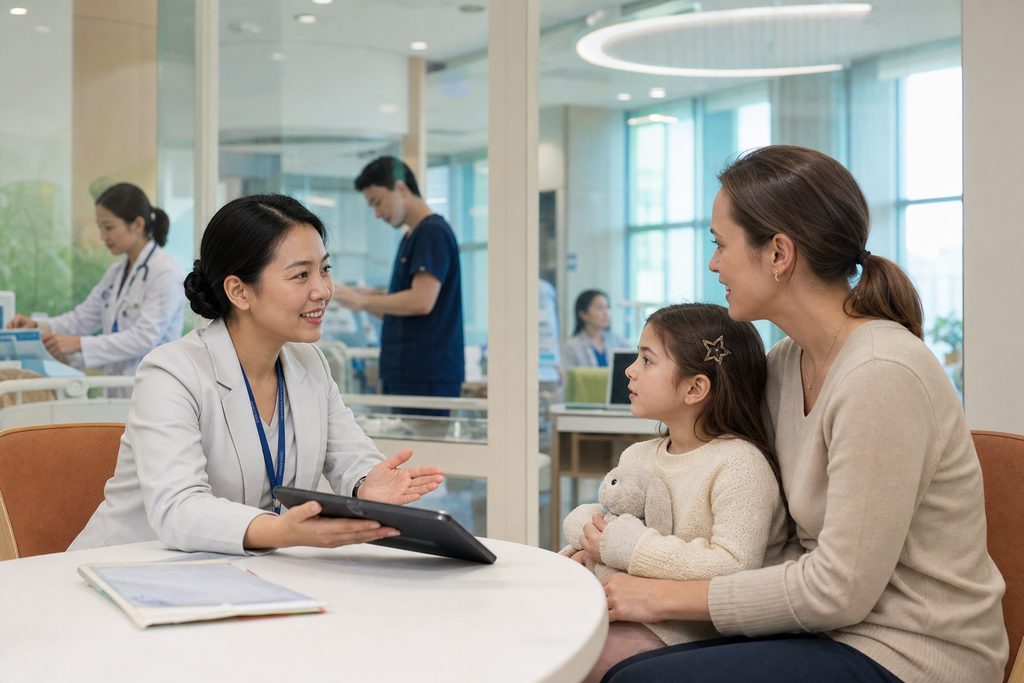
The third stage is on-the-ground support. A bilingual coordinator meets the family at the hospital entrance on the day of the first appointment. This person handles registration, payment, queue management, and real-time interpretation during the consultation. If the child is admitted, the coordinator returns for pre-operative preparation days, the surgery day itself, and discharge. They translate discharge instructions, medication schedules, and follow-up plans. They do not provide medical advice. They ensure nothing is lost in translation.
The fourth stage is follow-up. After the family returns home, the coordinator facilitates a video consultation with the treating surgeon at the four-to-six-week mark, and again at three months if needed. Imaging done locally can be uploaded and reviewed. This continuity is essential for surgical cases where the long-term outcome depends on proper rehabilitation and monitoring.
What the “Best Children’s Hospital China for Foreign Families with Full Support Service” Actually Requires From You
Searching for the “best children’s hospital China for foreign families with full support service” often reflects an understandable desire: find the one place that will handle everything. But even the best hospital and the best coordination team cannot replace what the family must bring. Here is what you need to prepare.
Medical records must be complete and translated. A surgical team cannot evaluate a complex case from a single ultrasound report. You need imaging files in DICOM format, not just printed films. You need operative notes from any prior surgeries. You need a summary letter from the child’s primary specialist explaining the diagnosis, treatment history, and current clinical question. These documents must be translated into Chinese by a medical translator—not a generalist. A mistranslated anatomical term can change a surgical plan.
Visa documentation requires precision. The applicable visa category for medical treatment in China is the S2 short-stay visa, endorsed for private affairs including medical treatment. The accompanying parent or guardian applies under the same S2 category. The hospital’s international department provides an invitation letter and treatment confirmation that supports the visa application. Processing time varies by embassy, but families should allow four to six weeks from application to issuance. Expedited processing is sometimes available but should not be assumed.
Payment expectations differ from Western systems. Chinese public hospitals, including their international departments, operate on a pre-payment model. You deposit funds at admission, and the hospital draws down against that deposit as services are provided. The initial deposit for a surgical admission might range from $10,000 to $30,000 depending on the procedure. Any surplus is refunded at discharge. Credit cards are accepted, but international transaction limits can cause problems—a single $25,000 charge may trigger a fraud block. Families should notify their bank in advance and carry a backup payment method.
Insurance reimbursement is retrospective. The hospital provides detailed invoices and medical reports suitable for insurance claims, but it does not bill international insurers directly. The family pays upfront and submits for reimbursement afterward. This is a critical difference from the private international hospitals in China, such as those listed on our private hospitals page, which often have direct billing arrangements. Families using Shenzhen Children’s Hospital should verify with their insurer before traveling that overseas pediatric surgery at a Chinese public hospital is a covered benefit.
Practical Considerations: Documents, Housing, and the Recovery Timeline
The child’s passport must be valid for at least six months beyond the intended stay. The parent or guardian traveling with the child needs notarized consent from the other parent if traveling alone—this is a requirement at Chinese visa application centers, not just at the border. A birth certificate showing the parent-child relationship is mandatory. Bring originals and two photocopies of everything.
Accommodation near the hospital matters more than families expect. Shenzhen Children’s Hospital is located in the Futian district, a central area with a range of hotels and serviced apartments. After discharge, the child may need to remain in Shenzhen for seven to ten days before flying home, both for a post-operative check and because long-haul flights immediately after surgery carry elevated thrombosis risk. Book accommodation with a kitchenette if possible—a child recovering from surgery may not tolerate restaurant food, and having control over meals reduces stress. Budget $80 to $150 per night for a comfortable hotel within a 15-minute walk of the hospital.
Language remains a barrier outside the hospital. The bilingual coordinator is present during medical appointments, not 24/7. Families should install a translation app ( Pleco or Google Translate with the Chinese offline pack downloaded) for basic interactions at restaurants, pharmacies, and shops. Shenzhen is a young, international city, and English proficiency is higher here than in most Chinese cities, but it is not universal. A printed card with the hotel address in Chinese characters is a small preparation that prevents large headaches.
Frequently Asked Questions
Yes, the international coordination channel effectively functions as a family package. When families search “book pediatric care Shenzhen Children’s Hospital family package abroad,” they are describing the remote evaluation-to-discharge pathway that the hospital’s international desk supports. The process begins with a remote case review. If the hospital confirms it can treat the condition, the coordination team assembles a timeline: appointment date, pre-op workup days, provisional surgery date, expected discharge window, and follow-up video consultation. This is not a commercial “package” with a single price tag—each component is billed separately by the hospital—but the logistical coordination is bundled. Families receive a single point of contact who manages the entire sequence.
The hospital’s international department provides a detailed cost estimate after reviewing the child’s records. This estimate includes surgeon fees, anesthesia, operating room charges, ward accommodation (standard private room), nursing care, and routine medications during admission. It does not include implant or device costs if those are needed—those are quoted separately once the surgical plan is finalized. It does not include the coordination service fee, which is charged by the facilitating organization, not the hospital. Families should ask for a written breakdown that separates hospital charges from third-party coordination fees. There should be no surprises. If something is unclear, ask before transferring funds.
Shenzhen Children’s Hospital has a pediatric intensive care unit (PICU) staffed by critical care specialists, and its surgical complication rates are tracked and reviewed through the hospital’s quality assurance system. That said, all surgery carries risk, and families traveling internationally for care should have a contingency plan. Know where your country’s nearest consulate is located—Shenzhen has multiple consulates, and Guangzhou, with a full diplomatic presence, is 30 minutes by high-speed train. Ensure your travel insurance covers medical evacuation if a prolonged ICU stay or complex complication requires transfer. The coordination team can help facilitate communication with insurers and consular officials, but the family bears ultimate responsibility for these arrangements. We address these scenarios upfront because trust is built on transparency, not on pretending risks do not exist.
The treating surgeon provides a detailed discharge summary in English, including operative notes, implant specifications if applicable, medication schedules, and rehabilitation instructions. This document is designed to be handed directly to the child’s local pediatrician or specialist. At four to six weeks post-discharge, a video follow-up consultation is scheduled. The family uploads any new imaging or lab results beforehand. The surgeon reviews progress and adjusts the recovery plan if needed. For orthopedic cases involving hardware, annual check-in video consultations may be recommended for two to three years. The coordination team arranges these sessions. The cost is typically $100 to $300 per follow-up video consultation.
Your Next Step
Traveling to another country for your child’s medical care is not a small decision. The right preparation makes the difference between a stressful experience and one where you can focus on what matters—your child’s recovery. Our team at China Medical Services has coordinated pediatric care pathways for families from over 20 countries, connecting them with top-tier hospitals including Shenzhen Children’s Hospital. We handle case review logistics, appointment scheduling, bilingual accompaniment, and follow-up coordination. We do
For more medical information and treatment options in China, visit chinamedservices.com (China Medical Services).
