Emergency Surgery in China for Travelers: Rapid Response Service
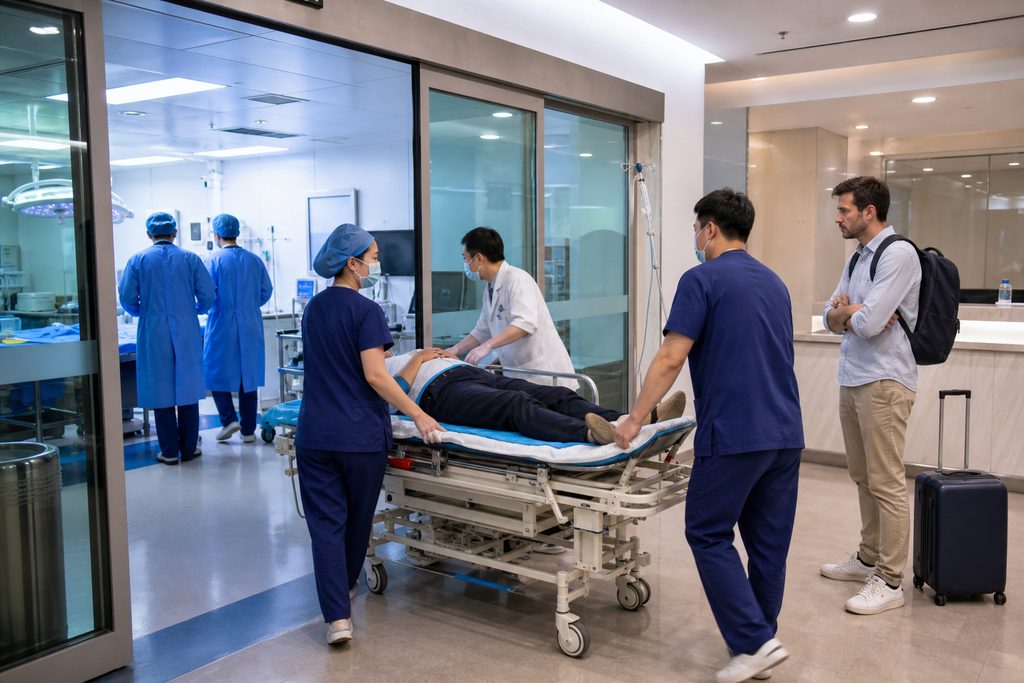
According to China’s National Health Commission, public hospitals across the country handled over 8 billion outpatient and emergency visits in 2023. Foreign travelers are a tiny fraction of that number — but when a tourist needs an appendectomy in Shanghai or a gallbladder removal in Beijing, the system moves fast. The emergency surgery cost for foreigners China typically ranges from $3,000 to $25,000 depending on the procedure and hospital tier, which is 60–80% less than comparable US hospital bills. That is the headline. The reality involves paperwork, payment deposits, and a hospital system that does not wait for insurance pre-authorization.
Emergency Surgery for Foreigners in China: The Short Answer
Yes, you can get emergency surgery in China as a foreign traveler. Public hospitals are legally required to treat anyone who walks through the emergency department doors, regardless of nationality or visa status. You will not be turned away. But you will be asked for a cash deposit before the operating room is booked. That deposit varies by hospital and procedure — typically $2,000 to $8,000 for common emergency surgeries. If you cannot pay upfront, treatment may be delayed while the hospital contacts your embassy or travel insurer. This is the single most important thing to understand before you need it.
Speed is not the problem. Chinese emergency departments are built for volume. A patient with acute appendicitis can go from triage to CT scan to operating room in under six hours at a major public hospital. The bottleneck is almost never clinical. It is financial and linguistic.
Who This Is Right For — and Who It Isn’t
Emergency surgery in China makes sense for travelers who are already in the country when a surgical emergency hits. It also works for expats living in China who want a faster, cheaper option than flying home. And it increasingly appeals to medical tourists who planned an elective procedure but developed an urgent complication.
Good candidates typically fall into these groups:
- Travelers already in China with acute appendicitis, gallbladder attacks, kidney stones requiring surgical intervention, or traumatic injuries
- Expats in Chinese cities who speak limited Mandarin and need coordination support
- Patients with travel insurance that covers emergency surgery abroad and provides direct billing or fast reimbursement
- People with flexible return dates who can stay for post-operative observation
Who should think twice? Anyone with a condition that can safely wait until they return home. If a doctor in your home country has already scheduled you for elective surgery, flying to China for an “emergency” version of it is not an emergency — it is medical tourism with extra risk. Also, patients with unstable cardiac conditions, severe coagulopathies, or complex multi-organ issues should consider whether a hospital far from their regular specialists is the right place for an unplanned operation. And if your travel insurance explicitly excludes China or requires pre-authorization you cannot obtain, the financial exposure may outweigh the savings.
The Options, Compared
Not all emergency surgery in China happens in the same kind of hospital. The choice between a public tertiary hospital, a public hospital international department, and a private international hospital changes everything: cost, language support, wait time, and payment process. Here is how they stack up for a foreign traveler needing urgent surgery.
| Factor | Public Tertiary Hospital | Public Hospital International Dept. | Private International Hospital |
|---|---|---|---|
| Emergency appendectomy cost | $3,000–$6,000 | $6,000–$12,000 | $10,000–$25,000 |
| Emergency gallbladder removal cost | $4,000–$8,000 | $8,000–$15,000 | $12,000–$28,000 |
| English-speaking staff | Rare; translators via app or companion | Yes, dedicated coordinators | Yes, standard |
| Deposit required before surgery | $2,000–$5,000 cash or card | $5,000–$10,000 | $8,000–$20,000 or insurance guarantee |
| Insurance direct billing | No | Sometimes | Usually yes |
| Typical time from ER to OR | 4–8 hours | 6–12 hours | 6–24 hours |
| Post-op follow-up language support | Minimal | Good | Excellent |
Public tertiary hospitals offer the lowest emergency surgery cost for foreigners China — and the least hand-holding. You will navigate registration, payment, imaging, and ward transfers largely on your own unless you bring a bilingual companion. International departments charge roughly 1.5 to 2 times the standard rate but provide English coordination. Private international hospitals are the most expensive and the most familiar for Western patients, with direct insurance billing and Western-style nursing. If you have solid travel insurance with direct billing, the private route may cost you nothing out of pocket. If you are paying cash, the public route is dramatically cheaper.
How Fast Can You Actually Get Surgery? The Real Timelines
Emergency surgery in China does not follow the same scheduling logic as elective surgery. There is no waiting list for an acute abdomen. When a surgeon determines you need an operation now, the system moves. But “now” has practical limits.
For a confirmed acute appendicitis at a major public hospital in Shanghai or Beijing, expect this sequence:
- Hour 0–1: Registration, triage, initial assessment by an emergency physician
- Hour 1–3: Blood work, ultrasound or CT scan, surgical consultation
- Hour 2–4: Deposit payment at the cashier, pre-operative preparation, anesthesia assessment
- Hour 4–8: Operating room
That is the ideal path. Delays happen when the hospital is crowded, when imaging results are ambiguous, or when the patient cannot pay the deposit quickly. A 24 hour emergency hospital Shanghai for tourists can process a straightforward case within a single shift. Complex trauma cases involving multiple specialties take longer — sometimes 12 to 24 hours from arrival to surgery, especially if the patient needs stabilization first.
For expats in Beijing wondering about urgent surgery package for expats Beijing price, the answer is that packages exist primarily through international departments and private hospitals. A bundled urgent surgery package — including surgeon fees, operating room, anesthesia, basic ward stay, and medications — starts around $8,000 for a simple appendectomy at a public hospital international department and runs upward of $20,000 at a private facility. These packages are not standardized; each hospital quotes based on the specific case.
Is Emergency Surgery in China Safe for Travelers?
Safety is a reasonable question. The honest answer: at top-tier Chinese hospitals, surgical safety outcomes are comparable to Western benchmarks. Fuwai Hospital in Beijing performs over 14,000 cardiac surgeries annually — more than any other hospital in the world — with mortality rates that match or beat international registries. But that is cardiac surgery, a highly specialized field. What about emergency general surgery?
China’s top 100 hospitals, as ranked by the Fudan University hospital ranking system, handle enormous surgical volumes. A surgeon at a major tertiary center may perform more appendectomies or cholecystectomies in a month than a Western surgeon does in a year. Volume builds competence. The risk areas for foreign patients are not surgical skill — they are communication gaps, unfamiliar processes, and post-operative care coordination.
So is emergency surgery in China safe for travelers? At a top-ranked public hospital or accredited private hospital, the clinical safety is high. The logistical safety — knowing what you are signing, understanding medication instructions, communicating pain levels — depends heavily on language support. This is where a bilingual medical companion changes the experience from disorienting to manageable.
What Emergency Surgery Actually Costs: A Breakdown
The emergency surgery cost for foreigners China breaks down differently than a US hospital bill. Chinese hospitals itemize everything: registration fee, imaging, laboratory tests, surgeon fee, anesthesiologist fee, operating room time, consumables, medications, ward bed, nursing care. A typical emergency appendectomy at a public tertiary hospital might look like this:
- Emergency registration and initial assessment: $20–$50
- Ultrasound and CT scan: $150–$400
- Laboratory tests: $100–$250
- Surgeon and anesthesiologist fees: $800–$1,500
- Operating room and consumables: $1,000–$2,500
- Ward stay (3–5 days): $300–$800
- Medications and post-op care: $300–$700
Total: roughly $3,000 to $6,000. The same procedure at a private international hospital in Shanghai or Beijing runs $10,000 to $25,000. In the United States, an uninsured appendectomy averages $15,000 to $35,000, and insured patients often still face $3,000 to $5,000 in deductibles and co-insurance. The savings are real, but only if you can pay the deposit upfront and handle the reimbursement paperwork afterward.
What is not included: airfare, visa fees, accommodation for family members, post-discharge follow-up if you need it after returning home, and any complication management beyond the standard post-operative period. Prices vary by hospital and case complexity — a perforated appendix with peritonitis costs significantly more than an uncomplicated one.
Practical Considerations: Records, Visas, Payment, and Follow-Up
If you are already in China when the emergency hits, you will not have time to prepare documents. The hospital will work with what you have: passport, insurance card if applicable, and any medical history you can provide. If you are planning ahead for a possible emergency — for example, traveling with a known gallstone condition — carry a translated summary of your medical history, current medications, allergies, and your home physician’s contact information. This saves hours in the emergency department.
Visa matters. If you entered China on a tourist visa and need emergency surgery, your existing visa generally covers the hospital stay. If your recovery requires staying beyond your visa validity, you will need to apply for an extension or a change to an S2 visa, which is the short-stay category used for medical treatment and private affairs. The hospital can provide supporting documentation. Do not overstay — exit bans and fines apply regardless of medical circumstances. For planned surgery, the S2 visa is the correct category from the start. An M visa is for commercial and trade activities and has nothing to do with medical treatment.
Payment methods: public hospitals accept Chinese bank cards, WeChat Pay, Alipay, and major international credit cards at larger facilities. Cash deposits are sometimes required. Private international hospitals accept international credit cards and often work directly with insurers. If your insurer requires direct billing, confirm with the hospital before admission — not all public hospitals can accommodate this.
Follow-up after returning home is the part most travelers forget. Chinese surgeons will provide discharge summaries and imaging on CD or via hospital app. Bring these to your home physician. Sutures, wound checks, and any late complications become your home doctor’s responsibility. Budget for that transition.
Frequently Asked Questions
At a major public hospital, a confirmed acute appendicitis typically goes from emergency department arrival to operating room within 4 to 8 hours. Private international hospitals may take longer because they often run fewer emergency operating rooms. The limiting factors are diagnostic confirmation and deposit payment, not surgical availability.
Public hospitals are required to stabilize life-threatening conditions regardless of ability to pay. But stabilization is not the same as definitive surgery. If you need an operation and cannot pay the deposit, the hospital may contact your embassy, your family, or a charity fund. Some hospitals will proceed with surgery and pursue payment afterward, but this is not guaranteed. Travel without insurance is a serious financial risk.
No. Emergency surgery cannot be pre-booked because emergencies are, by definition, unplanned. What you can do is arrange a consultation and diagnostic workup through a hospital international department, then schedule surgery if the clinical picture supports it. If you have known gallstones and want surgery in China, that is elective surgery — a different pathway with different timelines and costs.
In Shanghai, major public hospitals with 24-hour emergency departments include Zhongshan Hospital, Ruijin Hospital, and Huashan Hospital. In Beijing, Peking Union Medical College Hospital and Beijing Friendship Hospital run large emergency departments. Private options include United Family Healthcare and Jiahui International Hospital. Our top hospitals directory lists tier-1 facilities by city. If you are unsure, go to the nearest large public tertiary hospital — do not waste time traveling across the city for a “better” hospital when minutes matter.
Public hospital emergency departments rarely have English-speaking staff on duty at night. Translation apps help for basic communication but fail in high-stakes conversations about surgical consent, anesthesia risks, and post-operative instructions. A bilingual medical companion — arranged in advance or called in during the emergency — handles registration, deposit payment, communication with surgeons, and ward coordination. Our bilingual medical companion service provides exactly this support, from $300 per day.
Your Next Step
Emergency surgery in China works. The hospitals are capable, the costs are low by Western standards, and the system moves quickly once you are in it. What makes the difference between a smooth experience and a frightening one is preparation and language support. Our team at China Medical Services helps international patients coordinate emergency and urgent surgical care across 340+ top-ranked hospitals in 37 cities. We are not a hospital, we do not diagnose or treat, and we do not promise outcomes. We handle the logistics: hospital matching, bilingual accompaniment, deposit coordination, visa documentation, and post-discharge follow-up planning. If you are traveling in China or planning a trip with a known surgical risk, request a free consultation before you need it. It is easier to prepare in calm than in crisis.
For more medical information and treatment options in China, visit chinamedservices.com (China Medical Services).
