TCM Integrated Hospitals in China: What International Patients Actually Experience
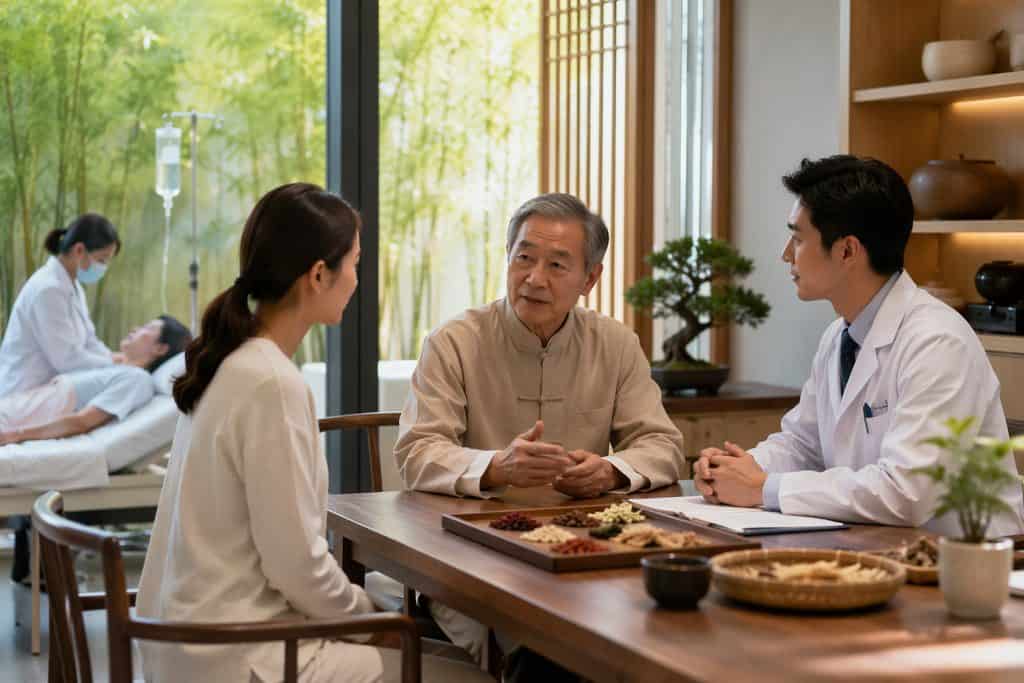
While patients in the UK often wait over 18 weeks for specialist pain management consultations on the NHS, the integrated wards at Shanghai’s Longhua Hospital combine MRI-guided diagnosis with acupuncture protocols initiated within 48 hours of admission. That gap — between a system treating symptoms in isolation and one layering modalities — is what drives a growing number of international patients to ask a very specific question: what does the TCM hospital cost China international patients actually look like, and is the model as coherent as the brochures suggest?
We coordinate care for people asking exactly this. Not as doctors. As the team that handles the logistics — the hospital matching, the document translation, the bilingual companion who stands beside you at the registration window. What follows is what we see on the ground.
How This Actually Works, Step by Step
Someone emails us a discharge summary from a hospital in Frankfurt or Dubai. Chronic psoriasis. Three years of topical steroids and one failed biologic. They want to know if a combined protocol — Western dermatology plus herbal decoctions and UVB light therapy — is available in a single hospital, not two clinics across town.
We send the records to the international patient center at a TCM-integrated hospital. A bilingual case manager reviews them with a senior physician. Five to seven business days later, we receive a preliminary treatment opinion. It outlines whether the case is suitable for integrated management, the expected duration of an inpatient stay, and a cost range. No promises. No guarantees. Just a clinical read on feasibility.
If the patient decides to proceed, we coordinate the S2 visa invitation letter from the hospital, book the initial consultation, and arrange a bilingual medical companion. The patient flies in. The companion meets them at the airport. Next morning, they walk into the hospital together.
That sequence — remote evaluation, then decision, then travel — is the only model that protects both the patient’s time and money. Flying to Beijing without a preliminary opinion is a gamble. We see it go wrong.
What “Integrated” Actually Means Inside a Chinese Hospital
The phrase gets thrown around loosely. In practice, it means something specific in the hospitals we work with: a single attending physician co-manages the case with a TCM specialist on the same floor. You are not discharged from the dermatology department and sent to the acupuncture clinic across the city. You stay in one bed. Two teams rotate through.
For oncology patients, this model is particularly concrete. A patient receiving FOLFOX chemotherapy for colorectal cancer may simultaneously receive an Astragalus-based injection to mitigate leukopenia, plus daily acupuncture for chemotherapy-induced peripheral neuropathy. The oncologist and the TCM physician review labs together. They adjust the herbal formula if liver enzymes shift. This is not alternative medicine layered on top. It is concurrent management with shared charting.
What is combined traditional Chinese and Western medicine treatment like for someone who has never encountered it? Disorienting at first. The morning starts with a Western nursing round — vitals, IV check, blood draw. By 10 a.m., a TCM practitioner arrives for pulse and tongue diagnosis. The herbal decoction arrives in a vacuum-sealed pouch, warmed, at 11 a.m. and again at 4 p.m. The patient is monitored for herb-drug interactions with the same lab frequency as any inpatient. The integration is in the workflow, not in a philosophy lecture.
A Realistic Timeline
Here is what a typical integrated treatment journey looks like from the moment you decide to explore the option. This is not a best-case scenario. It includes the waiting steps most people overlook.
| Stage | What Happens | Duration |
|---|---|---|
| Document preparation | Patient gathers medical records, imaging (DICOM format preferred), pathology slides, and current medication list. All documents must be translated into Chinese by a certified medical translator. | 1–3 weeks |
| Remote evaluation | Records sent to the hospital’s international department. A specialist reviews and issues a preliminary opinion on suitability and estimated treatment duration. | 5–10 business days |
| Decision and visa | Patient reviews the opinion, asks clarifying questions, and decides. Hospital issues an invitation letter. Patient applies for an S2 visa at the Chinese embassy or consulate. | 2–4 weeks |
| Travel and first consultation | Patient arrives in China. Bilingual companion assists with hospital registration. First face-to-face consultation with the integrated team. Treatment plan finalized. | Days 1–3 after arrival |
| Inpatient treatment | Active integrated treatment phase. Duration varies by condition: 2–4 weeks for chronic pain or dermatology, 4–8 weeks for post-stroke rehabilitation, intermittent cycles for oncology. | 2–8 weeks per cycle |
| Discharge and follow-up | Discharge summary provided in English and Chinese. Herbal prescriptions for continued use at home. Follow-up video consultations scheduled at 1, 3, and 6 months. | Ongoing |
The bottleneck is almost always document translation. Medical Chinese is a specialized skill. Rushing this step produces records that the receiving physician cannot fully interpret, which leads to a weaker preliminary opinion and a higher chance of the in-person consultation revealing surprises that should have been caught remotely.
What Can Go Wrong — and What Happens Then
Longhua Hospital affiliated with Shanghai University of Traditional Chinese Medicine is the most frequently cited in international patient circles, particularly for dermatology, rheumatology, and oncology integration. It has a dedicated international ward with English-speaking coordinators. Shuguang Hospital, also in Shanghai, runs a strong integrated hepatology program. The “best” depends entirely on your condition — a hospital that integrates well for psoriasis may not integrate well for post-stroke rehabilitation. The specialty match matters more than the institutional brand.
You cannot book a fixed-price “package” remotely the way you might book a hotel. What you can do is send your records for a preliminary evaluation, receive a treatment plan with an estimated cost range, and then decide. The plan is a clinical document, not a commercial quote. Only after the in-person consultation — where the physician examines you directly — is the treatment plan finalized and the cost confirmed. Anyone offering a firm, all-inclusive package price before a physician has seen you is selling hospitality, not medicine.
In hospitals with genuine integrated protocols, safety monitoring is rigorous. Liver and kidney function are tested frequently — often weekly for inpatients. The formulary is restricted to herbs with known safety profiles and documented interactions. The risk is not zero. Certain herbs potentiate warfarin. Others compete for cytochrome P450 metabolism and can alter chemotherapy drug levels. This is why integrated wards run by experienced teams matter — they know which combinations to avoid and which labs to watch. A standalone TCM clinic layering herbs onto your existing Western regimen without communication with your prescribing physician is a different and riskier proposition.
Your Next Step
The integrated hospitals exist. Some are genuinely impressive — wards where an oncologist and a TCM specialist round together, where the clinical pathways are documented, where the safety monitoring is as rigorous as any Western academic center. Others use the word “integrated” loosely and deliver parallel care under one roof. The difference is invisible until you ask the right questions.
We help international patients ask those questions before they book a flight. Our team handles the document translation, the hospital matching, and the on-the-ground coordination — but we do not practice medicine, and we do not promise outcomes. If you are considering an integrated treatment pathway in China, send us your records. We will get you a preliminary opinion from a hospital that matches your condition, not a brochure. That is where every real journey starts.
Frequently Asked Questions
Yes. The hospitals used for international patients are JCI-accredited and follow the same international safety standards as top hospitals in the US and Europe. Surgical teams perform high volumes of procedures — often more than their Western counterparts — which studies show leads to better outcomes.
Costs vary by procedure and hospital, but international patients typically save 40-80% compared to US prices — even when factoring in travel and accommodation. A consultation with our team will give you an exact, all-inclusive quote with no hidden fees.
Send us your existing medical reports to get started. We handle everything from hospital selection and appointment scheduling to visa assistance and post-operative recovery planning. Your medical records are reviewed by the specialist before you even book a flight.
For more medical information and treatment options in China, visit chinamedservices.com (China Medical Services).
