Hip Replacement in Shanghai: Costs, Surgeons, and Full Local Support
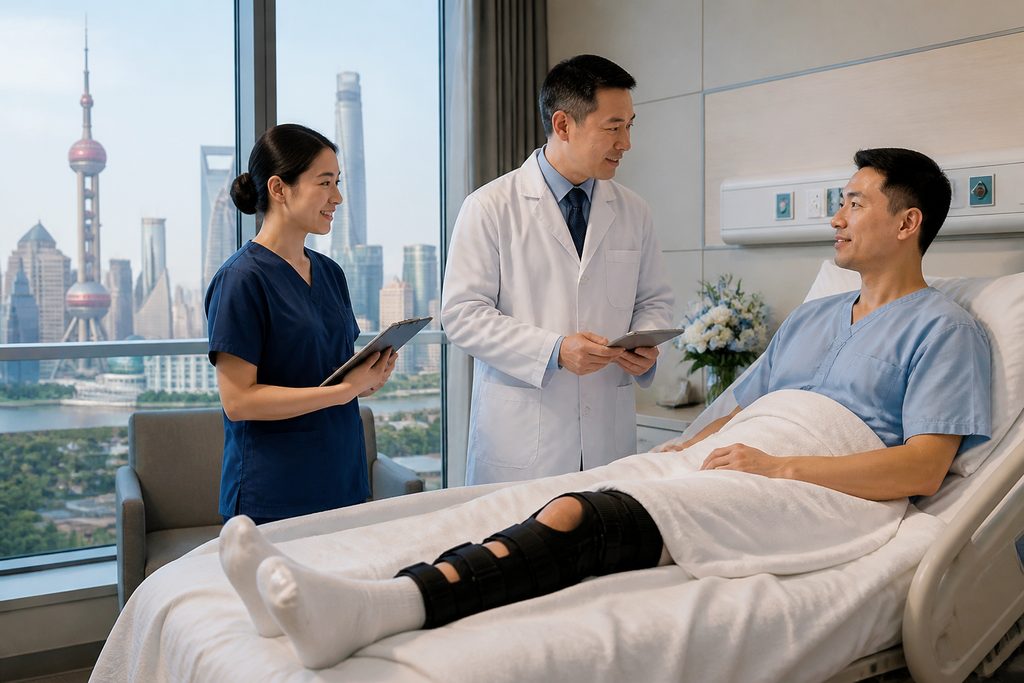
While patients in Canada wait a median 28.6 weeks for orthopedic surgery, surgeons at Shanghai Sixth People’s Hospital perform over 300 joint replacements every month. The clinical outcomes match or exceed Western benchmarks. But the hip replacement cost Shanghai hospitals quote is typically 70-80% lower than what a US patient faces. That gap—between a debilitating wait at home and an affordable, high-volume solution abroad—is why our team fields inquiries about this procedure every single day.
The decision is not trivial. Flying to another country for a major surgery requires trust in the system, not just the surgeon. We see two common scenarios. A patient in London is told the NHS wait for a hip replacement is 12-18 months. Another in Houston faces a $40,000 out-of-pocket bill even with insurance. Both end up searching the same phrase: “Getting your hip replacement in Shanghai China orthopedic surgery full local support.” This article walks through exactly what that means—the real costs, the clinical reality, the logistics, and the questions that keep patients up at night.
Key Takeaways
- Shanghai’s top orthopedic hospitals perform thousands of joint replacements annually, with surgeons who complete more procedures in a month than many Western surgeons do in a year.
- The all-inclusive price for a hip replacement in Shanghai—covering the implant, hospital stay, and surgeon fees—ranges from $12,000 to $18,000, compared to $40,000+ in the US.
- Language barriers and hospital navigation are the single biggest challenge for international patients; without local coordination, the process can stall before it starts.
- Surgical safety in China’s top-tier hospitals is comparable to international benchmarks, but patients must verify a hospital’s accreditation and infection rates—just as they would at home.
The Problem: When the Wait at Home Becomes the Real Risk
A hip worn down to bone-on-bone contact does not pause while a patient sits on a waiting list. A 2023 report from the Canadian Institute for Health Information found that only 57% of hip replacement patients received surgery within the recommended 26-week benchmark. The rest waited longer. Some waited more than a year. During that time, muscles atrophy. The opposite hip and the lower back take on unnatural loads. What starts as a single-joint problem cascades into a whole-body decline.
The financial picture is just as stark. A 2024 analysis by the Kaiser Family Foundation put the average total cost of a hip replacement in the United States at $39,000 to $45,000 for patients with commercial insurance—before deductibles and coinsurance kick in. For the uninsured, the hospital’s chargemaster price can exceed $60,000. That number is not an abstraction. It is a second mortgage, a drained retirement account, or a surgery delayed indefinitely.
These two forces—wait times and cost—are pushing patients to look beyond their borders. And Shanghai, with its concentrated orthopedic expertise and lower cost structure, keeps appearing at the top of their research.
Why Shanghai’s Orthopedic System Delivers Results
Clinical Volume Drives Better Outcomes
There is a well-documented relationship between surgical volume and patient outcomes. A landmark study in The Journal of Bone and Joint Surgery (2019) found that surgeons performing more than 50 hip replacements annually had significantly lower complication rates than those doing fewer than 10. Shanghai’s dedicated orthopedic hospitals operate on a different scale entirely. A senior surgeon at Shanghai Sixth People’s Hospital—one of the city’s flagship orthopedic centers—may complete 300 to 500 joint replacements per year. That is not an outlier. The hospital’s orthopedic department handles more than 4,000 joint surgeries annually across its teams.
This volume creates a feedback loop. Operating room staff work with the same instruments and protocols daily. Post-operative care pathways are refined through constant iteration. Complications are identified and addressed faster because the pattern recognition is sharper. For a patient, that means walking into a system where your surgery is not a special event—it is a standard, optimized workflow.
Technology Adoption Without the Legacy Friction
Many of Shanghai’s top orthopedic centers adopted robotic-assisted surgery platforms—such as the Mako system—years ago, but they did so without the decade-long capital depreciation cycles that slow adoption in some Western hospital networks. The result is that a patient can access robotic-arm-assisted hip replacement with precise implant positioning at a price point that remains far below Western equivalents. The technology is not experimental here. It is routine.
Also worth noting: Shanghai hospitals often use the same implant brands familiar to Western patients—Zimmer Biomet, DePuy Synthes, Stryker. The prosthetics are not local knockoffs. They are the same FDA-approved or CE-marked components a patient would receive in New York or Berlin, sourced through authorized distribution channels.
Cost Advantage Without Quality Compromise
The hip replacement cost Shanghai hospitals quote—typically $12,000 to $18,000 all-inclusive—does not reflect lower quality. It reflects structural economic differences. Physician compensation in China is a fraction of what it is in the US. Hospital construction and operating costs are lower. Malpractice insurance premiums, a massive cost driver in American healthcare, are negligible by comparison. The implant itself costs roughly the same everywhere. The savings come from everything wrapped around the implant: the operating room time, the surgeon’s fee, the hospital stay, the nursing care.
What about clinical safety? A 2022 study published in The Lancet examined surgical outcomes across multiple countries and found that China’s top-tier hospitals achieved perioperative mortality rates and infection rates comparable to OECD averages. The key qualifier is “top-tier.” The data does not apply to every hospital. It applies to the ones international patients should be considering—the Fudan-ranked, JCI-accredited institutions that make up our database.
How Safe Is Hip Replacement Surgery in China for International Patients
This is the question that keeps patients awake at 3 a.m. And it deserves a direct answer. The infection rate for primary total hip arthroplasty at China’s leading orthopedic centers ranges between 0.5% and 1.2%, according to published clinical data from institutions like Shanghai Sixth People’s Hospital and Peking University Third Hospital. That range aligns with the 0.5% to 1.5% rates reported in large US and European registries.
But safety is not just a surgical metric. It is also a systems question. Who manages your post-operative care? What happens if a complication arises after you fly home? These are the right questions to ask. The best hospitals in Shanghai have dedicated international patient departments with English-speaking coordinators. They provide translated discharge summaries, imaging on USB drives, and direct lines of communication for follow-up questions. Some have established telemedicine protocols for international patients at the 6-week and 12-week marks. None of this is automatic. It must be confirmed before you book a flight.
What Is Recovery Time for Hip Replacement Abroad
Recovery follows a predictable arc, and the timeline does not change just because you crossed a time zone. Most patients stand and take a few steps with a walker within 24 hours of surgery. The typical hospital stay is 3 to 5 days. By day 5 to 7, a patient can usually transfer to a hotel or serviced apartment, provided they have assistance.
Here is the timeline we advise patients to plan for:
| Phase | Timeframe | What to Expect |
|---|---|---|
| Hospital stay | Days 1–5 | Pain management, twice-daily physiotherapy, drain removal, initial mobilization |
| Local recovery in Shanghai | Days 6–14 | Transition to hotel, daily physio sessions, wound check, suture removal around day 12–14 |
| Travel clearance | Day 14–21 | Surgeon clearance to fly; compression stockings mandatory; aisle seat and frequent standing during flight |
| Continued recovery at home | Weeks 3–6 | Outpatient physiotherapy, walking with a cane, no driving, gradual return to daily activities |
| Full activity | 3–6 months | Most patients resume golf, swimming, cycling; high-impact activities require surgeon approval |
Flying after joint replacement carries a slightly elevated risk of deep vein thrombosis. The standard protocol is low-molecular-weight heparin injections for the first 10-14 days, compression stockings, and a clearance exam before departure. We have seen patients fly home as early as day 10. We have also seen surgeons require a full three weeks. The decision is clinical, not logistical.
All Inclusive Hip Surgery Shanghai Price: What the Package Actually Covers
The phrase “all inclusive” gets thrown around loosely in medical tourism. Patients need to read the fine print. A genuine all inclusive hip surgery Shanghai price package from a hospital’s international department should cover these line items explicitly:
- Pre-operative assessment: blood work, ECG, chest X-ray, and any required cardiac or anesthesia clearance
- The implant itself: specify the brand and model (Zimmer, DePuy, Stryker) in the quotation
- Surgeon’s fee and anesthesiologist’s fee
- Operating room charges and robotic system fee, if applicable
- Hospital room for the standard stay (typically 5 days)
- Inpatient physiotherapy and medications during the hospital stay
- One post-discharge wound check and suture removal
What is usually not included: the pre-arrival video consultation fee, your flight, your hotel after discharge, outpatient physiotherapy sessions beyond the hospital stay, meals outside the hospital, and any treatment for complications unrelated to the hip. A patient who expects a turnkey $14,000 experience can be shocked by an extra $3,000 in ancillary costs if these exclusions are not spelled out. We recommend getting the package scope in writing, in English, before making any payment.
Best Orthopedic Surgeon Shanghai for Foreigners: How to Evaluate Your Options
Finding the best orthopedic surgeon Shanghai for foreigners is not about picking a name from a list. It is about matching the surgeon’s sub-specialization to your specific case. A surgeon who does 400 primary hip replacements a year may not be the right choice for a complex revision of a failed implant. A surgeon who excels at anterior-approach hips may not be the best fit if your anatomy requires a posterior approach.
Here is the evaluation framework we use internally:
First, verify the surgeon’s annual volume for your specific procedure. A surgeon doing 300 primary hips and 50 revisions has a different risk profile for a revision case than one doing 150 revisions annually. Ask directly.
Second, confirm the hospital’s accreditation status. Look for JCI accreditation or a position on the Fudan Hospital Ranking’s orthopedic specialty list. Shanghai Sixth People’s Hospital, Huashan Hospital, and Changzheng Hospital all appear on the Fudan orthopedics ranking and have dedicated international patient pathways. You can explore our orthopedic department rankings for the full picture.
Third, assess the communication pathway. Does the surgeon have an English-speaking coordinator? Will the post-operative instructions be in English? Can you reach someone with clinical knowledge—not just an administrative assistant—if you have a question after discharge? These factors matter as much as surgical skill when you are 7,000 miles from home.
For a broader view of Shanghai’s hospital landscape, our Shanghai city page breaks down the options by specialty and international patient services.
Book Hip Replacement Shanghai Medical Tourism Package: The Process Step by Step
A patient who emails a Shanghai hospital directly with “I want to book a hip replacement” will likely receive a polite but unhelpful reply. The system does not work like a hotel reservation. Here is the actual sequence, based on years of coordinating these cases:
Step 1: Remote evaluation. You send recent X-rays (standing AP pelvis, frog-leg lateral), a surgical history, a medication list, and a brief description of your symptoms. The hospital’s orthopedic team reviews these—usually within 3 to 5 business days—and confirms whether you are a surgical candidate. This step often involves a written second opinion, which typically costs $300 to $500 and is credited toward your coordination fee if you proceed.
Step 2: Video consultation. You speak directly with the surgeon or the surgical team. They explain the recommended approach, the implant choice, the expected recovery trajectory, and the risks specific to your case. This is your chance to ask every question on your list. A top-specialist video consultation runs $500 to $800.
Step 3: Quotation and scheduling. If both sides agree to proceed, the hospital’s international department issues a formal treatment quotation and proposed surgery date. You will need to arrange payment—typically a wire transfer for the hospital deposit—and confirm your travel dates.
Step 4: Visa and travel. Medical treatment in China falls under the S2 visa category, which covers short-term private affairs including medical care. You will need an invitation letter from the hospital, proof of accommodation, and a passport with at least six months of validity. The hospital’s international department can provide the invitation letter. We cover visa logistics in detail on our patient coordination page.
Step 5: Arrival and surgery. You arrive in Shanghai, complete your pre-operative tests, and proceed to surgery. Our team handles the hospital registration, the queue navigation, the translation during consent-signing, and the discharge coordination.
Practical Considerations: Documentation, Payment, and Follow-Up
The logistics are not glamorous, but they are where plans fall apart. Here is what to prepare.
Medical records. Bring originals and digital copies of all imaging—not just the radiology report. The surgeon needs to see the films. A CD with DICOM files is standard. Bring a printed medication list with generic drug names, not just brand names. Bring your surgical history, including any implant cards if this is a revision case.
Payment. Most Shanghai hospitals require a deposit before admission. The deposit amount is typically the full estimated cost of the surgery and hospital stay. International wire transfers take 3 to 5 business days. Credit cards are accepted at international departments, but limits on foreign cards can be a problem—confirm the maximum single-transaction amount with your bank before you travel. WeChat Pay and Alipay are ubiquitous in China, but linking a foreign card can be finicky. Carry a backup payment method.
Insurance reimbursement. Most US and European insurers classify this as out-of-network care. That means you pay upfront and submit a claim afterward. Request an itemized invoice in English from the hospital’s international department before you leave. The invoice should include CPT or ICD-10 codes that your insurer will recognize. Some private international hospitals in Shanghai, such as Jiahui and United Family, offer direct billing with select international insurers—but their prices are higher, closer to $25,000 to $35,000 for the same procedure.
Follow-up. Before you leave Shanghai, confirm the communication channel for post-operative questions. Is there a WeChat contact? An email address that actually gets answered? A telemedicine appointment at 6 weeks? Get these details in writing. The surgeon who operated on you should review your 6-week X-ray, even if you take that X-ray at a local imaging center back home and email the file.
Frequently Asked Questions
Yes—provided you are at a top-tier hospital. The major Shanghai orthopedic centers use the same implant systems (Zimmer Biomet, DePuy Synthes, Stryker, Smith & Nephew) that are standard in North America and Europe. These are imported, registered with China’s National Medical Products Administration, and tracked with unique device identifiers. Ask for the implant’s model number and verify it against the manufacturer’s global catalog. A reputable hospital will provide this without hesitation.
What if something goes wrong after I return home?
This is the hardest scenario to plan for, and it requires honesty. Your local orthopedic surgeon may be reluctant to manage a complication from a surgery performed abroad. Before you travel
For more medical information and treatment options in China, visit chinamedservices.com (China Medical Services).
