Dental Care in Changsha: Your Complete Guide to Xiangya Hospital Area with a Local Companion
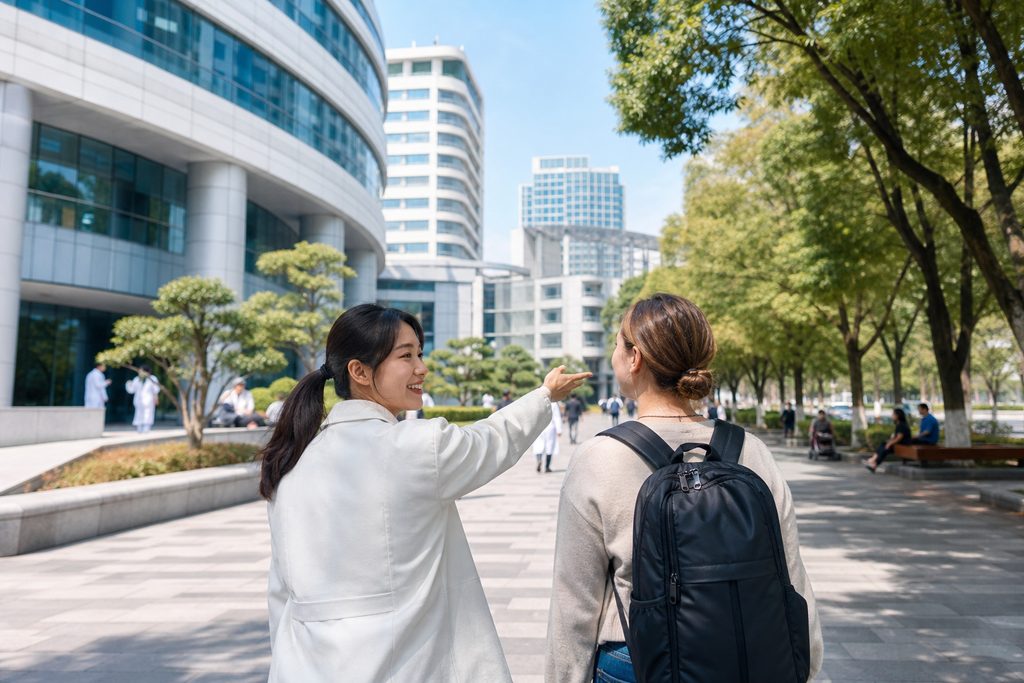
When 47-year-old Elena from Manchester cracked a molar on a business trip to Hunan, the pain was bad. The confusion was worse. She stood outside the sprawling Xiangya Hospital complex, staring at a sea of Chinese characters, and realized she had no idea which building to enter, let alone how to register. She spoke no Mandarin. The hospital’s daily outpatient volume exceeds 10,000 visits. Her phone’s translation app was useless against the noise and speed of a busy Chinese public hospital. This is the moment a local companion transforms chaos into a clear path. We have seen this scenario unfold hundreds of times. The dental care available in this medical district is world-class. Accessing it without local knowledge is the real challenge.
How This Actually Works, Step by Step
The process is not a mystery. It follows a predictable sequence that we coordinate for patients from initial inquiry through post-operative recovery. Understanding this sequence removes the anxiety that comes with the unknown.
First, you contact us with your dental concern and any recent X-rays or records you have. We translate these into Chinese and route them to the appropriate department. For dental implants, this means the oral implantology team. For general restorative work, the prosthodontics department. The point is precision. Sending records to the wrong specialist wastes weeks.
Second, the department reviews your materials and confirms whether they can help. They issue a written preliminary assessment. This is not a treatment plan. It is a feasibility opinion. It tells you what procedures are likely indicated and whether you need to be physically present for the next step. Most dental work requires an in-person examination. That is not negotiable at a public hospital.
Third, we schedule your initial consultation. This is where the public hospital system differs sharply from what Western patients expect. You cannot book a specific appointment slot online from overseas for a standard outpatient visit. The hospital releases registration numbers each morning. We handle that. Our bilingual companion secures your queue number, navigates you to the correct sub-specialty clinic, and sits beside you during the doctor consultation to translate everything in real time.
Fourth, after the examination, the dentist proposes a treatment plan with costs. You decide. If you proceed, we coordinate the treatment schedule, any required pre-operative clearances, and your follow-up visits. For multi-stage procedures like dental implants, this coordination spans several months and multiple trips to Changsha. We track every appointment.
Understanding Dental Implants Cost Changsha Xiangya Hospital and What Drives It
The question that dominates every initial conversation is straightforward: what will this cost me? The answer requires context. Dental implants cost at Changsha Xiangya Hospital and its affiliated stomatology centers reflect a pricing structure that differs fundamentally from private dental chains in the West.
A single tooth implant at a public hospital in Changsha, including the surgical placement, abutment, and crown, typically ranges from $1,200 to $2,800. This compares to $3,000 to $6,000 at private clinics in Southeast Asia and $4,000 to $8,000 in the United States. The variance depends on the implant system brand. Xiangya Hospital stocks Korean systems like Osstem and Dentium at the lower end of that range. Swiss Straumann or Swedish Nobel Biocare systems fall at the higher end. The dentist will recommend a system based on your bone density and aesthetic zone, not just price.
Bone grafting adds cost. If your tooth was extracted years ago and the jawbone has resorbed, you may need a sinus lift or ridge augmentation. This can add $500 to $1,500 to the total. A full-mouth reconstruction with All-on-4 or All-on-6 implant-supported bridges ranges from $12,000 to $22,000. That same procedure in Australia or the US often exceeds $45,000.
These are public hospital prices. Xiangya Hospital’s stomatology center is one of China’s oldest and most respected, tracing its roots to the Xiangya Medical College founded in 1914. The specialists here are faculty members who teach, publish research, and handle complex cases referred from across Hunan province. You are not paying for a sales consultant’s commission. You are paying for clinical time and materials. The cost advantage is real. But so is the complexity of navigating the system.
A Realistic Timeline
Dental tourism marketing often paints a picture of quick fixes. The biological reality of osseointegration does not cooperate with marketing timelines. Here is what a single tooth implant journey actually looks like when coordinated through Xiangya Hospital.
| Stage | Duration | What Happens |
|---|---|---|
| Remote record review | 3–7 days | We translate and submit your X-rays. The department confirms feasibility. |
| Visa processing (S2) | 2–4 weeks | We provide the hospital invitation letter. You apply at your local Chinese consulate. |
| Initial consultation & CBCT scan | 1 day | Companion escorts you. Dentist examines, takes 3D scan, gives final diagnosis and plan. |
| Implant placement surgery | 1 day | Usually scheduled 1–3 days after consultation if no grafting is needed. |
| Osseointegration waiting period | 3–6 months | You return home. The implant fuses with your jawbone. Nothing to do but wait. |
| Second trip: abutment & impression | 2–3 days | Minor procedure to expose implant. Digital scan for crown fabrication. |
| Crown fabrication | 2–3 weeks | Lab work. Some patients stay in Changsha. Others return home and come back. |
| Third trip: crown delivery | 1 day | Final fitting and adjustment. You leave with a functioning tooth. |
The total elapsed time from first contact to final crown is rarely less than four months. It is often six to eight. Anyone promising a complete implant in two weeks is describing a technique that skips osseointegration and carries a higher failure risk. We do not recommend that approach. We also do not coordinate it.
What this timeline assumes: your bone volume is adequate, you do not smoke heavily, and you have no uncontrolled diabetes. Each of those factors can extend the timeline or disqualify you as a candidate until the underlying condition is managed.
What Can Go Wrong — and What Happens Then
Honesty about failure modes is where trust is built. Dental implant procedures at a top-tier Chinese hospital are safe. Complication rates at Xiangya Hospital’s stomatology center are consistent with international benchmarks. But complications happen.
Early implant failure occurs in roughly 2-5% of cases. The implant simply does not integrate. This usually becomes apparent within the first month. The implant is removed, the site is allowed to heal for several weeks, and a new implant is placed. The hospital typically covers the replacement implant cost. You still bear the cost of the second surgery and the extended timeline. We have seen this happen twice in our coordination experience. Both patients completed treatment successfully on the second attempt.
Peri-implantitis is a longer-term risk. It is a bacterial infection around the implant, similar to gum disease around natural teeth. It develops slowly, often years after placement. The risk is higher in smokers and patients with poor oral hygiene. Treatment ranges from deep cleaning to surgical intervention. Your home dentist will need to monitor for this. Xiangya Hospital provides detailed post-operative care instructions in English, translated by our team. But long-term maintenance is your responsibility.
Communication breakdowns are the most preventable failure mode. A patient misunderstands the post-operative medication schedule because the pharmacist’s instructions were in Chinese. A follow-up appointment is missed because the SMS reminder was not translated. These are not hypothetical scenarios. They are exactly why a bilingual companion matters. Our companion does not just translate words. They translate the entire care pathway. They confirm you understand before you leave the consultation room.
A realistic concern: what if you need urgent follow-up after returning home? Xiangya Hospital’s international patient coordination office can arrange video follow-ups. But if a physical examination is required, you will need to see a local dentist. We strongly recommend establishing a relationship with a dentist in your home country before traveling. Share the Chinese treatment plan with them. Ensure they are willing to provide follow-up care. Most are. Some are not. Find out before you book the flight.
How to Find an English Speaking Dentist in Changsha China and Evaluate Your Options
The search query “how to find English speaking dentist in Changsha China” reveals a fundamental anxiety. You want clinical excellence. You also want to understand what the clinician is saying. These two needs do not always coexist in Chinese public hospitals.
Xiangya Hospital has an international medical department. Some of its stomatology faculty speak functional English. But functional English in a clinical setting means different things to different people. A professor who reads English-language journals fluently may still struggle to explain subtle treatment trade-offs in colloquial English that a patient from Texas or Dublin will grasp intuitively. The consultation pace in a public hospital is fast. Doctors see dozens of patients daily. They do not have time to repeat explanations.
This is not a criticism. It is a structural reality of a high-volume public teaching hospital. The solution is not to demand that the professor become fluent in English. The solution is to bring a competent interpreter. Our bilingual companions are medically literate. They understand dental terminology in both languages. They do not just translate words. They ensure the dentist’s clinical reasoning is communicated accurately and that your questions are understood fully.
What about private dental clinics near Xiangya Hospital that market themselves to foreigners? Several exist within a 15-minute walk of the hospital. They are not as regulated as Xiangya’s faculty practice. Some are excellent. Some are not. Evaluating them requires asking hard questions: Is the implant surgeon a former Xiangya faculty member or a recent graduate with limited experience? Does the clinic own its own CBCT scanner or send you elsewhere for imaging? What implant system do they use and why? A legitimate clinic answers these questions directly. A clinic that deflects or offers a price that seems too good to be true is one to avoid.
The best dental clinic near Xiangya Hospital for foreigners is often not a single clinic. It is the specific department within Xiangya’s stomatology center that matches your clinical need, accessed through the international coordination channel. That channel ensures you see an attending-level specialist, not a trainee. It ensures your records are reviewed before you arrive. It ensures a companion is present for every significant interaction.
Practical Considerations: Records, Visa, Payment, and Follow-Up Care
Bringing your dental care to Changsha requires more logistical preparation than a typical medical tourism trip to Bangkok or Budapest. The clinical quality is there. The infrastructure for international patients is developing but not yet seamless. Here is what you need to handle.
Your dental records must be translated before submission. A panoramic X-ray taken within the last six months is the minimum. A CBCT scan is better and often required for implant planning. If your home dentist can provide DICOM files on a USB drive, bring that. We handle the translation and formatting for Chinese hospital systems. Without this preparation, your first consultation will be wasted on ordering new imaging.
The visa category for dental treatment is an S2 visa. This is a short-stay private affairs visa. The hospital provides an invitation letter that specifies the treatment purpose and duration. You submit this with your application. Processing times vary by consulate. Plan for three to four weeks. Do not book non-refundable flights until the visa is in your passport. We have seen consulates request additional documentation. We have never seen a properly documented dental treatment visa application rejected, but delays happen.
Payment at Xiangya Hospital is upfront. The hospital does not directly bill international insurance. You pay the estimated treatment cost at the cashier. You receive an official invoice and detailed medical records. You submit these to your insurer for reimbursement. Check with your insurer before traveling. Confirm that overseas dental treatment is covered and understand the reimbursement rate. Some policies cover implant surgery but not the crown. Some cover neither. Know before you go.
Language is the friction point that compounds every other challenge. Signage in the hospital is primarily in Chinese. The registration kiosks are in Chinese. The pharmacy queue system is in Chinese. A bilingual companion absorbs this friction. They do not just interpret. They navigate the physical space, the queue systems, the payment counters, and the pharmacy. They ensure you are in the right place at the right time with the right paperwork. This is not a luxury service. In a hospital that sees over 10,000 outpatients daily, it is the difference between a manageable experience and a overwhelming one.
Follow-up care at home requires planning. Your implant needs annual monitoring. Your home dentist needs the treatment summary and implant passport that identifies the system, diameter, and lot number of your implant. We ensure you leave Changsha with this documentation in English. We also facilitate direct communication between your home dentist and the Xiangya specialist if a complication arises. This continuity of care is not automatic in cross-border treatment. It must be deliberately constructed.
Frequently Asked Questions
Yes, when accessed through a top-tier teaching hospital like Xiangya. The stomatology center follows sterilization protocols consistent with international standards. Implant systems used are the same FDA-approved or CE-marked brands used in Western countries. The primary risk is not clinical quality. It is communication failure and the logistical chaos of navigating a high-volume public hospital without language support. A local companion mitigates that risk directly.
You cannot book a standard outpatient appointment online from overseas. The public registration system is designed for domestic patients who queue on the day. However, through the hospital’s international medical coordination channel, we can pre-arrange a consultation slot with a specific department. This requires your translated records to be submitted and reviewed first. The appointment is confirmed before you travel. This is not a standard booking. It is a coordination service that bridges the gap between the domestic system and international patient needs.
Some agencies sell all-inclusive packages that bundle flights, hotels, treatment, and a guide. We advise caution. A package that locks you into a specific clinic before a specialist has reviewed your case is a red flag. The treatment plan should dictate the clinic, not the package. Our approach is different. We coordinate the medical pathway first. Once the treatment plan is confirmed, we arrange the practical support: companion, accommodation recommendations, and airport transfers. You are never committed to treatment before a Xiangya specialist has examined you and given you a clear, itemized plan and cost estimate.
Your home dentist is your first point of contact for any post-operative concern. We provide them with a complete treatment summary and direct contact information for the Xiangya specialist. The specialist can review new X-rays remotely and advise your home dentist. If a return trip to Changsha is necessary, we coordinate it. Implant manufacturers’ warranties are honored globally through their local representatives. Your implant passport is the key document that enables this.
Your Next Step
The decision to travel for dental care is a calculation. You are trading the convenience of a local dentist you can visit tomorrow for a significant cost saving and access to a high-volume specialist who has seen more complex cases than most Western dentists will encounter in a career. The calculation makes sense when the coordination is handled properly. It falls apart when it is not.
Our team has coordinated dental treatment pathways through Xiangya Hospital’s stomatology center for patients from over a dozen countries. We do not provide medical advice. We do not guarantee treatment outcomes. What we provide is a structured, transparent pathway that removes the unknowns that make cross-border dental care feel risky. We translate your records, secure your consultation, place a bilingual companion at your side, and ensure you leave with complete documentation for your home dentist.
If you are considering dental implants or complex restorative work and the numbers you have been quoted at home are daunting, let us show you what the same treatment looks like at Xiangya Hospital with full coordination support. Send us your recent X-rays and a brief description of your dental concern. We will translate them, submit them for review, and return a preliminary feasibility assessment and cost estimate. There is no charge for this initial review. It gives you a concrete basis for comparison. From there, you decide.
Submit your records for a free preliminary review.
For more medical information and treatment options in China, visit chinamedservices.com (China Medical Services).
