Why Choose Shenzhen for Cross-Border Medical Care: Hong Kong Adjacent Full Service Hub
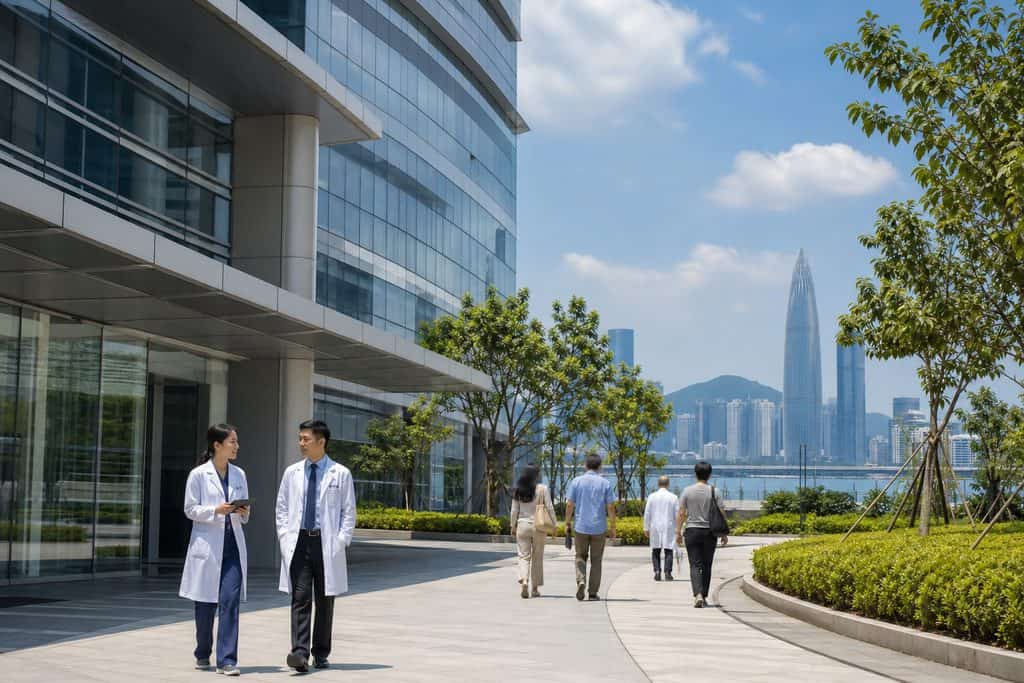
Why Choose Shenzhen for Cross-Border Medical Care: The Short Answer
You choose Shenzhen because it cuts your medical bill by 60–80% compared to Hong Kong private hospitals while putting you 14 minutes from a world-class oncology department via high-speed rail. A Shenzhen medical tourism cost comparison tells the story plainly: a PET-CT scan that runs HK$12,000–18,000 in Hong Kong costs roughly HK$3,500–5,000 across the border. Knee replacement surgery follows the same curve. The savings are real and immediate.
But Shenzhen is not a simple Hong Kong discount bin. The city has built genuine clinical depth over the past decade — Fudan-ranked departments, JCI-accredited international wings, and specialists who trained in the US and Germany. The challenge is knowing which hospital actually delivers for your specific condition and how to access it without Mandarin fluency. That is where the full-service model matters.
Who This Is Right For — and Who It Isn’t
Cross-border care works brilliantly for some patients. For others, staying put is the smarter call. Here is the honest breakdown.
Typically a good candidate:
- You need an elective procedure with a known diagnosis — orthopedic surgery, hernia repair, cataract removal, dental implants, or a comprehensive health screening package.
- You carry a confirmed imaging report and lab work, so the Shenzhen team can review your case before you travel.
- You live in Hong Kong or the Pearl River Delta and can attend follow-up appointments without expensive flights.
- You want a second opinion from a high-volume specialist — someone who sees 3,000 cases of your condition annually rather than 300.
- You are paying out of pocket and the math matters. A Shenzhen medical tourism cost comparison against Hong Kong, Singapore, or Bangkok prices will almost always favor Shenzhen for equivalent clinical quality.
Probably not a good candidate:
- Your condition is unstable or undiagnosed. Showing up at a Shenzhen hospital without prior records and hoping for a miracle workup wastes time and money. Get the diagnosis at home first.
- You require continuous, complex ICU-level care that makes cross-border transfer medically risky.
- You expect Hong Kong-style service culture. Shenzhen’s top international departments come close, but the broader hospital environment is busier, louder, and more crowded than what you are used to at Matilda or Adventist.
- Your insurance mandates treatment within Hong Kong and refuses to reimburse mainland care. Check this before booking anything.
The Options, Compared: Shenzhen vs. Hong Kong vs. Other Medical Travel Hubs
A Shenzhen medical tourism cost comparison only makes sense when you see the full field. The table below uses mid-range estimates for common procedures at JCI-accredited or Fudan-ranked hospitals. Prices include hospital fees and surgeon charges but exclude travel, accommodation, and any coordination service fees.
| Procedure | Shenzhen (USD) | Hong Kong Private (USD) | Bangkok JCI (USD) | Seoul JCI (USD) |
|---|---|---|---|---|
| Total knee replacement (single) | $8,000–14,000 | $28,000–42,000 | $14,000–20,000 | $18,000–25,000 |
| PET-CT scan (whole body) | $450–700 | $1,500–2,300 | $800–1,100 | $900–1,200 |
| Laparoscopic cholecystectomy | $3,500–5,500 | $10,000–16,000 | $5,000–8,000 | $7,000–10,000 |
| Comprehensive health screening (executive) | $400–900 | $1,200–2,500 | $500–1,000 | $600–1,200 |
| Dental implant (single, including crown) | $800–1,500 | $2,500–4,500 | $1,500–2,500 | $1,800–3,000 |
| IVF cycle (standard, excluding medication) | $4,000–7,000 | $12,000–18,000 | $6,000–9,000 | $7,000–11,000 |
Shenzhen wins on price across the board. Bangkok and Seoul offer more established medical tourism infrastructure and English-speaking environments, but they cannot match Shenzhen’s geographic proximity to Hong Kong. For a patient living in Causeway Bay, the door-to-door journey to a Shenzhen international hospital ward is under 90 minutes. That changes the calculus for procedures requiring multiple visits.
How to Actually Cross from Hong Kong to Shenzhen for Surgery
The question “can I cross from Hong Kong to Shenzhen for surgery” comes up in nearly every initial consultation we handle. The answer is yes — and thousands of people do it monthly — but there is a sequence you must follow to avoid wasting a trip.
Step one is remote evaluation. You do not simply walk across the border and ask for a surgical slot. Send your existing medical records, imaging files, and a summary of your treatment goals to the hospital’s international department. A specialist reviews these remotely. This written second opinion typically costs $300–500 and confirms whether surgery is indicated, what approach the team recommends, and whether your case fits their expertise. If the answer is no, you have saved yourself a futile border crossing.
Step two is the in-person consultation. Once the remote review confirms feasibility, you schedule a face-to-face appointment. You enter on an S2 visa — the short-stay category used for private affairs including medical treatment. Do not apply for an M visa; that is strictly for commercial and trade activities and will not cover your hospital stay. Your spouse or adult child accompanying you also applies for an S2. The hospital’s international department provides the invitation letter you need for the visa application.
Step three is admission and surgery. After the specialist examines you in person and agrees to proceed, the hospital schedules your procedure. This is where the coordination service proves its value: navigating pre-admission testing, deposit payment, and ward assignment in a 2,000-bed hospital with limited English signage is not something you want to attempt solo.
Which Hospital in Shenzhen Actually Serves International Patients Well
Searching for the “best hospital in Shenzhen for international patients price list” leads most people to a short list of four institutions. Each serves a different patient profile, and the price spread between them is significant.
The University of Hong Kong-Shenzhen Hospital (HKU-SZH) sits in Futian District and operates as a direct extension of Hong Kong’s public hospital philosophy transplanted to the mainland. It was the first Shenzhen hospital to adopt a packaged pricing model for common procedures — you pay a fixed fee that covers the surgery, ward stay, medications, and routine post-operative care within the package period. A total hip replacement package runs approximately RMB 45,000–65,000 (roughly $6,200–9,000). The hospital employs bilingual staff, accepts Hong Kong dollars at its cashier, and feels culturally familiar to Hong Kong residents. The trade-off: as a public institution, specialist appointment slots fill fast, and the environment is less plush than private alternatives.
Shenzhen Samii International Medical Center is newer and quieter. Located in Nanshan, it operates under a public-private hybrid model with German clinical management influence. Its orthopedic and neurosurgery departments attract patients specifically seeking European-trained surgical technique without the European price tag. A lumbar discectomy here costs roughly $7,000–11,000. The facility is modern, the corridors are calm, and English proficiency among senior medical staff is higher than at most mainland public hospitals.
Peking University Shenzhen Hospital houses one of the city’s strongest oncology departments, ranked among Guangdong’s top programs for tumor resection volumes. Its international medical center occupies a dedicated floor with priority scheduling and English-speaking coordinators. Cancer surgery packages here — say, a laparoscopic colorectal tumor resection — range from $10,000–18,000 depending on complexity and length of stay.
United Family Shenzhen (和睦家) is the private, JCI-accredited option that most closely resembles a Western clinic. English is the working language. Insurance direct billing is standard. The price list is transparent and higher than the public options above: a vaginal delivery package starts around $8,000, a knee arthroscopy around $12,000–18,000. For patients who prioritize a familiar care environment and minimal administrative friction, United Family delivers. For those whose primary goal is maximizing the cost differential versus Hong Kong, the public hospital international wings offer better value.
No single hospital wins for every condition. A Shenzhen full service medical hub packages for foreigners approach means matching your specific diagnosis to the institution with the highest relevant case volume, then layering on the coordination support that makes the experience navigable.
What It Costs: Real Numbers and What Drives Variance
The headline savings are real, but the final bill depends on several factors that a simple Shenzhen medical tourism cost comparison chart cannot capture. Here is what moves the needle.
Public international wing vs. private hospital. HKU-SZH and Peking University Shenzhen international departments charge roughly 1.5–2 times the standard public rate for the same procedure, which still lands at one-third to one-half of Hong Kong private prices. United Family charges 3–4 times the public rate — competitive with mid-range Bangkok hospitals but still below Hong Kong.
Ward class. A shared two-bed room in a public international wing might add $80–150 per night. A private suite at United Family runs $300–600 per night. For a five-day surgical stay, that difference alone is $1,000–2,500.
Implant and consumable choice. Orthopedic and cardiac procedures involve hardware — the difference between a domestically manufactured knee implant and an imported Stryker or Zimmer prosthesis can be $3,000–6,000. Confirm which implant your surgeon plans to use and whether the quoted package includes it.
Coordination service fees. If you engage a service to book hospital appointment Shenzhen near Hong Kong border, handle record translation, and provide a bilingual companion on the day, budget from $300 for basic appointment coordination up to $5,000–8,000 for comprehensive VIP end-to-end support spanning multiple visits. Any remote consultation fee you pay is credited in full toward on-the-ground coordination if you proceed within 90 days — a one-time credit applied to the coordination fee, never to hospital treatment charges.
Practical Considerations: Records, Payment, and Follow-Up
Cross-border care introduces logistical friction that domestic treatment does not. Knowing these pain points upfront prevents nasty surprises.
Medical records. Shenzhen hospitals require your imaging in DICOM format on a CD or USB, not just printed films or JPEG screenshots. Hong Kong private hospitals and imaging centers can export DICOM files — request this explicitly. Pathology slides must be physically transported as paraffin blocks or unstained slides. A written summary of your treatment history, translated into simplified Chinese if the hospital requests it, accelerates the review. Our team handles this translation as part of case preparation.
Payment. Public hospital international wings in Shenzhen generally require a cash deposit upfront — typically 50–80% of the estimated procedure cost — settled via UnionPay, WeChat Pay, Alipay, or bank transfer. Hong Kong credit cards work at United Family and Samii but may not be accepted at public hospital cashiers. Carry multiple payment methods. If your insurance reimburses after the fact, obtain itemized receipts and the discharge summary in English before leaving the hospital.
Language. Senior specialists at HKU-SZH and United Family speak functional to fluent English. At other institutions, English proficiency drops sharply once you step outside the international department and interact with ward nurses, pharmacy staff, or billing clerks. A bilingual companion who stays with you through registration, pre-op testing, and discharge paperwork eliminates the most common source of stress reported by international patients.
Follow-up after returning to Hong Kong. Your Shenzhen surgeon will provide a detailed post-operative plan — suture removal timeline, physiotherapy protocol, warning signs to watch for. Take this to your Hong Kong GP or specialist and establish who will manage wound checks, imaging, and rehabilitation. Most Shenzhen surgical teams offer one remote video follow-up included in the package; additional virtual consultations cost $100–300.
Frequently Asked Questions
Yes. The West Kowloon to Futian journey takes 14 minutes. From Futian Station, HKU-Shenzhen Hospital is a 10-minute taxi ride. The Shenzhen Bay Port is even closer to the Nanshan hospital cluster if you prefer a cross-border car. What you cannot do is arrive unannounced and expect same-day specialist access. You need a confirmed appointment, your records pre-submitted, and your visa in order. The rail journey is the easy part. The preparation is what determines whether the trip produces a treatment plan or a wasted afternoon.
Look at case volume, not marketing materials. A Shenzhen orthopedic department performing 1,200 knee replacements annually has refined its protocol through sheer repetition. Ask the international department coordinator three questions: how many of this specific procedure does your lead surgeon perform per year, what is your department’s surgical site infection rate, and what is your 30-day readmission rate for this procedure. Reputable hospitals answer these questions with data. Those that deflect or offer vague assurances are not where you want surgery. Several Shenzhen departments now publish outcomes data that matches or approaches Hong Kong public hospital benchmarks for common elective procedures.
This is the hardest question and the one that keeps people awake. Your Shenzhen surgeon remains responsible for complications directly related to the procedure. Most international departments provide a direct phone line or WeChat contact for post-operative emergencies. In practice, if you develop a surgical site infection or suspected deep vein thrombosis after returning to Hong Kong, you will likely present to a Hong Kong emergency department first for stabilization. The Shenzhen team then reviews the case and determines whether you need to return for revision surgery or can be managed locally. This handoff is smoother when the Shenzhen hospital has a formal relationship with a Hong Kong institution — HKU-SZH benefits from its direct University of Hong Kong affiliation here. For hospitals without such ties, the coordination burden falls on you and whatever service you have engaged to bridge the gap.
Your Next Step
Shenzhen has matured into a genuine medical resource for Hong Kong-based patients — not a discount alternative, but a high-volume clinical hub with specific strengths in orthopedics, oncology, and health screening. The question is whether your particular case aligns with the right department at the right hospital. That is where we come in. Our team at China Medical Services matches your diagnosis and records to the Shenzhen department with the most relevant expertise, coordinates the remote review, and handles the on-the-ground logistics so you focus on recovery rather than navigation. We are not a hospital, we do not employ doctors, and we never offer medical advice or outcome guarantees. What we provide is clarity — a candid assessment of your options, a transparent cost breakdown, and the logistical support to make crossing the border for care feel less like a gamble and more like a calculated, sensible decision.
For more medical information and treatment options in China, visit chinamedservices.com (China Medical Services).
