Mole Removal Clinics in China: Options, Costs, and How to Choose
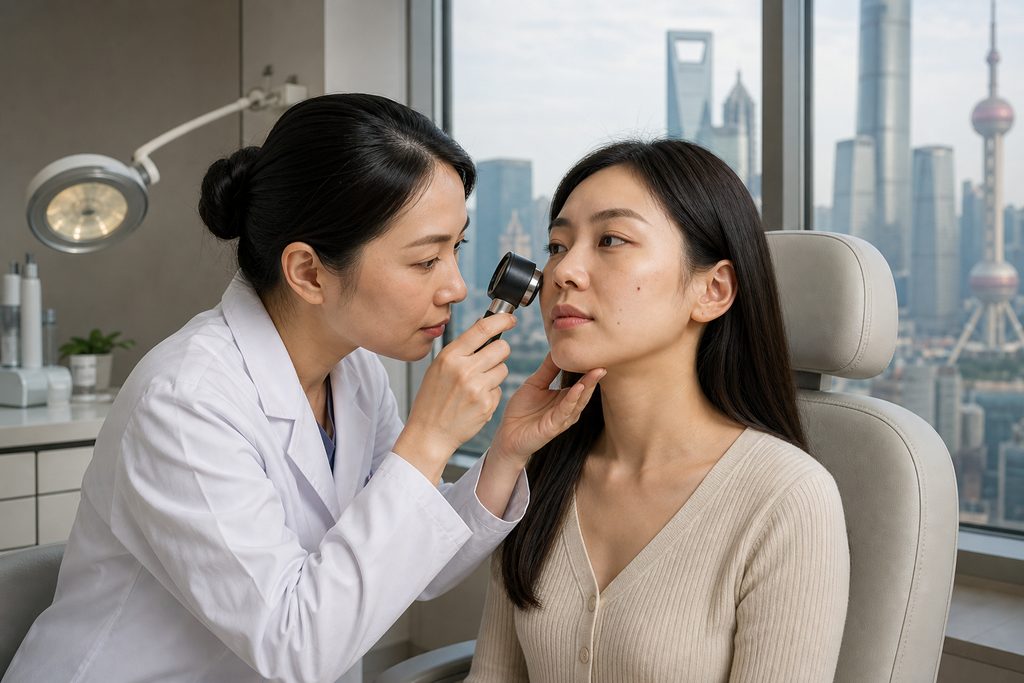
Mole Removal Clinics in China: Options, Costs, and How to Choose
What does mole removal cost China patients actually pay — and can a foreigner walk into a top Chinese dermatology department and get it done? The short answer: yes, and the price is usually far lower than in the West. A straightforward removal at a reputable Chinese hospital typically runs $150 to $800 per mole, depending on the method, the hospital tier, and whether pathology testing is included. Compare that to $300–$1,500 in the United States for the same procedure, and the appeal becomes obvious.
The complication is not the price. It is the system. Chinese public hospitals rarely let you book a specialist appointment from overseas, and the queue on the day of your visit can swallow an entire morning. Understanding how that system works — and where the private international clinics fit in — is the real work of planning this trip.
Mole Removal Cost China vs. the West: The Short Answer
For a single benign mole removed by shave excision or laser, expect $150–$400 at a public tertiary hospital in Beijing or Shanghai. A surgical excision with sutures and lab pathology pushes that to $400–$800. Private international clinics charge $500–$1,500 for the same procedure, but you get English-speaking staff, shorter waits, and direct insurance billing.
Three things drive the variance: the removal technique, whether the tissue goes to a pathologist, and whether you are in a public VIP channel or a private facility. The technique matters most. Laser removal sounds simple, but it destroys the tissue sample, which means no one can confirm the mole was benign. That is a real trade-off, not a marketing detail.
Who This Is Right For — and Who It Isn’t
Medical tourism for dermatology is not for everyone. Here is the honest breakdown.
Generally a good fit:
- You have one or several moles you want removed for cosmetic reasons, and you are already traveling to China or open to combining the trip with a vacation.
- You want a dermatologist to evaluate a suspicious lesion and you are willing to pay out of pocket for speed.
- You are uninsured or underinsured at home, where a single dermatology visit plus biopsy can exceed $1,000.
- You are already in China for work, study, or family reasons.
Probably not the right move:
- You have a lesion your home doctor has flagged as possible melanoma. Cancer care should start where your follow-up care will happen — not 7,000 miles away.
- You need a same-week appointment and cannot travel on short notice. Chinese public hospital scheduling does not bend to urgency from overseas.
- You have a bleeding disorder, active skin infection at the site, or a history of keloid scarring that makes any excision risky. Get cleared by a physician first.
- You are looking for a bargain on a procedure your home dermatologist says needs immediate attention. Price should never be the deciding factor in a possible cancer case.
The Options, Compared
There are genuinely different paths here, and they are not interchangeable. The table below lays out what each one actually delivers.
| Option | Typical Cost (per mole) | Wait Time | English Support | Pathology Included |
|---|---|---|---|---|
| Public tertiary hospital, standard channel | $150–$400 | Same-day queue, often 2–4 hours | Limited; interpreter usually needed | Yes, if excision |
| Public hospital international/VIP department | $400–$800 | Appointment-based, days to weeks | Yes | Yes |
| Private international clinic (e.g., United Family, Jiahui) | $500–$1,500 | Often within days | Yes, native-level | Yes |
| Laser removal at a cosmetic chain | $80–$300 | Walk-in possible | Rarely | No — tissue destroyed |
| US dermatologist (for reference) | $300–$1,500+ | Weeks to months | Yes | Yes, billed separately |
Which column fits you? If cost is the priority and you have someone to help with language, the public standard channel is the value play. If you want a predictable appointment and clear communication, the international or private route is worth the premium. And if a dermatologist at home has raised any concern about malignancy, stay home for that one.
Where to Go: Best Mole Removal Clinic Shanghai and Beyond
Shanghai is the most practical entry point for most international patients, and the dermatology departments at its top public hospitals are genuinely strong. Fudan University-affiliated hospitals, Ruijin Hospital, and the international departments at several tertiary centers handle a high volume of skin excisions every week. For patients specifically searching for the best mole removal clinic Shanghai has to offer, the realistic split is between public hospital dermatology departments and private international clinics like Jiahui and United Family.
Beijing offers a parallel set of choices, and the term mole removal medical tourism package Beijing gets searched for a reason — several agencies bundle the procedure with hotel and translation. Be careful with those bundles. A package that promises a specific surgeon on a specific date is overpromising. Chinese public hospitals assign specialists by department schedule, not by request.
Outside the two biggest cities, options thin out. Guangzhou, Chengdu, and Hangzhou have strong tertiary hospitals, but English-language dermatology support is less consistent. Our directory of top-ranked Chinese hospitals by city shows which facilities have international departments equipped for foreign patients.
One more thing worth knowing: dermatology is not one of the 45 specialties ranked in the Fudan Hospital Rankings, so there is no official “top 10 dermatology hospitals” list to lean on. Reputation here comes from hospital tier, department volume, and whether the international department is set up for foreigners.
Is Mole Removal Safe in China?
This is the question that stops people from booking. The honest answer: at a tertiary public hospital or a JCI-accredited private clinic, the procedure itself is as safe as it is anywhere in the world. Sterilization protocols, anesthesia standards, and pathology labs at China’s top hospitals meet international norms.
The risks are logistical, not clinical. They include miscommunication about which mole to remove, a language barrier during consent, and follow-up that falls apart once you fly home. Each of these is manageable with preparation.
What should give you pause is the low end of the market. Cosmetic chains offering $50 laser removals may not employ a dermatologist, may not send tissue to pathology, and may not have anyone who can explain aftercare in English. Saving $200 on a procedure that leaves you without a diagnosis is a bad trade.
What It Costs and What’s Included
Let’s put real numbers on the whole trip, not just the procedure. For a single mole removed at a public hospital’s international department, expect:
- Consultation and dermatologist evaluation: $50–$150
- Excision or shave removal: $150–$400
- Pathology lab fee: $50–$150
- Follow-up visit and suture removal: $30–$80
That lands most patients in the $300–$800 range for the medical portion. Private clinics can double that. What is not included: flights, hotel, meals, airport transfers, and interpretation. If you need a bilingual companion to navigate registration, payment, and the pharmacy, that service typically starts at $300 per day.
Payment at public hospitals is upfront and out of pocket for international patients; insurance reimbursement happens afterward, at home. Private international clinics often bill insurance directly, which is a meaningful convenience if your policy covers overseas care.
Practical Considerations: Records, Visas, and Follow-Up
Bring your medical records. If a home dermatologist has already photographed or biopsied the mole, those notes help the Chinese specialist. Digital photos with a ruler for scale are useful too.
On the visa question, this is where a lot of online advice gets it wrong. Medical travel to China uses the S2 visa, annotated for medical treatment. Stays beyond 180 days require an S1. Accompanying family members also apply under S2. The M visa is for commercial and trade activity and has nothing to do with medical care — if a service tells you to apply for an M visa for a procedure, that is a red flag. Always confirm current requirements with the nearest Chinese embassy or consulate, since rules and documentation expectations change.
Booking is the other friction point. Public hospital outpatient departments generally do not accept advance appointments from overseas. You register on the day, in person, and surgery is scheduled only after an in-person consultation. The workaround is the hospital’s international or VIP department, which does take advance bookings and provides English-speaking staff — at roughly 1.5 to 2 times the standard price. Private international clinics are the third path and the easiest to book from abroad.
After you return home, arrange a follow-up with a local dermatologist or your primary care doctor. If pathology came back showing anything concerning, that handoff matters enormously. Get the written pathology report translated before you leave China.
Frequently Asked Questions
In the US, a single mole removal with pathology commonly runs $300–$1,500, and a specialist visit can add several hundred more. In the UK, private dermatology charges £200–£600 per lesion. China’s public hospitals sit at the low end, roughly $150–$800 all-in, which is why the savings are real rather than marketing. Final pricing always varies by hospital and case complexity.
At a public hospital’s standard outpatient department, usually no — you register in person on the day. International and VIP departments, along with private clinics, do accept advance bookings. If you want certainty about timing, plan around those channels rather than the standard queue.
If the lab finds something concerning, the hospital will recommend further evaluation, and you should follow that advice immediately rather than waiting until you get home. This is exactly why excision with pathology is preferable to laser for any suspicious lesion. For confirmed melanoma, treatment planning should involve your home oncology team.
For short medical visits, the S2 visa is the applicable category, and accompanying family members apply under S2 as well. Requirements and supporting documents are set by the embassy or consulate handling your application, so verify current rules before you apply. Approval is never guaranteed.
Honestly, probably not if that is the only reason for the trip. The savings on one small procedure rarely cover international flights. It makes more sense if you are already in China, are combining it with other care, or are having multiple lesions removed at once.
Your Next Step
The takeaway is simple: mole removal in China is affordable, safe at the right facilities, and genuinely accessible to foreign patients — provided you understand that public hospitals work on a walk-in model and private clinics work on an appointment model. Choosing which one fits your situation is the decision that matters most.
We are China Medical Services, a coordination service rather than a hospital. We do not diagnose or treat anyone. What we do is help international patients find the right department, prepare records, arrange a written second opinion or video consultation with a Chinese specialty team, and provide bilingual support on the ground when you arrive. If you would like help figuring out which clinic fits your case, you can start with a free consultation — no pressure, no obligation, just a clear picture of your options.
This article is for general information only and is not medical advice. Any decision about removing a skin lesion should be made with a qualified physician who has examined it. Prices cited are estimates and vary by hospital, city, and case complexity.
For more medical information and treatment options in China, visit chinamedservices.com (China Medical Services).
