AI-Assisted Radiology in China: How Advanced Imaging Sharpens Your Treatment Plan
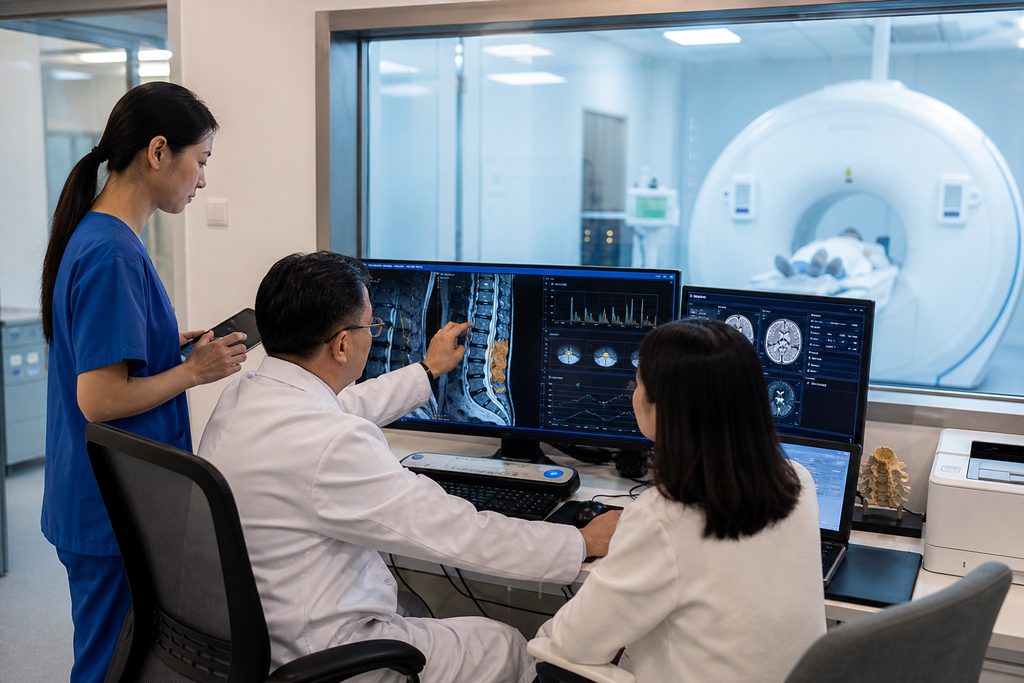
You’ve probably heard that getting a scan read by a computer sounds impersonal. Cold, even. The reality inside China’s top hospitals is the opposite. Our team regularly coordinates for patients who arrive with a stack of CDs, worried their diagnosis was missed or misinterpreted. They leave with something they didn’t expect: clarity. The machine doesn’t replace the radiologist. It acts as a second set of eyes—ones that have “seen” millions of prior scans and flag what a tired human might miss at 3 a.m. That’s the shift. And it’s already standard in the hospitals we connect you with.
The question we hear most isn’t about whether the technology works. It’s about the AI radiology cost in China and whether it’s worth traveling for. So let’s break that down directly. A chest CT with an AI-assisted read at a top-tier Shanghai hospital often falls between $150 and $350. A full-body AI screening package, the kind executives fly in for, runs $800 to $2,500 depending on the protocol. Compare that to a similar concierge scan in Singapore or the US, and you’re looking at a fraction of the price. But the real value isn’t the discount. It’s the speed and the second-level review that catches nodules measuring under 5mm—things a standard read might classify as “nonspecific.”
How This Actually Works, Step by Step
The process isn’t magic. It’s methodical. You don’t just show up and get scanned by a robot. Here’s how it unfolds when you work through a coordination team like ours.
First, you send your existing records. That’s your CTs, MRIs, PET scans—whatever you have. Our team translates the key clinical notes and forwards them to the appropriate department. A radiologist reviews your history before you even book a flight. This pre-review matters. It determines whether an AI-assisted protocol actually adds value for your specific case. If it does, we schedule the scan.
You arrive. The scan itself feels familiar. What’s different is the processing. Within minutes of image acquisition, the AI model overlays heat maps, measures lesions, and compares them against a reference database. The radiologist then reviews both the raw images and the AI annotations. You get a report that synthesizes both. Not a printout of algorithms. A clinical judgment, informed by computational precision. The turnaround can be same-day for urgent findings.
Where AI Imaging Actually Changes Outcomes
Lung cancer screening is where this technology shows its sharpest edge. In a 2023 study published in *The Lancet Digital Health*, an AI-assisted workflow in a Chinese screening program improved the detection rate of early-stage lung cancer by 18% compared to standard double-reading. That’s not marginal. For a disease where five-year survival hinges on catching it at stage I versus stage IV, that number represents lives.
But the application goes beyond lungs. We’ve seen it reshape treatment plans in three specific areas. Brain tumor segmentation—where AI quantifies tumor volume changes between scans with a precision the human eye can’t match. Liver lesion characterization—distinguishing a benign hemangioma from something that needs a biopsy. And breast imaging—where AI reduces false positives that lead to unnecessary biopsies. One patient we assisted had been told she needed a surgical biopsy based on a mammogram read overseas. The AI-assisted review at a Shanghai hospital reclassified the lesion as BI-RADS 3—probably benign. A short-interval follow-up confirmed it. She avoided surgery.
So how does AI imaging improve cancer treatment in China? It tightens the feedback loop. Oncologists adjust chemotherapy regimens based on precise volumetric changes, not just “the tumor looks a bit smaller.” Radiation oncologists contour target volumes with AI assistance, sparing more healthy tissue. The imaging doesn’t just diagnose. It guides every subsequent decision.
A Realistic Timeline
People underestimate the waiting steps. Here’s what a realistic calendar looks like when you pursue AI-assisted diagnostic imaging through a coordinated pathway.
| Stage | What Happens | Typical Duration |
|---|---|---|
| Days 1–3 | You submit existing scans and clinical summary. Our team translates and routes to the target hospital’s radiology department for pre-review. | 2–3 business days |
| Days 4–7 | Pre-review feedback arrives. The department confirms whether AI-assisted protocol is indicated and proposes a scanning schedule. | 2–4 business days |
| Days 8–21 | Visa processing. You apply for an S2 visa with the hospital invitation letter we help coordinate. Embassy processing times vary by country. | 5–14 calendar days |
| Days 22–25 | Travel and scan day. You arrive, complete the imaging, and receive preliminary verbal findings. The AI-annotated report is finalized within 24–48 hours. | 2–3 days on the ground |
| Day 26+ | Post-scan consultation. The radiologist and relevant specialist discuss findings with you via video or in person. Treatment plan refinement begins. | 1–2 days after report |
That’s roughly four weeks from first contact to having a refined treatment plan in hand. Can it move faster? Sometimes. But plan for a month. The bottleneck is almost never the scan. It’s the visa and the pre-review.
What Can Go Wrong — and What Happens Then
Let’s be direct. AI-assisted reads are powerful. They are not perfect. False positives happen. The algorithm might flag a 3mm lung nodule that the radiologist would have dismissed as benign scarring. That triggers anxiety. And sometimes, unnecessary follow-up scans.
What happens then? The radiologist overrules the AI. That’s the protocol. The human always has final authority. If the radiologist agrees the finding is suspicious, you get a clear recommendation: short-interval follow-up, biopsy, or ignore. You’re not left with an ambiguous machine output.
Another failure mode: poor-quality source images. If your prior scans are low-resolution or thick-slice, the AI comparison loses accuracy. We’ve had to re-scan patients because their overseas imaging didn’t meet the technical threshold for reliable AI analysis. That adds cost and time. We flag this early—usually during the pre-review stage.
And then there’s the language gap. The AI report is generated in Chinese at most public hospitals. Our bilingual medical companions translate the findings in real-time during your consultation. Without that layer, you’re staring at a report you can’t read, full of measurements you can’t interpret. That’s not a technology failure. It’s a coordination failure. And it’s avoidable.
Choosing the Right Facility: What Actually Matters
Patients often search for the best hospital for AI-assisted diagnosis in Shanghai because the city concentrates imaging expertise. That’s a fair instinct. But the “best” hospital depends on what you need scanned. A facility that excels at neuroimaging may not be the right choice for a prostate MRI.
Here’s what we look at when matching a patient to a center. First, case volume. A radiology department that reads 5,000 chest CTs a year has seen more pathology than one reading 500. The AI models trained on that high-volume data perform better. Second, subspecialty radiologists. You want a thoracic radiologist reading your lung scan, not a generalist covering the emergency department. Third, technical specs. Is the scanner 3T or 1.5T for MRI? What’s the slice thickness for CT? These details affect what the AI can extract.
Shanghai’s top hospitals—those in the Fudan ranking system—tend to meet all three criteria. They run high patient volumes, employ subspecialized radiologists, and invest in the latest Siemens and GE scanners with integrated AI modules. But don’t assume. Ask. A good coordinator can verify these specifics before you commit.
Is AI radiology accurate for diagnosis abroad? The short answer: yes, when the imaging protocol is standardized and the AI model has been validated on a diverse population. Chinese AI models have been trained predominantly on Asian populations. That’s actually an advantage if you’re of Asian descent—the algorithms are calibrated to your demographic. For other ethnicities, the models still perform well on anatomical measurements, but the validation data is thinner. This is an honest limitation worth acknowledging.
If you want to compare AI diagnostic imaging prices Beijing versus Shanghai, the difference is modest. Beijing’s top-tier public hospitals charge similar rates for the scan itself—a high-resolution chest CT runs $120–$250 in either city. The variance comes in the international department coordination fees. Shanghai’s international medical centers tend to be slightly more streamlined for foreign patients, with more English-speaking staff. Beijing’s hospitals, particularly those near the embassy district, have deep experience with diplomatic and expatriate populations. Neither city is the wrong choice.
Practical Considerations: Records, Visas, and Follow-Up
Bring everything. Not just the radiology report—the actual DICOM files on a CD or USB. The AI needs raw data, not a PDF summary. If you only have printed films, we can still work with them, but the AI analysis will be limited to what can be digitized.
Visa category matters. For medical imaging visits, you’ll apply for an S2 visa. Processing takes one to two weeks at most embassies. The hospital provides an invitation letter confirming your appointment. Our team helps draft the supporting documents, but we never guarantee approval. That’s between you and the consulate.
Payment is straightforward. Public hospital international departments accept credit cards and wire transfers. You pay for the scan and the AI-assisted read as a bundled fee. Insurance may reimburse—check your policy for out-of-network international diagnostic coverage. We provide itemized receipts and translated reports for claims.
Follow-up is the step people forget. If the scan finds something that needs monitoring, who tracks it when you’re back home? We recommend establishing a relationship with a local radiologist before you travel. Send them the Chinese report and DICOM files. They can continue the surveillance. The AI-assisted read becomes a baseline, not a one-off event.
Medical tourism AI scan packages in China are increasingly common. Some private international hospitals now offer executive screening bundles that include whole-body MRI, cardiac calcium scoring, and AI-assisted lung screening—all in a half-day visit. These packages run $1,500–$3,000 and are marketed to health-conscious travelers. They’re efficient. But they’re not for everyone. If you have a specific clinical concern, a targeted diagnostic protocol is more appropriate than a broad screening package. Don’t let the marketing override the medicine.
Frequently Asked Questions
In China, an AI-assisted chest CT at a top public hospital typically runs $150–$350. The same scan in the US often bills at $500–$1,200 before insurance. The AI component itself adds little to the Chinese price—it’s integrated into the standard workflow rather than billed as a separate line item.
Yes. A written second opinion with AI-assisted analysis can be arranged remotely. You send your DICOM files and clinical history. A Chinese subspecialty radiologist reviews your scans with AI support and issues a written report. This costs $300–$500 and takes 5–7 business days. It’s not a prescription, but it can clarify whether your current diagnosis is solid or worth questioning.
Rarely, but it happens. AI models are trained to detect specific patterns. An unusual presentation of a rare disease might fall outside the model’s training data. That’s why the radiologist always reviews the raw images independently. The AI is a safety net, not the sole reader. The combination of human and machine consistently outperforms either alone in published studies.
Most Chinese hospitals use AI software approved by China’s NMPA (National Medical Products Administration), not the FDA. Many of these algorithms—particularly in lung nodule detection and stroke triage—have published validation studies in peer-reviewed journals. The regulatory pathway is different, but the clinical evidence base is robust. Ask for the specific software name and validation data if this concerns you.
Chinese hospitals operate under the Personal Information Protection Law (PIPL), which governs how patient data is collected, stored, and transferred. Top-tier hospitals with international departments are accustomed to handling overseas patient data and have protocols for secure DICOM transfer. Still, ask about data handling before you send anything. A reputable coordinator will explain exactly where your files go and who accesses them.
Your Next Step
AI-assisted radiology isn’t a gimmick. It’s a tool that sharpens the diagnostic process—especially when you’re navigating a serious diagnosis and need certainty, not ambiguity. The hospitals we work with have integrated this technology into daily practice, not as a pilot program but as standard care.
Our team at China Medical Services handles the logistics: hospital matching based on your specific imaging needs, appointment coordination, bilingual companionship during your scan and consultation, and remote second-opinion facilitation. We don’t practice medicine. We connect you with those who do, and we make sure nothing gets lost in translation. If you’re considering whether an AI-assisted scan in China could refine your treatment plan, the next step is a conversation—no commitment, just clarity. Reach out through our consultation page and we’ll walk you through what’s possible.
For more medical information and treatment options in China, visit chinamedservices.com (China Medical Services).
