Knee Replacement Under 50 in China: Active Patient Joint Surgery Without the Wait
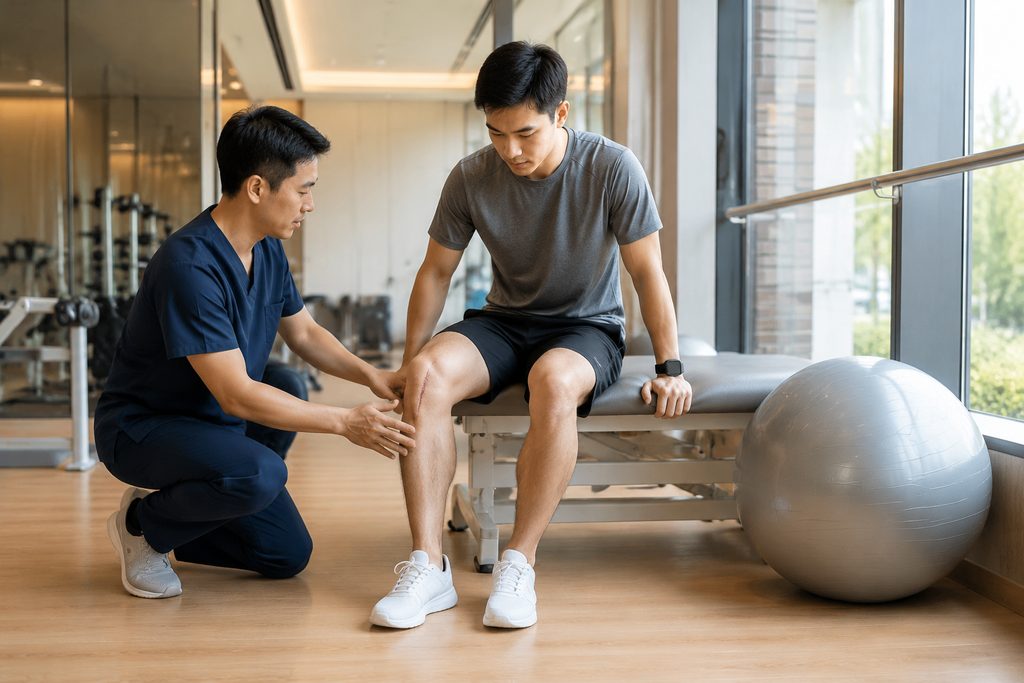
Data from the American Academy of Orthopaedic Surgeons shows that knee replacements in patients under 50 have risen nearly 200% over the past two decades. The old rule—wait until you’re 65—has collapsed. But a younger knee brings a harder problem. You need an implant that survives 30 years of tennis, skiing, or simply chasing your kids, not 15 years of gentle retirement walks. And in many Western systems, you’ll wait months for a surgical slot while your cartilage grinds down further.
Our team connects active patients under 50 with orthopedic departments inside China’s 340+ top-ranked hospitals. These are centers performing several thousand knee procedures annually, using implant systems identical to what you’d find at Mayo Clinic or Charité Berlin. The difference is access speed and a knee replacement cost China under 50 that typically runs 60-70% below US private-pay rates—without sacrificing implant longevity or surgical precision. We coordinate the pathway, not the medicine. You get the operating theater. We handle the logistics that make getting there possible.
How This Actually Works, Step by Step
Most international patients assume they need to fly to China first, find a surgeon, and hope for the best. That approach wastes time and money. Here’s the sequence we use instead.
You send us your existing imaging and reports. X-rays, MRI scans, any prior surgical notes. Our team translates these documents into clinical Chinese and forwards them to the orthopedic department at one of the hospitals in our network—often a center ranked in the Fudan University Hospital Rankings’ top 10 for orthopedics. A senior joint replacement surgeon reviews your file. Within 5 to 7 business days, you receive a written second opinion: Is a knee replacement indicated? Which implant design suits your activity level? What’s the anticipated recovery trajectory?
This written second opinion costs $300–500. It’s not a prescription. It’s a specialist’s analysis based on your actual imaging. And here’s what matters for planning: if you decide to proceed with surgery in China within 90 days, that entire fee credits toward your on-the-ground coordination service. Zero sunk cost for the evaluation.
Once you confirm you want to move forward, we coordinate a surgical date through the hospital’s international or VIP channel. This is not the standard public queue. It’s a reserved pathway for patients traveling from abroad. You’ll typically secure a date within 2 to 4 weeks of confirming, not the 3 to 6 months common in publicly funded systems. We arrange your S2 visa invitation letter, airport pickup, and a bilingual medical companion who stays with you from admission through discharge.
Why a 45-Year-Old Knee Is a Different Engineering Problem
A knee implanted at 70 faces modest demands. A knee implanted at 45 faces a decade of half-marathons, plyometric workouts, or simply standing all day as a surgeon or chef. The implant selection, surgical technique, and alignment precision all shift when the patient plans to stay active for 25-plus years.
Chinese joint replacement surgeons see an unusually high volume of younger patients. Why? China’s osteoarthritis burden is massive—affecting an estimated 180 million people—and it’s striking earlier due to high-impact occupational demands and recreational sports adoption. A surgeon at a top-tier orthopedics center in Beijing or Shanghai may perform over 400 knee replacements annually, with a substantial fraction on patients in their 40s. That volume builds pattern recognition you can’t get from a textbook. They’ve seen the varus alignment that fails at year 12. They know which polyethylene bearing surfaces tolerate higher impact.
Implant choice for young patients typically centers on highly cross-linked polyethylene inserts paired with oxidized zirconium or ceramic-coated femoral components. These materials reduce wear-particle generation by up to 60% compared to standard cobalt-chrome on conventional polyethylene, based on simulator studies. The goal is pushing revision timelines past 25 years. Some centers in our network also offer patient-specific instrumentation using preoperative 3D modeling, which can improve component alignment in anatomically complex knees. This isn’t experimental. It’s standard practice at the hospitals listed on our orthopedics department pages, where implant registries track outcomes across thousands of cases.
A Realistic Timeline
Optimism feels good. Accuracy prevents disaster. Here’s the actual timeline from first inquiry to walking without crutches, including the steps most people forget.
| Stage | What Happens | Typical Duration |
|---|---|---|
| Remote Evaluation | You send imaging; we translate and submit; surgeon reviews and returns written second opinion. | 7–10 business days |
| Surgical Date Confirmation | You accept the plan; we coordinate with the hospital international channel and lock a date. | 1–3 weeks |
| Visa Processing | Hospital issues invitation letter; you apply for S2 visa at your local Chinese embassy/consulate. | 1–4 weeks (varies by country) |
| Travel & Pre-op | Fly to China, airport pickup, pre-operative labs and clearance at the hospital (1–2 days). | 2–3 days |
| Surgery & Inpatient Stay | Total knee arthroplasty; typical inpatient stay 3–7 days depending on recovery speed. | 3–7 days |
| Local Recovery | Near-hospital accommodation; daily physiotherapy; follow-up wound checks. | 2–4 weeks |
| Return Flight | Cleared for air travel (usually by week 2–3 post-op with compression stockings and mobility aids). | — |
| Home Rehabilitation | Continued physiotherapy in your home country; remote follow-up with your Chinese surgeon if needed. | 3–6 months |
Total time on the ground in China: roughly 3 to 5 weeks. The visa step is the wild card. Some embassies process S2 visas in 4 business days. Others take 3 weeks. We can’t control consular timelines, but we can ensure your invitation documents are complete and correctly formatted the first time.
What Can Go Wrong—and What Happens Then
Every surgical journey carries risk. Pretending otherwise would be dishonest. Here are the failure modes we’ve seen and the actual recourse for each.
Surgical delay after arrival. You land in Shanghai, and your pre-operative bloodwork flags an elevated white count or an ECG irregularity that needs cardiac clearance. The hospital postpones surgery by 3 to 5 days while this is investigated. This happens in roughly 3-5% of cases. What we do: our bilingual companion stays with you through the additional consultations. We extend your accommodation booking. The hospital’s international department coordinates the clearance process internally. You don’t navigate it alone in a foreign language.
Implant-related complication. Infection, stiffness requiring manipulation under anesthesia, or—rarely—early mechanical failure. These complications occur at rates consistent with global joint registry data (infection risk approximately 0.5-1%). What happens: the treating hospital manages the complication under the same surgical package terms. You are not abandoned. Our team helps extend your visa if needed and coordinates communication between your home-country physician and the Chinese surgical team.
Post-operative deep vein thrombosis. The long flight home raises DVT risk. Chinese orthopedic protocols typically include mechanical compression and chemical prophylaxis (low-molecular-weight heparin) during the inpatient stay. You’ll be discharged with a prescription for extended prophylaxis and compression stockings. The key is continuing the regimen through your travel day and beyond. We brief you on this before you leave.
Dissatisfaction with outcome. Your knee replacement is mechanically sound, but you expected faster progress or less residual stiffness. This is the hardest scenario to fix remotely. Our recommendation: maintain contact with your Chinese surgical team via the hospital’s follow-up platform. Many top centers now offer post-operative video consultations for international patients. We can facilitate scheduling. But the daily physiotherapy—the real driver of outcome—happens at home, with your local therapist.
How to Evaluate a Hospital When You’re Under 50 and Active
Not every hospital that performs knee replacements on 70-year-olds should operate on a 45-year-old triathlete. Here’s what to look for beyond the glossy website photos.
First, ask for annual knee replacement volume by surgeon, not just by department. A department doing 2,000 knees per year spread across 15 surgeons averages 133 per surgeon. A department doing 1,200 knees with 3 dedicated arthroplasty surgeons averages 400 per surgeon. The second number predicts better outcomes. Published registry data from multiple countries shows a clear volume-outcome relationship with a threshold around 200 cases per surgeon per year for significant complication reduction.
Second, confirm implant inventory depth. Younger patients often benefit from specific bearing surfaces and constraint levels. A hospital stocking only one manufacturer’s standard cruciate-retaining system may not offer the optimal implant for a highly active 48-year-old. The top orthopedic centers in our network—including those listed in the Fudan Orthopedics Specialty Reputation rankings—maintain multi-manufacturer inventories and can select implants based on your alignment, ligament status, and activity goals.
Third, look at the rehabilitation protocol. Some hospitals discharge knee replacement patients on day 3 with a sheet of exercises and a follow-up appointment. Others keep you for 5 to 7 days with twice-daily supervised physiotherapy. For a younger patient aiming to return to high-impact activity, the intensive early rehab makes a measurable difference in range-of-motion recovery and gait normalization. When we match patients to hospitals, we prioritize centers with dedicated inpatient arthroplasty rehabilitation teams. You can browse the orthopedic capabilities of hospitals in cities like Beijing and Shanghai directly on our site.
And a question worth asking: is knee replacement safe in china for young patients? The data supports a clear answer. Infection rates at JCI-accredited and Fudan top-ranked Chinese orthopedic centers run 0.5-0.8%, consistent with international benchmarks. Implant selection includes the same FDA-approved or CE-marked systems used in Western hospitals—Zimmer Biomet, Stryker, DePuy Synthes, Smith & Nephew. The variable isn’t the hardware. It’s the surgeon’s experience with your specific demographic. That’s what you’re vetting for.
Practical Considerations: Records, Visas, and Follow-Up at Home
Getting these details wrong can unravel a perfectly planned surgical trip. Here’s what actually matters.
Medical records. You need standing AP and lateral knee X-rays taken within the last 3 months. If you have an MRI, include it—it shows cartilage status and subchondral bone changes that X-rays miss. Any prior knee surgeries? We need the operative notes. All documents must be in English or accompanied by a certified translation. Our team handles the clinical Chinese translation; you just need to provide the originals.
Visa category. You will apply for an S2 visa, which covers short-term private affairs including medical treatment. The hospital issues an official invitation letter confirming your surgical admission. Your accompanying family member also applies for an S2. Do not let anyone tell you to apply for an M visa—that’s strictly for commercial and trade activities. Presenting an M visa for medical treatment can result in entry denial.
Payment. Chinese public hospitals require payment before admission. The surgical package typically covers the implant, operating theater fees, anesthesia, inpatient stay, and standard medications. Your young active knee replacement abroad price will vary by hospital tier and implant choice, but as a reference point, total knee arthroplasty at a top-tier Chinese public hospital’s international wing runs from roughly $15,000 to $25,000. Private international hospitals like those on our private hospitals page may run $25,000 to $40,000 with direct insurance billing. Compare this to $50,000-$70,000 in the US for an uninsured patient, or £12,000-£15,000 in the UK private sector with considerably longer wait times. We provide a detailed cost breakdown before you commit. You wire payment to the hospital directly—we never hold your surgical funds.
Insurance. Some international insurers cover planned surgery abroad if the Chinese hospital holds JCI accreditation. Check your policy for “worldwide coverage” or “medical tourism” provisions. We can provide the hospital’s accreditation documents and itemized invoices for your reimbursement claim. We do not bill insurers directly.
Follow-up at home. Your Chinese surgeon will want X-rays at 6 weeks, 6 months, and annually thereafter. You get these done locally and upload them to the hospital’s patient portal. Some centers offer periodic video follow-up consultations. The long-term success of your implant depends on your local physiotherapist and your discipline with the home exercise program. We connect you to the system. You do the daily work.
And the question every active patient asks: how long does a knee implant last in active patients under 50? The Australian Orthopaedic Association National Joint Replacement Registry reports 15-year survival rates of approximately 93-95% for modern total knee replacements in patients under 55. That means 5-7% require revision by year 15. But those numbers include older implant designs and less cross-linked polyethylenes. Current-generation highly cross-linked bearings show even lower wear rates in simulator studies. A 45-year-old receiving a well-aligned modern implant today has a reasonable chance of reaching age 70 without revision. Not a guarantee. A reasonable probability, backed by registry data.
Frequently Asked Questions
The knee replacement cost China under 50 typically ranges from $15,000 to $40,000 depending on hospital tier and implant selection. Top public hospital international wings fall toward the lower end of that range. JCI-accredited private hospitals with English-speaking staff and direct insurance billing fall toward the higher end. The price includes the implant, operating theater, anesthesia, inpatient stay, and standard post-operative medications. It does not include airfare, accommodation, or our coordination fee. We provide a line-item estimate before you travel.
You can express a preference, and we will request that specific surgeon. Whether the hospital confirms that surgeon depends on their schedule and availability. Top joint replacement surgeons in China are in high demand. If your preferred surgeon is unavailable, we can usually secure a colleague within the same department who operates at comparable volume. We never guarantee a specific surgeon by name. We guarantee that we will present your case to a senior arthroplasty specialist and confirm their identity before you travel.
Revision knee arthroplasty—removing and replacing a failed implant—is more complex than a primary replacement. It requires specialized instrumentation, bone grafting capability, and often a constrained implant design. Many Chinese orthopedic centers handle revisions, but you should be evaluated by a surgeon who does a high volume of them specifically. We can direct your case to a revision specialist. The evaluation process is the same: send your imaging and prior operative notes, receive a written opinion, then decide.
Most will, but ask before you travel. Some surgeons feel uncomfortable managing a patient whose operation they didn’t perform. Others are perfectly willing to handle routine follow-up X-rays and physiotherapy referrals. We recommend having this conversation with your local orthopedist during the planning phase. We can provide a detailed surgical summary and implant sticker (identifying the exact components used) that any orthopedic surgeon can work with.
Yes, within the constraints of the visa process. Once you confirm you want to proceed, we can typically book knee replacement surgery China fast track within 2 to 4 weeks through the hospital’s international channel. The bottleneck is usually the S2 visa, not the surgical slot. Some embassies process quickly. Others don’t. We recommend starting the remote evaluation process early, even if you’re not yet certain about traveling, so that the surgical date can be secured as soon as you’re ready.
Your Next Step
You’ve been managing a deteriorating knee through a career, parenting, and the activities that keep you sane. You’ve probably already researched implant materials and surgical approaches more thoroughly than most patients. What you need now is an honest evaluation of whether a Chinese orthopedic center can deliver the specific outcome you’re after—and a logistics team that prevents the administrative chaos that derails medical travel.
Our organization does not practice medicine. We do not promise outcomes. What we do is connect you with orthopedic surgeons inside China’s 340+ top-ranked hospitals, translate your records, coordinate your surgical date, and put a bilingual companion at your side from admission through discharge. If you want to know whether your knee qualifies and what the all-in timeline looks like, start with a remote evaluation. The fee credits toward surgery
For more medical information and treatment options in China, visit chinamedservices.com (China Medical Services).
