Service Apartments for Medical Stays in China: Long-Term Recovery Near Hospitals
How This Actually Works, Step by Step
You have a surgery date. Or a treatment plan that will keep you in China for three weeks, maybe three months. The hospital sends you a packet of information about their international wing, but it says nothing about where your spouse will sleep or how you will heat up the bone broth your doctor recommends. That part falls on you.
Finding a service apartment near hospitals China medical stay is not like booking a hotel. Hotels work for a night or two. They fail for recovery. The bed is too soft. There is no kitchen. The cleaning staff knocks at 9 a.m. when you finally fell asleep at 6. Service apartments are different. They sit in the space between a hotel and a rental lease — weekly or monthly rates, a real kitchen, a washing machine, and enough space that you and the person caring for you are not tripping over each other.
Here is the sequence most of our patients follow. First, the hospital confirms your treatment timeline — not a tentative date, but a real one. You need that before you book anything. Then you figure out how close you actually need to be. Post-surgery, a ten-minute walk matters more than a fancy lobby. You search for serviced apartments within a one-kilometer radius of the hospital. You contact the property directly or through a bilingual coordinator who can negotiate monthly rates. You ask about the kitchen setup, the elevator reliability, and whether the building has a ramp if you will be on crutches. You book for a few days longer than you think you need. Recovery runs late more often than early.
What Makes a Service Apartment Different from a Hotel — and Why It Matters for Recovery
A hotel room in Shanghai’s Xuhui district might cost $120 a night. Multiply that by 30 nights. Then add restaurant meals three times a day because you have no kitchen. Then factor in the psychological weight of living out of a suitcase while your body heals from a major procedure. The math breaks quickly.
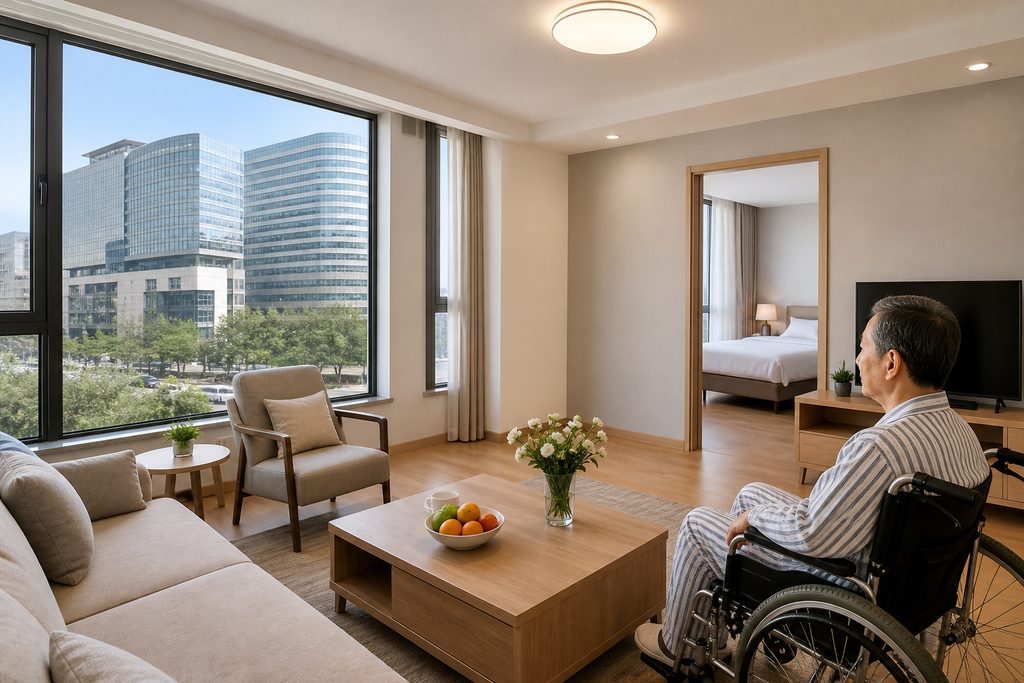
Service apartments designed for extended stay serviced apartment for surgery recovery China flip this equation. You get a one-bedroom or two-bedroom unit with a closed door between the living area and the bedroom. This is not a luxury. It is functional. The person recovering can sleep while the caregiver makes tea, takes a work call, or just breathes. Weekly housekeeping comes standard — not daily interruptions, but enough to keep things clean. The kitchen has an induction cooktop, a microwave, a full refrigerator. You can prepare the foods your body needs instead of relying on delivery apps that do not translate well at 11 p.m.
Rates drop sharply when you book by the month. A serviced apartment near Huashan Hospital in Shanghai might run $2,800 to $4,500 per month, depending on the season and the unit size. That same monthly budget in a mid-range hotel gets you a single room with a minibar and a kettle. The difference is not just money. It is the ability to heal on your own terms.
A Realistic Timeline
People underestimate how long the housing piece takes. They assume they can land, check into a hotel, and find an apartment the next day. You can. But you will pay more and get less. The units that offer best medical tourism apartments near top hospitals China are not infinite. They book up, especially during conference seasons and around major holidays.
Here is what a realistic housing timeline looks like when you are planning a service apartment near hospitals China medical stay:
| Stage | What Happens | Timeframe |
|---|---|---|
| Treatment confirmation | Hospital sends written treatment plan with dates | Day 0 (baseline) |
| Apartment search begins | Identify 3-5 properties within 1 km of hospital; check availability for your exact dates | 8-12 weeks before arrival |
| Negotiation and booking | Confirm monthly rate, kitchen setup, elevator access, cancellation terms | 6-8 weeks before arrival |
| Visa application | Submit S2 visa application with hospital invitation letter and accommodation proof | 4-6 weeks before arrival |
| Pre-arrival check | Reconfirm apartment readiness; arrange airport transfer | 1 week before arrival |
| Arrival and move-in | Check in, inspect unit, stock kitchen, walk the route to hospital | 2-3 days before first appointment |
| Recovery period | Treatment, follow-ups, and healing | 2 weeks to 3+ months |
The part most people forget is the gap between hospital discharge and feeling ready to fly home. A surgeon might clear you for travel at day 10. Your body might disagree until day 17. Booking the apartment for an extra week costs a few hundred dollars. Rebooking a flight and a hospital follow-up because you left too early costs far more.
What Can Go Wrong — and What Happens Then
Let us be direct about the failure modes. They are real. And most are preventable if you know about them ahead of time.
The apartment is not as described. Photos online show a bright, modern unit. You arrive to find a dim room facing a construction site. This happens. The recourse: book through a platform or coordinator that holds a deposit in escrow and offers a 24-hour inspection window. If the unit does not match the listing, you refuse it and get reassigned. Do not book through a random WeChat contact who sent you three photos and a prayer.
The hospital changes your schedule. A pre-op test comes back requiring a delay. Your surgeon gets called to an emergency. Your recovery takes longer than expected and you need three more weeks of follow-up. The apartment’s next tenant is checking in on Tuesday. This is why you book with flexible extension terms. Ask before paying: “If I need to extend by two weeks, what is the rate and is it guaranteed?” Some properties will extend at the same monthly rate. Others will switch you to a much higher daily rate. Know which one you are getting.
The location is walkable on the map but not in reality. Google Maps says 600 meters. But that 600 meters crosses an eight-lane road with no crosswalk, or a pedestrian bridge with only stairs. After abdominal surgery, that bridge might as well be a mountain. Have someone walk the route on video before you commit. Or ask a local coordinator to verify the path is actually navigable for someone in your condition.
How to Evaluate a Service Apartment for Medical Recovery: The Checklist That Matters
Most apartment reviews online were written by business travelers. They care about the gym, the breakfast buffet, the proximity to subway lines. You care about none of that. You need a different evaluation framework entirely.
When you are trying to book monthly service apartment for post surgery recovery China, here is what actually matters:
Kitchen functionality. Does the cooktop work? Is there a pot, a pan, a knife, a cutting board? Many serviced apartments have kitchenettes designed for making tea and reheating takeout. You need to cook real food. Ask for a photo of the kitchen with the cabinets open. If there is no rice cooker, can you request one? Some properties keep a stash of small appliances for long-stay guests.
Bathroom safety. After surgery, a slick tile floor is a hazard. Does the shower have a grab bar? Is there a shower chair available? Can the building maintenance team install temporary safety rails if needed? These are not unreasonable requests. They are standard for any property that regularly hosts medical travelers. If the front desk seems confused by the question, that tells you something.
Climate control autonomy. In northern Chinese cities, many residential buildings run on a centralized heating schedule. The government turns the heat on in mid-November and off in mid-March, regardless of the actual temperature. If your recovery falls in early November or late March, you could be cold. Ask whether the unit has independent air conditioning and heating that you control yourself. This matters more than the thread count of the sheets.
Noise profile. Chinese hospitals are often surrounded by dense residential neighborhoods. That means morning markets, school loudspeakers, and sometimes construction. Request a unit facing away from the main road. High floor is better than low floor, not for the view but for the quiet. If you are a light sleeper recovering from neurosurgery, this is not a preference. It is a medical necessity.
Language capability. Does anyone at the front desk speak English? If the toilet floods at 2 a.m. and you are on crutches, you need to communicate the problem quickly. Some international-brand serviced apartments like Ascott or Somerset have English-speaking staff. Local Chinese chains may not. This is where a bilingual coordinator on call becomes worth every dollar — they can handle the 2 a.m. phone call so you do not have to mime a plumbing emergency through a translation app.
Finding long-term recovery accommodation Beijing hospital district or in any major Chinese city follows the same logic. Beijing’s hospital clusters — around Dongcheng for Peking Union Medical College Hospital, or near Haidian for Peking University Third Hospital — have different housing ecosystems. The serviced apartments near PUMCH tend to be pricier and book further in advance. Those near Haidian have more options but less English support. Shanghai’s medical district around Xuhui and Jing’an has a denser concentration of international-grade serviced apartments because the expatriate community already lives there. Guangzhou’s options cluster around Tianhe district near the major hospitals.
The key is matching the apartment to the specific hospital, not the city in general. A beautiful apartment in Shanghai’s French Concession is useless if your daily appointments are at Zhongshan Hospital in Fenglin Road and you are spending an hour each way in traffic.
Practical Considerations: Visas, Payments, and the Paper Trail
Booking the apartment is half the battle. The other half is making sure the paperwork lines up so you can actually enter the country and stay legally.
Visa category. For medical treatment in China, you apply for an S2 visa, which covers short-term private affairs including medical visits. Your family members accompanying you also apply for S2 visas. The application typically requires an invitation letter from the Chinese hospital where you will receive treatment, proof of accommodation, and your travel itinerary. Processing time at most Chinese embassies and consulates runs two to four weeks, though this varies by country. Do not book non-refundable flights until the visa is in your passport.
Payment methods. Many serviced apartments in China accept international credit cards, but not all. Some require a WeChat Pay or Alipay transfer, which you cannot set up until you have a Chinese bank account — and you cannot open that bank account until you are physically in China with a residence registration. It is a circular problem. The workaround: use a booking platform that processes international cards, or work with a local coordinator who can handle the initial payment on your behalf and bill you in your home currency. Expect to pay a deposit equal to one month’s rent, refundable at checkout minus any damages.
Registration with local police. Under Chinese law, foreign nationals must register their accommodation with the local police station within 24 hours of arrival. Hotels do this automatically. Serviced apartments may or may not. Ask the property directly: “Do you handle the police registration for foreign guests, or do I need to go myself?” If they handle it, confirm they will give you the registration slip. You need that slip for visa extensions and hospital administrative processes.
Insurance and medical records. Your travel health insurance may cover the hospital bills but not the apartment. Check your policy. Some international health plans include a lodging allowance for accompanying family members during medical travel. It is worth asking. As for medical records, keep digital copies of everything — your referral letters, imaging reports, lab results — in a cloud folder accessible from your phone. Chinese hospitals will want to see your full history, and having it organized speeds up every intake process.
If you are wondering how to find medical stay apartment Shanghai or in any other Chinese city, the principle is the same: start with the hospital location, search outward in concentric circles, and prioritize function over aesthetics. A kitchen that works beats a lobby with a chandelier every time when you are three days post-op.
Frequently Asked Questions
You can, but you should not. Treatment timelines in Chinese hospitals can shift — a pre-operative test might require a delay, or a specialist’s schedule might change. Book the apartment only after you have a written treatment plan with confirmed dates. If you must secure housing early, choose a property with a flexible cancellation policy that allows date changes without penalty up to two weeks before check-in.
This is common. Always ask about extension terms before booking. Some properties guarantee the same monthly rate for extensions. Others switch to a much higher daily rate once the original booking period ends. Get the extension policy in writing. If your apartment cannot extend, a local coordinator can often find a nearby alternative on short notice, but you will pay a premium for last-minute booking.
Physically safe, yes — China’s major cities have low violent crime rates. The safety concern for post-surgical patients is environmental: bathroom falls, infection risk, and the physical strain of navigating crowded streets. Choose an apartment with grab bars or the ability to install them, a reliable elevator, and a route to the hospital that does not require climbing stairs or crossing dangerous intersections. If the apartment cannot confirm these details, move on to the next option.
In Beijing or Shanghai, expect $2,500 to $5,000 per month for a quality one-bedroom serviced apartment within walking distance of a major hospital. In Guangzhou, Chengdu, or Hangzhou, the range drops to $1,800 to $3,500. These are base rates. Holiday periods, major conference weeks, and spring festival can push prices up 20-30%. Budget an additional $500-800 for utilities, internet, and the initial grocery stock-up.
You can book directly if you speak Chinese, understand the local rental landscape, and have a way to pay Chinese bank transfers. Most international patients cannot do all three. A bilingual coordinator does not just translate — they verify the apartment in person, negotiate monthly rates that are not published online, handle the police registration, and serve as your emergency contact if something breaks at midnight. The cost of a coordinator is typically offset by the rate savings they can negotiate on long-stay apartments.
Your Next Step
Finding the right place to recover is not about luxury. It is about removing obstacles between you and healing. A quiet room, a working kitchen, a safe bathroom, and a short walk to your follow-up appointments — those are the things that let your body do its work. Everything else is noise.
Our team at China Medical Services helps international patients coordinate the full picture: hospital matching, appointment scheduling, bilingual accompaniment, and yes, finding the right long-term accommodation near your treating hospital. We do not practice medicine. We handle the logistics so you can focus on getting better. If you are planning a medical stay in China and want someone to walk the apartment route before you arrive — literally — reach out for a free consultation. No pressure. Just practical help from people who know the ground.
For more medical information and treatment options in China, visit chinamedservices.com (China Medical Services).
