Neurosurgery in China: Why American Patients Choose Brain and Spine Care Abroad
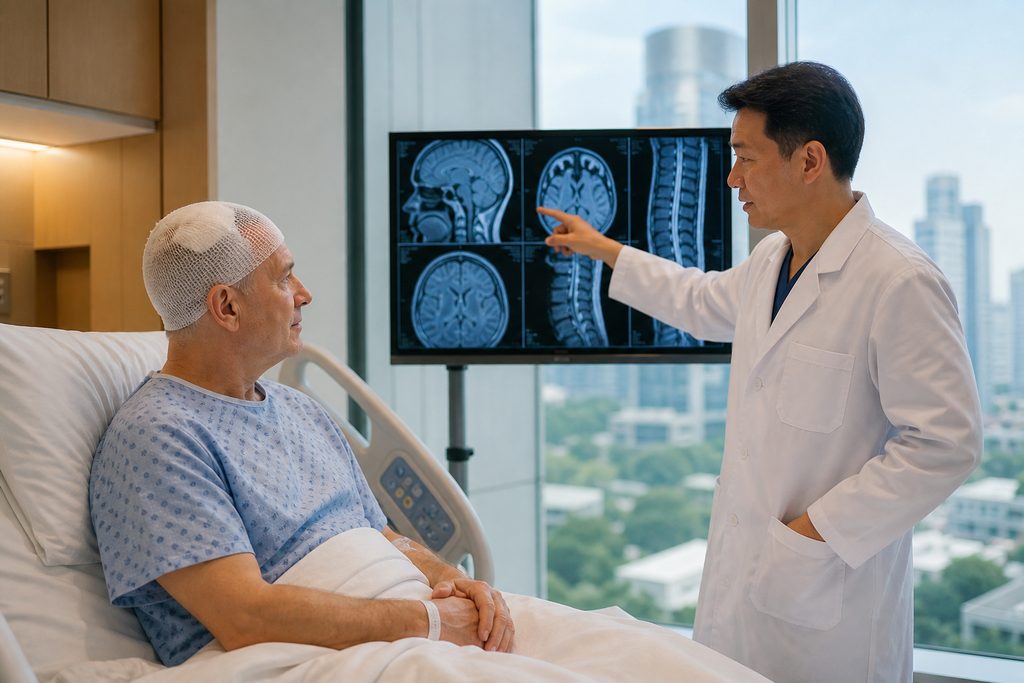
According to a 2023 report from the World Health Organization, neurological disorders are now the leading cause of disability worldwide, affecting approximately 1 in 3 people at some point in their lives. That statistic lands differently when it’s your own MRI on the screen. You’re sitting in a specialist’s office, hearing words like “resection” and “decompression,” and then the financial counselor slides a paper across the desk. The number has six figures. Maybe seven. And that’s when a question you never expected to ask enters your mind: what if I went somewhere else?
We hear this question weekly. The search for brain tumor surgery cost China has risen sharply among American patients facing high-deductible plans, coverage gaps, or simply the brutal math of U.S. neurosurgery pricing. A craniotomy that runs $150,000 to $300,000 in the United States often falls between $25,000 and $60,000 at a top Chinese neurosurgical center. Not a typo. But cost is only the entry point. The deeper question is whether the care is any good. The data says yes — and the logistics are less daunting than most people assume.
How This Actually Works, Step by Step
Most patients imagine a chaotic process: landing in a foreign country, wandering into a hospital lobby, hoping someone speaks English. That is not how this goes. Here is the real sequence.
You send us your existing imaging and reports. MRIs, CT scans, pathology slides, whatever you have. A Chinese neurosurgery team at a top-ranked hospital reviews them. They produce a written opinion: what they see, what they recommend, whether they would take your case. This is the Written Second Opinion stage. It costs $300–500 and takes about 5–7 business days. No travel required.
If the plan makes sense and you want to speak directly with the surgeon, we arrange a Video Consultation. You sit in your living room. The neurosurgeon sits in theirs. You discuss the approach, the risks, the recovery. That session runs $500–800 for a top specialist. And here is the part most people miss: every dollar you spend on remote consultations gets credited back if you later come to China for surgery. It’s a one-time credit applied to our coordination fee. The hospital’s treatment charges are separate — we never touch those.
Once you decide to proceed, we handle the rest: visa guidance, appointment scheduling, bilingual accompaniment, airport pickup, accommodation suggestions. You arrive. You have surgery. You recover. You go home. That’s the arc.
What the Brain Tumor Surgery Cost China Comparison Actually Looks Like
Let’s put numbers on the table. The brain tumor surgery cost China varies by tumor type, location, hospital tier, and whether you go through a public hospital’s international department or a private facility. Here’s a realistic breakdown, based on cases we’ve coordinated.
| Procedure | U.S. Average Cost (USD) | China Top Hospital Range (USD) | Notes |
|---|---|---|---|
| Craniotomy for tumor resection | $150,000 – $300,000 | $25,000 – $60,000 | Varies by tumor location and complexity |
| Endoscopic transsphenoidal pituitary surgery | $80,000 – $150,000 | $15,000 – $30,000 | Shorter hospital stay, faster recovery |
| Spinal fusion (1-2 levels) | $110,000 – $200,000 | $18,000 – $40,000 | Includes implant costs |
| Microdiscectomy | $35,000 – $70,000 | $8,000 – $18,000 | Outpatient or 1-night stay |
| Deep brain stimulation (DBS) | $100,000 – $180,000 | $30,000 – $55,000 | Bilateral, including device |
These are not promotional numbers. They reflect actual invoices from Fudan-ranked neurosurgery departments. The gap is real. And it’s not because of lower quality — it’s because of structural differences in how healthcare is priced across economies. A neurosurgeon in Shanghai earning a good living still operates in a system where the cost base is fundamentally different from that of a U.S. academic medical center.
But here is what the price tag doesn’t tell you. The surgeon who performs your craniotomy at Huashan Hospital or Beijing Tiantan Hospital likely does more of them in a year than most U.S. neurosurgeons do in a career. Volume matters in neurosurgery. A 2019 study in The Lancet Neurology found that centers performing more than 200 craniotomies annually had significantly lower complication rates than lower-volume centers. Some Chinese neurosurgery departments exceed 1,000 craniotomies per year. That’s not a statistic you find everywhere.
A Realistic Timeline
People want to know: how long until I’m on the table? Here is the actual timeline, including the steps most first-timers forget about.
| Stage | Duration | What Happens |
|---|---|---|
| Document preparation | 3–7 days | Collect and translate medical records, imaging, pathology reports. Translation into Chinese is required for hospital review. |
| Written second opinion | 5–10 business days | Chinese neurosurgery team reviews your case, issues a written report with treatment recommendations. |
| Video consultation scheduling | 1–2 weeks lead time | Top specialists have tight schedules. You wait for a slot. |
| Decision and deposit | Variable | You decide whether to proceed. Hospital requires deposit to secure surgical slot. |
| Visa processing | 2–4 weeks | S2 visa application with hospital invitation letter. Embassy processing times vary by location. |
| Travel and pre-op evaluation | 1 week | Arrive in China, complete fresh imaging and pre-surgical clearance. The hospital will redo scans — this is standard and non-negotiable. |
| Surgery and hospital stay | 1–3 weeks | Procedure plus inpatient recovery. Craniotomy typically 7–14 days inpatient; microdiscectomy may be 1–3 days. |
| Local recovery before travel | 1–4 weeks | Surgeons want you nearby for post-op follow-up before clearing you for a long-haul flight. |
Total: roughly 8 to 14 weeks from first contact to flying home. Some cases move faster. Emergency situations are different — but most neurosurgery is not emergency neurosurgery, despite how it feels when you get the diagnosis.
What Can Go Wrong — and What Happens Then
Let’s be direct. Surgery carries risk anywhere on earth. The question is what happens when something doesn’t go according to plan, and you’re 7,000 miles from home.
Complications happen. A CSF leak. An infection. A neurological deficit that wasn’t there before. These are known risks of brain and spine surgery, and Chinese neurosurgeons discuss them candidly during the video consultation. If a complication occurs, you are already in the hospital where the surgeon who knows your case practices. You are not transferred somewhere else. The same team manages it. This is actually an advantage over medical tourism models where you fly home shortly after surgery and hope nothing goes wrong.
What about legal recourse? This is the question Americans ask most often, and it deserves a straight answer. Medical malpractice litigation in China operates differently than in the U.S. Settlements are lower. The process is less familiar to Western patients. We tell every patient: you are choosing to be treated under Chinese medical law, and you should understand what that means before you sign a consent form. Some patients purchase international medical malpractice insurance. We can point you toward brokers who handle this — we do not sell it ourselves.
Another failure mode: the hospital reviews your case and says no. This happens. A tumor is too complex. The risks outweigh the benefits. The patient’s comorbidities make surgery unsafe. When a Chinese neurosurgery team declines a case, they explain why in writing. That opinion itself has value — it’s a second look from a high-volume center, and sometimes it confirms that surgery isn’t the right path at all.
How Safe is Brain Surgery in China? What the Numbers Show
The question how safe is brain surgery in China deserves more than reassurance. It deserves data.
China’s top neurosurgery centers report surgical mortality rates for elective craniotomy in the 1–3% range, which aligns with benchmarks from high-volume U.S. and European centers. A 2022 study published in the Journal of Neurosurgery examined outcomes at Beijing Tiantan Hospital, which performs over 15,000 neurosurgical procedures annually — likely the highest surgical volume of any neurosurgery department in the world. The study found a 30-day mortality rate of 1.2% for elective brain tumor resections, comparable to published outcomes from Mayo Clinic and MD Anderson.
Infection rates tell a similar story. Chinese hospitals accredited by JCI (Joint Commission International) or ranked in the Fudan hospital list maintain surgical site infection rates below 2% for clean neurosurgical procedures. That’s the same standard you’d expect in Cleveland or Boston.
But safety isn’t just mortality statistics. It’s also about the infrastructure around the surgery. Intraoperative MRI. Neuronavigation. Awake craniotomy capability. Intraoperative neurophysiological monitoring. These technologies are standard at China’s top 100 hospitals, not aspirational. The neurosurgery departments at Huashan, Tiantan, and West China Hospital have dedicated neurosurgical ICUs staffed by neurointensivists — not general intensivists managing a mixed unit. That subspecialization matters for post-operative outcomes.
The honest limitation: English proficiency varies. Even at international departments, the surgeon may speak functional but not fluent English. This is why a bilingual medical companion matters — not just for translation, but for catching nuance. When a surgeon says “the resection was subtotal,” you need to understand exactly what that means for your adjuvant treatment plan. We provide that bridge. It is not optional if you don’t speak Mandarin.
Spine Surgery Package China for Foreigners: What’s Included
Americans searching for a spine surgery package China for foreigners are often surprised by what the quote actually covers. In the U.S., you get a bill from the hospital, a bill from the surgeon, a bill from the anesthesiologist, a bill from the radiologist, and sometimes a bill from someone you never met who was apparently in the operating room. The Chinese international department model is different — it’s bundled.
A typical spine surgery package at a top-tier Chinese hospital’s international wing includes: the surgeon’s fee, anesthesiology, operating room charges, implant hardware, inpatient stay in a private room, nursing care, post-operative imaging, and in-hospital rehabilitation. One quote. One payment to the hospital. The coordination fee we charge is separate and covers everything outside the hospital walls: visa guidance, airport transfer, bilingual accompaniment, appointment scheduling, and communication with the medical team.
What it doesn’t include: airfare, hotel stays before admission or after discharge, meals outside the hospital, and any complications requiring extended ICU care beyond what was quoted. Those are billed separately if they occur. We tell patients to budget an additional 15–20% above the package price for contingencies. Most don’t need it. Some do.
And yes, can American patients get spine surgery abroad safely? The answer is yes — thousands do every year. The key is going through a hospital’s official international patient channel, not booking through a broker who has no direct relationship with the hospital. That’s the difference between a coordinated care pathway and a gamble.
Practical Considerations: Records, Visas, Payment, and Follow-Up
The medical records requirement is non-negotiable. Chinese neurosurgery departments want: recent MRI and/or CT scans (within 3 months), a written summary from your current neurologist or neurosurgeon, pathology reports if a biopsy was done, and a list of current medications. All of this must be translated into Chinese. We handle the translation — it’s part of the coordination service. But gathering the originals is on you, and it can take a week of phone calls to U.S. medical records departments.
Visas. The correct category for medical treatment is S2. Your accompanying family member also applies for S2. You’ll need an invitation letter from the Chinese hospital, which the international patient office provides after you’ve been accepted as a patient. Processing takes 2–4 weeks at most U.S. consulates. Expedited processing is sometimes available for an additional fee. We do not guarantee visa approval — that’s the embassy’s decision — but a complete application with a legitimate hospital invitation letter rarely gets denied without cause.
Payment. Chinese hospitals require prepayment. You wire funds or pay by credit card before admission. The hospital estimates the total and you deposit that amount. If the actual cost is lower, you get a refund. If it’s higher, you settle the balance before discharge. U.S. insurance sometimes covers care abroad, but usually as out-of-network reimbursement after you pay upfront. Call your insurer and ask about “international coverage for planned surgery” — those exact words — before you book anything.
Follow-up at home. This is the piece most patients neglect to plan. Your Chinese neurosurgeon will provide a detailed discharge summary and surgical report in English. You take that to your U.S. neurologist or neurosurgeon for continued care. Some U.S. doctors are skeptical of overseas surgery. Others are fine with it, especially when the operative report comes from a known high-volume center. We recommend identifying a local provider who will accept post-op follow-up before you travel. Not after.
Frequently Asked Questions
The process to book neurosurgery in Beijing international patient channels starts with a remote case review. You cannot simply call a Beijing hospital and schedule a craniotomy. You submit your records through a coordination service or directly to the hospital’s international patient office. The neurosurgery department reviews your case. If they accept it, they issue a treatment plan and cost estimate. Only then can you schedule a surgical date. The lead time from acceptance to surgery is typically 2–4 weeks, depending on the surgeon’s schedule and your visa timeline. Beijing Tiantan Hospital and Peking Union Medical College Hospital both have dedicated international patient centers that handle this process in English.
The best neurosurgery hospital Shanghai offers for international patients is widely considered to be Huashan Hospital, affiliated with Fudan University. Its neurosurgery department is ranked among China’s top three in the Fudan specialty reputation rankings and is particularly known for brain tumor surgery, with a dedicated skull base surgery center. Shanghai also has Ruijin Hospital and Zhongshan Hospital, both with strong neurosurgery programs and international patient departments. The right choice depends on your specific diagnosis — a pituitary tumor may be better served at one center, while a complex glioma may be better at another. The case review process helps determine the best match.
At China’s top 100 hospitals, elective brain surgery carries a safety profile comparable to high-volume U.S. academic medical centers. Surgical mortality rates for craniotomy fall in the 1–3% range, and infection rates are below 2% for clean cases. The key variable is hospital selection. A Fudan-ranked neurosurgery department with JCI accreditation operates at international standards. A lower-tier hospital without those credentials may not. The safety question is really a hospital selection question. Choose a top-ranked center with a dedicated neurosurgical ICU and published outcome data, and the risk profile looks very similar to what you’d face at a major U.S. hospital.
Will my U.S. health insurance cover spine surgery in China?
Most U.S. health insurance plans do not have in-network providers in China. Some PPO plans offer out-of-network international coverage with reimbursement after you pay upfront. A small number of employers offer global health plans that include direct billing at JCI-accredited Chinese hospitals. You need to call your insurer directly and ask two specific questions: “Does my plan cover planned surgery outside the United States?” and ”
For more medical information and treatment options in China, visit chinamedservices.com (China Medical Services).
