Medical Tourism from Central Asia to China: Full Support Hub for Kazakhstan, Uzbekistan & CIS Patients
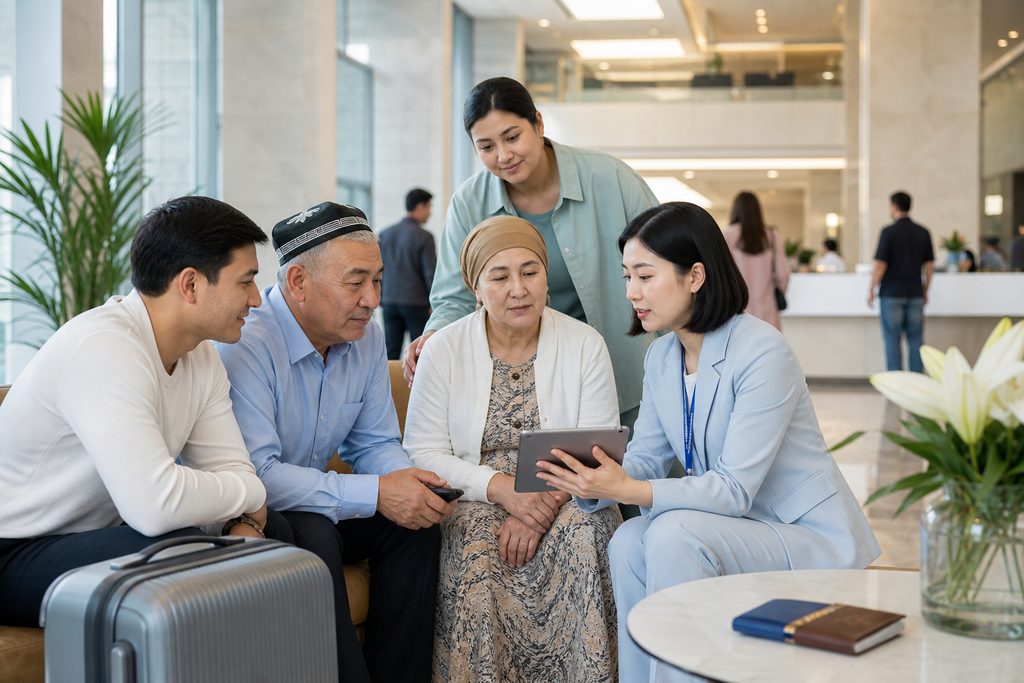
Have you checked the price of advanced oncology care in Western Europe or South Korea lately? The numbers stop making sense when you compare them to what top-tier Chinese hospitals charge. Cancer treatment cost China for Kazakhstan patients routinely runs 60% to 80% below equivalent protocols in Germany or Turkey, and that gap widens further for complex surgical interventions. The real question is not whether the savings are real. The question is whether you can pull off the logistics without a local team who speaks the languages, knows the hospital rules, and will not disappear after the first deposit clears.
Medical Tourism from Central Asia to China: The Short Answer
China’s top-ranked hospitals are accessible to Central Asian patients right now. The clinical infrastructure is world-class. The price advantage is massive. But the system was not built for walk-in international patients. Without a coordinator on the ground, you face language barriers, registration dead-ends, and weeks of wasted time. Our team functions as a single point of contact bridging that gap — we handle hospital matching, document translation, visa guidance, and bilingual accompaniment inside the hospital. We are not a hospital. We do not diagnose or treat. We make the machine work for you.
Who This Is Right For — and Who It Isn’t
This pathway works best for patients who have a confirmed diagnosis, need a procedure that is well-established in China’s top centers, and can travel. It is not a miracle option for every situation.
Typically a strong fit when:
- You have imaging, pathology, and clinical records ready to share for a remote evaluation.
- You need cardiac surgery, orthopedic joint replacement, spine surgery, or oncology treatment — specialties where China’s surgical volume is among the highest globally.
- You can commit to staying in China for the full treatment and immediate recovery window, typically 2 to 6 weeks depending on the procedure.
- You have a family member or companion who can travel with you.
Probably not the right move when:
- The patient is too unstable for commercial air travel.
- You need an experimental therapy still in early clinical trials with narrow inclusion criteria.
- You expect a fixed-price, all-inclusive package bookable online like a hotel room — Chinese public hospitals do not work that way, and anyone promising you that is not being straight with you.
The Options, Compared
Central Asian patients considering treatment abroad typically weigh three or four destinations. The table below lays out the real differences — not marketing claims, but what our team sees day to day when coordinating cases.
| Factor | China (Top Public Hospital, International Dept) | Turkey (JCI Private Hospital) | South Korea (Major University Hospital) | Germany / Western Europe |
|---|---|---|---|---|
| Knee replacement cost (unilateral) | $10,000 – $18,000 | $12,000 – $20,000 | $18,000 – $28,000 | $25,000 – $40,000 |
| Cardiac bypass surgery | $12,000 – $20,000 | $14,000 – $22,000 | $25,000 – $40,000 | $35,000 – $60,000+ |
| Language support for Russian-speaking patients | Available through coordination services; hospital staff rarely speak Russian natively | Limited; mostly Turkish and English | Rare; Korean and English dominant | German and English; Russian interpretation uncommon |
| Visa process for CIS citizens | S2 visa with hospital invitation letter; processing typically 5–10 business days | Varies by nationality; medical visa pathway exists | Medical visa available; processing times vary | Schengen medical visa; more documentation-intensive |
| Direct flight connectivity from Almaty / Tashkent | Multiple direct flights to Urumqi, Beijing, and Xi’an | Good connectivity via Istanbul | Requires transfer; limited direct options | Requires transfer; longer travel time |
For patients from Kazakhstan, Uzbekistan, and neighboring CIS countries, the China column often wins on a combination of flight time, total cost, and the availability of Russian-speaking coordination support — even though the hospitals themselves operate in Mandarin and English. That last point is where a local logistics team changes the equation.
How to Choose a Hospital in China for Heart Surgery and Other High-Stakes Procedures
The question “how to choose hospital in China for heart surgery” comes up in nearly every consultation we do with Central Asian families. It is the right question to ask. The wrong approach is to Google a hospital name and pick the one with the shiniest website.
What matters instead: surgical volume, the department’s position on the Fudan University specialty reputation rankings, and whether the hospital has a functioning international department that can process a foreign patient without chaos.
Fuwai Hospital in Beijing runs the largest cardiovascular surgery program on the planet — over 14,000 cardiac surgeries annually. That kind of volume produces teams that have seen every complication and know how to manage them. For orthopedics, hospitals like Peking University Third Hospital appear in the top tier of the Fudan orthopedics rankings. For oncology, our specialty rankings directory breaks down the top 10 hospitals by cancer type, so you match the disease to the department, not the brand name to the billboard.
And here is a hard truth most websites will not tell you: you cannot simply email a top Chinese public hospital and book a surgery slot from abroad. The standard outpatient system requires in-person registration, same-day queueing, and a face-to-face consultation before any surgical scheduling happens. That is why international patients almost always route through the hospital’s international medical center or VIP department — and why having someone on the ground to handle registration, queueing, and document hand-carrying is not a luxury. It is the difference between a plan and a fantasy.
Medical Tourism Packages from Uzbekistan to Beijing: What “Package” Actually Means
Searches for “medical tourism packages from Uzbekistan to Beijing” suggest people want a clean, pre-priced bundle. We understand the impulse. A fixed price feels safe. The reality is more nuanced.
In the Chinese public hospital system, the hospital itself does not sell “packages” to foreign patients. What a coordination service can bundle is everything around the clinical care: hospital selection and appointment scheduling, document translation, visa invitation letters, airport transfer, bilingual accompaniment during every hospital visit, and logistical support throughout the stay. The treatment cost itself is paid directly to the hospital according to its published fee schedule, and it varies by case complexity.
Our coordination fee structure is transparent. Bilingual medical companion services start from $300 per day. Hospital appointment coordination starts from $300. For patients who want a fully managed experience, VIP end-to-end coordination runs $5,000 to $8,000 — covering everything from pre-arrival document review through discharge and follow-up planning. Any remote consultation fee you pay is credited in full toward on-the-ground coordination if you proceed to treatment within 90 days.
If you see a website offering a flat “spine surgery package to China for $X,” read the fine print. Ask what happens when the pre-op imaging reveals something unexpected and the surgical plan changes. Ask who handles the visa if the embassy requests additional documents. A real package is a managed process, not a shopping-cart checkout.
Best Price Knee Replacement Shanghai International Patient: What Drives the Number
Patients typing “best price knee replacement Shanghai international patient” are usually comparing China against India, Turkey, and sometimes South Korea. Shanghai is a strong contender — not because it is the cheapest city in China, but because it offers a combination of internationally accredited hospitals, English-speaking surgical teams in the international departments, and direct flight connections from Almaty and Tashkent.
A unilateral total knee replacement through a Shanghai public hospital’s international department typically falls between $10,000 and $18,000. The range depends on implant choice (imported prostheses cost more), length of stay, and whether the case routes through the standard international ward or the VIP floor. This does not include airfare, accommodation outside the hospital, or coordination fees. It does include the surgeon’s fee, anesthesia, the implant, operating theater costs, and inpatient nursing during the acute stay.
For comparison, the same procedure with an imported implant in a private Istanbul hospital runs $12,000 to $20,000. In Seoul, you are looking at $18,000 and up. Shanghai’s advantage is not just the sticker price — it is access to surgeons who perform several hundred knee replacements a year, in hospitals where joint replacement is a high-volume, standardized service line.
One caveat: “best price” should never mean “cheapest surgeon we could find.” The hospitals we work with are drawn from the top 5% of China’s 35,000+ hospitals, ranked by the Fudan University hospital rankings and, where applicable, JCI accreditation. We do not match patients to low-cost, low-volume facilities to win on price.
Book Spine Surgery China with Russian Translator: The Logistics That Make or Break a Case
The search “book spine surgery China with Russian translator” reveals a specific anxiety: “I need the procedure, but I cannot afford a miscommunication about which vertebral level to operate on.” That anxiety is completely rational.
Spine surgery in China is advanced and high-volume. Hospitals in the Fudan orthopedics top 10 perform complex multi-level fusions, minimally invasive discectomies, and deformity corrections at a scale that few Western centers match. But the surgical consent process, pre-op instructions, and post-op rehabilitation protocols are all delivered in Mandarin or, in international departments, English. Russian is not a working language inside Chinese hospitals.
This is where a bilingual medical companion changes the experience. Our team includes Russian-speaking coordinators who accompany you to every consultation, translate the surgeon’s explanation in real time, and ensure the consent form you sign reflects what you actually discussed — not a rushed Google Translate approximation. They also handle the non-clinical friction: registration counters, pharmacy queues, payment windows, and discharge paperwork.
The process for booking spine surgery follows the same sequence as any other major procedure: remote evaluation of your MRI and clinical history first, a video consultation with the surgical team, confirmation of a treatment plan and cost estimate, then travel coordination. You do not fly to China hoping to find a surgeon. You arrive with a scheduled consultation and a team that knows your case.
Is Liver Transplant Safe in China for CIS Citizens? Addressing the Hardest Question
The search query “is liver transplant safe in China for CIS citizens” deserves a direct answer, not deflection. China has transplant centers that meet international clinical standards, with surgical teams trained in leading programs abroad and outcomes that compare favorably with Western benchmarks. The technical answer is yes — the procedure can be performed safely in qualified centers.
But there is a critical distinction that every Central Asian patient must understand. Our organization does not facilitate organ transplantation for foreign nationals. We do not arrange donor matching, transplant waitlisting, or transplant surgery coordination. The regulatory and ethical frameworks governing organ allocation in China are designed to prioritize Chinese citizens, and the pathway for foreign patients to access deceased-donor organs is neither straightforward nor something we can assist with.
If you are a CIS citizen exploring liver transplantation, your first step should be a written second opinion from a Chinese hepatology and transplant surgery team. They can review your imaging, labs, and clinical history and provide an analysis of whether transplantation is indicated, what alternative or bridging therapies might be appropriate, and what the realistic pathway looks like. That written opinion costs $300 to $500 and is for reference only — it is not a prescription and not a promise of transplant access. But it gives you an expert view before you spend money on travel.
What It Costs: The Real Numbers for Central Asian Patients
The table earlier in this article gave procedure-level ranges. Here is what the total financial picture looks like when you factor in everything beyond the hospital bill.
| Cost Component | Estimated Range (USD) | Notes |
|---|---|---|
| Remote video consultation (specialist) | $500 – $800 | Credited toward coordination fee if you proceed within 90 days |
| Written second opinion (top specialist) | $300 – $500 | For reference only; not a prescription |
| Hospital appointment coordination | from $300 | Refunded if we cannot secure the appointment |
| Bilingual medical companion | from $300/day | Half-day or full-day; covers translation, queueing, navigation |
| Airport transfer (round-trip) | $200 | Driver meets you at arrivals with a sign |
| VIP end-to-end coordination | $5,000 – $8,000 | Full case management from pre-arrival through discharge |
| Accommodation (serviced apartment, 30 days) | $1,500 – $3,000 | Varies by city and proximity to hospital |
| Airfare (Almaty/Tashkent to Beijing round-trip) | $400 – $800 | Economy class; fluctuates by season |
The hospital treatment cost itself is paid directly to the hospital. Our coordination fees cover the logistics layer — the part that prevents you from standing at the wrong window on the wrong floor with a stack of papers nobody will accept. For patients who start with a remote consultation and then travel, the consultation fee is credited in full toward the coordination service. That means you are not paying twice for the same case management pathway.
Practical Considerations: Visas, Records, and What Happens After You Fly Home
Visa category. Medical treatment in China falls under the S2 short-stay visa, not the M business visa. You will need an invitation letter from the hospital or from a coordinating entity that can document the purpose of your visit. Processing typically takes 5 to 10 business days at the Chinese embassy or consulate in your home country. Family members traveling with you also apply for S2 visas. Do not let anyone tell you to apply for an M visa for medical travel — that is incorrect, and it can get your application rejected.
Medical records. Chinese specialists need your full file before they can give a meaningful opinion. That means imaging in DICOM format (not just the written report), pathology slides or reports, blood work, and a detailed clinical summary translated into English or Chinese. Our team handles the translation and formatting so the receiving department gets a file that matches their expectations.
Payment. Chinese public hospitals require upfront payment or a deposit before admission. Credit cards are accepted at international departments, but limits can be an issue — check with your bank. Wire transfers are sometimes possible but slow. Bring multiple payment methods. Insurance that covers treatment abroad is ideal, but most public hospitals will not direct-bill foreign insurers; you pay first and claim reimbursement later. Private international hospitals are more likely to offer direct billing, though their procedure costs run higher.
Follow-up after returning home. This is the part patients underestimate. You will have post-operative imaging, lab work, and possibly rehabilitation needs once you are back in Kazakhstan or Uzbekistan. The Chinese surgical team will provide a discharge summary and follow-up instructions, but they cannot manage your care remotely. You need a local physician who agrees to receive the handoff before you travel. Our team can help coordinate that handoff and ensure your records are complete, but the ongoing relationship with your home-country doctor is yours to maintain.
Frequently Asked Questions
No — and anyone who promises you one without a prior in-person consultation is not operating within the rules of China’s public hospital system. What you can get is a scheduled consultation with the surgical team, a preliminary treatment plan based on your remote evaluation, and a high-confidence estimate of the surgical window. The actual surgery date is confirmed after the face-to-face consultation and pre-operative workup. Our coordination service secures the consultation slot and manages the process so the time between arrival and surgery is as short as the clinical situation allows.
What happens if I arrive and the hospital refuses to treat me?
This is rare when a
For more medical information and treatment options in China, visit chinamedservices.com (China Medical Services).
