Orthopedic Sub-Specialties in China: Joint, Spine & Sports Medicine Fit
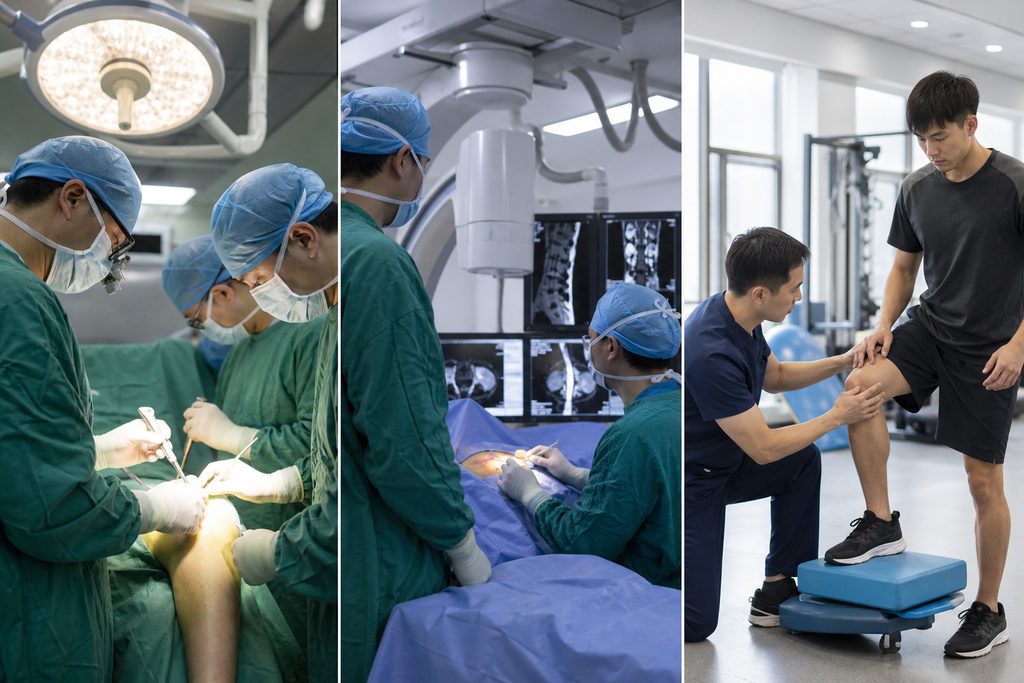
While patients in Canada wait a median 28.6 weeks for orthopedic surgery, surgeons at Beijing Jishuitan Hospital routinely perform over 300 joint replacements per month. The clinical outcomes match or exceed Western benchmarks. The bottleneck isn’t surgical skill. It’s system capacity.
That contrast is what draws international patients to explore orthopedic sub-specialties in China. But the landscape is vast. A patient with a worn-out knee, a herniated disc, and a torn rotator cuff all need dramatically different things from a hospital. Choosing wrong means wasted time, unnecessary cost, and a treatment plan that doesn’t fit the actual problem.
Our team helps patients navigate this exact decision every week. We don’t perform surgery. We connect you with the right surgical team for your specific condition. This article breaks down the three major orthopedic sub-specialties—joint replacement, spine surgery, and sports medicine—so you can see where your case fits, what it might cost, and how the process actually works.
How This Actually Works, Step by Step
The sequence is more concrete than most people expect. You don’t book a flight on a hunch. You build a paper trail first.
You send us your existing imaging and reports. MRIs, X-rays, CT scans, physician notes—whatever you have. Our team translates these documents into clinical Chinese and routes them to the orthopedic department that matches your condition. A specialist reviews your file. That review comes back to you as a written second opinion, typically within 5 to 7 business days. The report spells out whether a Chinese hospital would recommend surgery, what procedure they’d propose, and what the recovery timeline looks like.
If you want to speak with the specialist directly, we schedule a video consultation. You see the face behind the recommendation. You ask your questions. The specialist explains the rationale. This step costs between $500 and $800 for a top-specialist video consultation.
Only after that remote evaluation clarifies a feasible plan do we talk logistics. Visa documents, appointment coordination, travel dates. The remote evaluation fee credits in full toward on-the-ground coordination service if you proceed within 90 days. That means the money you spent understanding your options folds directly into making the trip happen.
This staged approach prevents the most expensive mistake we see: patients who fly to China without first confirming their case is a fit for the hospital they chose.
Joint Replacement: Volume, Robotics, and the Real Cost Picture
Joint replacement in China operates at a scale that reshapes what’s possible for international patients. Beijing Jishuitan Hospital’s orthopedic department handles over 20,000 surgeries annually. Shanghai Sixth People’s Hospital performs more than 15,000 joint replacements per year. These aren’t small boutique practices. They’re high-volume surgical centers where repetition breeds precision.
The question most patients ask first is about the best joint replacement hospital China cost. Here’s the honest picture. A total knee replacement at a top-tier public hospital in Beijing or Shanghai runs between $12,000 and $18,000 for international patients using the VIP or international department channel. A total hip replacement falls in a similar range, typically $14,000 to $20,000. Compare that to $35,000 to $50,000 in the United States, or $25,000 to $35,000 in Western Europe. The math is straightforward.
But cost isn’t the only variable. The technology matters.
Is robotic knee replacement available in Shanghai? Yes. Shanghai Sixth People’s Hospital and Changzheng Hospital both operate Mako robotic-arm assisted surgery systems. Huashan Hospital in Shanghai uses the CORI surgical system. These platforms allow for pre-operative 3D modeling of the patient’s anatomy and real-time intraoperative guidance. The result is more precise bone cuts, better soft tissue balancing, and potentially faster recovery. The robotic procedure adds roughly $3,000 to $5,000 to the total cost compared to conventional techniques. Whether that premium is worth it depends on your anatomy and your surgeon’s recommendation—not every knee needs a robot.
Joint replacement patients also need to understand the implant itself. Chinese hospitals use the same implant systems you’d find in a U.S. or European OR. Zimmer Biomet, Stryker, DePuy Synthes, Smith & Nephew—all the major manufacturers are present. There’s no compromise on hardware quality. The cost savings come from lower facility fees, lower professional fees, and a healthcare system built on high throughput rather than high margins.
| Procedure | China (International Dept) | United States | Western Europe |
|---|---|---|---|
| Total Knee Replacement | $12,000–$18,000 | $35,000–$50,000 | $25,000–$35,000 |
| Total Hip Replacement | $14,000–$20,000 | $40,000–$55,000 | $28,000–$38,000 |
| Robotic-Assisted Knee | $15,000–$23,000 | $45,000–$60,000 | $32,000–$42,000 |
Prices are estimates for international patients using VIP/international department channels. Varies by hospital and case complexity.
Spine Surgery: The Subspecialty Where Diagnosis Dictates Everything
Spine surgery in China splits into two broad paths: degenerative conditions and deformity or trauma. The hospital you need depends entirely on which camp you fall into.
A patient with a herniated lumbar disc who has failed conservative treatment needs a surgeon who performs microdiscectomies by the hundreds each year. For that, Shanghai Changzheng Hospital and Peking University Third Hospital are among the busiest spine centers in the world. A microdiscectomy at these hospitals costs between $8,000 and $14,000 for international patients. Recovery is measured in weeks, not months.
A patient with severe scoliosis or a complex spinal deformity needs something different. They need a center with dedicated spinal deformity surgeons, intraoperative neuromonitoring, and experience with multi-level instrumentation. West China Hospital in Chengdu and Xuanwu Hospital in Beijing handle these cases at volumes that few Western centers match. A multi-level spinal fusion for scoliosis runs $25,000 to $40,000. That’s one-fifth to one-third of the U.S. price.
The spine surgery vs sports medicine China price comparison reveals something important. Spine surgery costs more than most sports medicine procedures but less than joint replacement when you compare like-for-like complexity. A simple knee arthroscopy is cheaper than a lumbar fusion. But a complex multi-ligament knee reconstruction can exceed the cost of a single-level discectomy. The price tracks surgical complexity, not the sub-specialty label.
One thing international patients often miss: spine surgery in China frequently uses minimally invasive techniques that aren’t yet standard in every Western hospital. Tubular retractor systems, endoscopic discectomy, and percutaneous pedicle screw placement are routine at major Chinese spine centers. These approaches mean smaller incisions, less muscle damage, and shorter hospital stays. A typical microdiscectomy patient stays in the hospital for 2 to 3 days. A fusion patient stays 5 to 7 days. Compare that to Western hospital stays that can run twice as long for the same procedure.
Sports Medicine: Where the Timeline and the Technique Matter Equally
Sports medicine in China has evolved rapidly over the past decade. The driving force is straightforward: a growing middle class that runs marathons, plays basketball, and expects to stay active into their fifties and sixties. That demand has pushed hospitals to invest in arthroscopic equipment, dedicated sports rehabilitation units, and surgeons who specialize in ligament reconstruction.
ACL reconstruction is the archetypal sports medicine procedure. At top Chinese orthopedic hospitals, an ACL reconstruction using an autograft costs between $6,000 and $10,000. The same procedure in the U.S. runs $20,000 to $50,000. The techniques are identical. The implants—interference screws, suture anchors, graft preparation systems—come from the same manufacturers. The difference is the cost structure of the healthcare system, not the quality of the surgery.
But sports medicine isn’t just about the operation. It’s about the rehabilitation timeline. A patient who flies to China for an ACL reconstruction needs to understand the post-operative reality. You’ll be on crutches for 2 to 4 weeks. You’ll need physical therapy starting almost immediately. If you fly home after 10 days, you need a rehab plan and a therapist waiting for you. Chinese sports medicine surgeons will provide detailed rehab protocols. They won’t be there to supervise the next six months of your recovery.
That’s the trade-off. You get world-class surgery at a fraction of the cost. You take responsibility for the rehabilitation at home. For some patients, that’s a good deal. For others, the continuity of care matters more than the savings. There’s no universally right answer.
How to choose an orthopedic subspecialty in China comes down to this: match the hospital’s volume to your specific procedure. A hospital that does 3,000 joint replacements a year might do 200 ACL reconstructions. That’s fine if you need a new hip. It’s less ideal if you need a new ACL. The top orthopedic surgeon Beijing international patient resources point toward different hospitals for different procedures. Jishuitan for joints. Peking University Third Hospital for sports medicine. Changzheng for spine. The specialization is real and it matters.
A Realistic Timeline
Patients often underestimate the administrative runway. Here’s what a typical timeline looks like from first inquiry to surgery day.
| Stage | What Happens | Duration |
|---|---|---|
| Week 1–2 | You send medical records and imaging. Our team translates and routes to the appropriate orthopedic department. | 5–10 business days for specialist review |
| Week 3 | Written second opinion arrives. You review the recommended procedure, expected outcomes, and recovery timeline. | 1–2 days for you to review |
| Week 4 | Optional video consultation with the specialist. You ask questions, the surgeon explains the rationale. | 1 hour consultation; scheduling takes 3–5 days |
| Week 5–8 | If you decide to proceed, we coordinate the hospital appointment and begin visa processing. S2 visa processing at your local Chinese embassy or consulate typically takes 4–10 business days after document submission. | 2–4 weeks for appointment confirmation and visa |
| Week 9 | Travel to China. In-person consultation and pre-operative testing at the hospital. | 2–3 days of pre-op workup |
| Week 10 | Surgery. Hospital stay as dictated by the procedure. | 2–7 days inpatient |
| Week 11–12 | Early recovery in China. Staple or suture removal. Initial physical therapy. Clearance to fly home. | 10–14 days post-op before long-haul flight |
Timelines are estimates. Actual durations vary by hospital scheduling, visa processing speed, and individual case complexity.
The hidden step most people forget: document translation. Your MRI report, your physician’s notes, your list of medications and allergies—all of it needs to be in clinical Chinese before a Chinese orthopedic surgeon can meaningfully review your case. This isn’t Google Translate territory. Medical terminology requires precise translation. Our team handles this as part of the coordination service. If you’re trying to arrange things independently, budget at least a week and several hundred dollars for professional medical translation.
What Can Go Wrong — and What Happens Then
The honest failure modes deserve honest answers.
The specialist reviews your imaging and concludes you don’t need surgery. This happens more often than you’d think. A patient arrives with knee pain, convinced they need a replacement. The MRI shows moderate osteoarthritis that would respond to physical therapy, weight management, and injectable treatments. The written second opinion says: try conservative management for six months, then reassess. You’ve spent $300 to $500 on a written second opinion that saved you from an unnecessary operation. That’s not a failure. That’s the system working. The second opinion fee doesn’t get credited toward surgery because there’s no surgery to coordinate. But you got exactly what you paid for: an honest, expert assessment.
Your case is more complex than the initial records suggested. The specialist requests additional imaging. You need a weight-bearing X-ray series or a CT scan that your home physician didn’t order. Now you’re back to your local provider, getting more tests, extending the timeline by two to three weeks. This is frustrating but common. Better to discover the need for additional imaging from a distance than to arrive in China and find out the surgeon can’t proceed without it.
You book spine surgery package China arrangements, fly over, complete your pre-op workup, and then the anesthesiologist flags an issue. Uncontrolled hypertension. An undiagnosed cardiac arrhythmia. A lab value that warrants investigation. Surgery gets delayed while the issue is addressed. This is the reality of any responsible surgical program. The hospital won’t proceed until it’s safe. Our coordination team helps you navigate the delay—extending your visa if needed, rescheduling the procedure, managing the logistics. The coordination fee covers this. It’s why you have a team on the ground rather than trying to manage a surgical delay alone in a foreign country.
The complication you feared materializes. A post-operative infection. A nerve issue. A hardware problem. Chinese hospitals manage these complications the same way Western hospitals do: with antibiotics, revision surgery, extended hospitalization. The difference is you’re far from home, navigating a healthcare system in a language you don’t speak. Our bilingual medical companions stay with you through the resolution. They translate the surgeon’s explanation, the nurse’s instructions, the discharge plan. They don’t practice medicine. They make sure you understand the medicine being practiced on you.
Choosing Your Hospital: The Criteria That Actually Matter
The Fudan University hospital rankings are the most authoritative reference for Chinese hospital quality. The rankings split into two categories: a comprehensive Top 100 list and 45 specialty-specific reputation rankings. For orthopedic care, the specialty ranking is what you need.
The Fudan orthopedic reputation ranking consistently places Beijing Jishuitan Hospital, Peking University Third Hospital, Shanghai Sixth People’s Hospital, and West China Hospital among the top tier. These hospitals are ranked among China’s top 10 for orthopedics. But the ranking doesn’t tell you which hospital excels at your specific procedure. Jishuitan is legendary for joint replacement and trauma. Peking University Third is the national reference center for sports medicine. Changzheng Hospital in Shanghai leads in spine surgery. The general ranking obscures the subspecialty differentiation.
So how do you evaluate a hospital for your specific case? Look at procedure-specific volume. Ask directly: how many of this exact procedure does this surgeon perform each year? A surgeon doing 300 total knee replacements annually is operating at a different level of repetition than one doing 50. The data exists. High-volume Chinese orthopedic departments track their numbers. You just have to ask for them.
Look at the implant registry if one exists. Some Chinese hospitals participate in national joint replacement registries that track implant survival rates over time. This data is less mature than the well-established registries in Sweden, Australia, and the UK. But it’s growing. Ask what implant system the surgeon plans to use and what the hospital’s revision rate is for that implant. You may not get a precise number. The question itself signals that you’re an informed patient, and the response—even if qualitative—will tell you something about the surgeon’s transparency.
Consider the international patient infrastructure. A hospital might have brilliant surgeons and zero experience with foreign patients. That means no English-speaking staff on the ward, no international department to handle your admission, no familiarity with insurance reimbursement for overseas care. The clinical outcome might be excellent. The experience will be isolating. Our database at China Medical Services covers 340+ top-ranked hospitals across 37 cities, and we specifically track which ones have established international patient pathways. Not every great orthopedic hospital does.
Practical Considerations: Records, Visas, Payment, and Follow-Up
Your medical records are the foundation of everything. You need actual DICOM files from your MRI or CT scan—not just the radiologist’s report, not JPEG screenshots. The raw imaging data lets the Chinese surgeon manipulate the images, measure angles, plan implant sizing. You also need your complete medical history: prior surgeries, current medications, allergies, chronic conditions. Missing information delays the process. Inaccurate information creates risk.
The visa is an S2 short-stay visa annotated for medical treatment. Your family member traveling with you applies for their own S2. The hospital provides an invitation letter and treatment confirmation that supports the visa application. Processing time varies by country and season. Budget two to four weeks. Don’t book non-refundable flights until the visa is in your passport.
Payment happens upfront at Chinese public hospitals. You pay a deposit at admission. The hospital draws against it for surgery, medications, room charges, and consumables. You settle the balance at discharge. Major credit cards work at international departments. Wire transfers are sometimes required for large deposits. Private international hospitals like United Family or Jiahui accept direct insurance billing. Public hospitals generally do not. You pay, then you seek reimbursement from your insurer. Get pre-authorization from your insurance company before you travel. Get it in writing.
Language is the invisible barrier that makes everything harder. The surgeon may speak some English. The nurses, the physical therapist, the cafeteria staff, the person at the pharmacy window—they almost certainly do not. Our bilingual medical companions bridge this gap. They’re not interpreters in the abstract sense. They’re physically present with you, navigating the hospital’s geography, translating every interaction, making sure you understand what’s happening and why. From $300 per day, this is the service that transforms a disorienting experience into a manageable one.
Follow-up at home requires planning. You need a local orthopedic surgeon or physical therapist who will see you after surgery. You need to understand the post-operative protocol: when to start weight-bearing, which movements to avoid, what warning signs warrant an emergency visit. The Chinese surgeon will provide written instructions. You need someone at home who will read them and take them seriously.
Frequently Asked Questions
Your existing diagnosis usually answers this question. Osteoarthritis of the hip or knee points to joint replacement. Herniated discs, spinal stenosis, or scoliosis point to spine surgery. Ligament tears, meniscus injuries, or shoulder instability point to sports medicine. If your condition spans categories—a patient with both knee arthritis and a meniscus tear, for example—the written second opinion process clarifies which problem should be addressed first. Send your records. Let the specialist make the call.
The remote evaluation stage exists precisely so you can change your mind before committing significant time and money. A written second opinion costs $300 to $500. That’s the cost of an informed decision. If you proceed with the video consultation and then decide not to travel, you’re out the consultation fee. If you’ve already paid a coordination fee and the hospital appointment hasn’t been locked in, we refund the coordination component minus any work already performed. Once the hospital appointment is confirmed and you cancel, the coordination fee is non-refundable because the work has been done. We’re transparent about this before any money changes hands.
The major implant manufacturers—Zimmer Biomet, Stryker, DePuy Synthes, Smith & Nephew—supply Chinese hospitals with the same product lines they sell in the U.S. and Europe. There is no “export version” with inferior materials. The regulatory approval process for orthopedic implants in China is rigorous. The difference isn’t in the hardware. It’s in the cost of the operating room, the surgeon’s fee, and the hospital stay—all of which are substantially lower in China.
Your Chinese surgeon will provide detailed operative notes and post-operative instructions. You share these with your local orthopedic surgeon. If a complication arises—infection, stiffness, implant loosening—your local surgeon evaluates and treats it. The Chinese surgical team remains available for remote consultation. They can review new imaging, speak with your local surgeon, and offer guidance. But they cannot physically examine you or perform revision surgery from across the ocean. This is the inherent limitation of traveling for surgery. The remote support is real. The hands-on care is local.
Can I get a top orthopedic surgeon Beijing international patient appointment without going through a service like yours?
You can try. The public outpatient clinics at major Chinese hospitals are open to anyone who can register. But registration is in Chinese, often requires a Chinese phone number, and the appointment slots for famous surgeons fill within minutes of release. The international departments at hospitals like Peking Union Medical College Hospital or Beijing Jishuitan Hospital have English-speaking staff who can help. But they’re not travel coordinators. They won’t help with your
For more medical information and treatment options in China, visit chinamedservices.com (China Medical Services).
