Medical Escort Service Documentation: What We Photograph, Record, and Translate for Your Peace of Mind
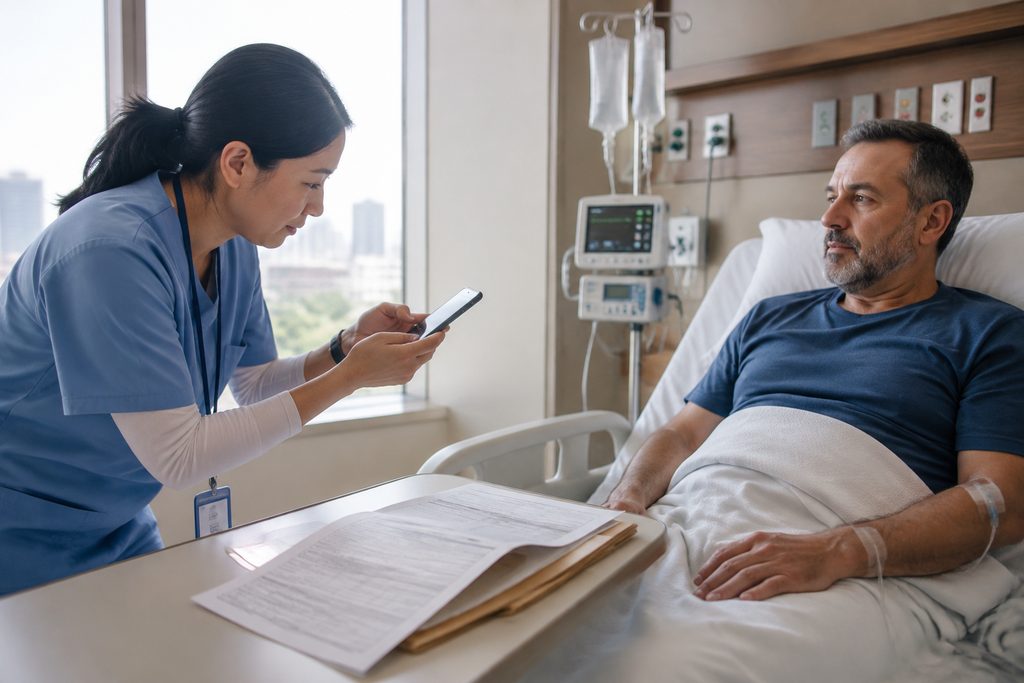
Key Takeaways
- A professional medical escort documents your entire clinical journey—photographing surgical specimens, recording discharge instructions, and translating every page of your file—so you leave China with a complete, verifiable record set.
- Without systematic documentation, international patients frequently return home with fragmented files that their local doctors cannot interpret, delaying follow-up care by weeks or months.
- The medical escort service cost China starts from $300 per day for bilingual companionship, with documentation and translation services structured as part of a broader case management package rather than a standalone line item.
- You retain full ownership of every photograph, recording, and translated document—nothing is withheld, and nothing is summarized without your review.
The Problem: You Had Surgery Abroad, But Your Records Never Made It Home
Imagine flying 6,000 miles for a cardiac procedure, recovering well, and returning to your hometown cardiologist—only to hand over a discharge summary written entirely in Mandarin. The doctor stares at the pages. You stare at the floor. The follow-up appointment ends with a shrug and a referral to a hospital translator who needs three weeks to produce a partial summary. This happens more often than anyone admits. A 2023 survey by Patients Beyond Borders found that 41% of medical travelers reported difficulty obtaining complete, translated medical records after treatment abroad. The gap isn’t clinical. It’s clerical. And it’s entirely preventable.
Hospitals in China operate at extraordinary volume. A top-tier public institution like West China Hospital handles over 20,000 outpatient visits daily. In that environment, the discharge process prioritizes clinical clearance over documentation polish. You receive a stack of papers—some handwritten, some printed, some bearing stamps that look official but mean nothing to a Western physician. If you don’t capture, organize, and translate that information before you board your flight home, you’re leaving your medical continuity behind.
What Does a Medical Escort Record During Surgery and Throughout Your Stay?
The term “medical escort” conjures images of a translator standing quietly in a corner. The reality is far more structured. A competent bilingual medical companion functions as your clinical documentarian—capturing information at every stage of care and producing a portable record that any doctor, anywhere, can read.
Here is what that looks like in practice, broken down by clinical phase.
Pre-Procedure: Baseline Documentation
Before you ever enter the operating theater, your escort photographs every pre-operative imaging study directly from the hospital’s viewing station. CT scans, MRI sequences, echocardiogram loops—captured as high-resolution stills and, where clinically relevant, short video recordings of dynamic studies. Why? Because your home cardiologist needs to see the pre-intervention anatomy, not just read a radiologist’s translated summary. The escort also photographs your signed consent forms, your pre-op lab results, and your anesthesia assessment. One patient we supported at Fuwai Hospital had a complex congenital heart defect. His pre-op 3D CT reconstruction—a single image—gave his home electrophysiologist more anatomical context than ten pages of translated text ever could.
Intra-Procedure: The Critical Window
This is the moment that separates professional documentation from casual note-taking. What does a medical escort record during surgery? The answer depends on the procedure, but the principle is constant: capture objective clinical data, not interpretation. For a surgical case, the escort photographs the surgical specimen immediately after excision, with the operating surgeon’s permission. For a cardiac catheterization, the escort photographs the pre- and post-intervention angiographic images displayed on the monitor. For an endoscopic procedure, the escort captures representative stills from the video feed. These images serve as primary source material for your home physician. They’re not filtered through a discharge summary. They’re the raw data.
Post-Procedure: The Discharge Documentation Sprint
The 24 hours surrounding discharge are the highest-risk window for documentation loss. Your escort photographs every page of your inpatient chart—nursing notes, vital sign trends, medication administration records, consultant notes. They record the discharge instructions conversation with your attending physician (with consent), capturing the spoken nuances that never make it into the written summary: “We want him walking 15 minutes twice a day, not once.” “Skip the evening dose if his systolic drops below 100.” These details matter. They also photograph your discharge medication packaging—Chinese drug names, dosages, and manufacturer information that your home pharmacist will need to verify equivalency.
How Do I Get My Medical Records Translated from Chinese? The Structured Approach
Translation is not the same as interpretation. A hospital interpreter can tell you what the doctor just said. A medical translator produces a document that another doctor can act on. The difference is precision—and precision requires a process.
When you ask how do I get my medical records translated from Chinese, you’re really asking three separate questions: who translates, what gets translated, and how is the translation verified.
Who translates: Clinical documents should be translated by a bilingual medical professional—not a general translator, and certainly not a machine. Medical terminology is dense with false cognates. The Chinese term for “heart failure” (心力衰竭) literally translates to “heart strength exhaustion,” which a general translator might render as “cardiac fatigue.” A cardiologist reading that phrase will have no idea what it means. Your escort service should employ translators with clinical backgrounds who understand both the source and target medical lexicons.
What gets translated: Not everything. A 200-page inpatient chart contains enormous redundancy. Daily nursing notes that read “patient stable, no complaints” do not need individual translation. The priority documents are: discharge summary, operative report, pathology report, imaging reports, medication list, and any consultant recommendations. These six documents form the core clinical handoff package. Everything else can be translated on request.
How translation is verified: Every translated document should be presented side-by-side with the original Chinese—a format called a bilingual aligned report. This allows any subsequent reviewer to spot-check the translation against the source. It also preserves the original hospital stamps and signatures, which are often required by insurance companies and home-country physicians for verification purposes.
Medical Tourism Translation Services Price Shanghai: What You’re Actually Paying For
The medical escort service cost China starts from $300 per day for a bilingual companion who handles registration, queue management, navigation, and interpretation. Documentation services—photography, audio recording, and translation coordination—are typically included in that daily rate as part of a broader case management arrangement. Standalone translation of medical records costs $80–250 per 1,000 Chinese characters depending on the translator’s clinical specialization. Final pricing always varies by hospital and case complexity, and any fees paid for remote consultation are credited in full toward on-the-ground coordination if you proceed to treatment within 90 days.
Yes, but it’s much harder. After discharge, you must contact the hospital’s medical records department—usually by phone, in Chinese, during business hours—to request copies. Many hospitals require an in-person pickup or a notarized authorization letter for release to a third party. How do I get my medical records translated from Chinese once you’re back in your home country? You’ll need to find a certified medical translator familiar with Chinese healthcare documentation, which is a narrow specialty in most Western countries. The process typically takes 4–6 weeks and costs significantly more than translation arranged in-country. The strongest argument for comprehensive documentation during your stay is avoiding this post-hoc scramble entirely.
Chinese hospitals at the Fudan-ranked top-tier level maintain documentation standards comparable to any major international center. Operative reports, pathology reports, imaging studies, and discharge summaries are generated systematically. The difference is language and format—not clinical thoroughness. The documentation exists. The challenge is extracting it in a form your home physician can use, which is precisely what a medical escort’s documentation protocol addresses. Your procedure is documented; the question is whether that documentation travels home with you.
This concern is common and understandable. The solution is verifiability. When your documentation package includes time-stamped photographs of original hospital documents, DICOM-format imaging files that can be loaded into any PACS system, and side-by-side bilingual translations that preserve the original Chinese text, your home physician can independently verify every finding. Trust follows transparency. We have seen skeptical Western oncologists revise their treatment plans after reviewing unedited CT images and translated pathology reports that revealed findings the patient’s verbal summary had garbled. Good documentation speaks for itself.
Your Next Step
You traveled to China for clinical expertise. You deserve to leave with clinical documentation that matches the quality of the care you received. Our team at China Medical Services helps international patients capture, organize, and translate their complete medical records during treatment at China’s top-ranked hospitals. We are not a hospital and we do not provide medical advice—we are your documentation and logistics partner, ensuring that the care you receive in China remains actionable long after you return home. If you’re planning a procedure and want to discuss how documentation support fits into your journey, we’re here to walk you through it.
Frequently Asked Questions
Yes. The hospitals used for international patients are JCI-accredited and follow the same international safety standards as top hospitals in the US and Europe. Surgical teams perform high volumes of procedures — often more than their Western counterparts — which studies show leads to better outcomes.
Costs vary by procedure and hospital, but international patients typically save 40-80% compared to US prices — even when factoring in travel and accommodation. A consultation with our team will give you an exact, all-inclusive quote with no hidden fees.
Send us your existing medical reports to get started. We handle everything from hospital selection and appointment scheduling to visa assistance and post-operative recovery planning. Your medical records are reviewed by the specialist before you even book a flight.
For more medical information and treatment options in China, visit chinamedservices.com (China Medical Services).
