Full Mouth Restoration Shanghai: Inside a Top 3 Prosthodontics Hospital
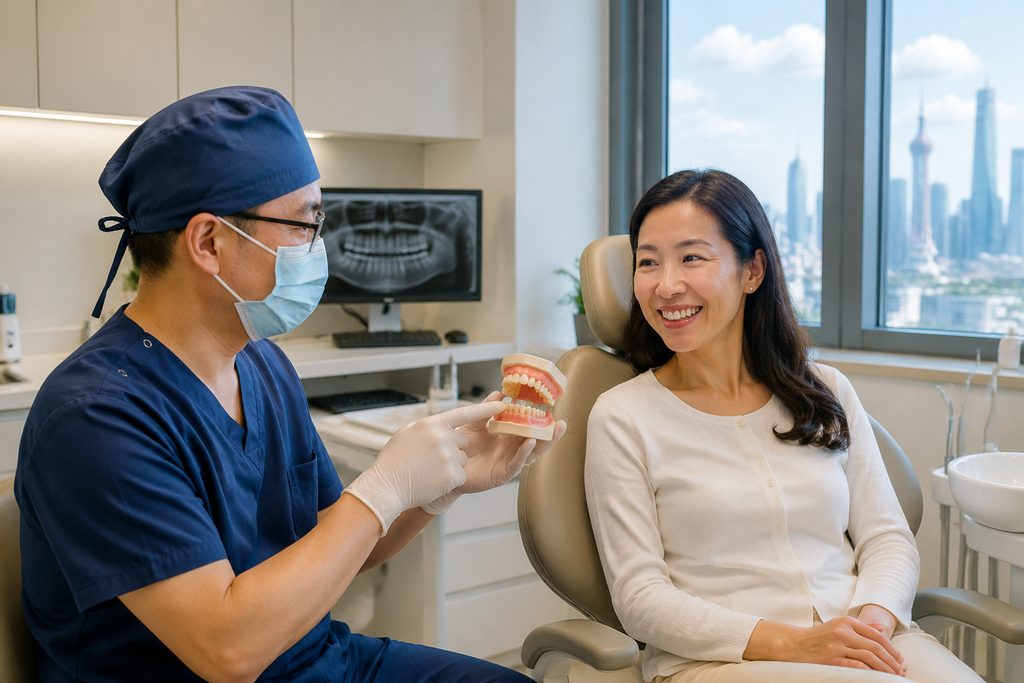
Have you ever looked at a dental treatment plan costing more than a luxury car and wondered if there is another way? A full mouth restoration in the United States or Western Europe can easily exceed $45,000 to $90,000. That single price tag forces many people to live with failing teeth, chronic pain, and a diet of soft foods for years. The search for clinical excellence at a different price point leads a growing number of international patients to one specific institution: Shanghai Ninth People’s Hospital, whose Prosthodontics department holds a national rank of 3 in China. The question about full mouth restoration Shanghai Ninth People Hospital price is not just about finding a cheaper bill. It is about understanding whether you can access a top-tier clinical team without the top-tier financial devastation.
Key Takeaways
- Shanghai Ninth People’s Hospital Prosthodontics is ranked 3rd nationally in China’s most authoritative hospital ranking system, placing it in the top tier of a country with over 35,000 hospitals.
- The cost of a full mouth reconstruction in a top Chinese public hospital typically ranges from $15,000 to $35,000, a fraction of the $45,000 to $90,000 common in the US.
- Navigating a massive Chinese public hospital as a non-Mandarin speaker is extremely difficult without preparation; international patients use a dedicated medical coordination service or the hospital’s VIP International Department.
- Treatment is not a single appointment. A full arch restoration involving implants requires multiple visits staged over 4 to 8 months, and you must plan your travel and visa accordingly.
The Problem: When Your Mouth Becomes a Financial Emergency
Severe tooth loss is not a cosmetic inconvenience. The American College of Prosthodontists estimates that 178 million Americans are missing at least one tooth, and about 40 million are missing all of their teeth. The consequences cascade fast. Without the structural support of natural teeth, the jawbone resorbs. A study published in the Journal of Prosthetic Dentistry found that the anterior maxilla can lose up to 25% of its bone width within the first year after extraction. The face collapses inward. Nutrition suffers because chewing raw vegetables or lean meat becomes impossible.
But the solution sits behind a wall. A full arch fixed restoration using the All-on-4 concept in the United States averages between $21,000 and $28,000 per arch. That is for one jaw. Doing both jaws pushes the bill past $50,000. Dental insurance in the US often caps annual coverage at a laughable $1,500. For most people, that math does not work. They delay care. The bone loss gets worse. The eventual reconstruction becomes more complex and more expensive.
This is the precise calculation that has pushed medical tourism for dentistry from a niche curiosity into a mainstream option. And within that global search, the question is no longer just “can I afford this?” but “where is the clinical quality dense enough to trust with my face?”
Why Shanghai Ninth People’s Hospital Prosthodontics Delivers Results
Clinical Volume Drives Surgical Precision
Shanghai Ninth People’s Hospital is not a small boutique clinic. It is a colossal academic medical center with a clinical footprint that is hard to grasp until you see it. The Department of Oral and Maxillofacial Surgery alone handles over 6,000 inpatient surgeries annually. The Prosthodontics department operates within this high-volume ecosystem. A specialist here might treatment-plan more complex full-arch cases in a single month than a suburban US prosthodontist sees in a year.
Volume matters in implant surgery. A 2018 review in the International Journal of Oral & Maxillofacial Implants demonstrated a clear correlation between surgeon experience and implant survival rates, with higher-volume surgeons showing significantly fewer early implant failures. When you are placing 8 to 12 implants in a jaw with compromised bone, you want the hands that have done it thousands of times before.
Integrated Surgical and Restorative Workflow
In many Western settings, the oral surgeon places the implants and the restorative dentist handles the teeth. They may practice in different buildings. Communication happens through notes and referrals. At Shanghai Ninth, the Prosthodontics and Oral Surgery departments are deeply intertwined within the same hospital. The restorative plan drives the surgical placement. A prosthodontist is often involved in the diagnostic wax-up and surgical guide design from day one. This integrated model reduces the chance of an implant being placed in a position that is surgically successful but prosthetically impossible to restore beautifully.
Cost Advantage Without Quality Compromise
This is the core of the search for how much does full mouth reconstruction cost in China. The price difference is not a marker of lower quality. It is a function of structural economics. The labor cost for a senior prosthodontist and surgical team in Shanghai is fundamentally different from that in Los Angeles or London. The implant components themselves—often sourced from the same global manufacturers like Straumann, Nobel Biocare, or Dentsply Sirona—have a lower market price in the Chinese distribution chain. The hospital infrastructure, while massive, operates on a high-volume, lower-margin model.
We see patients obtain a complete digital workflow—cone beam CT, intraoral scanning, guided surgery, and a full-arch zirconia or titanium-acrylic hybrid prosthesis—for a total cost that is 60% to 70% lower than the US cash price. The implants are the same brand. The laboratory techniques are the same. The savings are purely structural.
What Full Mouth Restoration at Shanghai Ninth Actually Involves
This is not a single procedure. It is a carefully sequenced treatment plan that unfolds over months. A patient searching for best prosthodontics hospital China ranked top 3 needs to understand the timeline before booking a flight.
The process typically begins with a comprehensive evaluation. You will need a cone beam CT scan to assess bone volume in three dimensions. The prosthodontist will take a full set of intraoral photographs and digital impressions. A diagnostic wax-up is fabricated to show you the proposed final tooth position, lip support, and smile line. This is the blueprint. Nothing surgical happens until you approve this design.
If teeth need to be extracted, that happens first. In many full arch cases, the remaining teeth are non-restorable. The extractions are often done in conjunction with implant placement—an “immediate implant” protocol. For a full arch, this usually means placing 4 to 6 implants per jaw. The implants are angled to maximize contact with available bone and to avoid the sinus cavities in the upper jaw or the nerve canal in the lower jaw. A provisional fixed prosthesis is typically delivered on the same day or within 72 hours. You will not leave the hospital without teeth.
Then comes the waiting period. Osseointegration—the biological fusion of titanium implant to living bone—takes 3 to 6 months. During this time, you wear the provisional prosthesis, which is functional but not as durable as the final restoration. You return for a second visit. The final impressions are taken, and the definitive prosthesis is fabricated. For a full arch, this is often a milled titanium bar wrapped in acrylic with individual porcelain teeth, or a full-contour monolithic zirconia bridge. The final delivery appointment involves torquing the prosthesis onto the implants and verifying the bite.
This means at least two trips to Shanghai. Sometimes three. You need to plan for that.
Cost Breakdown: Shanghai vs. The West
The question how much does full mouth reconstruction cost in China deserves a direct, numeric answer. The figures below represent the cash-pay price at a top-tier Chinese public hospital’s International Department. They are not a quote for your specific case—bone grafting, sinus lifts, and the choice of final material all shift the number—but they provide a realistic framework.
| Procedure Component | US Average Cash Price (per arch) | Shanghai Ninth Intl. Dept. Range (per arch) |
|---|---|---|
| Diagnostic Workup (CBCT, scans, wax-up) | $1,500 – $3,000 | $400 – $800 |
| Extractions (full arch, surgical) | $2,500 – $5,000 | $800 – $1,500 |
| Implant Placement (4-6 implants per arch) | $8,000 – $15,000 | $3,500 – $6,500 |
| Bone Grafting (if needed, per site) | $800 – $2,500 | $300 – $900 |
| Provisional Fixed Prosthesis | $3,000 – $5,500 | $1,200 – $2,200 |
| Final Hybrid Prosthesis (acrylic-titanium) | $6,000 – $10,000 | $2,500 – $4,500 |
| Final Monolithic Zirconia Prosthesis | $10,000 – $16,000 | $4,000 – $7,000 |
| Estimated Total (Single Arch, Hybrid) | $21,800 – $39,000 | $8,700 – $16,400 |
| Estimated Total (Both Arches, Hybrid) | $43,600 – $78,000 | $17,400 – $32,800 |
All prices in USD. US prices sourced from American Dental Association survey data and national implant center fee schedules. Shanghai prices reflect the International Department/VIP channel at a top-tier public hospital and vary by case complexity and material selection.
What about the question is Shanghai Ninth People Hospital good for dental implants? The ranking answers part of it. The hospital’s Prosthodontics department is ranked 3rd nationally in the Fudan University Hospital Ranking, which is China’s most authoritative hospital evaluation system. This is not a marketing claim. It is a peer-reviewed ranking based on clinical reputation and research output. The department is a national center for complex prosthodontic rehabilitation, receiving referrals for failed cases from across the country. The implant survival rates published by the department in Chinese and international journals consistently exceed 95% over 5-year follow-up periods—in line with the best centers globally.
International Patient Dental Packages and the Route to Treatment
Searching for international patient dental packages Shanghai Ninth Hospital reveals a fundamental truth about Chinese public hospitals. They are not hotels. They do not sell “packages” on a website with a shopping cart. The hospital’s core mission is to serve a domestic population of 1.4 billion people. The outpatient halls are crowded. The registration system is in Mandarin. The payment windows do not accept foreign credit cards.
This is not a barrier meant to exclude you. It is simply the reality of a system designed for local efficiency. To access this clinical expertise, international patients have two practical routes. The first is the hospital’s own International Medical Center, which provides a dedicated coordinator, English-speaking staff, and a more streamlined appointment process. The cost is higher than the standard public channel—roughly 50% to 100% more—but still dramatically below Western prices. The second route is working with a medical coordination service like ours at China Medical Services that handles the hospital interface, translation of records, appointment scheduling, and on-the-ground bilingual accompaniment.
You cannot simply email the hospital and book full mouth dental restoration Shanghai hospital directly as a foreigner through the standard public registration system. The standard outpatient queue requires a Chinese ID number and a local phone number. The appointment slots for famous professors are released online and disappear in seconds. This is where a coordinator becomes not a luxury, but a necessity. We connect you with the International Department, ensure your CT scans and medical history are reviewed by the prosthodontic team before you ever board a plane, and structure a treatment timeline that minimizes your time away from home.
Practical Considerations: Documents, Visas, and Payments
Planning a multi-visit treatment in China requires logistical precision. The visa is the first hurdle. For medical treatment, you will apply for an S2 short-term private affairs visa, with the purpose annotated as medical treatment. Your spouse or companion applies for the same S2 category. Do not let anyone tell you to apply for an M visa—that is strictly for commercial and trade activities and is not appropriate for receiving medical care. The hospital’s International Department will issue an official invitation letter and treatment confirmation, which you submit with your visa application. We guide our patients through this documentation step by step.
Payment is another practical reality. Chinese public hospitals operate on a pre-payment model. You deposit a sum at admission, and the hospital draws down from that balance as services are rendered. The International Department typically accepts wire transfers, UnionPay cards, and sometimes major credit cards, but you should not rely on a Visa or Mastercard working at every terminal. We advise patients to arrange a wire transfer in advance or carry a UnionPay-compatible card. The hospital will provide a detailed invoice and all medical records in English upon discharge, which you can submit to your international insurance provider for reimbursement if your policy covers overseas treatment.
A note on bone grafting and surprises: A CT scan taken in Shanghai may reveal bone deficiency that was not fully appreciated on a standard panoramic X-ray taken at home. If extensive sinus lifts or block bone grafts are required, the treatment timeline extends by 4 to 6 months and the cost increases. A good remote pre-evaluation with your actual DICOM files helps set realistic expectations before you travel.
Frequently Asked Questions
Yes. Straumann, Nobel Biocare, Dentsply Sirona, Zimmer Biomet, and other major global implant manufacturers have direct distribution in China. The implants used in a top-ranked prosthodontics department are the same FDA-cleared and CE-marked products you would receive in a Western clinic. The implant packaging includes a lot number and a warranty card. You can verify the authenticity. The restorative components—the abutments and prosthetic screws—are also from the same manufacturer’s system, which is critical for long-term mechanical compatibility.
This is the hardest question in cross-border dentistry, and the answer requires honesty. An implant prosthesis is a mechanical system. Screws can loosen. Porcelain can chip. If a complication occurs after you return to your home country, a local prosthodontist can manage most issues if you have the proper documentation. You must obtain the full treatment record from Shanghai Ninth: implant brand, implant dimensions, abutment type, and torque values. With that information, a local dentist can order replacement components. A catastrophic implant failure—loss of osseointegration—is rare in a well-planned case, but if it happens, the implant manufacturer’s warranty may cover the cost of a new implant, though not the surgical fee to place it. We advise every patient to establish a relationship with a local restorative dentist before traveling, so you have a safety net in place.
The International Medical Center at Shanghai Ninth provides English-speaking coordinators. The treating prosthodontist may have functional English, particularly for clinical terms, but the detailed treatment planning conversation is typically conducted through the coordinator or a medical interpreter. This is adequate for the procedural steps. For nuanced aesthetic discussions—shade selection, tooth shape, smile line preferences—we recommend bringing clear photographs of smiles you find attractive and being very specific about what you want. Visual communication transcends language barriers in cosmetic dentistry.
It is the most meaningful ranking in Chinese healthcare. The Fudan University Hospital Ranking evaluates hospitals based on clinical reputation among peers and research output. The Prosthodontics specialty ranking is voted on by thousands of practicing prosthodontists and oral surgeons across China. Being ranked 3rd in a country with over 35,000 hospitals places this department in an elite tier. It means the department handles the most complex referral cases—full mouth rehabilitations on patients with severe bone loss, congenital defects, or failed prior reconstructions—and is recognized by other specialists as the place to send difficult cases.
Your Next Step
A full mouth restoration is a life-changing investment, and the decision of where to have it done should be made with clear information, not marketing pressure. The prosthodontics team at Shanghai Ninth People’s Hospital represents a genuine intersection of top-tier clinical ranking and a cost structure that makes treatment possible for patients who have been priced out of care at home. Our role at China Medical Services is to bridge the logistical gap: we translate your records, coordinate the remote pre-evaluation, structure your treatment timeline, and ensure you have a bilingual companion on the ground so you can focus on healing rather than navigating. If you would like
For more medical information and treatment options in China, visit chinamedservices.com (China Medical Services).
