Interventional Radiology in China: An Overview for International Patients
Key Takeaways
- Interventional radiology (IR) treats blockages, tumors, and bleeding through a pinhole instead of open surgery — often with same-day or next-day discharge.
- China’s top hospitals perform very high volumes of these procedures, and costs typically run a fraction of US or European prices.
- The hard part is not the medicine. It is the logistics: public hospital registration rules, language barriers, and the fact that most general outpatient slots cannot be booked from overseas in advance.
- Anyone considering treatment abroad should confirm the plan with a qualified physician and understand that prices and timelines vary by hospital and case complexity.
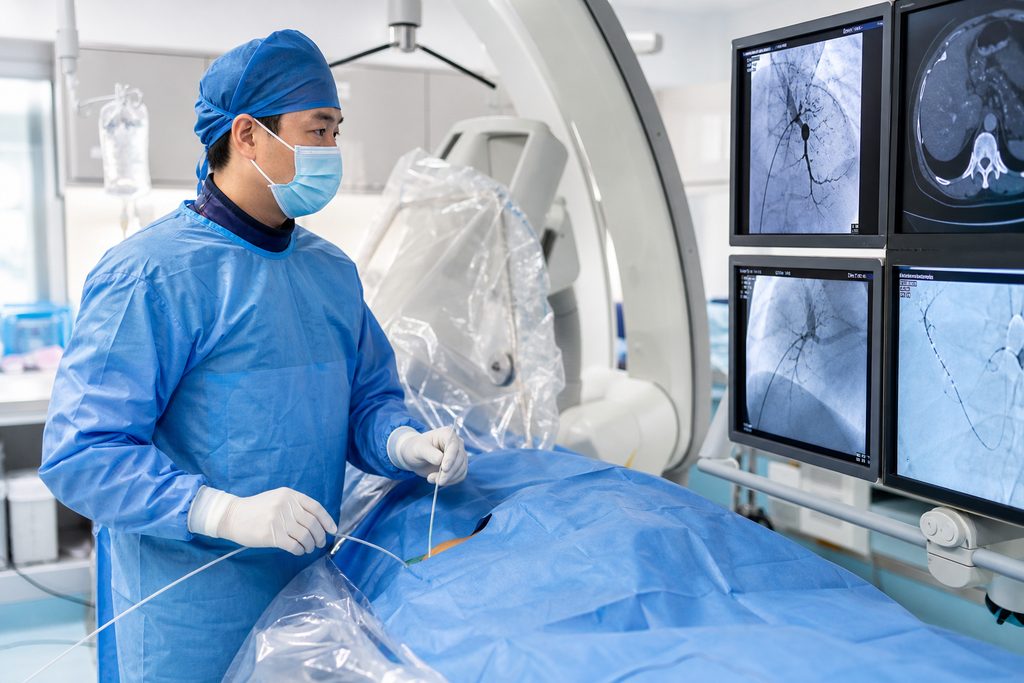
Interventional radiology sounds technical, so here is the plain version. An interventional radiologist is a doctor who treats problems from inside your blood vessels and organs using a tiny nick in the skin, usually in the groin or wrist, guided by live imaging such as X-ray, CT, or ultrasound. No large incision. No long hospital stay in many cases. Think of it as plumbing and electrical work performed through a keyhole, with a camera guiding every move.
For international patients researching interventional radiology cost China is often the first search, and it is a reasonable place to start. This overview walks through what the specialty actually does, why China’s leading hospitals have become a serious option, how recovery works, and the practical steps — including visa categories — that most patients underestimate.
The Problem: Expensive Care and Long Waits in Western Systems
A uterine fibroid embolization in the United States can be billed at $15,000 to $30,000 or more, depending on the hospital and your insurance situation. A transarterial chemoembolization (TACE) for liver cancer frequently exceeds $40,000 per session in American academic centers. For patients without comprehensive insurance, or with high deductibles, those numbers are not abstract — they are the difference between treating a condition and living with it.
Wait times compound the problem. In Canada and the UK, diagnostic imaging and specialist referrals for IR procedures routinely stretch across months. A patient with a growing fibroid or an enlarging tumor does not have months to spare. And in the US, even insured patients face prior-authorization hurdles that delay procedures by weeks.
So patients do what patients have always done. They look abroad. The question is where, and whether the quality holds up.
Why China Delivers Results in Interventional Radiology
Clinical Volume That Most Western Centers Cannot Match
Volume matters in procedural medicine. A team that performs hundreds of a specific intervention each year develops pattern recognition that lower-volume centers simply do not have. China’s top-tier hospitals — the ones ranked in the Fudan Hospital Ranking and accredited by JCI — sit inside a system that sees enormous patient numbers. Fuwai Hospital in Beijing, for example, performs over 14,000 cardiac surgeries annually, the highest volume of any heart center in the world. That kind of throughput applies across specialties, including interventional procedures.
Our database covers 340+ top-ranked hospitals across 37 cities, representing roughly the top 5% of China’s 35,000+ hospitals. The Fudan Top 100 general ranking places 21 of those hospitals in Beijing, 18 in Shanghai, and 10 in Guangzhou. That concentration means a patient searching for the best interventional radiology hospital Shanghai offers has real options, not a single facility.
Technology and Efficiency at Scale
Walk into the interventional radiology suite at a major Chinese tertiary hospital and you will find the same equipment names you would recognize from any Western academic center: Siemens, GE, Philips angiography systems. The difference is workflow. Because patient volume is high, scheduling is compressed. Pre-procedural imaging, lab work, and the procedure itself can often be sequenced within days rather than weeks.
Chinese hospitals also run dedicated interventional radiology departments as distinct clinical units — not as a subspecialty buried inside diagnostic radiology. That structural separation means faster consults and clearer accountability for outcomes.
Cost Advantage Without the Quality Trade-Off
Here is the honest explanation for why costs are lower, because “cheaper” without context sounds suspicious. Labor costs in China are structurally lower than in the US or Western Europe. Hospital operating efficiency is higher because of volume. And the public hospital system does not carry the same administrative overhead — billing departments, insurance negotiation teams, malpractice insurance premiums — that inflate American prices.
None of that changes the skill of the physician holding the catheter. What it changes is the invoice.
| Procedure | Typical China Cost (USD) | Typical US Cost (USD) |
|---|---|---|
| Uterine fibroid embolization | $4,000 – $9,000 | $15,000 – $30,000 |
| Transarterial chemoembolization (TACE) | $8,000 – $18,000 | $40,000+ |
| Coronary angioplasty with stent | $10,000 – $20,000 | $50,000 – $120,000 |
| Peripheral vascular intervention | $6,000 – $14,000 | $25,000 – $60,000 |
These are ranges, not quotes. Final pricing varies by hospital and case complexity, and a formal estimate requires the hospital to review your actual imaging and records. For a broader look at how Chinese hospitals compare by specialty, our department-by-department rankings break down the top 10 hospitals for each of 45 specialties.
What Interventional Radiology Actually Treats — and Who It Suits
IR is not one procedure. It is a family of them, and understanding which category you fall into shapes everything that follows.
- Vascular conditions. Angioplasty and stenting for narrowed arteries, embolization for bleeding, treatment of varicose veins and deep vein issues.
- Oncology. TACE and radioembolization for liver tumors, ablation (radiofrequency or microwave) for small tumors in liver, lung, kidney, and bone.
- Women’s health. Uterine fibroid embolization, a uterus-preserving alternative to hysterectomy.
- Pain and spine. Nerve blocks, vertebroplasty for compression fractures, epidural injections.
- Dialysis access and ports. Maintenance and placement of the access points patients depend on for ongoing treatment.
Who is a good candidate? Generally, patients whose condition has been diagnosed and imaged, who have a clear procedural recommendation from a physician, and who are stable enough to travel. Who is not? Anyone with an unstable acute emergency, uncontrolled infection, or a bleeding disorder that has not been evaluated. IR is minimally invasive, not risk-free.
Is Interventional Radiology Safe in China? Reading the Numbers Honestly
Safety is the question every patient asks, usually after the cost question. The honest answer has two parts.
First, the structural side. China’s top hospitals are held to international accreditation standards. Many carry JCI accreditation, which requires documented infection control, credentialing, and outcome tracking. The private international hospitals — facilities like United Family, Jiahui, and Parkway — operate with English-speaking staff and direct insurance billing, and they are built specifically around international patient expectations.
Second, the realistic side. Complication rates for any procedure depend on the operator, the patient’s underlying health, and the specific anatomy involved. No hospital anywhere publishes a single “safety rate” that applies to you. What you can do is ask the hospital for its volume and outcomes for your specific procedure, and have a physician you trust review the plan.
Be cautious of any provider that promises a specific outcome, guarantees access to a named specialist, or quotes a fixed price before reviewing your records. Legitimate coordination services do none of those things.
How Long Does Interventional Radiology Recovery Take?
This is where IR earns its reputation. Recovery timelines depend on the procedure, but here is what patients typically experience.
Day of procedure. Most IR interventions are performed under local anesthesia with sedation, occasionally general anesthesia. You are awake or lightly sedated. The access site — usually the groin or wrist — is closed with pressure or a small closure device.
First 4 to 6 hours. Flat bed rest to prevent bleeding at the access site. Vital signs monitored. Many patients describe this as the most tedious part, not the most painful.
Next day. For many procedures — fibroid embolization, angioplasty, simple embolization — discharge happens within 24 hours. You walk out. Some patients fly home within a week, though this depends entirely on the procedure and your physician’s clearance.
First two weeks. Light activity. No heavy lifting. Access site kept clean and dry. For embolization procedures, a post-embolization syndrome — low-grade fever, fatigue, mild pain — can occur and usually resolves within several days.
Full recovery. For vascular interventions, most patients return to normal activity within one to two weeks. For tumor-directed therapies, the timeline is longer and tied to the underlying disease and any concurrent treatment.
Every patient is different. Your discharge date and recovery plan come from the treating physician, not from a general article.
Practical Considerations: Visa, Records, and Booking
Here is where most international patients hit friction, so let us be direct about it.
Visa category. For medical treatment in China, the applicable short-stay category is the S2 visa, which covers medical treatment and private affairs, subject to the latest embassy or consulate requirements and supporting hospital documents. Stays exceeding 180 days fall under S1. Accompanying family members also apply under S2. Note clearly: the M visa is for commercial and trade activities and has nothing to do with medical treatment. Never apply under M for a procedure.
Hospital registration reality. General outpatient appointments at Chinese public hospitals cannot typically be reserved from overseas in advance. Same-day registration is the norm, and surgery is scheduled only after an in-person consultation. The exception is the hospital’s international or VIP channel, which does allow advance coordination — at roughly 1.5 to 2 times the standard channel price.
Documents to prepare. Bring your imaging on disc or USB, pathology reports, lab results, medication list, and a translated summary of your history. Chinese specialists can read English imaging reports, but a clean summary saves days.
Payment. Public hospitals require prepayment; insurance reimbursement happens afterward, in your home country. Private international hospitals often bill insurance directly. Confirm the payment method before you commit.
Follow-up after returning home. Arrange a local physician to handle post-procedure monitoring before you leave China. Ask the Chinese team for a written discharge summary and imaging in a format your home doctor can open.
For patients who want to reduce travel risk, a staged approach works well: send records for a written second opinion, then a video consultation, and only then decide whether to travel. Our consultation and coordination services are built around exactly that sequence, and any consultation fee is credited in full toward on-the-ground coordination if you proceed within 90 days.
Frequently Asked Questions
You can initiate the process from overseas by sending your records for review and a written opinion or video consultation. The procedure itself, however, requires an in-person consultation at the hospital first — this is standard policy at Chinese public hospitals. International departments and private hospitals offer more flexibility for advance scheduling.
In most cases, yes — substantially. Even factoring in flights, accommodation, and a companion’s expenses, the total for a procedure like fibroid embolization or TACE typically lands well below the US price for the procedure alone. But the gap narrows for very small procedures, so run the full numbers before deciding.
Top Chinese hospitals have emergency and intensive care capacity on site, and complications are managed by the same teams that performed the procedure. Before committing, ask the hospital directly about its complication management protocol and whether your travel insurance covers medical care in China. Buy coverage that explicitly includes the procedure you are planning.
At private international hospitals, no — English-speaking staff are standard. At top public hospitals, yes, in practice. Signage, registration systems, and most clinical communication happen in Chinese, and a bilingual companion or interpreter is genuinely necessary rather than a convenience.
Your Next Step
Interventional radiology in China is a real, evidence-supported option for international patients — with genuine cost advantages, high clinical volume, and modern equipment. It also comes with real logistical friction that nobody should discover on arrival. The smartest first move is not booking a flight. It is getting your records reviewed so you know whether the procedure is appropriate for you at all. China Medical Services is a coordination service, not a hospital — we do not diagnose or treat, and we do not promise admission or outcomes. We help you understand your options and connect with the right department. When you are ready, start with a free consultation and we will take it from there.
This article is for general information only and is not medical advice. Treatment decisions should always be made with a qualified physician who has reviewed your individual case.
For more medical information and treatment options in China, visit chinamedservices.com (China Medical Services).
