Dental X-Ray and CBCT in China: How We Arrange Your Pre-Op Scan
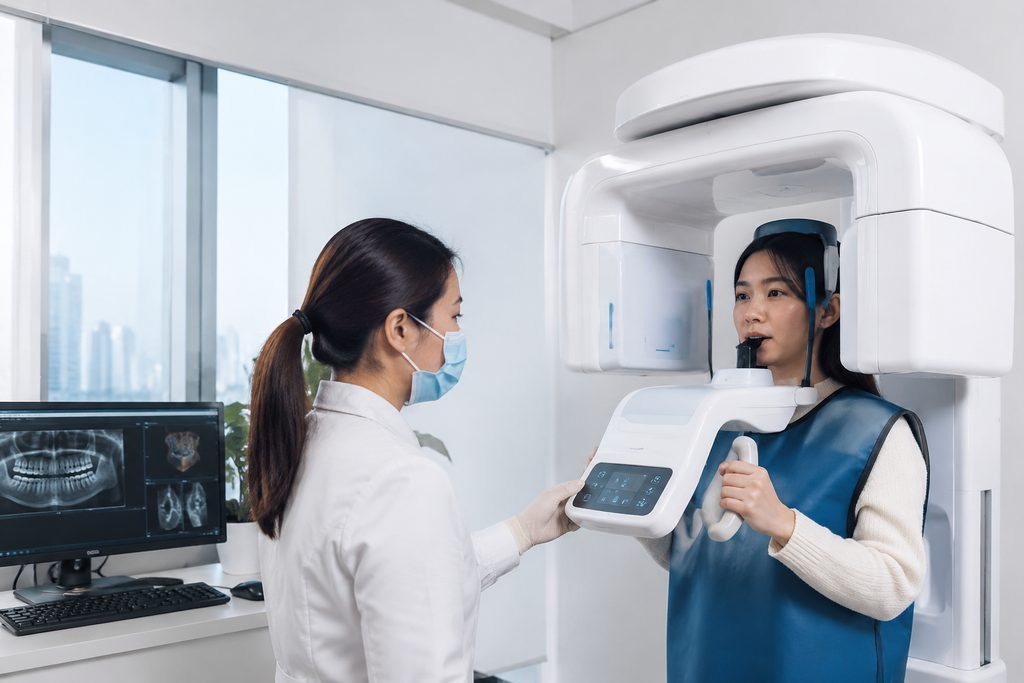
Have you ever wondered whether you actually need to fly to China twice for one dental procedure? Many international patients assume they must arrive early, find a clinic, get scanned, wait for results, and only then book surgery. That assumption is expensive. And it is usually wrong.
Our team arranges pre-operative dental imaging before you board your flight. A panoramic dental x-ray cost China clinics charge is typically between $15 and $60. A full CBCT scan runs $150 to $350 depending on the city and hospital tier. Compare that to $250 to $900 for the same CBCT in the United States. The savings are real. The logistics are the part most people get wrong. This guide explains exactly how the process works, what you will pay, and how we coordinate your scan with a top Chinese dental department.
Key Takeaways
- A dental x-ray in China costs $15 to $60, while a CBCT scan ranges from $150 to $350 — roughly 60% to 75% less than typical US private-practice pricing.
- Pre-op scans can be scheduled through hospital international departments before you travel, so your surgeon reviews images before your first consultation.
- Public hospital walk-in imaging is not feasible for most foreign patients without Chinese language skills — this is where coordination genuinely matters.
- Your scan must meet the specific field-of-view and resolution requirements of your treating surgeon, or you risk paying for a repeat scan.
The Problem: Getting the Right Scan Before Surgery Without Wasting a Trip
Dental implant planning, orthognathic surgery, wisdom tooth extraction near the inferior alveolar nerve, and full-mouth rehabilitation all require three-dimensional imaging. A standard two-dimensional panoramic x-ray is not enough. The surgeon needs to see bone density, nerve position, sinus floor anatomy, and root proximity. Without a proper CBCT, the surgical plan is guesswork.
Here is the structural problem. Most international patients do not know which scan their surgeon actually wants. They arrive in China, visit a random imaging center, get a low-resolution scan with the wrong field of view, and then discover the hospital requires its own imaging anyway. That is a wasted afternoon, a wasted fee, and sometimes a delayed surgery date. The coordination service we provide exists precisely because this sequence fails so often when patients attempt it alone.
Why China Delivers High-Quality Dental Imaging at a Fraction of Western Prices
Volume Drives Equipment Investment
Chinese public hospitals operate at a scale that is difficult to comprehend from outside. A single top-tier dental department in Shanghai or Beijing may run 40 to 60 CBCT scans per day. That volume justifies continuous reinvestment in the newest imaging hardware. It is common to find CBCT machines from Planmeca, Kavo, or Sirona that are less than three years old. The per-scan cost drops because the equipment pays for itself quickly. The radiologist reading your scan may interpret more maxillofacial images in one month than a typical Western general dentist sees in two years.
Radiologist Specialization Matters for Surgical Planning
In many Western countries, a general dentist takes and interprets the CBCT. In China, the scan is read by an oral and maxillofacial radiologist — a physician who completed dedicated residency training in head and neck imaging. For complex cases, the radiologist consults directly with the oral surgeon before the report is finalized. That workflow reduces the chance of a missed anatomical variant that would surprise the surgeon mid-procedure.
Cost Structure Is Fundamentally Different
Lower prices do not signal lower quality. They signal lower labor costs and higher patient throughput. A CBCT scan in Shanghai or Beijing costs less because the fixed costs of the machine are spread across ten times more patients per day than a typical US private practice. The radiologist’s time costs less. The facility overhead costs less. The imaging physics are identical. A voxel is a voxel. What you are not paying for is the American layer of malpractice insurance premiums and administrative billing overhead that adds hundreds of dollars to every scan.
Dental X-Ray and CBCT in China: How We Arrange Your Pre-Op Scan
The sequence works like this. You send us your existing dental records — recent panoramic x-rays, any previous CBCT, your treatment plan from your home dentist, and a short description of the planned procedure. Our team translates these documents into Chinese. We then contact the international department of the hospital your surgeon works at and request a pre-operative imaging order.
This step matters more than most patients realize. A hospital imaging department will not scan a patient without a physician’s order. You cannot simply walk in and ask for a CBCT. The order must specify the field of view, the resolution, and the clinical indication. We handle that communication. The hospital schedules your scan for the day you arrive or the following morning. Your surgeon receives the images before your first in-person consultation. That means your consultation becomes a surgical planning session, not a discovery meeting.
Practical tip: If you already have a recent CBCT from your home country, send it to us before booking a new scan. Many Chinese oral surgeons accept high-quality external CBCT images if they were taken within the last 3 months and include the correct field of view. This can save you $150 to $350 and one fewer appointment.
What Each Scan Type Actually Costs and When You Need It
The phrase “dental x-ray” covers several different examinations. Knowing which one your case requires prevents overpaying for imaging you do not need — or under-scanning and forcing a repeat. Here is the breakdown.
| Scan Type | Typical Cost in China (USD) | Typical Cost in US (USD) | When It Is Needed |
|---|---|---|---|
| Intraoral periapical x-ray | $15 – $30 | $25 – $75 | Single tooth evaluation, root canal follow-up |
| Panoramic x-ray (OPG) | $25 – $60 | $60 – $150 | General dental assessment, implant screening |
| CBCT (small field of view) | $150 – $220 | $250 – $500 | Single implant site, single quadrant evaluation |
| CBCT (large field of view) | $220 – $350 | $400 – $900 | Full arch implant planning, orthognathic surgery, TMJ assessment |
| Medical-grade CT maxillofacial | $300 – $500 | $800 – $2,000 | Complex trauma, tumor evaluation, hospital admission requirement |
These figures reflect published price lists from public hospital international departments and private international dental clinics in Beijing, Shanghai, and Guangzhou. Actual charges vary by hospital tier and case complexity. A CBCT scan price Shanghai international clinics quote is typically at the higher end of the range, while public hospital imaging departments trend lower.
Can I Get a Dental X-Ray Before My Flight to China?
Yes — and in many cases you should. The question of whether to get a dental x-ray before your flight to China depends on what your home dentist can provide and what your Chinese surgeon will accept. Here is the honest answer.
If your home dentist can produce a high-resolution CBCT with a large field of view, taken within the last 3 months, and exported in DICOM format, many Chinese oral surgeons will use it for initial planning. This is especially true for straightforward single-implant cases. But there is a catch. If the scan quality is marginal, or the field of view is too small, or the surgeon plans a procedure that requires specific angulation, the hospital will order its own imaging regardless. That means you may pay twice.
Our recommendation depends on the procedure. For single-tooth implants, get the CBCT at home if your dentist offers it at a fair price. For full-arch rehabilitation, orthognathic surgery, or any procedure involving the mandibular nerve, book the scan in China through the hospital. The imaging will be exactly what the surgeon wants, and the cost is low enough that the convenience outweighs the small savings of scanning at home.
How to Book a Dental CBCT Scan in Beijing or Shanghai
If you want to book a dental CBCT scan Beijing or Shanghai, you have three realistic routes. Each has trade-offs.
The first route is going through a hospital international department. This requires a physician’s order, which means you need a consultation first. The scan is billed at the hospital’s published rate, and the images go directly into the hospital’s PACS system for your surgeon to review. This is the most integrated option and the one we recommend for surgical cases.
The second route is a private international dental clinic. These clinics — including United Family, Jiahui, and Raffles Dental — accept direct online bookings, have English-speaking staff, and will scan you without a prior consultation in many cases. The cost is higher, usually $250 to $350 for a CBCT. But the experience is smoother for a patient who wants zero friction. If you are considering dental tourism packages China with x-ray included, most of those packages route through private clinics for exactly this reason.
The third route is a standalone imaging center. These are common in large Chinese cities and offer the lowest prices — sometimes $100 to $150 for a CBCT. But the staff rarely speak English, the reports are written in Chinese, and the images may not transfer cleanly to your hospital’s system. We generally steer surgical patients away from this option unless a bilingual coordinator is physically present.
Caution: A cheap standalone imaging center CBCT may not meet hospital standards. If the DICOM export is incomplete, or the scan lacks the required resolution, the hospital will reject it and order a repeat scan. The $100 you saved becomes a $250 additional cost and a lost half-day.
Practical Considerations: Documentation, Payment, and Timing
Bring a copy of your passport and any prior dental records. Public hospital imaging departments require identity verification before scanning. If you are using the S2 visa category for medical treatment, your hospital appointment confirmation serves as supporting documentation for the visa application. We provide this documentation to patients who book through our coordination service.
Payment at public hospitals is almost always required upfront. International credit cards are accepted at hospital international department payment windows, but not always at standalone imaging centers. Carry a UnionPay-compatible card or enough cash in RMB for smaller facilities. Private international clinics accept Visa and Mastercard without issue. Your insurance may reimburse the scan cost if you have international dental coverage — request an itemized receipt with the hospital’s official stamp, as this is required by most insurers.
Timing matters. A CBCT scan takes 10 to 20 minutes including positioning. The report is usually available within 2 to 4 hours at public hospitals, and sometimes faster at private clinics. But if your surgeon wants a specialized radiographic stent or a specific reconstruction, the processing time can extend to 24 hours. Build one full day into your itinerary for imaging before any surgical consultation.
Frequently Asked Questions
A dental CT scan — meaning a CBCT — in China costs $150 to $350 depending on the field of view and the facility type. The equivalent scan in the United States typically costs $250 to $900 at a private oral surgery or implant practice. The savings come from lower facility overhead and higher patient volume, not from lower image quality.
Yes, in almost all cases. Chinese hospitals and international clinics export CBCT data in the universal DICOM format. Your home dentist can import these files into their own imaging software. Request the DICOM files on a USB drive or via secure download before you leave China — do not settle for a printed film or a PDF report alone.
This happens occasionally, most often with low-resolution scans from standalone imaging centers or scans with an inadequate field of view. If you booked your scan through the hospital’s own imaging department, rejection is rare. If you scanned elsewhere and the hospital requires its own imaging, you will pay the hospital’s scan fee. This is why we advise surgical patients to scan at the treating hospital whenever possible.
At a public hospital, yes. The imaging department requires a physician’s order from a doctor within that hospital system. At a private international clinic, no — you can book a CBCT directly, and many clinics will provide a radiologist’s report without a prior consultation. The trade-off is cost: private clinic scans run $100 to $150 more than public hospital scans.
At a private international clinic, yes — the staff speak English and the patient flow is designed for foreigners. At a public hospital imaging department, it is significantly harder. Registration kiosks, payment windows, and technician instructions are all in Chinese. A bilingual coordinator or companion changes this from a stressful guessing game into a 30-minute appointment. That is the core value of the service we provide.
Your Next Step
Dental imaging in China is affordable, fast, and technically excellent — when the logistics are handled correctly. The failure points are almost never the scan itself. They are the ordering, the scheduling, the language barrier, and the file transfer. Our team at China Medical Services coordinates pre-operative imaging with top dental departments across 37 cities, so your surgeon sees the right images before you ever sit in the chair. We are not a hospital and we do not provide diagnoses — we handle the coordination so you can focus on the treatment decision. If you are planning a dental procedure in China, send us your records and we will map out the imaging plan.
For more medical information and treatment options in China, visit chinamedservices.com (China Medical Services).
