Hotel for Medical Treatment in China: How We Book Your Recovery Stay
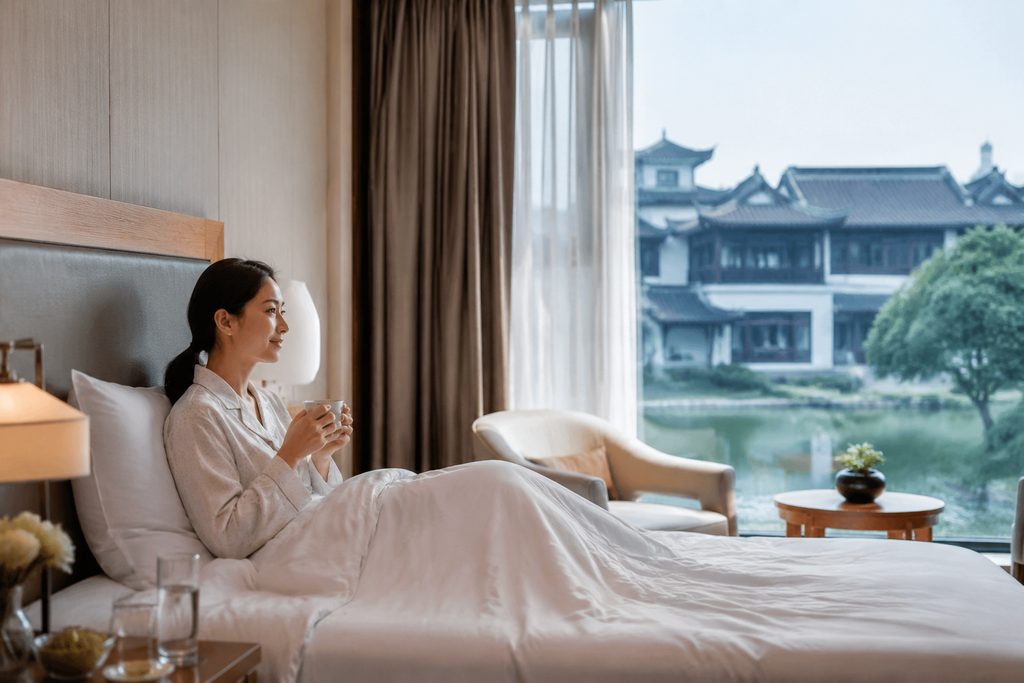
According to China’s National Health Commission, over 300,000 international patients arrived for inpatient care in 2023, a figure that has climbed steadily since border restrictions lifted. Most of those patients faced the same practical question after discharge: where do I recover? A hotel for medical treatment China is not a single building or a branded chain. It is a category of accommodation chosen deliberately for proximity to your hospital, access to follow-up care, and features that support healing — and booking one correctly changes the trajectory of your recovery.
Our team at China Medical Services has coordinated recovery stays across 37 cities, from Beijing’s Haidian district to Guangzhou’s Tianhe area. We have seen what works and what fails. This article explains the booking process honestly, including costs, safety questions, and the mistakes that cost patients time and money.
How This Actually Works, Step by Step
You do not simply open a booking site and pick a hotel near the hospital. The sequence that reliably produces a safe recovery stay looks different.
First, your medical team confirms your discharge date and any post-operative requirements. Do you need daily wound care? Will a nurse visit? How many follow-up appointments are scheduled, and at what intervals? These answers determine the hotel’s required proximity and room configuration.
Second, we identify hotels within a defined radius of your hospital — usually 10 to 20 minutes by car, sometimes less if you have mobility restrictions. We screen for elevators, wheelchair access, in-room refrigerators for medication, and front desks that accept international guests. Not every hotel in China is licensed to host foreigners, and this matters more than most patients expect.
Third, we confirm the booking with the hotel directly, not through a third-party aggregator. Direct confirmation allows us to negotiate extended-stay rates, request specific floors, and arrange early check-in if your discharge happens before noon. We also document the hotel’s policy on medical equipment — some properties restrict oxygen concentrators or mobility aids unless notified in advance.
Fourth, we coordinate with your hospital’s international department so that any home-care nurse or follow-up transport aligns with the hotel’s visitor policies. This step is where most independent bookings fall apart. Hotels do not automatically allow medical personnel into guest rooms.
How to Book Recovery Stay China: What You Are Actually Paying For
The phrase how to book recovery stay China implies a simple reservation. It is not. You are paying for four things, only one of which is the room.
The room rate is the visible cost. A standard international-grade hotel near a top-tier public hospital in Shanghai or Beijing runs $80 to $180 per night. Serviced apartments with kitchenettes cost $120 to $250 per night. But the room is the smallest component of a safe recovery arrangement.
You are also paying for location. A hotel 40 minutes from your hospital saves $30 a night and risks a $200 emergency taxi ride when a complication arises at 2 a.m. We calculate the real cost of distance, not the advertised rate.
The third component is coordination labor. Someone must call the hotel, explain your medical needs in Mandarin, confirm the room type, and handle the inevitable friction when the front desk does not understand why a nurse needs elevator access at odd hours. Our bilingual team handles this as part of the booking, not as an add-on.
The fourth component is contingency planning. What happens if your discharge is delayed by three days? What if the hotel overbooks? We maintain backup options within the same radius so a delay does not become a crisis.
A Realistic Timeline
Patients consistently underestimate how long the full sequence takes. Here is a realistic schedule based on our coordination experience.
| Stage | What Happens | Typical Duration |
|---|---|---|
| Medical records review | You send existing reports; hospital international department reviews them | 3–7 business days |
| Treatment plan confirmation | Hospital confirms procedure, expected length of stay, discharge criteria | 1–3 weeks, depending on specialist availability |
| Visa application | S2 visa with medical treatment annotation; hospital provides invitation documents | 1–4 weeks, varies by embassy |
| Hotel screening and booking | We shortlist properties, confirm medical-need accommodations, book directly | 5–10 business days |
| Arrival and admission | Airport transfer, hospital check-in, pre-operative tests | 2–5 days before surgery |
| Discharge to recovery hotel | Transfer arranged, hotel notified, follow-up schedule set | Same day as discharge |
Notice the waiting steps people forget: document translation, specialist appointment lead time, and visa processing. None of these can be compressed by paying more. They are institutional realities. We plan around them rather than promising to eliminate them.
What Can Go Wrong — and What Happens Then
Recovery stays fail in predictable ways. Understanding them is how you avoid them.
The most common failure is a hotel that refuses to allow a visiting nurse into the room. This happens more often than patients expect, particularly at properties that cater primarily to business travelers. When it occurs, our team contacts the hotel management directly, explains the medical necessity, and provides documentation from the hospital. If the hotel still refuses, we move the patient to one of our pre-vetted backup properties within the same radius. The cost difference is absorbed by us, not the patient.
Another failure mode is a delayed discharge. The hospital decides to keep you an extra two days for observation. Your hotel booking starts tonight. We rebook the check-in date and negotiate the rate extension. Because we book directly and maintain relationships with these properties, this rarely incurs a penalty.
Language friction is the third risk. A patient recovering alone cannot explain to a housekeeper that the bathroom needs sanitizing, or to the front desk that the air conditioning is aggravating a respiratory condition. Our bilingual companion remains reachable throughout the recovery stay, not just during hospital visits.
Medical Hotel Near Shanghai Hospital Price: What the Numbers Actually Look Like
Searchers often type medical hotel near Shanghai hospital price expecting a fixed figure. The honest answer is a range that depends on three variables: which hospital, which district, and what level of care you need.
Near Huashan Hospital in Jing’an district, international-standard hotel rooms start around $100 per night. Near Zhongshan Hospital in Xuhui, expect $90 to $150. Serviced apartments with a separate living area and kitchenette run $140 to $220. These are 2024-2025 reference ranges and shift with season and local events.
But the room rate is not the full cost. Add $300 per day for a bilingual medical companion if you need one during recovery. Add $200 round-trip for airport transfers. Add $100 to $300 for a video consultation if a question arises after discharge. The all-in cost of a two-week recovery stay near a Shanghai hospital typically lands between $2,500 and $5,000, excluding the procedure itself. Compare that to the United States, where a comparable recovery arrangement near a major medical center can exceed $15,000, and the value proposition becomes clear.
Ask the hotel directly: “Do you allow registered nurses to visit guest rooms?” and “Is your front desk staffed 24 hours with English-speaking personnel?” If the answer to either is no, keep looking.
Is It Safe to Recover in Hotel After Surgery China?
The question is it safe to recover in hotel after surgery China deserves a direct answer. It depends on the surgery, the hotel, and the support structure around you.
For minor procedures — laparoscopic surgeries, orthopedic arthroscopy, uncomplicated cardiac catheterization — a well-chosen hotel is generally safe, provided you have follow-up access and a way to reach your medical team quickly. For major open surgeries, the hospital will typically keep you inpatient until the risk of acute complications has passed. Discharge to a hotel occurs only after the medical team clears you.
The safety variables are concrete. Is the hotel within 20 minutes of the hospital? Does it have an elevator that accommodates a wheelchair? Is there a refrigerator for temperature-sensitive medication? Can the front desk call an ambulance and communicate your location in Mandarin? These are checkable facts. We verify each one before booking.
What a hotel cannot provide is medical monitoring. If your surgeon says you need daily wound checks, a hotel room alone is insufficient. You need a visiting nurse or a companion trained to observe and report. That service exists in China’s major medical cities, and we arrange it as part of the recovery stay when the hospital recommends it.
Practical Considerations: Documentation, Payment, and Follow-Up
Your recovery stay is not just a hotel reservation. It is a logistical node in a medical journey.
Bring your discharge summary in English and Chinese. Bring your medication list with generic names. Bring the hospital’s 24-hour international department phone number. These three documents solve most problems before they escalate.
Payment works differently in China than in the West. Most hotels require a deposit at check-in, refundable at checkout. International credit cards are accepted at international-grade properties but not universally. We advise patients to carry a backup payment method and to confirm card acceptance before arrival.
Insurance reimbursement is retrospective. Chinese public hospitals require prepayment for services; your insurer reimburses you after you submit claims. The same applies to hotel costs only if your policy covers medical travel lodging — most do not. Check your policy language before assuming recovery stay costs are recoverable.
Follow-up at home matters as much as the stay itself. Before you leave China, obtain a written summary from your surgeon: what was done, what medications continue, what symptoms warrant immediate attention, and when you can resume normal activity. This document is your bridge back to your home physician.
Can I Book Hotel with Nurse Care Beijing?
The search can I book hotel with nurse care Beijing reflects a common assumption: that hotels offer nursing as a standard amenity. They do not. What exists instead is a coordination layer.
In Beijing, near Peking Union Medical College Hospital or Fuwai Hospital, no hotel employs registered nurses for guest care. What we arrange is a visiting nurse from a licensed home-care agency, coordinated with the hotel’s management so the nurse can access your room. The nurse visits on a schedule — daily wound care, medication administration, vital sign monitoring — and reports to your surgical team if anything looks abnormal.
The cost of a visiting nurse in Beijing ranges from $80 to $150 per visit, depending on the complexity of care and the nurse’s qualifications. This is separate from the hotel rate and separate from our coordination fee. We disclose all of this before booking so there are no surprises.
Do not assume a hotel will accommodate medical equipment or visiting clinicians. Always confirm in writing before arrival. Verbal assurances from a booking site are not sufficient.
Frequently Asked Questions
It is a regular hotel chosen for specific medical criteria: proximity to your hospital, elevator access, refrigerator availability, 24-hour front desk, and willingness to host international guests with medical needs. There is no official “medical hotel” designation in China. The difference is in the screening and booking process, not the property type.
Room rates range from $90 to $220 per night depending on district and property class. Add companion services, transfers, and any visiting nurse care, and a two-week stay typically totals $2,500 to $5,000. Final costs vary by hospital location and case complexity.
For procedures where the hospital clears you for discharge, a properly vetted hotel within 20 minutes of the hospital is generally safe. The key variables are proximity, elevator access, 24-hour staffing, and a clear line to your medical team. A hotel cannot replace medical monitoring; if your surgeon requires daily checks, arrange a visiting nurse.
Hotels do not employ nurses. What you can arrange is a visiting nurse from a licensed home-care agency, coordinated with the hotel so the nurse can access your room. We arrange this when the hospital recommends it. Cost is $80 to $150 per visit, separate from the room rate.
Foreign patients use an S2 visa annotated for medical treatment. Accompanying family members also apply for S2. Stays exceeding 180 days require an S1 visa. The hospital provides supporting documents. The M visa is for commercial activities and is not appropriate for medical travel.
Your Next Step
Recovery is where medical outcomes are secured or lost. The hotel you choose, its distance from your hospital, and the support around you matter as much as the surgery itself. Our team at China Medical Services coordinates recovery stays across 37 cities, working with 340+ top-ranked hospitals. We do not perform medical procedures, and we do not promise outcomes. What we do is handle the logistics — hotel screening, nurse coordination, follow-up transport — so you can focus on healing. If you are planning treatment in China and want a recovery stay handled properly, start with a free consultation. We will ask about your procedure, your hospital, and your recovery needs, then tell you honestly what a safe stay looks like.
For more medical information and treatment options in China, visit chinamedservices.com (China Medical Services).
