Full Mouth Implants in Shanghai: Companion Service for International Patients
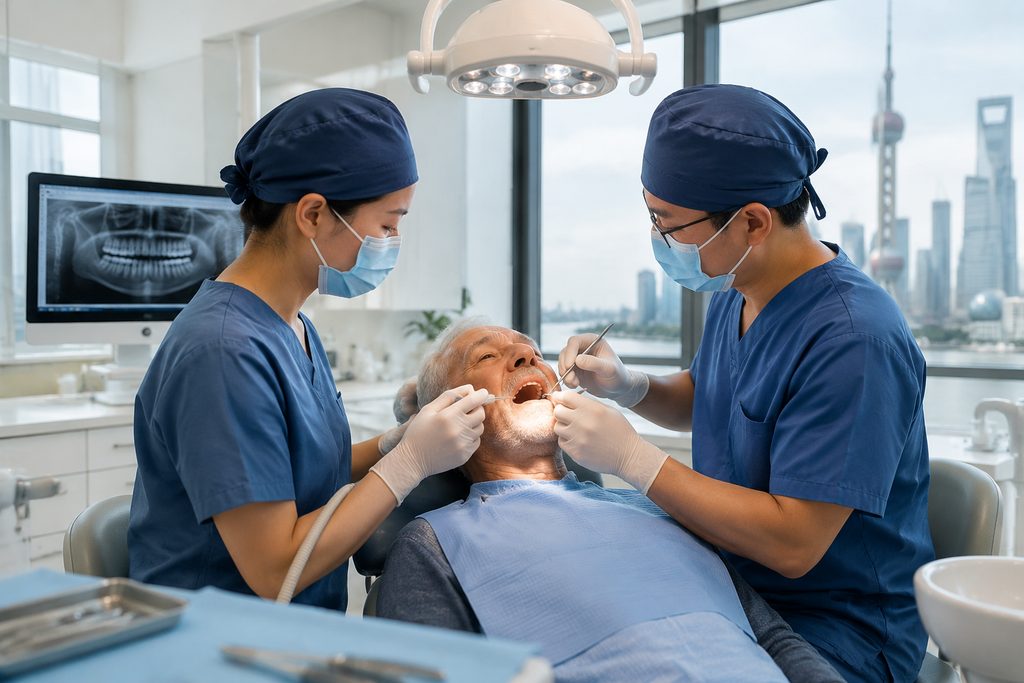
Have you ever wondered whether flying to another country for a complete dental rebuild could actually be safer and more predictable than doing it at home? That question drives a growing number of Western patients toward Shanghai every year. The full mouth dental implants cost Shanghai clinics quote — typically $12,000 to $25,000 — lands at roughly a quarter of what the same treatment commands in the United States or Australia. But price alone never tells the whole story.
What matters more is whether you can navigate the system once you land. That is where a companion service changes the experience. Our team at China Medical Services has watched this specific procedure evolve from a niche medical-tourism option into a structured, protocol-driven treatment path. The hospitals have matured. The implant systems are the same brands you would find in Zurich or Los Angeles. What remains difficult is the language barrier, the hospital registration process, and the follow-up coordination. We handle those pieces.
How This Actually Works, Step by Step
The sequence starts before you book a flight. You send us your existing dental records — panoramic X-rays, CBCT scans if you have them, any treatment plans from your home dentist. A Chinese oral and maxillofacial specialist reviews them. That review produces a written assessment: bone volume, sinus position, whether you need grafting, which implant system fits your case.
Then comes the cost estimate. Not a vague range — a line-item plan. Implant hardware, surgical fees, provisional prosthesis, final zirconia or titanium bridge. You compare that against what your home clinic quoted. Most patients decide within two weeks of receiving the plan.
After you agree, we coordinate the hospital appointment. Public hospitals in Shanghai require in-person registration for outpatient visits — you cannot fully book surgery from overseas through the standard channel. But the international departments at major teaching hospitals operate differently. They accept pre-arranged consultations with English-speaking coordinators. That is the route we use.
You fly in. A bilingual medical companion meets you at the hospital entrance, handles registration, translates every conversation with the surgeon, and stays with you through imaging and the treatment-plan discussion. Surgery typically happens on the second or third visit, not the first. The surgeon wants to examine you in person before committing to a surgical date.
After surgery, the companion coordinates your follow-up appointments, medication instructions, and the temporary prosthesis fitting. If you need a second trip for the final bridge placement — common with traditional full-arch protocols — we arrange that too. Some patients opt for same-day loading protocols like All-on-4, which reduces the total time in Shanghai to about two weeks.
What Full Mouth Restoration in Shanghai Actually Involves
Let us be precise about what “full mouth restoration” means in a Shanghai hospital context. You are not getting 28 individual implants. No reputable surgeon does that. The standard protocols are either All-on-4 (four implants per arch supporting a fixed bridge) or All-on-6 (six implants per arch for cases with adequate bone). Some patients with severe bone loss require zygomatic implants — longer fixtures anchored in the cheekbone — and Shanghai has several surgeons who perform this routinely.
The question patients type into search engines — what is full mouth restoration like in China — deserves a straight answer. The clinical steps mirror what you would experience in any advanced dental center. CBCT imaging. Digital surgical guides. Implant placement under local anesthesia or sedation. A provisional fixed bridge within 24 to 72 hours in immediate-loading cases. Final prosthesis after osseointegration, typically three to six months later.
What differs is the operational environment. Chinese top-tier hospitals run on volume. A single oral surgery department might place 50 implants in a day. That volume produces experienced surgeons — the lead implantologist at a major Shanghai hospital may have placed more than 10,000 implants over a career. It also means the system moves fast. You will not wait three weeks for a CBCT scan. You will get it the same day.
But volume cuts both ways. A busy public hospital will not hold your hand. Nurses may not speak English. Payment windows are crowded. Instructions come in Chinese. Without a companion, a straightforward process becomes exhausting. With one, you focus on healing.
A Realistic Timeline
Here is what the calendar actually looks like for an international patient pursuing full mouth implants in Shanghai. These ranges reflect what we see in practice, not optimistic best-case scenarios.
| Stage | Duration | What Happens |
|---|---|---|
| Remote evaluation | 5–10 days | You send records; Chinese specialist reviews; written plan and estimate returned |
| S2 visa application | 1–3 weeks | Hospital issues invitation letter; you apply at Chinese embassy or consulate |
| Arrival and first consultation | Day 1–2 | In-person exam, CBCT, surgical planning discussion with implantologist |
| Surgery | Day 3–7 | Implant placement; possible extractions and bone grafting in same session |
| Provisional prosthesis | Day 4–10 | Fixed temporary bridge fitted (immediate-loading protocols) |
| Recovery and follow-up | Week 2–3 | Suture removal, healing checks, adjustment of provisional bridge |
| Final prosthesis | Month 3–6 | Either return to Shanghai or complete at a partner clinic in your home country |
The piece most people forget is document translation. Your home dental records, if they are not in English or Chinese, need certified translation before the Chinese specialist can review them. That adds three to five days on the front end. The S2 visa also requires a formal invitation document from the hospital — something we obtain on your behalf once the treatment plan is confirmed.
And one more thing. Some patients assume they can fly in, have surgery, and fly home in seven days. That works for single-arch immediate loading. For full mouth restoration with extensive grafting, plan on two to three weeks in Shanghai for the surgical phase. Rushing this timeline leads to complications.
What Can Go Wrong — and What Happens Then
Implant surgery fails sometimes. Any clinic that claims otherwise is lying to you. The honest failure modes for full mouth implants include early implant failure (the fixture does not integrate), peri-implantitis (infection around the implant), provisional bridge fracture, and nerve injury causing temporary or permanent numbness in the lower lip or chin.
What is the recourse in Shanghai? Early implant failure — which occurs in roughly 2–5% of cases depending on patient health and bone quality — is typically addressed by removing the failed fixture, allowing the site to heal, and placing a new implant at no additional surgical fee. Most Shanghai hospital contracts specify this. Peri-implantitis is managed with debridement and, in advanced cases, implant removal. Nerve injury requires honest evaluation: most cases resolve within weeks to months, but permanent alteration is possible and should be disclosed before surgery.
What if you fly home and the provisional bridge cracks? This happens. Chewing hard foods too early, grinding at night, or a poorly balanced occlusion can fracture the acrylic provisional. The fix is usually straightforward — a dental lab near you can repair or replace the provisional while you wait for the final prosthesis. We maintain contact with partner clinics in several Western countries for exactly this scenario. But understand: the final prosthesis responsibility lies with the Shanghai clinic if you return, or with a local dentist if you transfer care. Get that in writing before you leave.
And the biggest risk for international patients is not clinical. It is coordination failure. Missed appointments because of address confusion. Wrong floor in a 20-story hospital building. A prescription you cannot read. These are the problems that turn a successful surgery into a miserable experience. They are also the problems a companion service eliminates.
How to Evaluate a Shanghai Implant Clinic Before You Commit
You cannot assess a clinic by its website. Chinese hospital marketing is notoriously polished and occasionally misleading. Here is what we tell patients to check instead.
First, verify the surgeon’s credentials through the hospital’s official international department, not through a third-party agent. The surgeon should hold a specialist registration in oral and maxillofacial surgery or implantology. Ask how many full-arch cases they complete per year. A surgeon doing fewer than 50 full-arch restorations annually is not the one you want for a complex case.
Second, confirm the implant system. Stick with major brands: Straumann, Nobel Biocare, Astra Tech, or Osstem. These systems have global warranty coverage. If the clinic quotes a price that seems too low, ask which implant brand is included. No-name implant systems from small Chinese manufacturers cost less but have thinner clinical track records and limited international support.
Third, understand the lab. The final prosthesis quality depends heavily on the dental laboratory. Shanghai’s top labs use CAD/CAM milling and work with zirconia or titanium frameworks. Ask where the lab is located and whether the technician will be present at the try-in appointment. A good lab technician is worth more than a charismatic surgeon when it comes to the final bridge fit.
Fourth, get the warranty in writing. What happens if an implant fails in year one? Year five? Reputable Shanghai hospitals offer 5-year warranties on implants and 2-year warranties on the prosthetic bridge. If the clinic hesitates to put warranty terms in the contract, walk away.
The question is dental work safe in Shanghai for tourists deserves a measured answer. The clinical standards at top-tier hospital dental departments are comparable to Western teaching hospitals. Infection control protocols follow national standards that are enforced through regular inspections. The implant brands are the same. What is less safe is walking into an unvetted clinic through a random online ad. That is true in any country. The vetting is the point.
Practical Considerations: Costs, Visas, Payment, and Follow-Up at Home
Let us put numbers on the table. The all on 4 implants price China clinics advertise typically ranges from $8,000 to $15,000 per arch, depending on whether grafting is included and which prosthetic material you choose. Full mouth (both arches) lands between $12,000 and $25,000. Compare that to the United States, where full mouth restoration commonly runs $45,000 to $80,000. The savings are real. But they are not the only consideration.
Price anchor: When a Shanghai clinic quotes you a full mouth implant package, ask whether the price includes the CBCT scan, surgical guide fabrication, provisional bridge, final prosthesis, and all follow-up visits within 12 months. Many advertised prices exclude the final bridge — the single most expensive component.
Visa category matters. Foreigners seeking medical treatment in China apply for an S2 visa with the treatment purpose annotated. Your accompanying family member also applies for an S2. The hospital’s international department issues an invitation letter that supports the application. Processing times vary by country — allow three weeks. Do not book non-refundable flights before the visa is in your passport.
Payment is straightforward. Chinese hospitals require prepayment for major procedures. International departments accept wire transfers and major credit cards. Some private international clinics in Shanghai — such as Jiahui or United Family — bill directly to certain international insurers. Public hospital international departments generally do not. You pay upfront and seek reimbursement from your insurer afterward. Check your policy’s out-of-network coverage for dental procedures performed abroad; most standard policies exclude elective dental work entirely.
Language is the wildcard. Even in international departments, the surgical team may speak limited English. The nurses almost certainly will not. A bilingual companion bridges that gap for every interaction — registration, pre-op instructions, post-op medication schedules, dietary restrictions, and emergency contacts. Our companions are not interpreters standing in the corner. They are active coordinators who know the hospital layout, the payment windows, the pharmacy locations, and the unwritten rules of Chinese hospital culture.
Follow-up at home requires planning. If you choose a delayed-loading protocol, you need a local dentist willing to monitor the implants during the osseointegration period. Some Western dentists are reluctant to touch work done in China. We recommend identifying a follow-up dentist before you travel, sharing the Shanghai treatment plan with them, and getting their agreement in advance. Alternatively, you return to Shanghai for the final prosthesis — a shorter trip, since the surgical phase is complete.
Frequently Asked Questions
For both arches using a standard All-on-4 or All-on-6 protocol with a fixed zirconia bridge, expect $12,000 to $25,000. The range reflects bone grafting needs, implant brand, prosthetic material, and whether you use a public hospital international department or a private clinic. Always confirm what the quoted price includes before comparing.
Shanghai Ninth People’s Hospital (Shanghai Jiao Tong University School of Medicine) runs one of China’s most respected oral and maxillofacial surgery departments, with a dedicated implantology center. For English-first service and direct insurance billing, private options like Jiahui International Hospital and United Family Shanghai offer strong implant programs. The best choice depends on your case complexity and whether you prioritize clinical volume or service environment.
You can pre-arrange the consultation and reserve a surgical window through the hospital’s international department, but no reputable surgeon will perform surgery without an in-person examination first. The package — implants, surgery, prosthesis — gets finalized after that first visit. What you can do remotely is submit records, receive a preliminary plan, and confirm the surgeon’s availability.
At top-tier hospital dental departments and accredited private clinics, yes. Infection control standards are enforced, implant systems are international brands, and surgical volume is high. The risk lies in unvetted clinics and uncertified practitioners — the same risk you would face anywhere. Proper vetting through a service that knows the hospital landscape removes most of that exposure.
For the surgical phase with immediate-loading provisional bridges, plan on two to three weeks. If you need extensive grafting or choose a delayed-loading protocol, you will return three to six months later for the final prosthesis — that second trip can be as short as five to seven days.
Your Next Step
Full mouth implants in Shanghai are not a shortcut. They are a considered decision that trades the convenience of home treatment for substantial savings and access to high-volume surgical expertise. The clinical outcome depends on choosing the right surgeon and clinic — and the experience depends on having someone who speaks the language, knows the system, and stays with you through every step.
Our team at China Medical Services coordinates remote evaluations, hospital appointments, S2 visa documentation, and bilingual companion support for international patients pursuing dental treatment in Shanghai. We do not perform surgery, and we do not promise outcomes. What we do is make the process navigable. If you are weighing full mouth restoration and want a clear-eyed assessment of your options, request a free consultation — send your records, get a specialist review, and decide with real information in hand.
That is the whole point. Informed patients make better decisions. And better decisions lead to better outcomes — in Shanghai or anywhere else.
For more medical information and treatment options in China, visit chinamedservices.com (China Medical Services).
