Implant Maintenance in China: Our Long-Term Follow-Up Companion Service
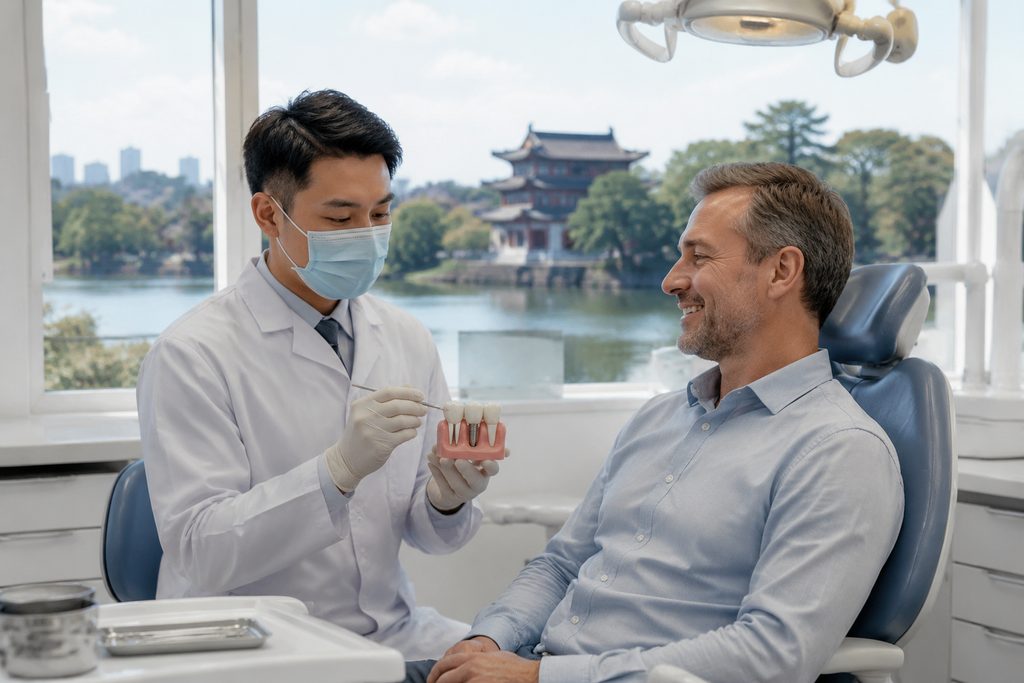
You have probably heard that getting dental implants abroad means you are on your own once you fly home. That is not quite true. A growing number of international patients are discovering that dental implant maintenance cost China is a fraction of what they would pay in the United States or Europe, while the clinical follow-up is just as rigorous. The real challenge is not the dentistry. It is the logistics: knowing where to go, what to ask, and how often to return. That is where a structured follow-up companion service changes the entire equation.
Key Takeaways
- Dental implants have a long-term survival rate above 95% at 10 years, but only with consistent professional maintenance.
- Routine implant maintenance in China typically costs $50–150 per visit, compared to $200–500 in the US or UK.
- Peri-implantitis affects approximately 20% of patients at 5–10 years if no structured recall system exists.
- Language barriers and unfamiliar hospital systems are the biggest obstacles for foreign patients seeking follow-up care in China.
The Problem: Implants Fail Silently Without Long-Term Follow-Up
Dental implants are not a set-and-forget solution. A 2023 systematic review published in the Journal of Clinical Periodontology found that the prevalence of peri-implant mucositis reaches 46.8% at the patient level, while peri-implantitis affects 19.8% of patients. These conditions develop slowly. No pain. No obvious warning signs in the early stages. By the time a patient notices bleeding, swelling, or mobility, the bone loss may already be significant.
For international patients, the problem compounds quickly. You had the implant placed in Shanghai or Beijing. You flew home to London, Dubai, or Sydney. Your local dentist may not have the original surgical records. The implant system might be a brand they rarely work with. And the recall schedule — how often should dental implants be checked? — may differ from what your Chinese surgeon recommended. Records get lost. Advice conflicts. Follow-up appointments slip.
Without a structured maintenance plan, even a perfectly placed implant can fail. Bone loss around an implant is often irreversible. The cost of removing a failed implant and starting over is three to five times higher than the cost of routine maintenance. Ignoring follow-up is the most expensive decision a patient can make.
Why Long-Term Follow-Up in China Delivers Better Value
Clinical Volume Means More Implant Experience
Top Chinese dental hospitals and specialized implant centers handle volumes that most Western clinics never approach. A single department at a major Shanghai teaching hospital may place 3,000–5,000 implants per year. A busy private implant clinic in Beijing might see 60–80 maintenance patients per week. That scale matters. Clinicians who see hundreds of peri-implantitis cases annually develop pattern recognition that a general dentist seeing ten implant patients a year simply cannot match.
For patients asking how often should dental implants be checked, the answer from Chinese specialists is typically every 6 months for the first two years, then annually. But the real value is having a clinician who knows what to look for at each interval — probing depths, bleeding on probing, radiographic bone levels, occlusal changes. High-volume centers do this as routine, not as an exception.
Cost Structure: Lower Prices Without Lower Standards
The dental implant maintenance cost China reflects structural economics, not discount dentistry. A standard maintenance visit — including professional cleaning around the implant, periodontal probing, and a periapical radiograph — typically runs $50–150 at a top-tier public hospital or reputable private clinic. The same visit in the United States averages $200–500. In the UK, £150–300. In Australia, AUD $250–450.
Why the gap? Lower labor costs for hygienists and assistants. Efficient patient flow in high-volume departments. Lower malpractice insurance premiums. And a healthcare system where public hospital pricing is regulated. None of these factors reduce clinical quality. The implant systems used in China — Straumann, Nobel Biocare, Osstem, Dentium — are the same global brands used in Europe and North America.
| Maintenance Service | China (USD) | United States (USD) | United Kingdom (USD) |
|---|---|---|---|
| Routine implant check + cleaning | $50–150 | $200–500 | $180–380 |
| Periapical X-ray (single implant) | $10–30 | $40–100 | $35–80 |
| Peri-implantitis debridement (per implant) | $100–250 | $400–900 | $350–750 |
| Implant crown replacement | $300–800 | $1,200–2,500 | $1,000–2,000 |
Figures are approximate ranges and vary by hospital tier, city, and case complexity.
Continuity of Records and Treatment Philosophy
When you return to the same hospital or clinic network that placed your implant, the original surgeon or their department can review your baseline radiographs, surgical notes, and abutment specifications. That continuity matters. A new clinician seeing you for the first time lacks that baseline. They may not know whether the marginal bone level has changed by 0.5 mm or 2 mm. They may not know the torque value used on the abutment screw. Returning to the source of your treatment closes those information gaps.
What a Structured Maintenance Visit Actually Looks Like
A proper implant maintenance appointment is not a quick polish. It is a systematic evaluation. Here is what a patient should expect at a reputable Chinese implant center:
- Medical history update: Any new medications, systemic conditions, or smoking status changes. Diabetes control and bisphosphonate use are particularly relevant.
- Soft tissue assessment: Probing depths around the implant, bleeding on probing, suppuration, and keratinized tissue width.
- Radiographic evaluation: A periapical X-ray to measure marginal bone levels against baseline. Cone-beam CT is reserved for suspected pathology.
- Mechanical evaluation: Abutment screw torque check, crown integrity, occlusion analysis, and wear patterns on opposing teeth.
- Professional debridement: Specialized instruments — titanium or plastic scalers, not stainless steel — to remove biofilm without scratching the implant surface.
- Oral hygiene instruction: Specific techniques for cleaning around the implant, including interdental brushes, water flossers, and antimicrobial rinses where indicated.
For patients wondering can I get my dental implant checked while traveling, the answer is yes — and in China, the process is often faster than at home. Same-day or next-day appointments are common at private international dental clinics. Public hospital departments may require a few days’ notice, but walk-in availability exists at many centers.
Choosing Where to Go: What Actually Matters for Implant Aftercare
Searching for the best dental clinic in Shanghai for implant aftercare leads down a rabbit hole of marketing claims. Strip away the noise and focus on four concrete criteria.
First, look at the implant system. If your implant is a Straumann or Nobel Biocare, confirm the clinic stocks the corresponding prosthetic components and drivers. This is non-negotiable. A clinic that does not stock your system cannot properly remove or retorque your abutment screw.
Second, check the clinician’s implant-specific training. General dentists can perform basic maintenance. But if you have any signs of peri-implantitis, you want a periodontist or an implantologist with specific training in surgical management. Ask directly: how many peri-implantitis cases do you treat per month?
Third, verify the diagnostic equipment. The clinic should have digital periapical radiography at minimum. For complex cases — suspected implant fracture, nerve proximity, or significant bone loss — access to cone-beam CT is essential. Most top-tier Chinese dental hospitals have this equipment on-site.
Fourth, assess the language support. If you do not speak Mandarin, a clinic with English-speaking staff or a bilingual medical companion is not a luxury. It is a safety requirement. Misunderstanding a post-operative instruction or a medication regimen can have real consequences.
For patients comparing options across cities, the dental and stomatology department rankings provide a useful starting point. Shanghai and Beijing dominate the top tiers, but excellent implant centers exist in Guangzhou, Chengdu, and Hangzhou as well.
Implant Warranty and Guarantees: What International Patients Should Know
Many patients ask about implant warranty international patients China before committing to follow-up care. The honest answer is nuanced. Most implant manufacturers — Straumann, Nobel Biocare, Dentsply Sirona — offer global warranties on the implant fixture itself, typically 10 years to lifetime, provided the implant was placed by a certified clinician and the patient attends recommended maintenance visits. The warranty covers the fixture, not the crown or the clinical work.
What that means in practice: if your implant fixture fractures due to a manufacturing defect, the manufacturer will replace the fixture. But the surgical and restorative fees to remove the failed fixture and place the new one are not covered. That is the clinician’s responsibility, and policies vary widely.
Some Chinese implant centers offer their own clinical guarantees — typically 5–10 years on the implant and crown, conditional on annual maintenance visits at that center. Read the fine print. A guarantee that requires you to return to the same clinic annually is effectively a maintenance contract. That is not a bad thing. It is a structured way to ensure you actually get the follow-up care your implant needs.
Practical tip: Before leaving China after implant placement, request a written maintenance protocol from your surgeon. It should specify recommended recall intervals, the implant system and component codes, baseline radiographs, and contact information for the department. This document becomes your roadmap for any future care, in China or at home.
Practical Considerations: Records, Visas, and Payment for Follow-Up Visits
Returning to China for implant maintenance involves more than booking a dental appointment. Here is what you need to handle.
Medical records. Bring your original implant passport, surgical records, and baseline radiographs. If you had the implant placed at a different Chinese hospital, request a records transfer or bring physical copies. Chinese hospitals do not automatically share records across institutions.
Visa. For medical follow-up visits, the S2 visa is the appropriate category. It covers short-term private affairs including medical treatment. The hospital or clinic can provide a supporting letter confirming your appointment. Processing times vary by embassy, so apply at least 4–6 weeks before your planned visit. Do not apply for an M visa — that is for commercial and trade activities, not medical care.
Payment. Public hospitals in China require upfront payment. International credit cards are accepted at most major hospitals and private clinics, but transaction limits can apply. Alipay and WeChat Pay are widely used, but international cards linked to these platforms sometimes face restrictions. Cash is always accepted. Private international clinics often accept direct insurance billing; public hospitals typically require you to pay first and claim reimbursement later.
Language. Even at top-tier hospitals, front-desk staff may have limited English. Registration, payment, and radiology departments are the most common friction points. A bilingual companion who knows the hospital layout and processes can compress a half-day of confusion into a 90-minute visit.
Frequently Asked Questions
Most implant specialists recommend a professional check every 6 months for the first two years after placement, then annually thereafter. Patients with a history of periodontitis, smokers, or those with diabetes may need more frequent recalls — typically every 3–4 months. Your individual risk profile determines the right interval.
Expect to pay $50–150 for a routine maintenance visit at a reputable clinic or public hospital. If peri-implantitis treatment is needed, costs rise to $100–250 per implant for non-surgical debridement. Surgical intervention, including bone grafting, ranges from $500–1,500 depending on complexity. These are cash prices; insurance reimbursement depends on your home policy.
Yes, but the evaluation will be less precise. Without baseline radiographs and the implant system details, the clinician can assess current health but cannot measure bone loss over time. If you have the implant passport or can contact your original clinic to send records, do that before your appointment. Digital records can often be transferred within 24–48 hours.
Implant failure is uncommon — the 10-year survival rate exceeds 95% — but it does happen. If the fixture must be removed, the same Chinese center can typically perform explantation, site grafting, and replacement after a healing period of 3–6 months. The total cost for removal and replacement is typically 50–70% of the original implant cost, depending on whether grafting is needed.
It depends on your travel patterns. If you visit China once or twice a year for business or family, aligning your implant check with those trips is practical. If you have no other reason to travel, the cost of flights and accommodation may outweigh the savings on maintenance. In that case, a hybrid approach works: annual checks in China when possible, and a written protocol that your local dentist can follow in between.
Your Next Step
An implant is a 20-year commitment, not a one-time purchase. The maintenance plan you choose matters as much as the surgeon who placed the fixture. If you are considering follow-up care in China — or if you had implants placed here and need a structured recall plan — we can help you navigate the system. China Medical Services connects international patients with top-tier Chinese hospitals and provides bilingual companion support for dental visits, records coordination, and appointment logistics. We are not a hospital and we do not provide diagnoses — we are the bridge between you and the clinical expertise you need. Start with a free consultation to discuss your implant maintenance needs and how a structured follow-up plan could work for you.
For more medical information and treatment options in China, visit chinamedservices.com (China Medical Services).
