Is My Jaw Clicking Serious? When to Treat It and What It Costs in China
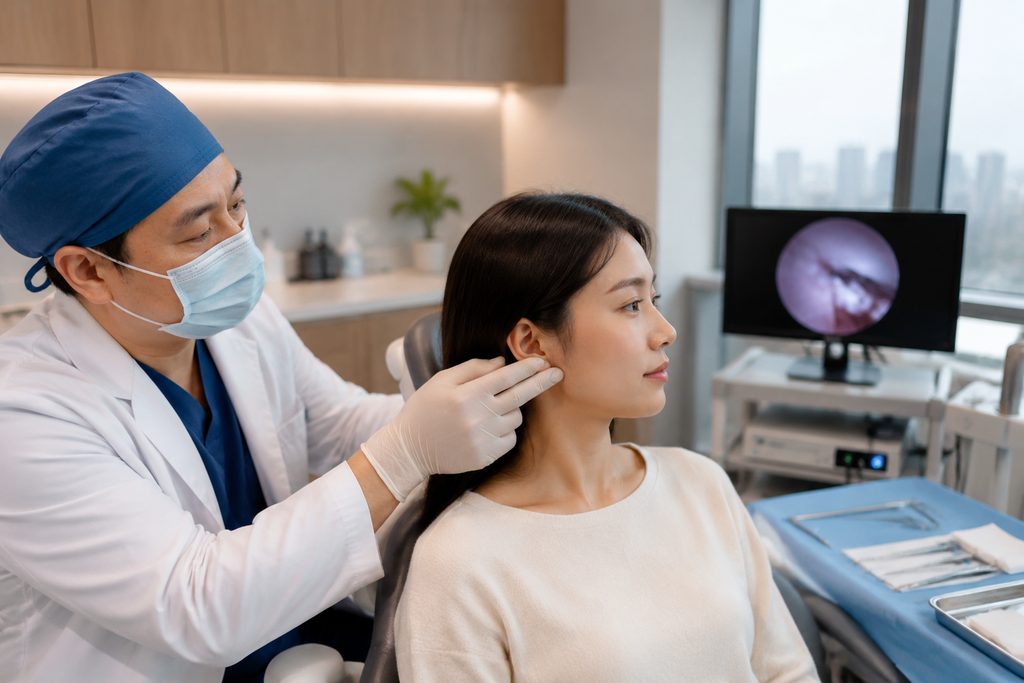
You’ve probably heard that a clicking jaw is just a harmless quirk, something to ignore until it goes away. The reality is more complicated. For roughly 1 in 12 adults, that click is the first audible sign of a temporomandibular joint (TMJ) disorder that can progress from an annoyance to chronic pain, limited mouth opening, and even joint degeneration. The question “is my jaw clicking serious” deserves a straight answer: it depends entirely on what accompanies the sound. A painless click with full range of motion is usually benign. A click with pain, locking, or grinding is a different story.
TMJ Treatment Cost China: The Short Answer
The short answer: a painless click alone rarely needs treatment. But if you also have pain, limited opening, or a jaw that locks, the click signals a structural problem worth evaluating. Conservative care in China — splint therapy, physical therapy, medication — typically runs from $500 to $3,000 total. Arthroscopic surgery, when genuinely necessary, ranges from $4,000 to $12,000 at top Chinese hospitals. That’s roughly one-fifth to one-third of US prices for comparable procedures.
The caveat: “clicking” is not one condition. It can mean a displaced disc that snaps back into place, a disc that stays displaced, arthritis, or hypermobility. Each has a different prognosis and a different price tag. So before you book anything, you need to know which type of click you have.
Who This Is Right For — and Who It Isn’t
Traveling to China for TMJ care makes sense for a specific profile of patient. It is not for everyone with a noisy jaw. Here’s who should consider it.
Good candidates for TMJ treatment in China:
- You have a confirmed diagnosis — via MRI or cone-beam CT — of internal derangement, disc displacement without reduction, or degenerative joint disease
- Conservative treatment at home (splint, physiotherapy, medication) has failed after 3–6 months of consistent effort
- You’ve been quoted $20,000+ for arthroscopy or open joint surgery in the US, UK, or Australia
- You need a second opinion from a high-volume oral and maxillofacial surgery department
- Your condition is stable enough for international travel and you can commit to 2–4 weeks in China for surgery plus initial follow-up
Who should NOT pursue this:
- Painless clicking with full range of motion and no locking — this rarely requires any intervention, let alone international travel
- Acute trauma with suspected fracture — go to your nearest emergency department, not an airport
- Uncontrolled systemic conditions (rheumatoid arthritis flare, bleeding disorders, poorly managed diabetes) that complicate surgery
- Patients who have not yet tried a properly fitted occlusal splint and structured physical therapy for at least 10–12 weeks
- Anyone expecting a guaranteed cure — TMJ surgery has real failure rates, and no ethical surgeon promises otherwise
Being honest about who should stay home is what makes the rest of this guide credible. If you’re in that second list, treat locally first.
The Options, Compared
For a clicking jaw that actually needs treatment, you’re looking at a spectrum. The table below compares the genuine alternatives, with realistic cost ranges in China versus the United States. Prices vary by hospital tier, surgeon seniority, and case complexity.
| Treatment Option | Best For | China (USD) | USA (USD) | Recovery Time |
|---|---|---|---|---|
| Occlusal splint therapy | Clicking with muscle pain, bruxism, early disc displacement | $500–$1,500 | $1,500–$4,000 | 2–4 months nightly wear |
| Physical therapy + medication | Myofascial pain, mild disc displacement with reduction | $300–$1,200 | $1,000–$3,500 | 6–12 weeks |
| Arthrocentesis | Acute locked jaw, disc displacement without reduction | $1,500–$3,500 | $4,000–$9,000 | 1–2 weeks |
| TMJ arthroscopy | Adhesions, synovitis, persistent disc displacement | $4,000–$8,000 | $15,000–$30,000 | 2–4 weeks |
| Open joint surgery (disc repair/replacement) | Severe degeneration, ankylosis, failed arthroscopy | $6,000–$12,000 | $25,000–$50,000 | 6–12 weeks |
Which column suits you depends on where you are in the treatment ladder. If you haven’t worn a properly fitted splint yet, start there — it’s the cheapest and least invasive option on both sides of the Pacific. If you’ve already exhausted conservative care and a surgeon has confirmed structural damage on imaging, then arthroscopy or open surgery becomes a rational discussion. The China column matters most for patients in that second group, where the savings are measured in five figures, not hundreds.
How to Fix Clicking Jaw Without Surgery
Most clicking jaws never see an operating room. The majority of TMJ disorders — some studies suggest 80–90% — respond to conservative management. That’s true whether you’re treated in Chicago or Shanghai. So before you even think about jaw clicking surgery price Shanghai, understand what non-surgical care actually involves.
First, a properly fitted occlusal splint. Not the boil-and-bite kind from a pharmacy. A custom hard acrylic splint made from dental impressions, adjusted over multiple visits. It stabilizes the joint, reduces clenching forces, and in many cases eliminates the click entirely. Second, targeted physical therapy: jaw exercises, postural correction, manual therapy on the lateral pterygoid and masseter muscles. Third, behavioral changes — hard food avoidance, gum chewing cessation, stress management. Fourth, medication: NSAIDs for inflammation, muscle relaxants for acute spasms, low-dose tricyclic antidepressants for chronic pain syndromes.
But here’s what many patients don’t hear: conservative care fails when it’s applied inconsistently. A splint worn twice a week won’t fix anything. Physical therapy done for two weeks then abandoned won’t either. The patients who avoid surgery are the ones who treat conservative care like a prescription, not a suggestion, for a full 3–6 months. If you’ve genuinely done that and still click with pain or locking, then — and only then — does surgery enter the conversation.
Best TMJ Specialist Beijing Hospital: Where the Volume Is
China’s advantage in TMJ surgery isn’t a secret technology. It’s volume. The oral and maxillofacial surgery departments at major Chinese teaching hospitals see more TMJ cases in a month than many Western departments see in a year. That repetition produces surgeons who have performed thousands of arthroscopies and open joint procedures. For a condition where technical skill directly correlates with outcomes, that matters.
Beijing and Shanghai host the highest concentrations of this expertise. Peking University School of Stomatology, affiliated with one of China’s oldest dental institutions, runs a dedicated TMJ clinic with full imaging capabilities — MRI, CBCT, and arthrography under one roof. Shanghai Ninth People’s Hospital, affiliated with Shanghai Jiao Tong University, operates one of the largest oral and maxillofacial surgery departments in the country. Its TMJ unit handles complex disc displacements, ankylosis cases, and failed surgeries referred from other provinces. For patients searching for the best TMJ specialist Beijing hospital, these academic centers are the usual starting point. Our department rankings across 45 specialties can help you compare oral surgery programs side by side.
Private international hospitals in both cities — think United Family and Jiahui — offer English-speaking oral surgeons for initial consultations and conservative management. But for actual arthroscopy or open joint surgery, the public academic hospitals remain the standard. That’s where the surgical volume lives. The trade-off is language and process, which we’ll get to.
What It Costs: TMJ Treatment Cost China, Line by Line
Let’s break down what you’re actually paying for if you travel to China for TMJ care. These are 2026 reference ranges, and every figure varies by hospital and case complexity.
Initial consultation with a TMJ specialist at a public hospital international department: $50–$150. MRI of both TMJs (open and closed mouth views): $200–$400. Cone-beam CT if bone involvement is suspected: $150–$300. Custom occlusal splint: $500–$1,200 including fittings. Arthrocentesis (outpatient, local anesthesia): $1,500–$3,500 all-inclusive. TMJ arthroscopy (day surgery or one-night stay): $4,000–$8,000. Open joint surgery with disc repair: $6,000–$12,000 including 5–7 days of hospitalization.
What’s not included: international flights, accommodation, meals, visa fees, and any follow-up imaging after you return home. Budget $80–$200 per night for a decent hotel near a major Beijing or Shanghai hospital. Add $300–$600 for a bilingual medical companion if you’re navigating a public hospital without Chinese language skills — a service we provide, and one that most international patients find essential. For context on how these prices compare across the broader Chinese healthcare landscape, see our guide to top-ranked hospitals across 37 cities.
Also worth knowing: remote video consultations with a Chinese TMJ specialist cost $100–$300. A written second opinion from a top hospital runs $300–$500. If you later travel to China for treatment, any consultation fee is credited in full toward the on-the-ground coordination service. It’s a low-risk way to test whether Chinese surgeons agree with your home diagnosis before you commit to a flight.
Practical Considerations: Records, Visas, and Follow-Up
You cannot just show up at a Shanghai hospital with a clicking jaw and expect surgery the next week. Chinese public hospitals require in-person outpatient evaluation before any surgical booking. No exceptions. That means your trip has two phases: consultation and imaging first, then surgery scheduled days or weeks later. Some international patients do this in one extended stay of 3–4 weeks. Others make two shorter trips.
Records matter enormously. Bring every MRI, CT, and panoramic X-ray you’ve ever had, preferably on CD or USB in DICOM format. Bring written reports translated into English or Chinese. Bring a list of every treatment you’ve tried and for how long. Chinese surgeons are pragmatic — they want to see that conservative care genuinely failed before they operate. If you can’t document that history, expect to repeat some of it.
Visa: for medical treatment in China, the S2 visa is the applicable short-stay category, issued for private affairs including medical treatment. Bring a letter from the receiving hospital confirming your appointment, plus your medical records. Your accompanying family member applies for their own S2. Processing times vary by embassy, so start at least 6–8 weeks before your intended travel date. We provide guidance on documentation, but approval is always at the consulate’s discretion.
Payment: Chinese public hospitals require upfront payment or a deposit before surgery. Most international insurance plans reimburse after the fact — you pay first, claim later. Private international hospitals in Beijing and Shanghai often handle direct billing. Confirm this with your insurer before you travel. Follow-up after you return home is the weak point of any medical travel. You’ll need a local dentist or oral surgeon willing to see you for post-operative checks. Arrange that before you leave, not after.
Frequently Asked Questions
A click by itself, with no pain and full mouth opening, is usually not serious. It’s often a disc that slips forward and snaps back — annoying but stable. A click accompanied by pain, limited opening (under 35mm), locking, or a grinding sensation (crepitus) suggests structural damage. That combination warrants imaging and specialist evaluation. If the click suddenly stops and your jaw locks shut, that’s an acute disc displacement without reduction — treat it as urgent.
Not directly. Chinese public hospitals do not allow overseas patients to book surgery without an in-person outpatient consultation first. What you can do is arrange the consultation, imaging, and specialist review through a coordination service before you travel. If surgery is then recommended, scheduling happens on-site. Anyone promising you a locked-in surgery date before you’ve been seen by the surgeon is not describing how the system actually works.
TMJ surgery has a documented failure rate. Studies on arthroscopy report success rates of 70–90% depending on the specific diagnosis and how success is defined. Open joint surgery carries higher risks: nerve injury, infection, heterotopic bone formation, and persistent pain. A responsible surgeon will discuss these before operating. If surgery fails, revision options exist but are more complex and less predictable. This is exactly why conservative care should be genuinely exhausted first. No one should fly to another country for a surgery that might have been avoidable.
Prices are broadly similar between the two cities for public hospital international departments. Shanghai Ninth People’s Hospital and Beijing’s Peking University School of Stomatology both fall in the $4,000–$12,000 range for arthroscopy and open joint procedures. Shanghai sometimes runs slightly higher for private international hospitals due to demand. The bigger variable is your specific diagnosis and the surgeon’s seniority. A full professor with 20 years of TMJ surgery experience will charge more than a junior attending, in either city.
No. Chinese hospitals do not use the gatekeeper referral system common in the UK or some US insurance plans. You can book directly with a specialist’s outpatient clinic. The challenge is doing so from overseas without Chinese language skills or a local phone number. That’s where a coordination service earns its fee — registering you, creating a hospital medical card, booking the right department, and ensuring you actually see the specialist you came for rather than whoever is available that day.
Your Next Step
A clicking jaw is a signal, not a verdict. Most clicks resolve with disciplined conservative care. The minority that don’t need an honest conversation with a high-volume surgeon — and for many Western patients, the cost of that conversation in China is a fraction of what it would be at home. We help international patients navigate that process: hospital matching, appointment coordination, bilingual companions, and visa guidance. We are not a hospital, we do not diagnose, and we make no promises about surgical outcomes. What we do is make the system legible. If you have imaging and a history of failed conservative treatment, start with a free consultation. We’ll tell you honestly whether China makes sense for your specific case — even if the answer is no.
For more medical information and treatment options in China, visit chinamedservices.com (China Medical Services).
