Knee Replacement in China for Foreigners: Costs, Hospitals, and Companion Support
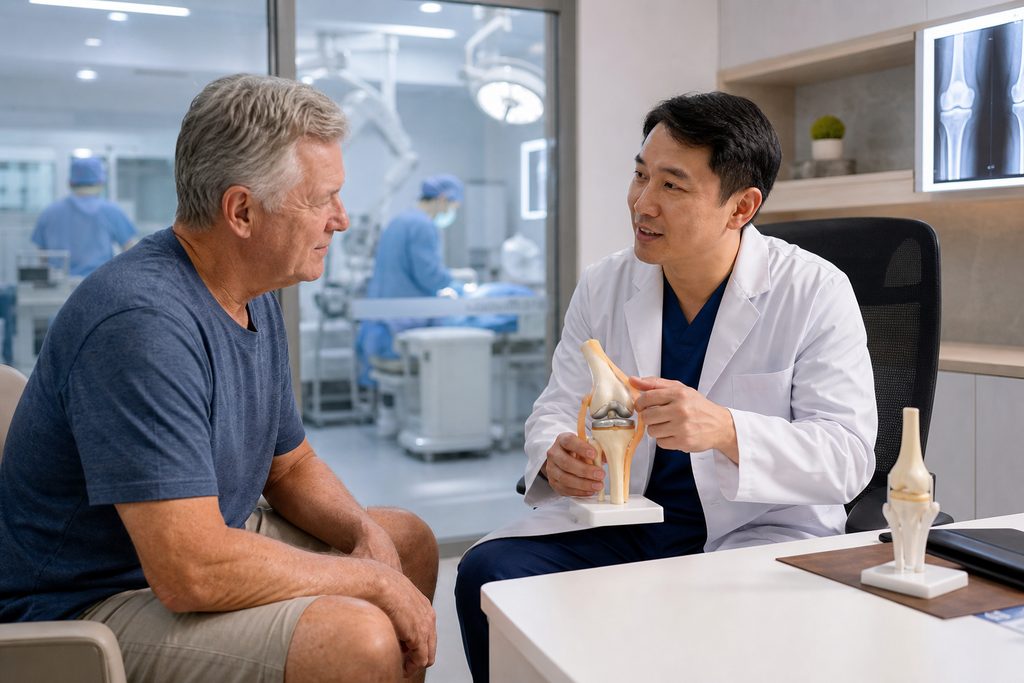
When 54-year-old Daniel from Manchester finally accepted that his right knee wasn’t going to heal itself, he did what most people do: he started Googling. The quotes he got from private UK hospitals made him wince. Then a colleague mentioned having a hip done in Bangkok. That sent him down a rabbit hole — and eventually to a search term he never thought he’d type: “knee replacement cost China for foreigners.” What he found surprised him. Not just the price difference, but the fact that someone could actually walk him through the whole thing in English, from the first MRI review to the airport pickup after discharge.
That’s where we come in. Our team at China Medical Services helps international patients navigate joint replacement surgery in China’s top hospitals. We’re not surgeons. We’re the people who make sure you never stand alone at a registration window in a sprawling Chinese hospital with a folder of records and no idea where to go.
How This Actually Works, Step by Step
The process starts long before you book a flight. You send us your existing records — X-rays, MRI reports, any surgeon’s notes from back home. Our team translates them into Chinese and submits them to the orthopedic department at hospitals that match your case. Within a few days, you get a written assessment: whether you’re a surgical candidate, what approach the Chinese team recommends, and a realistic price range.
Then you decide. Many patients start with a video consultation. You speak directly with the orthopedic specialist who would perform the surgery. You ask about implant types, surgical technique, rehab expectations. The consultation costs between $500 and $800 for a top specialist. If you later proceed with surgery in China, that fee is credited in full toward our on-the-ground coordination service.
Once you commit, we handle hospital registration, appointment scheduling, and admission paperwork. A bilingual medical companion meets you at the hospital on surgery day. They translate every conversation with nurses and doctors. They handle payment at the cashier. They make sure your family knows what’s happening at every step.
After discharge, the companion helps with follow-up appointments before you fly home. Your home physician receives a full summary in English.
Knee Replacement Cost China for Foreigners: What the Numbers Actually Look Like
Let’s be direct about money, because that’s usually the first question. A total knee replacement at a top-tier Chinese public hospital typically runs between $12,000 and $20,000 for international patients. That includes the implant, hospital stay, surgeon fees, and standard post-operative care. The same procedure in the United States averages $35,000 to $50,000. In the UK privately, you’re looking at £15,000 to £20,000. In Australia, around AUD $30,000.
What accounts for the gap? Lower labor costs, high surgical volume, and a hospital system built for scale. Chinese orthopedic surgeons at major centers perform several hundred knee replacements annually. Volume breeds competence. But the price difference doesn’t mean lower quality — many of these hospitals use the same implant brands you’d find in Europe or North America: Zimmer Biomet, Stryker, DePuy Synthes, Smith & Nephew.
| Procedure | China (International Patient) | United States | United Kingdom (Private) |
|---|---|---|---|
| Total Knee Replacement | $12,000 – $20,000 | $35,000 – $50,000 | £15,000 – £20,000 |
| Partial Knee Replacement | $10,000 – $16,000 | $25,000 – $40,000 | £12,000 – £17,000 |
| Bilateral Knee Replacement | $22,000 – $35,000 | $60,000 – $90,000 | £28,000 – £38,000 |
These figures vary by hospital and case complexity. A complex revision surgery costs more. A private international hospital in Shanghai charges more than a public hospital’s VIP wing. Always get a written quote before committing.
Best Hospital for Knee Surgery Shanghai: Where Patients Actually Go
Shanghai is the most common entry point for international orthopedic patients. The city has direct flights from most major hubs, strong English-language infrastructure, and several hospitals with dedicated international departments.
For knee replacement specifically, three names come up repeatedly. Shanghai Sixth People’s Hospital runs one of the highest-volume orthopedic departments in China. Its joint replacement team performs over 3,000 procedures annually. Zhongshan Hospital Fudan University offers a strong orthopedic program within a comprehensive academic medical center. And for patients who want a fully Western-style experience, Jiahui International Hospital provides English-speaking staff, JCI accreditation, and direct insurance billing — at a higher price point.
You can browse our full orthopedics department rankings to compare hospitals by specialty reputation. The Fudan rankings give you a starting point, but they don’t tell you which hospital fits your specific case. That’s what a consultation is for.
A Realistic Timeline
People underestimate how long the pre-surgery phase takes. Here’s what a typical knee replacement journey looks like for an international patient:
| Stage | What Happens | Duration |
|---|---|---|
| Week 1 | You send medical records; we translate and submit to hospitals | 5–7 days |
| Week 2 | Written second opinion or video consultation with orthopedic team | 3–7 days |
| Week 3–4 | Hospital confirms surgical indication; you decide and pay deposit | 1–2 weeks |
| Week 5–6 | S2 visa application with hospital invitation letter | 1–2 weeks |
| Week 7 | Arrival in China; pre-operative testing (blood work, ECG, chest X-ray) | 2–3 days |
| Week 8 | Surgery; hospital stay | 5–10 days |
| Month 3 | Walking independently; outpatient physiotherapy | — |
| Month 6 | Full return to most activities | — |
Document translation and visa processing are the two steps people forget to budget time for. Start the process at least eight weeks before you want to be on the operating table.
What Can Go Wrong — and What Happens Then
Let’s be honest about failure modes, because anyone who tells you medical travel is risk-free is selling something.
The hospital rejects your case. It happens. Maybe your BMI is too high, maybe your bone quality is poor, maybe your cardiac clearance isn’t sufficient. Chinese hospitals are selective about international patients because complications are harder to manage across borders. If one hospital says no, we submit to another. If two say no, we tell you straight: surgery in China isn’t right for you right now.
The surgery gets postponed. A pre-operative test flags an issue. Your blood pressure spikes on arrival. The surgeon’s schedule shifts. You might wait an extra week. Our companion helps you extend your visa and rebook accommodation. Annoying, but manageable.
You develop a complication. Infection rates for knee replacement in top Chinese hospitals run around 0.5% to 1%, comparable to international benchmarks. If something goes wrong, you’re already in the hospital that performed the surgery. The same team manages the complication. Your companion coordinates communication with your family and your insurer.
You hate being in a foreign hospital. Some patients underestimate the cultural adjustment. Chinese hospital food, shared wards in public hospitals, the sheer density of people. If this is a concern, choose a private international hospital or a VIP ward. You’ll pay more, but you’ll have a private room and Western food options.
No legitimate medical travel service can guarantee a specific surgical date or a specific surgeon. Anyone who promises that is lying. What we guarantee is that if we can’t secure the appointment we agreed on, you get a full refund of our coordination fee.
Is Knee Replacement Surgery Safe in China? What the Data Shows
This is the question every patient asks, and it deserves a straight answer. China performs more joint replacements than any country except the United States. The top 5% of Chinese hospitals — the ones in our database — operate at international standards. Many are JCI-accredited. Their orthopedic departments publish in peer-reviewed journals. Their infection rates and revision rates are tracked and reported.
But “China” is not one hospital. A county-level hospital in a third-tier city is not the same as Shanghai Sixth People’s Hospital. The safety question isn’t really “is China safe?” — it’s “is this specific hospital safe?” That’s why we only work with hospitals ranked in the Fudan top 100 or holding JCI accreditation. You can see the full list on our top hospitals page.
One more data point: Chinese orthopedic surgeons at high-volume centers perform 300 to 500 knee replacements per year. Studies consistently show that surgeon volume correlates with better outcomes. A surgeon who does 400 knees a year has seen every anatomical variation, every complication, every tricky case. That’s not marketing. That’s epidemiology.
How Long Is Knee Replacement Recovery Time? Planning Your Return Home
Recovery follows a predictable arc, but it’s not linear. Here’s what to expect:
Days 1–3: You’re in the hospital. Physiotherapists get you standing within 24 hours of surgery. Walking with a walker by day two or three. Pain is managed with a combination of nerve blocks and oral medication.
Days 4–10: You’re walking with a walker or cane. Stairs are introduced. You’re discharged once you can get in and out of bed independently, walk 50 meters, and manage stairs. Most international patients stay 7 to 10 days total.
Weeks 2–6: You’re home. Swelling decreases. You transition from walker to cane. You can fly long-haul by week 2 or 3, provided you move around the cabin and wear compression stockings. Your surgeon will clear you for flight.
Months 3–6: Most patients walk without aids. Range of motion approaches 120 degrees. You’re back to driving, light exercise, and daily life. Full recovery — including high-impact activity — takes 9 to 12 months.
The single biggest predictor of good recovery is physiotherapy adherence. Patients who do their exercises twice daily recover faster than those who don’t. Your Chinese hospital will give you a rehab protocol. Follow it.
Practical Considerations: Records, Visa, Payment, and Follow-Up
Before you book anything, gather these documents: recent knee X-rays (weight-bearing views), MRI report if you have one, a letter from your primary physician summarizing your medical history, and a list of current medications. If you’ve had prior knee surgery, include the operative report. Incomplete records cause delays.
For the visa: you’ll apply for an S2 visa, which covers short-term private affairs including medical treatment. The hospital issues an invitation letter confirming your scheduled treatment. Your companion — a spouse, sibling, or adult child — applies for their own S2 visa. Processing takes one to two weeks at most Chinese embassies. Requirements vary by country, so check with your local consulate before applying. We provide the hospital documentation; we don’t guarantee visa approval.
Payment is upfront. Chinese public hospitals require prepayment before surgery. International patients typically pay via bank transfer or credit card through the hospital’s international department. Private international hospitals may bill your insurer directly. If you have travel insurance or a policy that covers overseas treatment, start the pre-authorization process early. Most insurers require a treatment plan and cost estimate before approving.
Follow-up after you return home: your Chinese surgeon will want photos of your incision at week 2 and week 6 post-op. You’ll email them. Your home physician handles any long-term monitoring. If a complication arises, we can arrange a video consultation with the original surgical team.
Bring a family member or friend if you can. Recovery is easier with someone who knows your baseline. If you come alone, our companion service can arrange post-discharge nursing support in your hotel or serviced apartment.
Frequently Asked Questions
You can’t book a surgical date sight-unseen at a public hospital. Chinese law requires an in-person consultation before surgery. What you can do is complete the remote evaluation — records review, video consultation, surgical indication confirmation — before you travel. That way, when you arrive, the surgery is scheduled within days, not weeks. Some private international hospitals offer more structured packages, but even they require a pre-operative assessment on arrival.
It depends entirely on your policy. Some international health insurance plans cover treatment at JCI-accredited hospitals in China. Most domestic US or UK policies won’t. Check your policy for “overseas treatment” or “medical tourism” clauses. If your insurer requires pre-authorization, start that process the moment you decide on a hospital. We can provide itemized cost estimates and hospital documentation to support your claim.
Knee implants last 15 to 25 years in most patients. If you need a revision down the line, you can return to the same Chinese hospital or have it done at home. Your Chinese medical records will be provided in English, including implant type, size, and surgical technique. Any competent orthopedic surgeon can work from those records.
This is exactly what the companion service solves. Your bilingual medical companion is with you for every interaction — registration, consultations, pre-op testing, surgery day, discharge. They translate in real time. They also handle the non-medical logistics: pharmacy runs, meal orders, calling a taxi. For patients who choose a private international hospital, many staff speak English, but the companion is still useful for anything outside the hospital walls.
Potentially, yes — if you speak Chinese or have a Chinese-speaking family member. The hospital’s own fees don’t change. What you’d save is our coordination fee. What you’d lose is the translation, the hospital selection guidance, the appointment logistics, and someone who knows which window to go to and what to say. For most international patients, the fee is a fraction of the total trip cost and buys significant peace of mind.
Your Next Step
Knee replacement in China isn’t for everyone. It’s for patients who want high-volume surgical expertise at a fraction of Western prices, and who are willing to travel for it. It’s also for patients who value having a local partner handle the parts of the process that don’t involve a scalpel — the paperwork, the translation, the logistics.
Our team at China Medical Services coordinates the whole journey. We don’t perform surgery. We don’t promise outcomes. We connect you with hospitals that do the surgery well, and we make sure you understand every step before you commit. If you’re considering knee surgery abroad with companion service support, start with a free consultation. Send us your records. We’ll tell you honestly whether China is a good fit for your case.
That’s the whole pitch. No pressure. Just information, and a clear path forward if you want it.
For more medical information and treatment options in China, visit chinamedservices.com (China Medical Services).
