IVF Worth It in China: Our Service Reviews Your Fertility Case
IVF Worth It in China: The Short Answer
For many international patients, yes — IVF in China is worth it. The IVF cost China international patients typically pay ranges from $4,500 to $9,000 per standard cycle, compared with $15,000 to $30,000 in the United States and $8,000 to $14,000 in much of Western Europe. That is a 60–80% saving before travel costs. But the real question is not just price. It is whether you can navigate a system built primarily for Chinese-speaking citizens, and whether the clinic you choose actually delivers outcomes worth traveling for.
The honest caveat: cost savings mean nothing if you pick the wrong clinic or cannot communicate your medical history clearly. Chinese fertility medicine is advanced. The top reproductive centers in Beijing and Shanghai run some of the highest-volume IVF programs in the world. Volume matters in reproductive medicine. Clinics that perform thousands of cycles annually see complications earlier and refine protocols faster. But volume alone does not guarantee a good fit for a foreign patient. Language, documentation, and continuity of care after you fly home — those are the variables that decide whether the trip was worth it.
Who This Is Right For — and Who It Isn’t
IVF abroad is a serious undertaking. It involves multiple clinic visits, precise medication timing, and emotional resilience under unfamiliar conditions. Some patients are excellent candidates for doing this in China. Others should stay home.
Typically a good candidate:
- You have a confirmed diagnosis of infertility and have completed initial testing at home
- You are paying out of pocket and the price difference genuinely changes your options
- You are open to a structured, protocol-driven approach rather than highly individualized concierge care
- You can commit 3–4 weeks in China for one full cycle, or can arrange two shorter trips
- You have no medical contraindications that would make long-haul travel risky during ovarian stimulation
Should likely not pursue IVF in China:
- You have a complex medical history requiring frequent in-person consultations with a specialist who knows you personally
- You need donor eggs or donor sperm and are not prepared for the legal and ethical differences in gamete donation rules
- You are in an active mental health crisis or have severe anxiety about medical environments where you do not speak the language
- You have a condition that makes blood clot risk, ovarian hyperstimulation syndrome, or ectopic pregnancy particularly dangerous and you lack a clear emergency plan
- Your home country’s regulatory framework prohibits or does not recognize treatments performed abroad, which could complicate legal parentage
Being explicit about who should not go is not meant to discourage. It is meant to save you from a costly mistake. We would rather tell you to stay home than watch you fly across the world for a treatment that was never right for you.
The Options, Compared
When patients ask “is IVF worth it in China,” the answer depends on what you are comparing it against. Here is a realistic table of the main choices for international patients considering IVF abroad.
| Factor | China (Top Public/International Dept) | China (Private International Clinic) | United States | Thailand |
|---|---|---|---|---|
| Cost per standard cycle | $4,500–$7,000 | $7,000–$12,000 | $15,000–$30,000 | $8,000–$14,000 |
| English-speaking staff | Limited; translators often needed | Yes, standard | Yes | Yes, widely available |
| Annual cycle volume at top centers | 3,000–8,000+ | 500–1,500 | 500–2,500 | 1,000–3,000 |
| Wait time to start | 1–4 weeks | 1–2 weeks | 2–8 weeks | 1–3 weeks |
| Legal framework for foreigners | Permitted; documentation required | Permitted; streamlined | State-dependent | Permitted; well-established |
| Follow-up after returning home | Remote; limited | Remote; better | Local; excellent | Remote; variable |
Which column fits you? If budget is the dominant constraint and you are comfortable with structured protocols plus a translator, China’s top public hospital international departments deliver exceptional clinical volume at the lowest price. If you want English-speaking care from day one and direct insurance billing, a private international clinic in China — such as those listed on our private hospital directory — may suit you better, though the cost rises. The United States remains the best choice if you need continuity with a local team and cannot afford any communication friction. Thailand is a middle ground: more expensive than China, less expensive than the US, with a mature medical tourism infrastructure.
What “Our Service Reviews Your Fertility Case” Actually Means
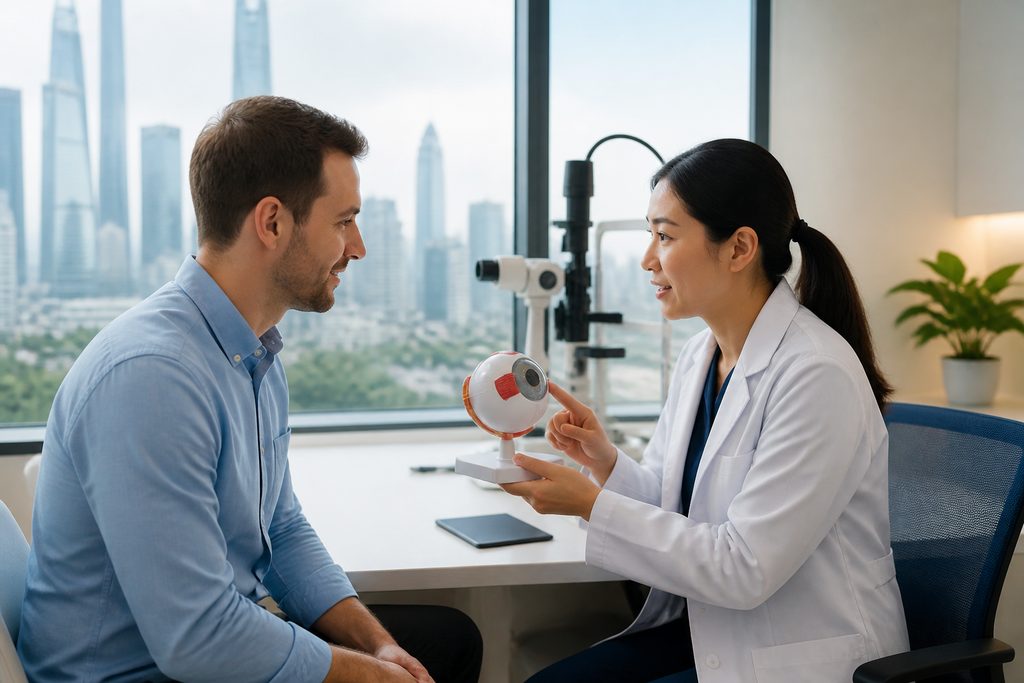
You searched for a review of your fertility case. Let us be precise about what that involves, because the phrase gets thrown around loosely. A meaningful case review is not a chatbot response. It is a structured evaluation of your medical records by a reproductive specialist, followed by a written or video summary that tells you whether IVF in China is a reasonable option for your specific situation.
What we facilitate is a written second opinion or a video consultation with a Chinese fertility team. You send your existing examination reports — hormone panels, semen analysis, ultrasound findings, previous IVF cycle records if any. The specialist reviews them. You receive written analysis, treatment suggestions, and a realistic assessment of your chances. This service costs from $300 to $800 depending on whether you choose a standard international department specialist or a top-tier expert. The fee is credited in full toward on-the-ground coordination if you later proceed with treatment in China within 90 days.
That credit mechanism matters. It means you are not paying twice. You pay once for the review, and if the review says “yes, there is a path,” that money counts toward the coordination that gets you into the clinic.
But a case review cannot promise a baby. No ethical service can. What it can do is tell you whether your age, ovarian reserve markers, and diagnosis fall within ranges where Chinese clinics routinely achieve results. It can flag red flags — like untreated uterine pathology or severe male factor — that would need addressing before you book a flight. And it can tell you, honestly, if your case is better served at home.
What It Costs and How Long It Takes
The headline figure — $4,500 to $9,000 per cycle — covers the clinical IVF procedure itself: ovarian stimulation medications, egg retrieval, laboratory fertilization, embryo culture, and embryo transfer. It does not cover pre-cycle testing, which may add $300 to $800. It does not cover intracytoplasmic sperm injection (ICSI) if male factor is present, which typically adds $500 to $1,000. Genetic testing of embryos (PGT-A), if recommended, adds $1,500 to $3,500 per batch. Frozen embryo storage costs $300 to $600 per year.
Travel costs are separate. Budget $2,000 to $4,000 for flights, accommodation, food, and local transport for a 3–4 week stay, depending on your origin and city. Shanghai and Beijing cost more than Chengdu or Hangzhou, but the top reproductive centers are concentrated in the major cities.
Timeframe for one full cycle:
- Week 1: Arrival, baseline ultrasound and bloodwork, medication starts
- Weeks 2–3: Monitoring every 2–3 days, medication adjustments
- Week 3: Egg retrieval (day surgery, local or light sedation)
- Days 3–5 after retrieval: Embryo transfer, or freeze-all if genetic testing is planned
- Week 4: Departure
- 10–14 days after transfer: Pregnancy test, which can be done at home
Some patients split this into two trips: one for stimulation and retrieval, one for transfer weeks or months later. That adds travel cost but reduces time away from work.
Practical Considerations: Records, Visa, Payment, and Follow-Up
You cannot walk into a top Chinese fertility clinic as a foreigner and expect to start treatment the same week. The system requires preparation.
Medical records. Chinese clinics require translated, notarized copies of your prior fertility workup. This includes blood tests, imaging reports, and any previous IVF records. Translation quality matters. A mistranslated hormone value or diagnosis can derail a protocol. Our team handles certified medical translation as part of case coordination.
Visa. Medical treatment in China falls under the S2 visa category, issued for short-term private affairs including medical treatment. The hospital must provide an invitation letter and treatment confirmation. Accompanying family members also apply for S2. Processing typically takes 1–3 weeks depending on your home country’s Chinese embassy or consulate. We guide you on exactly which documents the embassy will ask for, but we never guarantee approval — that decision rests solely with the visa officer.
Payment. Public hospitals in China require prepayment before each stage of treatment. International credit cards are accepted at most international departments, but some smaller clinics only take Chinese bank cards or cash. Private international clinics often accept major international insurance with direct billing. Check your policy carefully: most international health insurance plans exclude IVF entirely, and those that cover it usually require pre-authorization.
Follow-up after returning home. This is the weakest link in cross-border IVF. Once you leave China, your clinic cannot easily manage complications like ovarian hyperstimulation syndrome or early pregnancy concerns. You need a local gynecologist or fertility specialist at home who is willing to take over monitoring. Arrange this before you fly. Do not assume your home clinic will cooperate — some refuse to manage pregnancies initiated abroad. Ask first.
Do not book flights until your case review is complete and the clinic has confirmed in writing that they will accept you as a patient. Verbal assurances are not enough.
How to Choose a Fertility Clinic Abroad
This is the question underneath every other question. How do you actually choose? The answer is not “read reviews on Google.” Chinese clinics have limited presence on Western review platforms, and the reviews that do exist are often filtered or translated poorly. You need a different approach.
Start with the Fudan University hospital rankings. The reproductive medicine specialty list names the top 10 departments in China. Cross-reference those names with our specialty rankings directory, which organizes 45 specialties including reproductive medicine. Then look at three things: annual IVF cycle volume, the clinic’s published success rates for your age group, and whether the clinic has a dedicated international patient department.
Cycle volume is the single most underrated factor. A clinic performing 5,000 cycles a year has seen everything. Its lab runs constantly, its embryologists are fast, and its protocols are refined by sheer repetition. A clinic performing 300 cycles a year cannot match that depth, no matter how nice the waiting room is.
When you ask “best fertility clinic China reviews,” understand that no independent, verified review platform exists for Chinese fertility clinics in English. What exists is word of mouth, embassy referrals, and the experience of medical coordinators who work with these clinics daily. That is the gap our service fills. We know which clinics accept foreigners smoothly, which have English-speaking staff, and which are better suited to complex cases versus straightforward ones.
China IVF Success Rates for Foreigners
Here is a hard truth: no clinic in China publishes separate success rates for foreign patients. The data you see — and you should demand to see it — is aggregate data for all patients in your age group. The good news is that top Chinese centers report live birth rates per embryo transfer that are comparable to good Western clinics: roughly 40–55% for women under 35, 30–40% for ages 35–37, 20–30% for ages 38–40, and under 15% for ages 41–42. These figures vary by clinic and by whether genetic testing is used.
But success rates are not the whole story. A 45% live birth rate means nothing if the clinic will not accept your case because your ovarian reserve is too low. Chinese clinics, especially the top public ones, sometimes decline difficult cases to protect their published statistics. Private international clinics are more willing to take on complex patients, but at higher cost and with no guarantee of better outcomes. This is another reason why a case review before you travel is essential.
Booking an IVF Treatment Package in Shanghai
Shanghai has the highest concentration of top-tier fertility centers in China, including several ranked in the Fudan top 10 for reproductive medicine. If you want to book IVF treatment package Shanghai, the process typically works like this: you submit records, receive a case review, the clinic confirms acceptance, you sign a treatment agreement, pay a deposit, and receive a schedule. Packages often bundle the clinical cycle, basic medications, and monitoring visits into one price.
What packages rarely include: advanced genetic testing, ICSI, embryo freezing beyond the first year, and any treatment for complications. Read the fine print. Ask what happens if the cycle is cancelled midway — some clinics refund unused medication, others do not. Ask what happens if you do not produce enough eggs. Ask about their policy on transferring multiple embryos. Some Chinese clinics still transfer two embryos by default, which raises twin pregnancy rates and associated risks. You have the right to request single embryo transfer.
Before you book any package, ask the clinic to send you their standard treatment agreement in English. If they cannot or will not provide one, that is a red flag.
Frequently Asked Questions
At accredited top-tier hospitals, yes. The clinical standards at Fudan-ranked reproductive centers are high, and complication rates are comparable to Western benchmarks. The risks are not in the medicine. They are in communication gaps, documentation errors, and lack of local support if something goes wrong. A bilingual medical companion reduces those risks substantially, but no service can eliminate them entirely.
This depends entirely on your home country’s laws, not on China’s. China permits IVF for married heterosexual couples and, in some clinics, for single women, but the legal parentage of a child born from treatment abroad is determined by your own jurisdiction. Consult a family law attorney in your home country before starting treatment. Do not rely on clinic staff for legal advice.
Most IVF cycles do not result in a live birth on the first attempt. That is the statistical reality everywhere, not just in China. If your first cycle fails, you have two options: return for another cycle, or use frozen embryos if any remain. Frozen embryo transfer cycles cost significantly less — typically $1,500 to $3,000 — because no stimulation or retrieval is needed. Ask about cumulative live birth rates across multiple cycles, not just per-cycle rates.
China has strict regulations on gamete donation. Donor sperm is available at some licensed centers, but donor eggs are scarce and often restricted to Chinese citizens or have long waiting lists. If your case requires donor eggs, China may not be your best option. Spain, the Czech Republic, and the United States have more established donor egg programs, though at higher cost. Be honest about this in your case review.
No, but you need a plan for language. Top public hospital international departments have some English-speaking staff, but the level varies. Private international clinics in our private hospital directory generally provide full English service. If you choose a public hospital, a bilingual medical companion who attends appointments with you, translates medical instructions, and handles registration and payment is not a luxury — it is the difference between a manageable experience and a stressful one.
Your Next Step
IVF in China offers real savings and access to high-volume, experienced fertility centers. It is not the right choice for everyone, and the decision should never be made on price alone. The smart first step is a structured case review: send your records, get an honest assessment from a Chinese reproductive specialist
For more medical information and treatment options in China, visit chinamedservices.com (China Medical Services).
