International Patient Department in China: How We Arrange Your Care
While patients in Canada wait a median 28.6 weeks for orthopedic surgery, surgeons at Beijing Jishuitan Hospital routinely perform over 300 joint replacements per month — with clinical outcomes that match or exceed Western benchmarks. The gap between what Western systems can deliver and what Chinese top-tier hospitals actually do every day is real. But accessing that capacity from overseas is not a matter of booking a flight and walking in.
The heart surgery price China international patients encounter is often 60–80% lower than comparable quotes in the US or Europe. That number means nothing, though, if you cannot navigate the system that delivers it. This article explains how an international patient department in a Chinese hospital actually works, what we arrange on your behalf, and where the process can break down.
How This Actually Works, Step by Step
You send us your existing medical records — imaging, lab reports, discharge summaries, anything you already have. Our team translates them into Chinese and forwards them to the international patient department of a hospital that matches your condition. A specialist reviews the file. That review typically takes 3 to 7 business days.
What comes back is either a written second opinion or an invitation to schedule a video consultation with the treating department. If the specialist confirms that treatment in China is feasible, we then coordinate the next steps: an appointment date, a preliminary cost estimate, and the documents you need for your visa application. You are not booking surgery at this stage. You are confirming that surgery is even the right option.
Once you decide to proceed, we handle the hospital registration, deposit payment, and scheduling of preoperative testing. You arrive in China with a clear plan already in place — not with a hope and a printout.
What an International Patient Department Actually Does
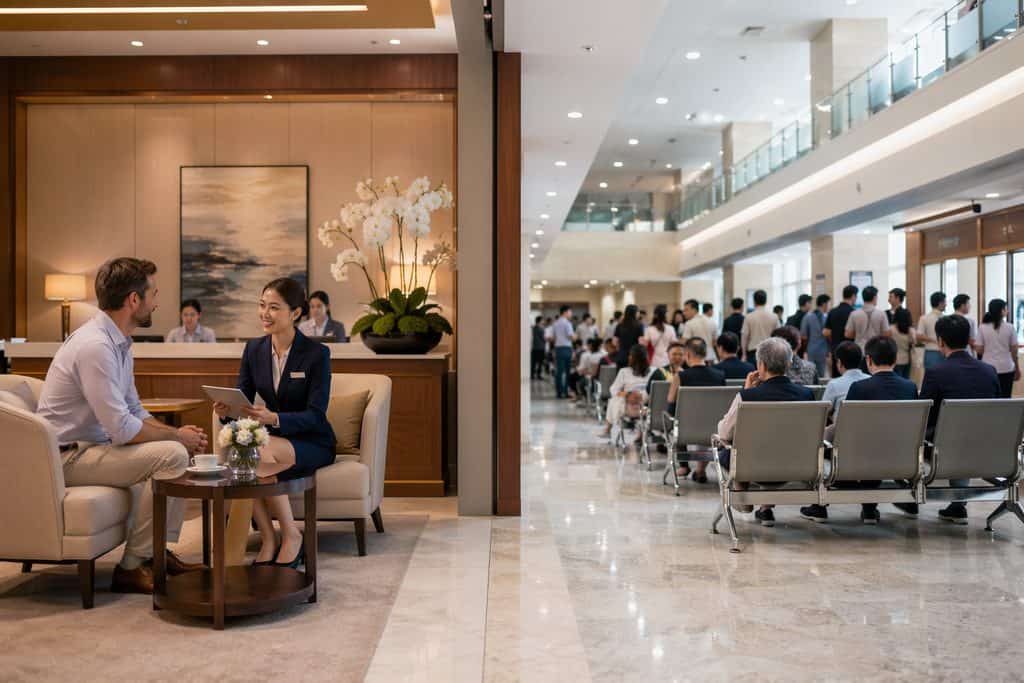
Most top-tier Chinese public hospitals operate a dedicated international patient department, often called a VIP or special medical service unit. This is not a marketing label. It is a separate administrative channel with its own registration desk, its own waiting areas, and its own roster of senior specialists.
The practical difference matters enormously. A standard outpatient clinic at a major Chinese hospital can see 10,000 patients in a single day. Registration happens the same morning, queues form before dawn, and every interaction runs in Mandarin. The international patient department bypasses that entirely. Appointments are scheduled in advance. An English-speaking coordinator handles your paperwork. The attending physician is usually a department head or senior consultant, not a junior resident.
This is also where the cost difference from Western care narrows somewhat. The international channel typically charges 1.5 to 2 times the standard public rate. A cardiac bypass that costs $12,000–20,000 through the regular public route may run $18,000–30,000 through the international department. Still a fraction of the $120,000+ typical in the United States, but not the headline number you may have seen.
A Realistic Timeline
| Stage | What Happens | Typical Duration |
|---|---|---|
| Day 1–3 | You submit medical records; we review for completeness | 2–3 days |
| Week 1–2 | Records translated and forwarded to hospital international department | 3–7 business days |
| Week 2–3 | Specialist review; written opinion or video consultation scheduled | 5–10 days |
| Week 3–5 | Treatment plan confirmed; cost estimate issued; hospital deposit requested | 1–2 weeks |
| Week 4–6 | S2 visa application with hospital invitation letter | 1–3 weeks, varies by consulate |
| Week 6–8 | Arrival in China; preoperative testing; admission | 2–5 days after arrival |
Notice that the visa step does not start until the hospital has confirmed your treatment plan. Consulates require a formal invitation document from the hospital. That document only gets issued after the international patient department has accepted your case. Trying to apply for a visa before you have hospital confirmation wastes time and usually fails.
Translation is the step patients forget. Your records need to be professionally translated into Chinese before any serious specialist will review them. That alone can add three to five days if the file is large or handwriting is poor.
What Can Go Wrong — and What Happens Then
The most common failure point is incomplete records. A specialist in Shanghai will not make a surgical decision based on a single MRI report and a one-paragraph summary from your home doctor. They want the actual imaging files, the full operative notes if you have had prior surgery, and current lab work. If we request additional documents, the clock resets. That is not bureaucracy. That is a senior surgeon refusing to guess.
Sometimes the specialist concludes that surgery in China is not appropriate. Maybe your condition is better managed conservatively, or the risk profile does not justify the travel. That happens in roughly 10–15% of cases we see. The recourse is simple: you pay for the review and the opinion, and you stay home. You are not committed to anything beyond the consultation fee.
Visa rejection is another real possibility. The S2 visa for private affairs and medical treatment is generally straightforward, but consular officers have discretion. A weak invitation letter, incomplete financial documentation, or a prior overstay in any country can trigger refusal. We cannot guarantee visa approval. We can make sure your application is as strong as it can be.
And then there is the language barrier outside the hospital. Your international patient department coordinator speaks English. The pharmacist, the lab technician, the nurse on the ward at 2 a.m. — often not. That is where a bilingual medical companion becomes essential for anyone traveling alone.
Is Cancer Treatment in Shanghai Good for Foreigners?
Shanghai hosts several hospitals whose oncology departments rank among China’s top 10 in the Fudan specialty reputation rankings. Fudan University Shanghai Cancer Center and Zhongshan Hospital both run dedicated international wards with English-speaking staff and experience managing foreign patients. The question is not whether the clinical expertise exists. It does, and at high volume.
The real question is whether your specific cancer, at your specific stage, is better treated in Shanghai than at home. For many solid tumors, the protocols are similar — chemotherapy regimens, radiation techniques, and surgical approaches follow the same international guidelines. Where Shanghai often pulls ahead is in access speed and cost. A PET-CT that takes weeks to schedule in parts of Europe can be done within days. Immunotherapy drugs that cost $15,000 per cycle in the US may cost $3,000–5,000 for the same molecule from a Chinese manufacturer.
But continuity of care is the hidden cost. Cancer treatment is rarely a single event. It is months of cycles, scans, and adjustments. If you start treatment in Shanghai, you need a plan for who manages you when you go home. That conversation should happen before you book anything.
JCI Accredited Hospitals in China for Medical Tourists
Joint Commission International accreditation is the closest thing to a universal quality signal for international patients. China has roughly 100 JCI-accredited facilities, concentrated in Beijing, Shanghai, Guangzhou, and Shenzhen. These include private international hospitals like United Family and Jiahui, as well as the international wings of major public hospitals.
JCI matters for two reasons. First, it means the hospital has been audited against Western safety standards — medication reconciliation, surgical timeout protocols, infection control. Second, it usually means the billing and documentation systems are set up for international insurance reimbursement. Not every JCI-accredited facility is a top clinical powerhouse, and not every top clinical powerhouse bothers with JCI. The Fudan rankings measure clinical reputation; JCI measures process safety. You want both, ideally.
Our database of top-ranked hospitals shows which Fudan-ranked institutions also hold JCI accreditation for their international departments.
Cost of Hip Replacement in China vs USA
A total hip replacement in the United States typically costs $30,000–45,000 for the hospital and surgeon fees alone, before anesthesia, implants, and rehabilitation. In China, the same procedure through a top-tier public hospital’s international department runs $8,000–15,000 all-inclusive. That is a real spread, and it holds across most orthopedic procedures.
But the comparison is not apples-to-apples in every dimension. US hospitals typically include a structured rehabilitation pathway — physical therapy starts the day after surgery and continues for weeks. Chinese public hospitals are more variable on rehab. Some have excellent inpatient rehab programs. Others discharge you after five to seven days and expect you to arrange outpatient therapy yourself. If you are traveling from abroad, that gap matters. You may need to budget for private rehabilitation or extend your stay.
Implant choice is another variable. Chinese hospitals use the same international implant brands — Zimmer, DePuy, Stryker — as Western facilities. But the specific model available at a given hospital may differ from what your home surgeon would choose. Ask before you commit.
What Is the Recovery Time After Spine Surgery in China?
Recovery time after spine surgery depends far more on the procedure than the country. A microdiscectomy for a herniated disc typically means 2–4 weeks before you can sit comfortably and 6–8 weeks before light activity. A lumbar fusion is a different story: 3–6 months before you feel normal, and up to a year for full bony fusion.
Chinese hospitals do not have a magic recovery protocol that Western hospitals lack. What they do have is volume. A senior spine surgeon at a major Chinese orthopedic center may perform 300–500 procedures per year. That volume translates into shorter operative times, fewer complications, and more refined surgical technique. The recovery timeline itself, though, is governed by biology. Bone fuses at its own pace.
One practical difference: if you plan to recover in China, the cost of extended inpatient rehabilitation is dramatically lower than in the US. A month of rehab that costs $30,000 in an American facility might run $5,000–8,000 in China. Some patients choose to stay for the early recovery phase precisely for that reason.
Practical Considerations: Records, Visa, Payment, and Follow-Up
Your medical records need to be complete, legible, and ideally already digitized. If your home hospital uses an online portal, download everything. If you have imaging on CD or USB, send the original files, not screenshots. Chinese specialists are particular about reviewing primary imaging, not reports written by someone else.
Visa category: S2 is the correct short-stay visa for medical treatment and private affairs. If your treatment will require more than 180 days in China, you need an S1. Family members accompanying you apply for their own S2 visas. The hospital’s international patient department will issue the invitation letter that supports your application. Consulates may also ask for proof of funds and a detailed treatment plan.
Payment is almost always upfront. Public hospitals in China do not bill your insurance company. You pay a deposit, the hospital deducts from it, and you settle the balance before discharge. You then submit the itemized receipt to your insurer for reimbursement. Private international hospitals like those in our JCI-accredited directory often offer direct billing with major international insurers, which removes that cash-flow burden.
Follow-up at home is the piece patients overlook. Your Chinese surgeon cannot easily manage your recovery from 8,000 miles away. Before you leave, get a detailed discharge summary in English, all operative notes, and a clear medication list. Identify a local physician who is willing to take over your follow-up. Some Chinese hospitals offer video follow-up consultations, but that is not a substitute for having someone local who can examine you.
Frequently Asked Questions
No. Solid-organ transplantation in China is subject to strict national regulations, and no hospital can offer a transplant package to a foreign patient without a full medical evaluation, a confirmed match, and approval through the hospital’s transplant committee. What you can do is submit your records for a transplant assessment. If the team determines you are a candidate, the process then proceeds according to Chinese law and hospital policy. Anyone offering a guaranteed transplant slot is not operating through legitimate channels.
For a coronary artery bypass graft through a top-tier public hospital’s international department, expect $18,000–30,000 all-inclusive. Valve replacement runs $25,000–40,000 depending on whether you need a mechanical or biological valve. These figures vary by hospital and case complexity, and they assume no major complications. Fuwai Hospital in Beijing, which performs over 14,000 cardiac surgeries annually, is the high-volume reference point for these procedures.
Chinese hospitals carry liability insurance, and the international patient department has a formal complaint and mediation process. That said, medical negligence claims in China operate very differently from Western systems. Your legal recourse as a foreign patient is limited. This is why the pre-treatment evaluation matters so much — you are betting on the quality of the initial decision, not on your ability to sue later.
Inside the international patient department, no. The coordinators and most senior physicians speak functional English. Outside that bubble — in the pharmacy, the imaging department, the hospital canteen, the taxi — yes, you will struggle without help. A bilingual medical companion costs from $300 per day and solves most of these frictions.
Your Next Step
You now understand what an international patient department in China actually does, what the process looks like from first contact to discharge, and where the risks sit. The decision to pursue treatment abroad is never purely financial. It is about access, timing, and whether the clinical case justifies the distance.
We are China Medical Services. We do not practice medicine, and we do not promise outcomes. What we do is connect you with the right hospital, translate your records, coordinate your appointments, and make sure you are not alone in a system you do not know. If you are considering treatment in China, start with a free consultation — tell us your situation, and we will tell you honestly whether this path makes sense.
For more medical information and treatment options in China, visit chinamedservices.com (China Medical Services).
