How Does Acupuncture Work in China? Exploring the Science, Costs, and Best Hospitals
You might think acupuncture is a mysterious, ancient ritual with no place in modern medicine. The reality is that China’s top hospitals now use it alongside surgery and pharmaceuticals, backed by a growing body of neurological research. If you are considering traveling for treatment, understanding how acupuncture works in China—and the real acupuncture cost China clinics charge—changes the entire calculation.
Our team at China Medical Services regularly fields questions from patients in the US, Europe, and the Gulf states who have tried conventional pain management and found it lacking. They want to know whether acupuncture is scientifically credible, what a session actually costs in Beijing or Shanghai, and whether the hospitals that rank among China’s best are accessible to foreigners. The short answer: yes, credible, and more affordable than you probably expect. The longer answer requires looking at how the practice evolved inside China’s hospital system, what the research says, and where the real value lies.
How This Actually Works, Step by Step
Here is the sequence a typical international patient follows when pursuing acupuncture in China. It is not a spa visit. It is a structured clinical encounter.
You begin by sending us your existing medical records—imaging reports, blood work, a summary of your diagnosis, and a list of medications. Our team translates these documents into Chinese and forwards them to the relevant department at a partner hospital. That department might be a pain management unit, a neurology department, or a traditional Chinese medicine (TCM) hospital, depending on your condition.
A specialist then reviews the file. For many patients, the first step is a written second opinion, which costs from $300 to $500 and provides a clear read on whether acupuncture is appropriate for your case. If the specialist recommends it, the next stage is a video consultation, priced from $100 to $300 for a standard international department or $500 to $800 for a top specialist. During that call, you discuss your symptoms, your goals, and the proposed treatment frequency.
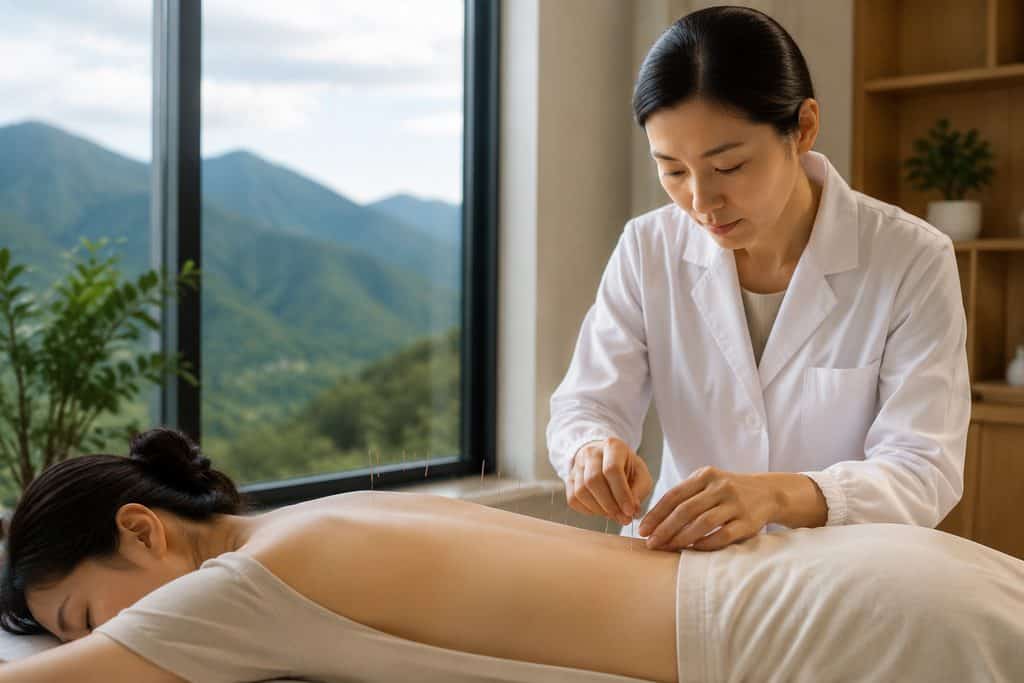
Only after this remote evaluation do you travel. In China, the first in-person visit typically includes a comprehensive intake: pulse diagnosis, tongue examination, and a review of how your pain or condition responds to pressure and movement. The acupuncturist then places needles—usually between 10 and 20—and leaves them for 20 to 30 minutes. Most patients receive a course of 6 to 10 sessions, scheduled two or three times per week. Some hospitals combine acupuncture with cupping, moxibustion, or tuina massage. The total cost depends on the hospital tier and whether you use the international VIP channel.
How Does Acupuncture Work Scientifically? What the Research Shows
The question “how does acupuncture work scientifically” deserves a direct answer, because the old explanation—that it balances qi flowing through meridians—does not satisfy most Western patients. Modern research offers a different framework.
Needle insertion triggers a cascade of local and central nervous system responses. Studies using functional MRI show that acupuncture modulates activity in the limbic system, the brain region that processes pain and emotion. A 2017 review published in Evidence-Based Complementary and Alternative Medicine found that acupuncture increases the release of endogenous opioids—your body’s own painkillers—as well as adenosine, a compound that reduces inflammation at the needle site.
There is also a mechanical effect. Inserting a needle into connective tissue causes fibroblasts to stretch and release signaling molecules that can reduce local inflammation. This may explain why acupuncture shows measurable effects on conditions like knee osteoarthritis and chronic low back pain, even when researchers control for placebo. A landmark 2012 meta-analysis in Archives of Internal Medicine, led by Andrew Vickers at Memorial Sloan Kettering, pooled data from nearly 18,000 patients and concluded that acupuncture outperformed sham acupuncture and standard care for chronic pain. The effect size was modest but real—roughly a 50% reduction in pain scores for acupuncture versus 30% for sham.
So when a Chinese hospital integrates acupuncture into a pain management protocol, it is not abandoning science. It is using a low-risk intervention with a demonstrated neurophysiological footprint. The mechanism is still debated, but the clinical signal is consistent enough that the US National Institutes of Health and the World Health Organization both list acupuncture as a reasonable option for certain conditions.
Is Acupuncture Effective for Chronic Pain? A Nuanced Answer
Yes—for some conditions, in some patients, with realistic expectations. The evidence is strongest for chronic musculoskeletal pain: low back pain, neck pain, shoulder pain, and knee osteoarthritis. The evidence is weaker for migraines, though several trials show fewer headache days per month. The evidence is genuinely mixed for fibromyalgia and neuropathic pain.
One thing worth understanding: acupuncture is not a one-time fix. The Vickers meta-analysis found that the benefits persist at 12 months, but they depend on completing a full course of treatment, not a single session. Patients who expect one needle session to erase years of back pain will be disappointed. Patients who commit to six or eight sessions over three to four weeks often report meaningful improvement.
Chinese hospitals tend to be more aggressive with acupuncture frequency than Western clinics. A typical course at a top TCM hospital in Beijing might involve daily sessions for the first week, then tapering. That intensity is one reason some international patients choose to travel—they can compress a two-month Western treatment arc into three weeks. But it also means you should plan for recovery time and avoid scheduling demanding sightseeing around your treatment days.
Acupuncture Cost China: What You Will Actually Pay
Let’s talk numbers, because the acupuncture cost China patients encounter is dramatically lower than in the United States or Europe, but it varies by hospital tier and channel.
| Setting | Cost per Session (USD) | Notes |
|---|---|---|
| Public TCM hospital, standard outpatient | $15–$40 | Chinese-language environment; long queues; same-day registration only |
| Public hospital international department | $60–$120 | English-speaking staff; appointment possible; shorter waits |
| Private international hospital (e.g., United Family, Jiahui) | $150–$300 | Western-style care; direct insurance billing; premium environment |
| Treatment package (10 sessions, international dept.) | $500–$1,000 | Often includes initial consultation and follow-up |
For comparison, a single acupuncture session in the United States typically costs $75 to $150, and in the UK between £40 and £70. So even at a private international hospital in Shanghai, you are paying roughly the same as a mid-range US clinic—but with a specialist who performs acupuncture daily, often within a hospital that handles thousands of cases annually.
How much is acupuncture session in China? If you walk into a public TCM hospital as a local would, perhaps $20. But as a foreigner without Chinese language skills, that route is difficult. The practical floor for an English-supported experience is closer to $60 per session through an international department. The realistic range for a full course, including consultation and coordination, is $800 to $2,500 depending on the hospital and the number of sessions.
One caution: these figures cover the acupuncture itself. They do not include flights, accommodation, visa fees, or our coordination services. A three-week treatment trip to Beijing with daily sessions, a mid-range hotel, and a bilingual companion will land somewhere between $5,000 and $9,000 all-in. That is still a fraction of what a comparable intensive program would cost in the US, but it is not pocket change.
A Realistic Timeline
Here is what the calendar actually looks like for an international patient seeking acupuncture in China. The steps people forget are document translation and visa processing—both take longer than you expect.
| Stage | Duration | What Happens |
|---|---|---|
| Records review and translation | 3–7 days | You send medical files; we translate and forward to the hospital department |
| Written second opinion | 5–10 days | Specialist reviews your case and advises whether acupuncture is appropriate |
| Video consultation | 1–2 weeks lead time | You speak with the treating team; treatment plan and frequency are set |
| S2 visa application | 1–4 weeks | Requires hospital invitation letter and supporting documents; varies by embassy |
| Travel and first in-person visit | Day 1 of treatment | Comprehensive intake, then first acupuncture session |
| Treatment course | 2–4 weeks | 6–12 sessions, typically 2–3 per week |
| Follow-up at home | 1–3 months | Telemedicine check-in; written summary for your local physician |
Total time from first inquiry to walking into a Beijing clinic: three to eight weeks. If you already have a visa and your records are in English, the timeline compresses to about two weeks. If you need translation of non-English records, add another week.
What Can Go Wrong — and What Happens Then
Acupuncture is low-risk, but this process has failure modes worth naming.
The first is mismatch of expectations. A patient arrives expecting acupuncture to cure a condition it cannot treat—say, advanced osteoarthritis requiring joint replacement. The specialist reviews the imaging and says surgery is the answer. That is not a failure of acupuncture; it is a failure of triage. The fix is the written second opinion step, which costs $300 to $500 and can save you a wasted trip. We recommend it for every patient considering travel for acupuncture.
The second is language and logistics breakdown. A public TCM hospital in Guangzhou sees thousands of patients daily. Without a bilingual companion, you will struggle with registration, payment, and understanding the treatment plan. Our bilingual medical companion service starts at $300 per day and handles queueing, translation, and navigation. It is not a luxury; it is the difference between a smooth visit and a stressful one.
The third is visa rejection. The S2 visa is the correct category for medical treatment, but approval is never guaranteed. Embassies require a hospital invitation letter and sometimes proof of financial means. We provide guidance and document support, but the decision rests with the consulate. Apply early and do not book non-refundable flights until the visa is in hand.
And a clinical note: acupuncture occasionally causes minor bleeding, bruising, or temporary soreness at needle sites. Serious complications—pneumothorax from a misplaced needle, for instance—are extremely rare when performed by trained hospital staff, but they are not zero. Choose a hospital, not a back-alley clinic.
Best Acupuncture Hospital Beijing: How to Choose
If you search for the best acupuncture hospital Beijing offers, you will find a short list of institutions that dominate the field. Beijing is the center of TCM in China, home to the national acupuncture research infrastructure.
The top tier includes Guang’anmen Hospital, affiliated with the China Academy of Chinese Medical Sciences, and the Beijing Hospital of Traditional Chinese Medicine. Both are public institutions with dedicated international departments. Guang’anmen is widely regarded as a leader in acupuncture research and clinical volume. The Beijing Hospital of TCM runs specialized pain and neurology acupuncture units. Neither publishes official “rankings” in the way Western hospitals do, but both appear consistently at the top of the Fudan University specialty reputation lists for TCM.
Shanghai offers a comparable option in the form of acupuncture treatment packages Shanghai hospitals provide through their international departments. Shuguang Hospital and Longhua Hospital, both affiliated with Shanghai University of Traditional Chinese Medicine, are the standard-bearers. They tend to be slightly more expensive than Beijing but offer more English-speaking staff.
How do you evaluate a provider? Look for three things. First, hospital affiliation—a TCM hospital attached to a major medical university is a different animal from a standalone clinic. Second, specialist credentials; in China, acupuncturists in hospitals are typically physicians with five or more years of training in both Western and Chinese medicine. Third, treatment volume. A department that performs several hundred acupuncture sessions per week has refined its technique through sheer repetition.
Our database covers 340+ top-ranked hospitals across 37 cities, including the TCM institutions in Beijing and Shanghai. We can help you compare departments and identify which one aligns with your condition. But the decision should always follow a specialist review of your records, not a Google search.
Practical Considerations: Records, Visa, Payment, and Follow-Up
Bring everything. Imaging on CD or USB, not just printed reports. A medication list with generic names. A letter from your primary physician summarizing your diagnosis and any prior treatments. If you have had acupuncture before, note what worked and what did not.
Visa category: S2, endorsed for medical treatment. Your accompanying family member also applies for an S2. The hospital must issue an invitation letter confirming your treatment plan. Processing times vary by embassy—budget four weeks to be safe. Do not apply for an M visa; that is for commercial and trade activities, and using it for medical travel is incorrect.
Payment: public hospital international departments generally require prepayment for each session. Private international hospitals may bill your insurer directly. Most travel insurance policies do not cover acupuncture abroad, so expect to pay out of pocket. Keep every receipt; some US and European insurers reimburse acupuncture retroactively with a letter of medical necessity.
Follow-up at home is straightforward. The treating physician provides a written summary in English, which you can share with your local doctor. Many hospitals offer telemedicine follow-up for a fee. The goal is continuity—your acupuncturist in China should communicate with your care team at home, not replace it.
Frequently Asked Questions
The evidence from large meta-analyses, including one pooling 18,000 patients, shows acupuncture outperforms sham acupuncture for chronic pain. The effect is modest but real, and it appears to be mediated by endogenous opioid release and local anti-inflammatory responses, not just expectation.
Through a public hospital international department, expect $60 to $120 per session. Private international hospitals charge $150 to $300. A full course of 10 sessions typically runs $500 to $1,000 at the international department level, excluding travel and coordination costs.
In accredited hospitals, yes. Serious complications like pneumothorax are rare—estimated at fewer than 1 in 100,000 treatments when performed by trained physicians. The larger risks are logistical: language barriers, miscommunication, and choosing an unregulated clinic. Stick to university-affiliated TCM hospitals.
Yes, and this is common. Many patients pair acupuncture with orthopedic consultation, physiotherapy, or pain management. A written second opinion can clarify whether acupuncture should be primary or adjunctive. The hospital international departments are equipped to coordinate multiple specialties.
Yes. The S2 visa is the appropriate category for short-term medical treatment and private affairs. It requires a hospital invitation letter and supporting documents. Approval times vary by embassy, so apply four weeks before your intended travel date.
Your Next Step
Acupuncture in China sits at an unusual intersection: a centuries-old practice now delivered inside hospitals that perform cutting-edge research. The science is imperfect but meaningful. The costs are low by Western standards. The logistics, however, are not trivial—and that is where we come in.
We are China Medical Services, a team that connects international patients with China’s top-tier hospitals. We do not practice medicine, and we do not promise outcomes. What we do is handle the coordination: records translation, specialist review, appointment scheduling, bilingual accompaniment, and visa guidance. If you are considering acupuncture in China, start with a conversation. Send us your records, and we will tell you honestly whether the trip makes sense. No pressure, no obligation.
The core message is simple: acupuncture in China is a legitimate, evidence-supported option for chronic pain, delivered at a fraction of Western prices inside hospitals that treat thousands of cases annually. The key is choosing the right hospital and preparing properly. If you want to explore it, our team is here to help you navigate the process—one step at a time.
For more medical information and treatment options in China, visit chinamedservices.com (China Medical Services).
