Airport Transfer for Medical Patients China: Is Booking Worth It?
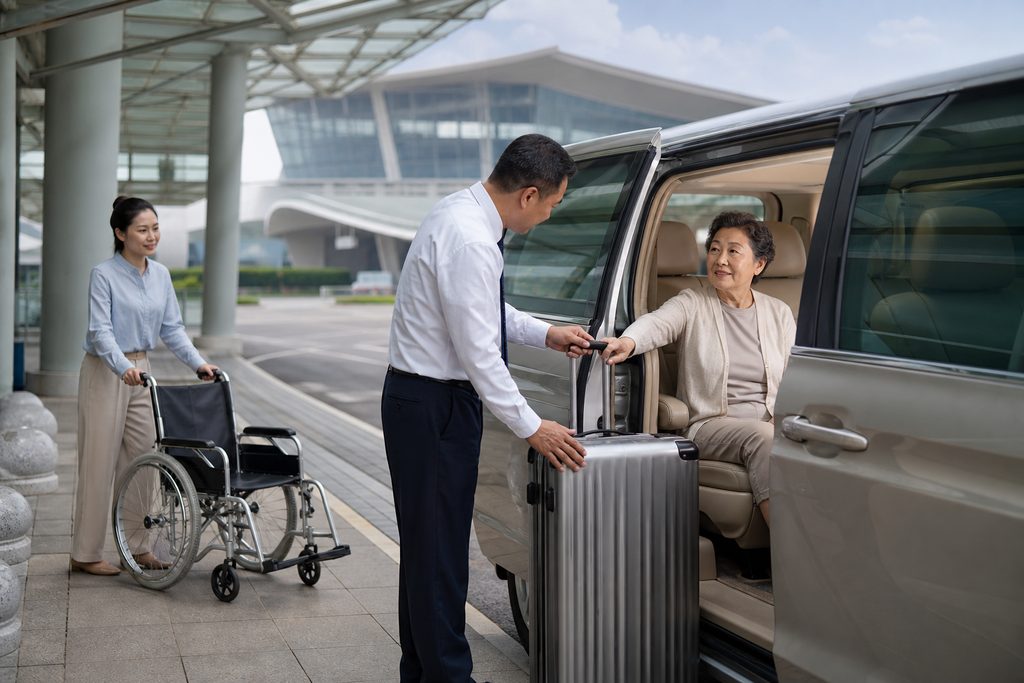
According to the China National Tourism Administration’s medical tourism reports, over 300,000 international patients entered China for treatment in 2024. Most of them landed at Beijing Capital, Shanghai Pudong, or Guangzhou Baiyun with one shared worry: how do I get from the arrivals gate to the hospital without adding more stress to an already difficult trip?
Airport transfer for medical patients China is a service most travelers never think about until they’re standing in a foreign terminal, exhausted, possibly in pain, and facing a taxi queue with no shared language. Booking a private transfer costs $200 round-trip through coordination services. The real question isn’t whether you can get from the airport to the hospital — it’s whether the predictable, pre-arranged option saves you enough physical and mental energy to justify the price. For most patients, the answer is yes. Here’s why, and here’s what you should actually compare before you book.
How This Actually Works, Step by Step
A pre-booked airport transfer for a medical trip follows a straightforward sequence. You send your flight number, arrival date, terminal, and destination hospital to the coordination team. They confirm the vehicle type, the driver’s name, and the meeting point — usually just outside customs or at a designated pickup zone. The driver waits with a name sign. You walk out, get in, and go.
But the parts people forget are the details. First, your medical records and visa documents need to be ready before you even board the plane. The transfer itself doesn’t require documents beyond your passport and hospital admission letter, but having the hospital’s Chinese-language address printed or saved on your phone helps enormously. Second, you need to confirm whether the driver will wait if your flight is delayed — most professional services track flight arrivals and adjust automatically. Third, clarify what happens if you miss the connection entirely. Reputable coordinators offer a backup number to call or message.
What you send: flight details, passenger count, luggage estimate, destination. Who reviews it: the local coordination team. What comes back: a confirmation with driver contact, vehicle plate number, and meeting instructions. What happens next: you land, clear immigration, meet the driver, and arrive at the hospital entrance — not the taxi stand across the street, not a subway exit two blocks away. The hospital entrance.
Is Airport Pickup Included in Medical Tourism Packages?
The short answer: sometimes, but don’t assume it. Most hospital international departments in China do not include transportation in their base treatment packages. A few high-end private hospitals — United Family, Jiahui, Raffles — may arrange pickup for inpatients as a courtesy. Public hospitals like Fuwai, Peking Union, or Zhongshan generally do not. Their international VIP wards focus on clinical coordination, not ground logistics.
So if you’re asking “is airport pickup included in medical tourism packages,” the honest answer is that it depends entirely on the package structure. Ask the hospital or your coordinator directly: “Does this include arrival transfer, and if so, from which airport?” Beijing has two major airports — Capital (PEK) and Daxing (PKX). They’re 67 kilometers apart. Getting that wrong means a two-hour detour.
Independent medical travel coordination services typically offer transfer as an add-on. At China Medical Services, a round-trip airport transfer costs $200. That covers both arrival and departure, with a driver who knows the hospital entrances and can communicate basic information in English. It does not cover ambulance transport, which is a separate medical decision made by the hospital.
A Realistic Timeline
Here’s what the transfer and arrival sequence actually looks like, from the day you book to the day you walk into the hospital.
| Stage | What Happens | Realistic Timeframe |
|---|---|---|
| Day 1 | Submit flight details and destination hospital to coordinator | 15 minutes |
| Day 1–2 | Receive driver confirmation, meeting instructions, backup contact | Within 24 hours |
| Day 3–14 | Visa processing (S2 visa for medical treatment) — this is the step people forget takes longer than the transfer booking | 5–10 business days typical |
| Arrival day | Land, clear immigration (30–90 minutes), meet driver at designated zone | 30–120 minutes after landing |
| Transfer duration | Beijing Capital to city-center hospitals: 40–70 minutes. Shanghai Pudong to downtown: 50–80 minutes. Traffic doubles this at peak hours. | 40–90 minutes |
| Departure day | Driver picks you up at hospital or hotel, returns you to correct terminal | Allow 3 hours before international flight |
Notice the gap between Day 2 and arrival day. That’s not transfer time — that’s visa processing, document translation, and hospital admission confirmation. The transfer itself is the easiest part of the entire trip to arrange. People who skip it to save $200 often end up spending that amount in taxis, stress, and missed appointments anyway.
What Can Go Wrong — and What Happens Then
Flight delays happen. Professional transfer services track your flight number and adjust pickup time automatically — but only if you booked through a service that does this. If you booked a random driver through a hotel concierge, you might find no one waiting. The recourse: call the backup number, or take a taxi and request a refund later. With a coordination service, the backup is built in.
Language breakdown is the second failure point. Taxi drivers in Beijing and Shanghai rarely speak English. You might have the hospital name in Chinese characters on your phone, which helps. But if you’re post-surgical, medicated, or traveling with a frail family member, negotiating a taxi rank in a foreign language is exactly the kind of friction that turns a manageable trip into a miserable one.
And then there’s the wrong-terminal problem. Shanghai Pudong has two terminals connected by a 10-minute shuttle. Beijing Daxing is enormous. A pre-booked driver knows which terminal your airline uses. A taxi driver might not, and they might not care enough to check before dropping you off.
What happens when a transfer fails? You call the coordination team. They call the driver. If the driver is unreachable, they dispatch a replacement or reimburse you for a taxi. That’s the difference between a service and a booking — the service has a human on the other end who can fix things.
Private Airport Transfer Cost Shanghai Hospital: What You’re Actually Paying For
Let’s talk numbers. A private airport transfer to a Shanghai hospital through a coordination service costs $200 round-trip. A taxi from Pudong Airport to downtown Shanghai runs about 150–250 RMB ($21–35) one way. A Didi (Chinese Uber equivalent) is similar. The metro costs under $2 and takes 50–70 minutes with one transfer.
So why would anyone pay $200 for something the metro does for $2? Because the metro requires navigating ticket machines, carrying luggage through turnstiles, transferring lines, and walking from the station to the hospital — all in Chinese, all while possibly in pain. The taxi requires communicating a destination, handling cash or payment apps, and hoping the driver knows the hospital’s specific entrance. The private transfer removes every one of those variables.
The private airport transfer cost Shanghai hospital comparison isn’t really about money. It’s about what you’re buying: certainty. You know the price before you land. You know someone is waiting. You know they’ll get you to the right entrance. For a patient traveling for surgery or serious treatment, that certainty has real value.
How to Get from Beijing Airport to Hospital: Comparing the Real Options
If you’re wondering how to get from Beijing airport to hospital, you have four main choices. The Airport Express train runs from Beijing Capital to Dongzhimen in about 25 minutes for 25 RMB ($3.50). From there you’d transfer to the subway or a taxi. The airport shuttle buses cost 20–40 RMB and run to major hubs. Taxis cost 100–200 RMB depending on distance and traffic. And private transfers cost $100 one-way through coordination services.
The train is fast and cheap — if you’re healthy, traveling light, and confident navigating Chinese transit. The shuttle is slower but straightforward. Taxis are everywhere but language is a real barrier. The private transfer is the only option where someone waits with your name on a sign and handles the luggage.
For patients arriving for cardiac surgery at Fuwai Hospital or oncology treatment at Peking Union, the subway isn’t a serious recommendation. Post-flight fatigue, pre-treatment anxiety, and unfamiliar surroundings make the $100 one-way transfer a reasonable medical-adjacent expense. It’s not luxury. It’s logistics.
Medical Travel Airport Assistance China: What It Includes and What It Doesn’t
Medical travel airport assistance China typically includes the basics: flight tracking, meet-and-greet at arrivals, help with luggage, and direct transport to the hospital or hotel. Some services add wheelchair assistance, which requires coordination with the airport’s own accessibility services — a separate process the driver can help facilitate but cannot replace.
What it does not include: medical care during transit. Drivers are not paramedics. If you need oxygen, monitoring, or medical supervision during the transfer, that’s a medical transport service, not a standard airport pickup. Hospitals arrange medical transport for admitted patients who require it. For everyone else, the standard transfer is a vehicle and a driver — not an ambulance.
Also worth knowing: the driver can help you check in at the hospital’s international department, but they won’t handle your registration paperwork. That’s what a bilingual medical companion does, and it’s a separate service starting at $300 per day. The transfer gets you to the door. The companion gets you through it.
Book Airport Transfer for Surgery Abroad: When It’s Non-Negotiable
There are specific situations where you should book airport transfer for surgery abroad without hesitation. If you’re arriving the day before a major procedure, you want zero variables. If you’re traveling alone, you need someone who knows where you’re going. If you’re bringing a child or an elderly parent, the logistics multiply. If your flight lands late at night, taxi availability and language barriers both get worse.
If you’re arriving a week early for consultations and are healthy and mobile, the metro or a taxi is fine. Save the $200. But if your arrival timing is tight, your mobility is limited, or your stress threshold is already maxed out, the transfer is the cheapest insurance you’ll buy on the whole trip.
One more consideration: return transfers. After surgery, you will not want to negotiate a taxi to the airport. You’ll be tired, possibly in discomfort, and carrying discharge documents and medications. Booking the round-trip upfront means the departure leg is already handled. You don’t have to think about it. You just get in the car.
Practical Considerations: Visa, Payment, Insurance, and Language
Before you book any transfer, make sure your visa is sorted. Medical travelers to China use the S2 visa, which covers short stays for treatment and private affairs. Family members accompanying you also need S2 visas. The transfer itself doesn’t require a visa — you need it to enter the country at all.
Payment for transfers through coordination services is typically handled in advance by bank transfer or card. You won’t need cash for the driver. That matters because Chinese taxis increasingly expect mobile payment via WeChat or Alipay, which foreign visitors often can’t set up easily. Pre-paying removes that friction entirely.
Insurance is another angle. Most international health insurance plans reimburse medical transport if it’s medically necessary. A standard airport transfer usually isn’t covered — it’s a travel expense, not a medical one. Check your policy, but don’t expect reimbursement for a $200 round-trip pickup.
Language is the final layer. The driver may speak basic English or none at all. The coordination team handles communication by phone or message if issues arise. For hospital navigation — registration, consultations, pharmacy, billing — the driver is not your interpreter. That’s the companion’s role. The transfer and the companion are different services with different jobs.
Frequently Asked Questions
For most patients, yes. The $200 round-trip price removes language barriers, navigation stress, and timing uncertainty at the exact moment you’re most vulnerable. If you’re healthy, mobile, and arriving days before treatment, public transit works fine. If you’re arriving close to a procedure or traveling with limitations, book the transfer.
Professional coordination services confirm your driver’s name, vehicle plate number, and meeting point before you fly. They also track your flight and adjust for delays. If the driver doesn’t show, you call the backup number and the team dispatches a replacement or reimburses your taxi fare. That accountability is what separates a service from a random booking.
No. The driver gets you to the correct hospital entrance. Hospital registration, translation, queue management, and billing are handled by a bilingual medical companion — a separate service starting at $300 per day. The two services complement each other but don’t overlap.
Reputable transfer services track flight status and adjust pickup times automatically for delays. For cancellations, contact the coordination team as soon as you know. They’ll reschedule the pickup for your new arrival time. If you miss the connection entirely and arrive on a different day, most services will accommodate the change without a new booking fee.
Yes, a taxi from Pudong or Capital airport to a city-center hospital typically costs $20–40 one way. But you’ll need to communicate the destination in Chinese, handle payment, and navigate the hospital’s specific entrance yourself. The transfer costs more because it removes those variables. Whether that’s worth it depends on your mobility, language ability, and how much energy you want to spend on logistics instead of treatment.
Your Next Step
Airport transfer for medical patients China is a small line item in a much larger trip — but it’s the first thing you experience after landing, and it sets the tone for everything that follows. A pre-arranged pickup costs $200 round-trip and buys you certainty, language support, and one less thing to manage while you’re already managing a medical condition.
Our team at China Medical Services coordinates airport transfers, bilingual medical companions, hospital appointments, and visa guidance for international patients across 340+ top-ranked hospitals in 37 Chinese cities. We don’t provide medical care — we handle the logistics around it. If you’re planning treatment in China and want the arrival leg handled before you board the plane, tell us your flight details and destination hospital. We’ll confirm the rest.
For more medical information and treatment options in China, visit chinamedservices.com (China Medical Services).
