Allergy ENT Check in China: Cost, Safety, and How to Book
Allergy ENT Check in China: A Guide for International Patients
Have you been sneezing through every spring for a decade, or losing your voice in meetings because of chronic sinus trouble — and still don’t know what you’re actually allergic to?
If you’re weighing an allergy ENT check in China, the short answer is this: a full workup — consultation, skin prick or blood testing, and a treatment plan — typically costs between $150 and $600 at a top-tier public hospital, versus $1,000 to $4,000 for comparable testing in the United States. That gap is real. But the process works differently here, and showing up without preparation is the fastest way to waste a trip.
Allergy ENT Check Cost in China: The Short Answer
Expect to pay $150–$600 all-in at a major public hospital, or $400–$1,200 at a private international clinic. That covers the ENT consultation, a panel of allergen tests, and a written treatment plan. A la carte pricing looks like this: specialist consultation runs roughly $30–$80 at public hospitals and $150–$350 at international clinics; a skin prick panel covering 10–20 allergens sits around $60–$150; a serum-specific IgE blood panel (the kind that doesn’t require you to stop antihistamines beforehand) runs $100–$300 depending on how many allergens are tested.
The caveat that makes this more complicated than a price tag: public hospital outpatient departments generally cannot be pre-booked from overseas. You register on the day, in person, in Chinese. That single rule shapes everything else in this guide.
Who This Is Right For — and Who It Isn’t
A China allergy ENT workup tends to make sense for:
- Expats and long-term visitors in Beijing, Shanghai, or Guangzhou with new or worsening nasal, sinus, or throat symptoms
- Travelers already in China who want testing done faster and cheaper than at home
- Patients with a known diagnosis who need ongoing immunotherapy (allergy shots) or medication management while living here
- Anyone combining an allergy workup with other medical appointments during a single trip
It’s genuinely a poor fit for:
- Anyone with active anaphylaxis history who needs emergency evaluation — go to the nearest emergency department, not a scheduled clinic
- Patients seeking a same-week appointment with one specific named professor without going through a hospital’s international department
- People who need results interpreted in a language other than Chinese or English
- Anyone whose home country insurer requires pre-authorization that hasn’t been obtained — reimbursement rules vary widely
The Options, Compared
| Option | Typical Cost | English Support | Booking Lead Time | Best For |
|---|---|---|---|---|
| Public hospital ENT (top-tier) | $150–$600 | Limited; varies by hospital | Same-day registration only | Cost-conscious patients, straightforward cases |
| Public hospital international/VIP department | $400–$900 | Yes, dedicated staff | Several days to 2 weeks | Patients wanting a senior specialist and English service |
| Private international clinic | $400–$1,200 | Yes, English-speaking throughout | Often 1–3 days | Families, direct insurance billing, Western-style flow |
| Traditional Chinese Medicine clinic (adjunct) | $50–$200 per session | Varies | 1–7 days | Chronic symptom management alongside standard care |
For a first-time visitor with a simple case, a top-tier public hospital delivers the best value. If your schedule is tight or you need everything in English, the international department or a private clinic is worth the premium. Many patients split the difference: testing at a public hospital, follow-up at a private clinic.
How to Book an Allergy ENT Check in Shanghai or Beijing
Booking an allergy ENT check in Shanghai or Beijing follows the same basic rhythm, and it is not an e-commerce transaction. Here’s the honest sequence.
Step one: decide on the hospital tier. Beijing concentrates the largest number of top-ranked hospitals in the country, with Shanghai close behind. Both cities have strong ENT departments and both have international departments at their flagship institutions. If you’re searching for the best allergy clinic in Beijing, the realistic answer is that several public hospitals and private international clinics all deliver competent care — the difference is service model, not diagnostic quality.
Step two: prepare your records. Bring any prior allergy test results, medication lists, and imaging. Translate key documents into Chinese if you can; if not, a bilingual companion can handle this on-site.
Step three: registration. At a public hospital, this happens in person on the day. You take a number, register, pay, then see the doctor. At an international department or private clinic, staff can often pre-register you by email.
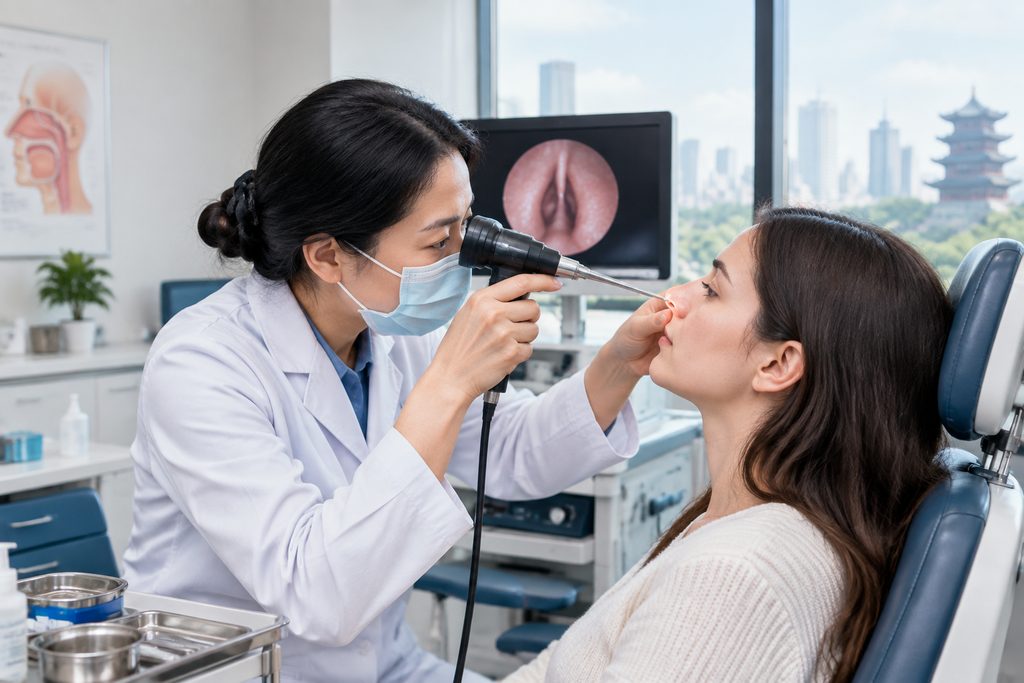
Step four: the visit itself. The ENT specialist takes a history, examines your nasal cavity and throat, then orders testing. Skin prick results appear in 15–20 minutes. Blood test results typically return within 24–48 hours.
For patients who want the process handled end to end, our team at China Medical Services coordinates registration, interpretation, and follow-up through hospital international departments.
How Long Does an Allergy ENT Check Take?
A single visit runs 2–4 hours door to door at a public hospital — most of that is waiting, not examination. The consultation itself is usually 10–20 minutes. Skin prick testing adds about 30 minutes including the observation period. If you’re doing blood testing instead, you’ll likely leave after the draw and receive results electronically within two days.
Private clinics compress this to roughly 60–90 minutes because appointments are scheduled rather than queued.
Plan on two trips if you need a follow-up to discuss results and start treatment. Some hospitals now offer telehealth follow-up, which saves the second visit for patients already in the country.
Is Allergy Testing in China Safe?
Yes — with context. China’s top-tier hospitals operate to international standards, and many hold JCI accreditation. Skin prick testing uses the same standardized allergen extracts and the same protocols you’d encounter in Europe or North America. Blood-based specific IgE testing uses internationally validated assay platforms.
Two things to know. First, anaphylaxis is rare during skin prick testing but not impossible; reputable clinics keep epinephrine and resuscitation equipment on hand, and you should confirm this before testing if you have a history of severe reactions. Second, quality varies outside the top tier. A small neighborhood clinic is not the same product as a flagship hospital’s ENT department. Choose accordingly.
If you carry an epinephrine auto-injector, bring it. Availability of specific brands in China differs from your home country.
Practical Considerations for International Patients
Visa category. Medical treatment in China falls under the S2 visa for short stays, with S1 for stays exceeding 180 days. Accompanying family members apply under the same category. Note that the M visa is for commercial and trade activity — it is not a medical visa, despite what some outdated guides suggest. Requirements change, so confirm current documentation with your nearest Chinese embassy or consulate.
Payment. Public hospitals require prepayment; you then seek reimbursement from your insurer afterward. Private international clinics frequently bill insurance directly. Bring a card that works internationally, and carry some cash as backup — not every counter accepts foreign cards.
Language. This is the single biggest practical hurdle. A large Chinese hospital may see more than 10,000 outpatients in a day. Signage, registration systems, and pharmacy instructions are in Chinese. If you don’t read Chinese, arrange interpretation in advance rather than hoping to manage.
Follow-up after you leave. Ask for your full test results and treatment plan in writing, ideally with English translations of the allergen names. Your home physician will need these to continue immunotherapy or adjust medication.
Frequently Asked Questions
Not directly at a standard public hospital outpatient department — registration happens in person on the day. You can pre-book through a hospital’s international department or a private international clinic. Appointment coordination services can also handle this on your behalf, though no service can guarantee a specific named specialist or a specific date.
It depends entirely on your policy. Travel insurance usually covers emergencies, not elective diagnostic workups. Some international health plans reimburse overseas outpatient care; many do not. Call your insurer before you travel and ask specifically about outpatient allergy testing and whether pre-authorization is required.
Allergy testing identifies sensitivities, not life-threatening disease. If a clinician finds something unexpected during the ENT examination — a polyp, a mass, or another abnormality — they will refer you for further imaging or biopsy. Top-tier hospitals in Beijing and Shanghai have the full diagnostic chain on site. Discuss any significant finding with your physician at home before making treatment decisions.
If you’re going to a public hospital, yes — practically speaking. Registration, payment, pharmacy pickup, and the consultation itself all happen in Chinese. International departments and private clinics provide English service, which is reflected in their pricing.
Some hospitals and clinics bundle consultation, testing, and a follow-up visit into a package price. These can offer modest savings and simpler logistics, but compare carefully — a package that excludes the specific allergens you need tested isn’t a bargain. Ask exactly which allergens are covered before you commit.
Your Next Step
An allergy ENT workup in China is affordable, clinically sound, and genuinely faster than many Western systems — provided you understand that public hospital access works on walk-in registration, not online booking. That one fact trips up more international patients than anything else.
We’re China Medical Services, a coordination service, not a hospital and not a provider of medical advice. We help international patients navigate hospital selection, registration, interpretation, and follow-up across 340+ top-ranked hospitals in 37 cities. If you’d like help mapping out your visit, start with a free consultation — no pressure, just a clear picture of what’s possible.
This article is for general information only and does not constitute medical advice. Allergy testing and treatment decisions should be made with a qualified clinician who can review your individual history.
For more medical information and treatment options in China, visit chinamedservices.com (China Medical Services).
